Pick a Talent Sourcing Tool by the Bottleneck It Removes
A talent sourcing tool finds and ranks people who have not applied to you. The best one for you is whichever removes your slowest hour: building the search, reading profiles, reaching people, or keeping track of who you found. Pick by that bottleneck. Not by database size, and not by a vendor's top-ten list. Then test the tool on a role you have already filled before you commit.
Talent sourcing is finding people who haven't applied yet
Talent sourcing is the proactive part of recruiting. You identify, research and approach people who match a role before they raise their hand. Everything after someone applies is recruiting in the narrower sense: screening, interviewing, closing. Sourcing fills the top of the funnel when the job posting alone does not.
That split matters when you buy. An applicant tracking system, by itself, is built for the people who find you. A sourcing tool is built for the people you have to go and find. Some products now do both, but ask which half they are strong at. If the role is one where good candidates are employed and not browsing, the sourcing half decides how fast you get a shortlist. We cover that in what passive candidate sourcing actually takes.
The best talent sourcing tool is the one that removes your slowest hour
Before you compare anything, time one real search from start to finish. Most recruiters find the hours pile up in one of four places:
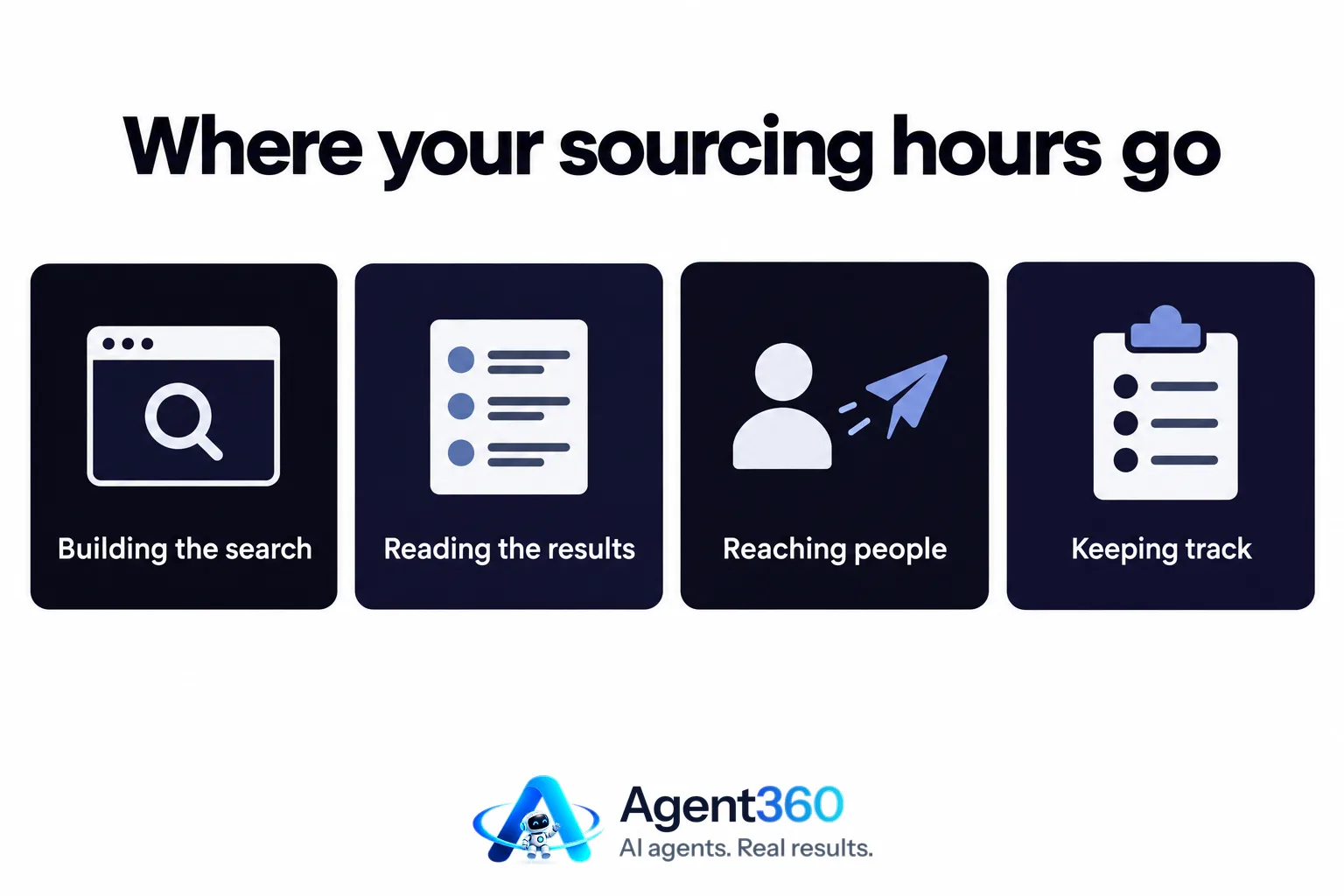
- Building the search. Translating a job description into titles, skills, seniority and location filters, or into a boolean string, and then rewriting it when results are junk.
- Reading the results. Opening profiles one by one to decide who is worth a message.
- Reaching people. Finding contact details, writing messages, following up.
- Keeping track. Remembering who you contacted, who replied, who you rejected last quarter and who deserves a second look.
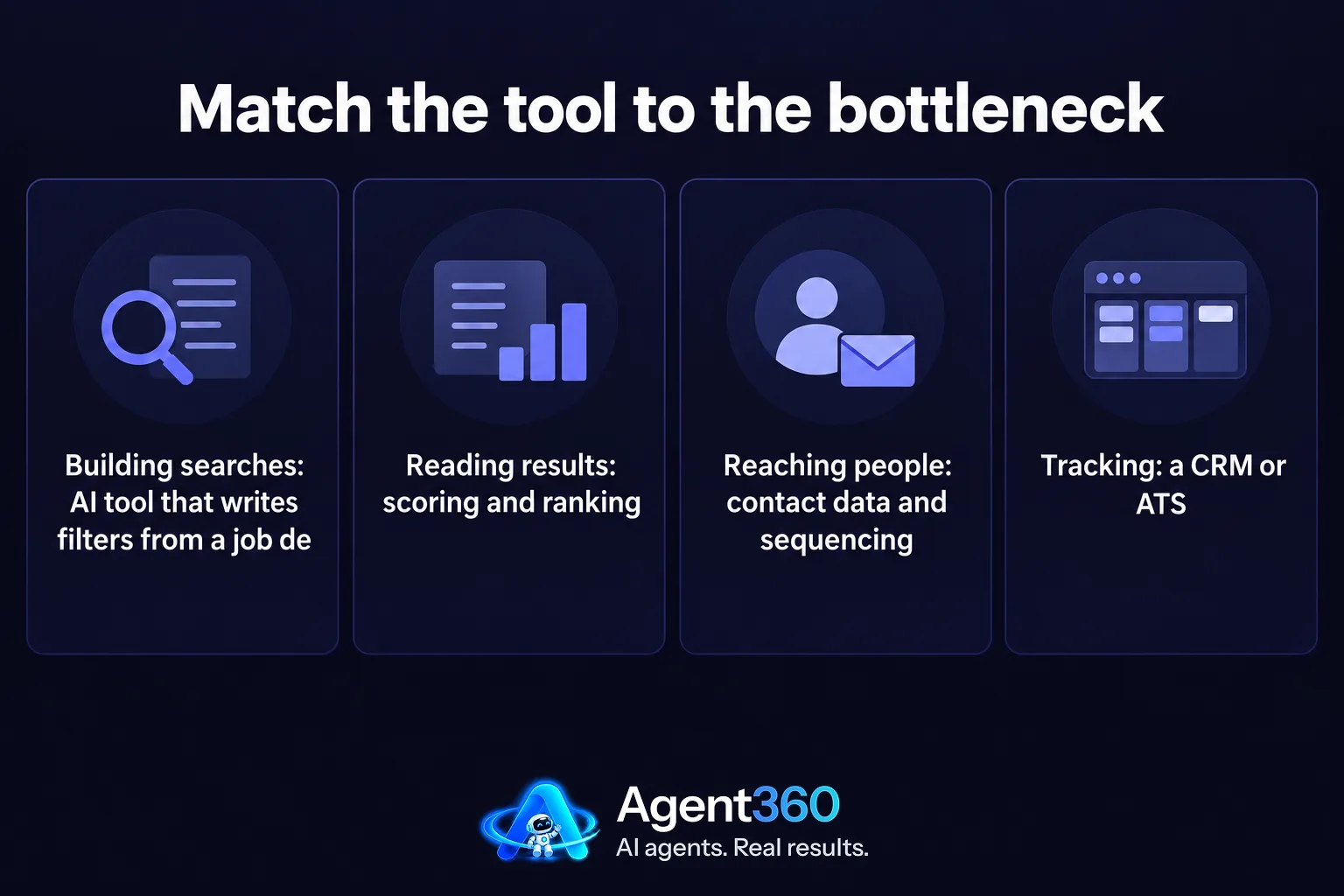
If your hours go to building searches, an AI tool that writes filters from a job description pays back fastest. If they go to reading, you need scoring. Reaching people? Contact data and sequencing. Tracking? A CRM or ATS. Buy an outreach sequencer when your real problem is that you cannot tell who is worth contacting, and you just send more messages to the wrong people, faster.
Some readers will push back on this: database size is the wrong first question. A large pool of profiles you cannot filter or rank well is just more reading. Ask how quickly you get from a job description to a list of fifty people you would actually message.
Ten sourcing tools for recruiters, by what they do
We are not ranking vendors here. A ranking written by a company that sells one of the products is worth little, and tool names and pricing change faster than a blog post does. The types stay put. These are the ten you will meet, roughly in the order a search runs:
- Professional-network search with messaging. The familiar option: deep filters over a large network and built-in outreach. You still build the query and read the results yourself. See how it compares in HiringAgent vs LinkedIn Recruiter.
- Boolean and X-ray search on the open web. Cheap, flexible, and dependent on the skill of whoever writes the string. There is a case for a boolean search alternative if that skill is your bottleneck.
- Public-profile databases with filters. Aggregated profiles you search by title, skill, location and years of experience, without needing a network seat.
- Niche community sources. Code repositories, design portfolios, conference speaker lists, trade forums. Narrow, but often the only place the real signal lives for specialist roles.
- AI sourcing from a job description. The tool reads the description, builds the filters, finds matching people and ranks them. It replaces the search-building and first-pass reading steps.
- Contact-data finders. They return an email or phone number for someone you have already decided to approach. Useful late, wasteful early.
- Outreach sequencers. Automated messages and follow-ups across email or text. They multiply whatever list you feed them, good or bad.
- Talent CRMs and candidate pools. A searchable record of past candidates and silver medalists, so each new role does not start from zero.
- Applicant tracking systems with sourcing built in. One pipeline for sourced candidates and applicants, so nothing lives in a spreadsheet.
- Screening tools. Resume scoring, assessments and AI phone screens that turn a long list into a short one before a human spends time.
Most teams do not need all ten. A common working stack is one search source, one place to track people, and one way to screen. For how those layers fit together, read sourcing tools for recruiters: what each layer actually does.
Use the 5 C's as a buying checklist, not a recruiting philosophy
There is no single official list of the 5 C's of recruitment. Articles and training courses use different words, so if someone quotes you one version as the standard, be skeptical. For choosing a sourcing tool, here is a working version that turns into five questions you can put to any vendor:
- Criteria. Can the tool take the role as you have written it and turn it into a search without you translating by hand? If you must rewrite your needs into its vocabulary, that is your search-building hour back again.
- Channels. Where do its candidates come from, and are those the places people in your target role are actually visible? Ask for the source, not just the count.
- Contact. Once you have chosen someone, how do you reach them? Get clear on what it does not do. Some tools include no messaging inside a network and leave outreach to your own inbox.
- Conversation. What happens when someone replies? A tool that stops at a list leaves the first call, the scheduling and the status updates to you.
- Conversion. Can you see how many sourced people reached screen, interview and offer? Without that you cannot tell a good source from a busy one. Funnel metrics are what make the answer visible.
Score each candidate tool from one to five on each question, for your own role and your own team. A tool that is brilliant on channels and blank on conversation is fine if you already have a strong ATS. If you are a team of one, it is a poor choice.
Test on a role you already filled
Demos run on the vendor's favorite searches. Run yours. Take a role you recently hired and know well, and put the same job description through the tool. Then check:

- Time to a usable list. How long from pasting the description to fifty people you would message? Write the number down.
- Would your hire have shown up? Is the person you hired in the results, and near the top of the ranking? If not, find out why. Wrong filters are fixable; a ranking that cannot see good people is not.
- The obvious misses. Scan the top twenty for people who clearly do not fit. A few are normal. If it is most of them, scoring is not doing its job.
- The reasoning. Does each score come with a reason you can check in ten seconds? A bare number you have to take on trust is hard to defend to a hiring manager.
- What you still do by hand. List every step you had to do outside the tool. That list is the true cost of the product.
Be wary of any tool that claims to pick the person for you. Scores rank; people decide. We lay out where that line falls in what AI can and can't decide in hiring.
Where HiringAgent fits, and where it doesn't
HiringAgent is built for teams whose bottleneck is the first half of that list: building the search and reading the results. You paste a job description, and the Sourcing Agent turns it into filters for titles, locations, skills, seniority and years of experience. It then pulls matching people from a database of public professional profiles, up to 300 per run on Pro and Scale and 100 on Starter. Each person is scored 0 to 100 against the role, with a one-line reason and the gap to check; 80 and above counts as a strong match. It also tracks everyone in one ATS and can run AI phone screens. It does not post to job boards, integrate with other ATS systems, or send LinkedIn InMail, so if those are your bottleneck, look elsewhere. Plans start at $197 a month with unlimited users; details are on the pricing page.
Questions
What are the best talent sourcing tools?
There is no single best one; the best tool is the one that removes your slowest step. Losing time building searches? Choose AI sourcing from a job description. Losing time reaching people? Choose contact data and outreach tools. Losing track of candidates? Choose a talent CRM or an ATS with sourcing built in. Test any of them on a role you have already filled.
What are the top 10 sourcing tools for recruiters?
Ten types cover most stacks: professional-network search, boolean and X-ray search, public-profile databases, niche community sources, AI sourcing from a job description, contact-data finders, outreach sequencers, talent CRMs, ATS platforms with sourcing, and screening tools. Most teams need only a search source, a place to track candidates and a way to screen.
What is talent sourcing?
Talent sourcing is the proactive search for people who match a role before they apply: identifying them, researching their background and approaching them. It sits ahead of screening and interviewing. It matters most for roles where strong candidates are employed and not actively browsing job boards.
What are the 5 C's of recruitment?
There is no universal standard list, and sources define them differently. For choosing a sourcing tool, a useful set is criteria, channels, contact, conversation and conversion. Put plainly, can the tool read your role, find the right people, reach them, handle the replies, and show you which sourced candidates actually converted?
More articles
- Filter Sales Candidates by Deal Size: Proxies, Then Proof
- Steps to Find Qualified Employees Online, in Order
- A Phone Screening Agent Should Ask, Not Decide
- Job Agent Meaning: Four Things the Term Can Mean
- Staffing Agency Tools: What You Actually Need, by Job
- Recruiting Reports That Actually Change a Hiring Decision
- Prospecting Tools for Recruitment Agencies That Earn Their Fee
- Are All Tracking Systems the Same? Not Even Close
