What Passive Candidate Sourcing Actually Takes
Passive candidate sourcing means going after people who already have a job and have no job board tabs open. Nobody applied. Nobody raised a hand. You picked a target profile, found the people who fit it, and reached out first — probably before any of them had given a new job a second thought.
Most companies run both channels at once: an apply page for the people actively looking, and a sourcing effort aimed at everyone else. If your hiring plan only has the first part, you're competing for a slice of the market that's actively unhappy, underemployed, or between jobs. And you're missing almost everyone who's doing fine where they are but would move for the right role.
Most of the people you want to hire are not applying anywhere
At any given moment, only a small share of people in a given role are actively job hunting. The rest are employed, reasonably satisfied, and not checking job boards. That doesn't make them unreachable — it just means the channel is different. You don't wait for them to find your posting. You find them, usually on a professional network, and start a conversation about a specific role.
This matters most where supply is already tight: senior engineers, experienced account executives, finance leads with industry-specific knowledge. For those roles, the applicant pool skews toward people job-searching for a reason — a layoff, a bad manager, a company in trouble. Sometimes that's fine. Often, though, the stronger candidate is the one who isn't looking at all.
What does it mean to be a passive candidate?
A passive candidate is someone currently employed who isn't actively applying to jobs, posting an open-to-work signal, or checking job boards — but who would consider a move if the right opportunity reached them directly. They're not unreachable, and they're not uninterested in general. They're just not doing the work of looking. The whole premise of sourcing is that a meaningful share of the best people for any role fall into this category, and the only way to reach them is to go find them.
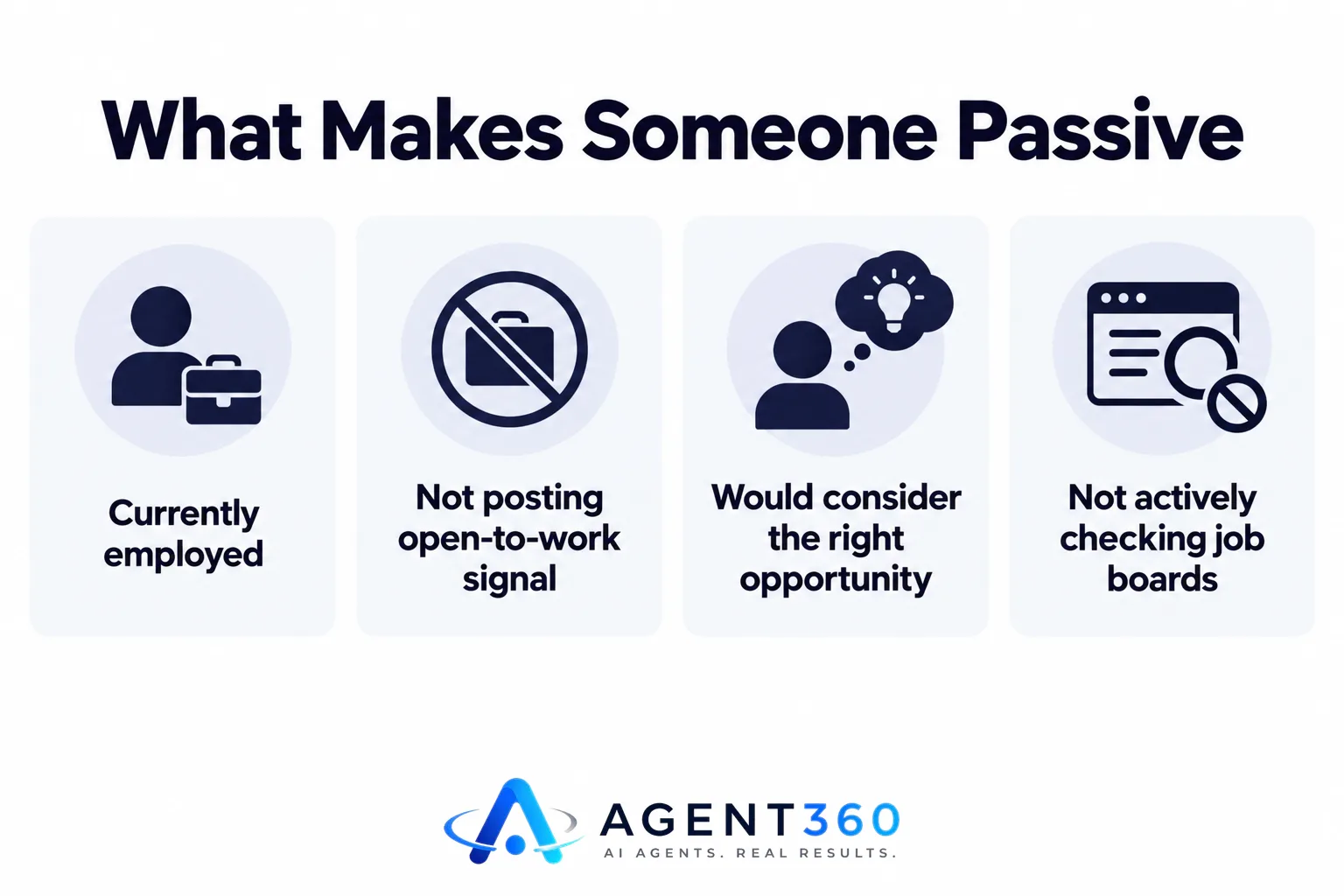
Passive doesn't mean disengaged. Someone two years into a role, performing well, with no plans to leave this quarter, is still a passive candidate for a role that offers meaningfully more scope, pay, or title. The signal you're looking for isn't intent to leave. It's fit for the role, regardless of whether they're currently shopping.
What does candidate sourcing mean?
Candidate sourcing is the process of searching for people who match a role's requirements and compiling them into a list to contact, rather than waiting for them to apply. It starts with the job itself: the titles, years of experience, skills, and location that define who's qualified. From there, sourcing turns those requirements into search filters, runs them against a pool of professional profiles, and produces a shortlist ranked by fit. AI candidate sourcing does this same work — turning a job description into filters and a ranked list — in a fraction of the time it takes to build a boolean string by hand.
The output of sourcing is a list of people, not applications. Nobody on it has expressed interest yet. That's the next job: outreach.
What's the difference between active and passive recruiting?
Active recruiting responds to candidates who come to you — job board applicants, referrals, people who fill out your apply form. Passive recruiting (sourcing) goes out and finds candidates who haven't applied anywhere. The practical differences:
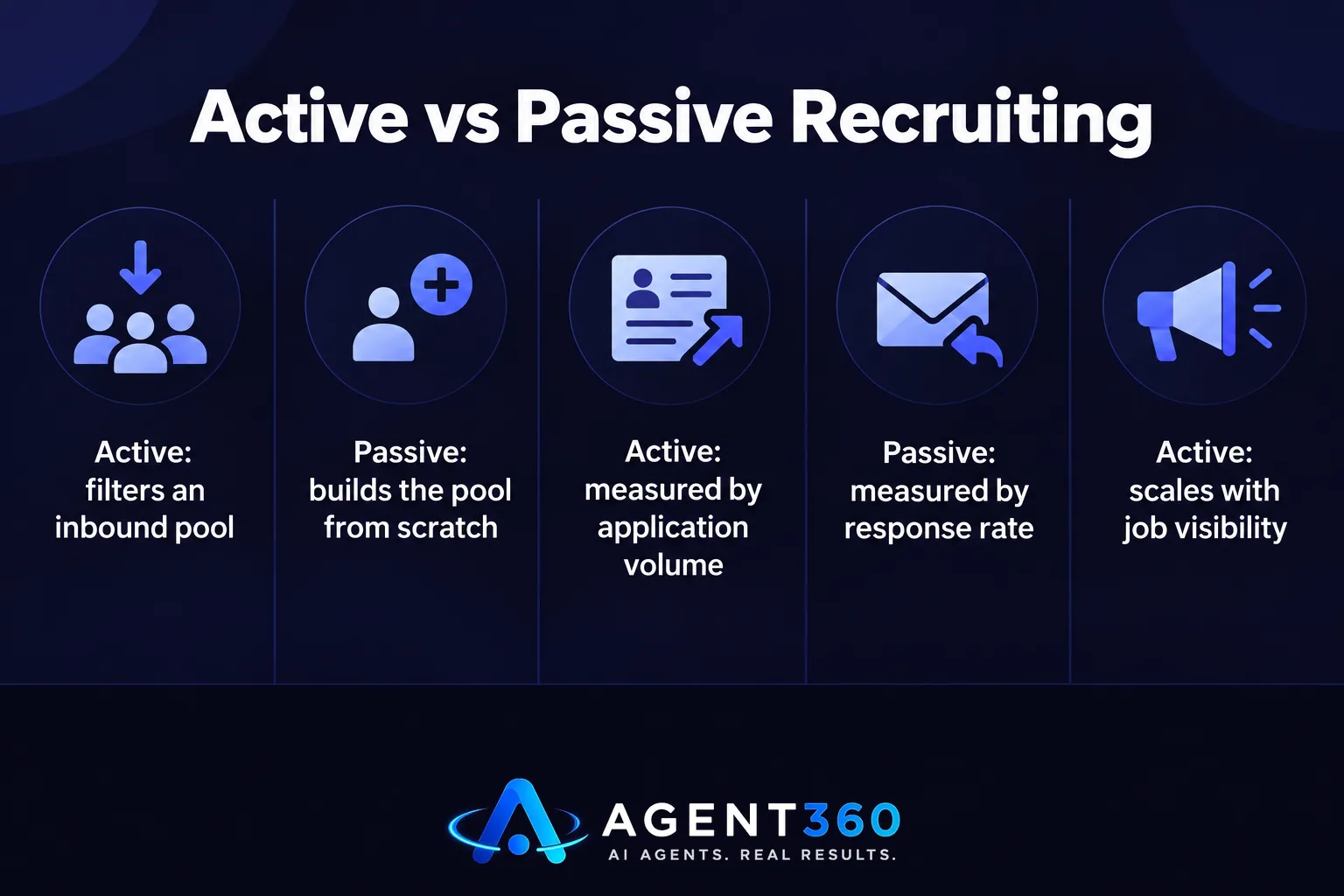
- Active recruiting filters an inbound pool; passive recruiting builds the pool from scratch, search by search.
- Active candidates have already decided to look; passive candidates need a reason to consider it, which means the first message has to do real work.
- Active recruiting is measured by application volume and conversion; passive recruiting is measured by response rate and how many sourced conversations turn into a first interview.
- Active recruiting scales with how many people see your job; passive recruiting scales with how precisely you can define and search for the role, which is why vague job descriptions produce weak sourced lists no matter how many profiles you pull.
Most hiring plans need both. A role with thin applicant flow — specialized skills, a tight local market, a title that doesn't exist at most companies — leans harder on sourcing. A role with high applicant volume and low differentiation between candidates can often be filled from inbound alone. For something like a senior account executive search, where the title alone doesn't tell you much about who's actually performing, sourcing against clear seniority and tenure signals usually beats sorting through whoever happened to apply.
Write the outreach like a job description, not a pitch
The first message to a passive candidate fails for one of two reasons: it's vague, or it's a sales pitch. "Exciting opportunity," "great culture," and "would love to connect" tell a currently-employed person nothing they can act on. They already have a job. What gets a reply is specificity — the actual title, the actual comp range if you can share it, what the role is responsible for, and why you're reaching out to this person specifically rather than a template list.

A short, specific message that references something true about their background outperforms a long, generic one almost every time. If the role, the comp, and the reason for reaching out are all vague, the message reads as mass outreach, and a passive candidate with no urgency to move has no reason to respond to mass outreach.
Where HiringAgent fits
HiringAgent builds the sourced list automatically: paste a job description, and it turns the requirements into search filters, pulls matching profiles, and scores each one 0–100 against the role, so outreach starts from a ranked shortlist instead of a flat list of names. It's not a replacement for LinkedIn Recruiter's network reach or InMail — see the comparison if that's the alternative you're weighing — but it does the sourcing, scoring, first-round phone screening, and pipeline tracking in one place, starting at $197 a month with unlimited users.
FAQ
Do I need a recruiter to do passive sourcing?
No. Sourcing is a search process — define the role, search for matching profiles, rank them — and tools built for it can do the search and scoring work that used to require a dedicated sourcer. A person still needs to write the outreach and judge fit, but the search itself doesn't require recruiting experience to run.
How long should I wait before following up with a passive candidate?
Give it about a week. Passive candidates aren't checking their inbox for job messages, and a second note isn't pushy if it adds something new — a detail about the role, a reason you thought of them specifically. A near-identical repeat of the first message usually gets ignored twice.
Is it legal to source candidates from public profiles without asking first?
Reaching out based on what's sitting on someone's public professional profile is standard recruiting practice, and it doesn't require their consent beforehand. What matters is how you handle their data once they respond — that's a privacy and recordkeeping question, not a sourcing one.
More articles
- How to Find Candidates Who Are Open to Work
- Resume Parsing Software: What It Gets Right (and Wrong)
- AI Resume Screening Scores Resumes, Not Hires
- Automated Phone Screening Interviews: What They Replace
- AI Phone Screening for Recruiters: What the Call Should Do
- What an ATS With AI Candidate Matching Should Actually Do
- The Best ATS for Startups Finds Candidates Too
- What a Modern Applicant Tracking System Actually Does
