Job Agent Meaning: Four Things the Term Can Mean
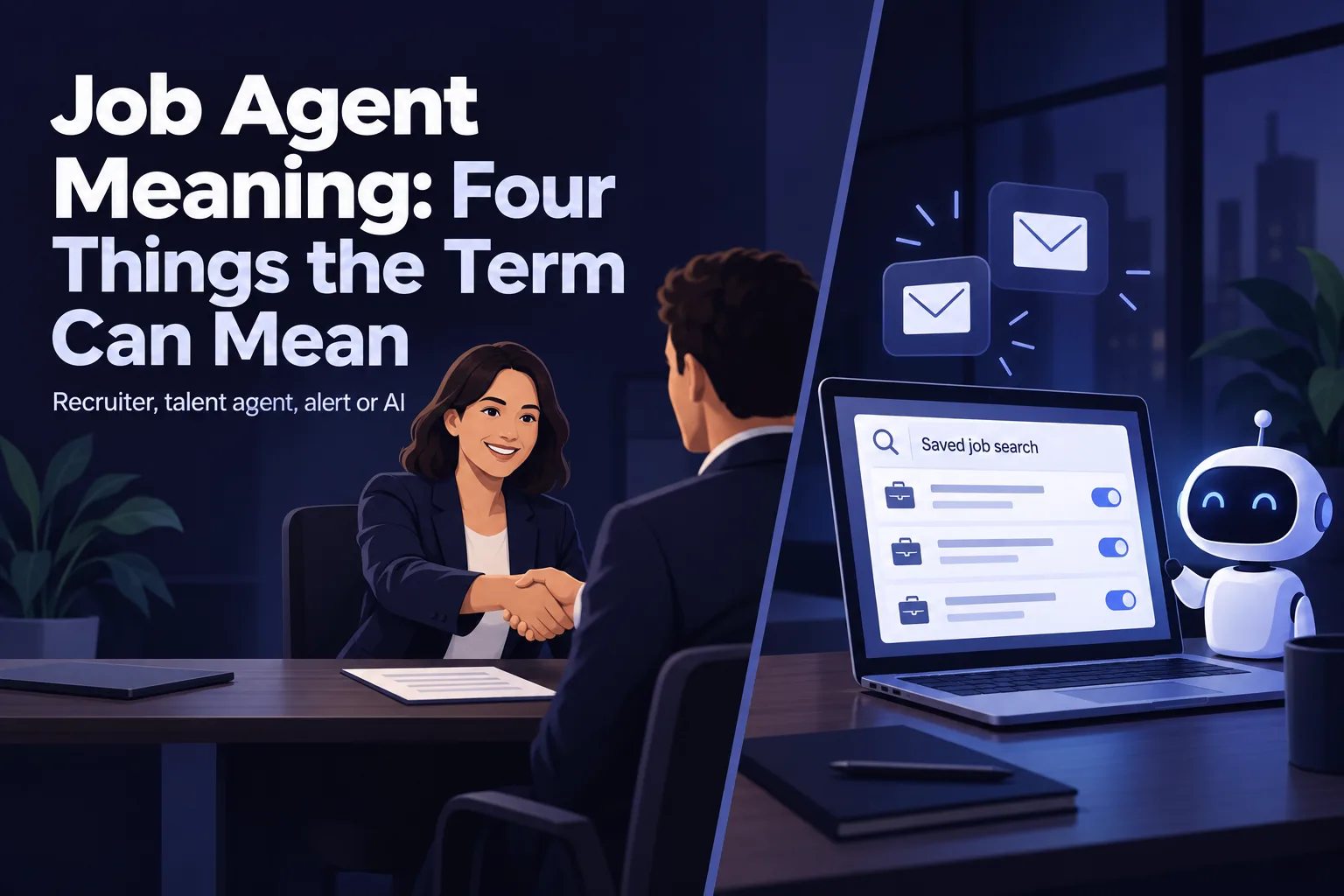
A job agent is anyone or anything that acts for you in the job market. That covers three things: a person such as a recruiter, staffing agent or talent agent; a saved search that emails you new postings (often called a job alert); and, more recently, software that searches and screens for you. Who is asking changes the meaning. Candidates usually mean the saved search. Hiring managers usually mean the staffing agent. We cover both below, plus the slang, the employment question and how to build one.
What does the job of an agent mean?
An agent acts for someone else and is trusted to make moves in their name. In hiring, that gives you three working versions:
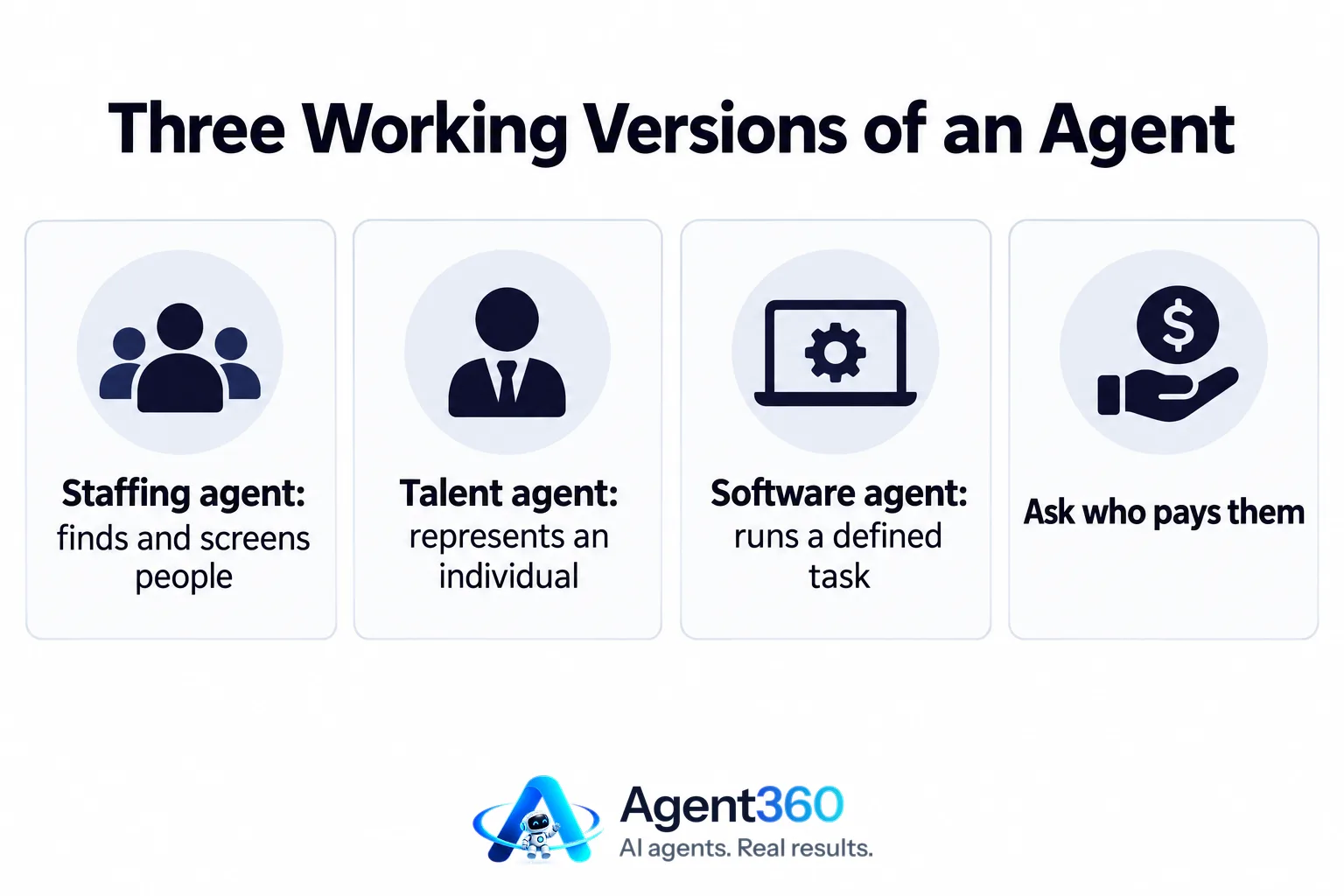
- The staffing or recruiting agent. Finds, screens and presents people for a client's open role.
- The talent agent. Represents an individual, finds them work and negotiates terms. This is common in entertainment, sport and some executive and creative fields.
- The software agent. A saved search or AI tool that runs a defined task, such as finding matching postings or matching candidates, without you doing it by hand.
Ask of any agent: who pays them? An agent works for whoever pays the fee. A talent agent is paid out of the client's earnings, so they work for the person. A staffing agent is paid by the employer, so their client is the employer, however friendly they are to candidates. Plenty of people push back on that framing, because good recruiters do care about candidates. They do. But when interests collide, the fee decides whose side the agent takes.
How does a staffing agency work?
A staffing agency sells a filled role. The client brings a vacancy, the agency finds and screens people, and the client pays for the result. The payment model is what separates the types:
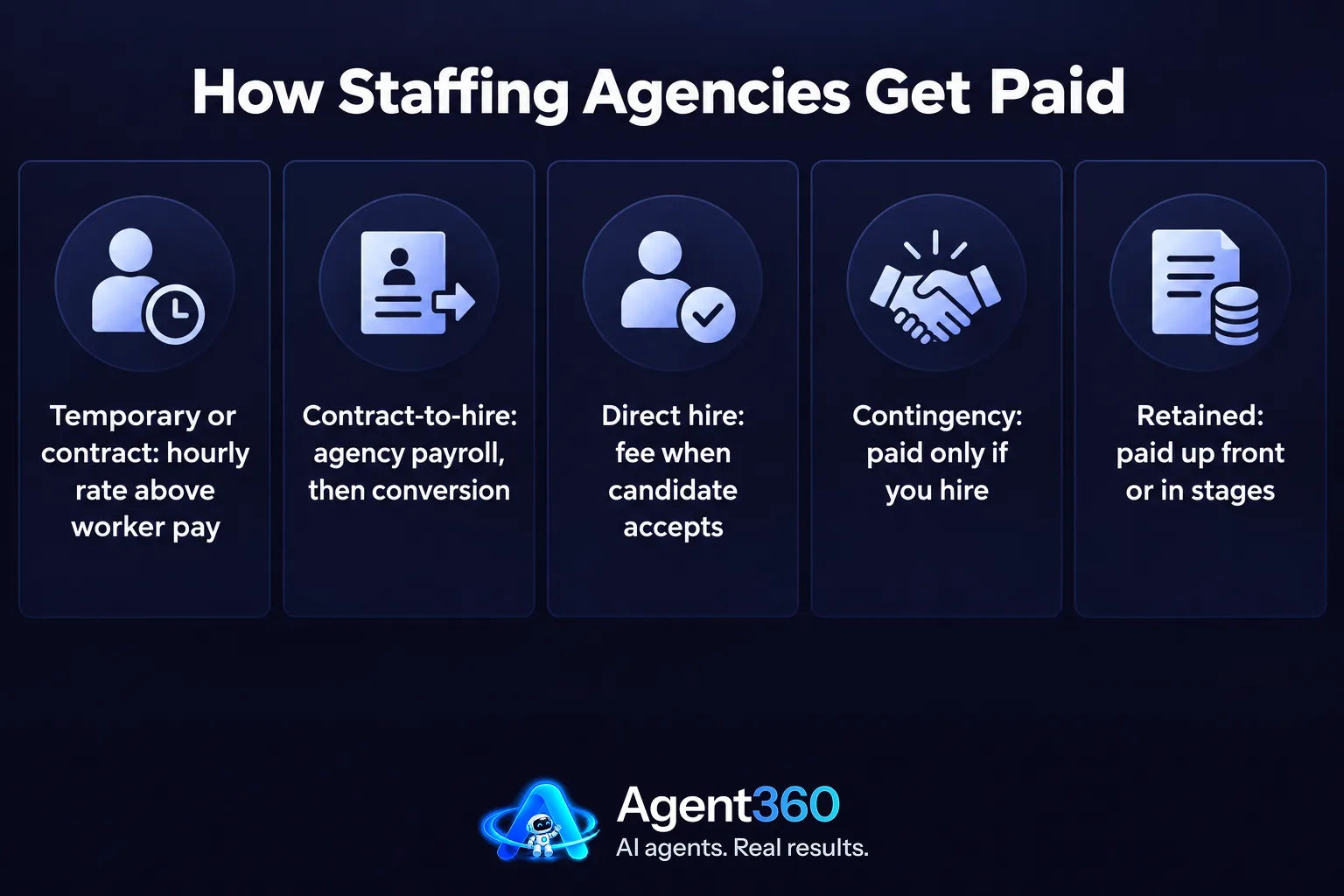
- Temporary or contract staffing. The agency usually employs the worker and bills the client an hourly rate that sits above what the worker is paid. The gap covers the agency's costs and margin.
- Contract-to-hire. The worker starts on the agency's payroll, and the client can convert them to a permanent hire, usually under an agreed conversion arrangement.
- Direct hire or permanent placement. The agency charges a fee when a candidate accepts, typically a percentage of salary. Terms vary a lot, so read what happens if the hire leaves early.
Two fee structures sit on top of that. A contingency agency is paid only if you hire its candidate, so it may be working your role alongside many others. A retained agency is paid up front or in stages to work your search more exclusively. Weighing that fee against running the search yourself? The comparison with a recruiting agency sets the trade-offs out side by side.
Is an agent an employee?
Often not. It depends on the arrangement and the jurisdiction, so check with an employment lawyer before you rely on any of this.
- A talent agent is generally an independent business that represents a client. They are not the client's employee.
- A sales agent or commission-based agent may be an independent contractor or an employee. The label in the contract does not settle it. Control over hours, methods and exclusivity weighs heavily in most legal tests.
- An agency recruiter is an employee of the agency, not of the client who hired the agency.
- A temp worker placed by an agency is, in many arrangements, an employee of the agency, even while taking daily direction at the client's site. Some places treat the client as a joint employer in certain respects.
For a hiring leader, the takeaway is simple. The agency's contract, not the word “agent,” tells you who carries payroll, liability and conversion rights.
What does agent mean in slang?
Outside hiring, “agent” is loose slang. A few uses you will run into:
- In gaming, “agents” are the playable characters in some shooters, so “agent” can just mean a player's character.
- “Agent of chaos” describes someone who stirs things up, usually with a grin.
- Spy-film shorthand, such as calling someone “a secret agent” or “Agent Smith,” is a joke about someone who seems to be working an angle.
- “My agent” as a joke means someone is speaking for you, or you are pretending to be too important to answer directly.
None of these is the job-market meaning. If you saw “job agent” in a job listing or an email footer, it almost certainly means one of the three working versions above.
How to create a job agent
Which kind you build depends on which side of the hire you are on.

If you are the candidate: build a saved search
Most job boards call this a job alert or saved search. The mechanics are similar everywhere: enter a title, a location and some keywords, choose how often to be emailed, and save it. Three decisions make it work:
- Run several narrow agents, not one broad one. One agent per title variant beats a vague one that returns noise you stop reading.
- Include the titles companies actually use. The same job can be called three different things.
- Prune weekly. If an alert keeps sending irrelevant results, tighten it or delete it.
Know the limit. A saved search matches keywords in postings. It does not know you, and it only sees jobs that were posted publicly.
If you are the hirer: build a sourcing agent from your job description
The employer version flips the direction. Instead of searching postings, it searches people. The steps:
- Write the description with searchable specifics. Titles, skills, seniority and years of experience become your filters. Vague wording gives you vague results. The guide to writing a job description that attracts candidates covers how to be specific without scaring people off.
- Turn the description into filters. By hand, that means boolean strings. With software, the tool builds the filters for you.
- Score the results against the role. A list of 300 profiles is not a shortlist until it is ranked.
- Check the top of the list yourself. A score tells you where to look first, not who to hire.
That is the core of AI sourcing. Before you buy anything, read what it replaces and what it does not.
One way to build the hiring-side agent
HiringAgent, by Agent360, is built for this version of the job agent. Paste a job description and its agents source candidates from a database of public professional profiles and score each one 0–100 against the role. You can then run AI phone screens and track everyone from applicant to hired, all in one ATS. Plans start at $197 a month with unlimited users and no contract; the pricing page has the three tiers.
Know the limits too. It does not post to job boards, send LinkedIn InMail or integrate with other ATS tools. The AI phone screen gives no transcript, recording or score, so a person decides who moves on.
Questions people still ask
What is the meaning of a job agent?
A job agent is a person or tool that finds work or workers on someone's behalf. It can be a recruiter or staffing agent who finds candidates for an employer, a talent agent who finds work for an individual, or a saved search that emails you new postings that match your criteria.
Is a job agent the same as a recruiter?
Not always. A recruiter is a person who finds candidates for an employer. “Job agent” can also mean a talent agent working for an individual, or software like a job alert. When the term comes up, check who pays: the one who pays is the agent's client.
Does a staffing agency work for the candidate or the employer?
The employer, in most placements, because the employer pays the fee or the hourly markup. A good agency treats candidates well because it needs a pool of them, but it is paid to fill the client's role. Want someone who works for you? That is a talent agent or a career coach, not a staffing agency.
More articles
- Filter Sales Candidates by Deal Size: Proxies, Then Proof
- Steps to Find Qualified Employees Online, in Order
- A Phone Screening Agent Should Ask, Not Decide
- Pick a Talent Sourcing Tool by the Bottleneck It Removes
- Staffing Agency Tools: What You Actually Need, by Job
- Recruiting Reports That Actually Change a Hiring Decision
- Prospecting Tools for Recruitment Agencies That Earn Their Fee
- Are All Tracking Systems the Same? Not Even Close
