Steps to Find Qualified Employees Online, in Order
Finding qualified employees online takes five steps: define what “qualified” means in 90-day outcomes, decide whether you are fishing in the active or passive pool, pick one or two channels to match, write a description that filters, and screen the top of the list within days. Most people jump to step three and post on a job board. Then they wonder why the inbox is full and the shortlist is empty. The website is the least important decision here.
Start with the 30-60-90 rule, because it defines “qualified”
The 30-60-90 rule for a new job is a plan for what the person learns in the first 30 days, contributes in the first 60, and owns by day 90. Hiring managers usually file it under onboarding. Use it earlier, as a sourcing document.
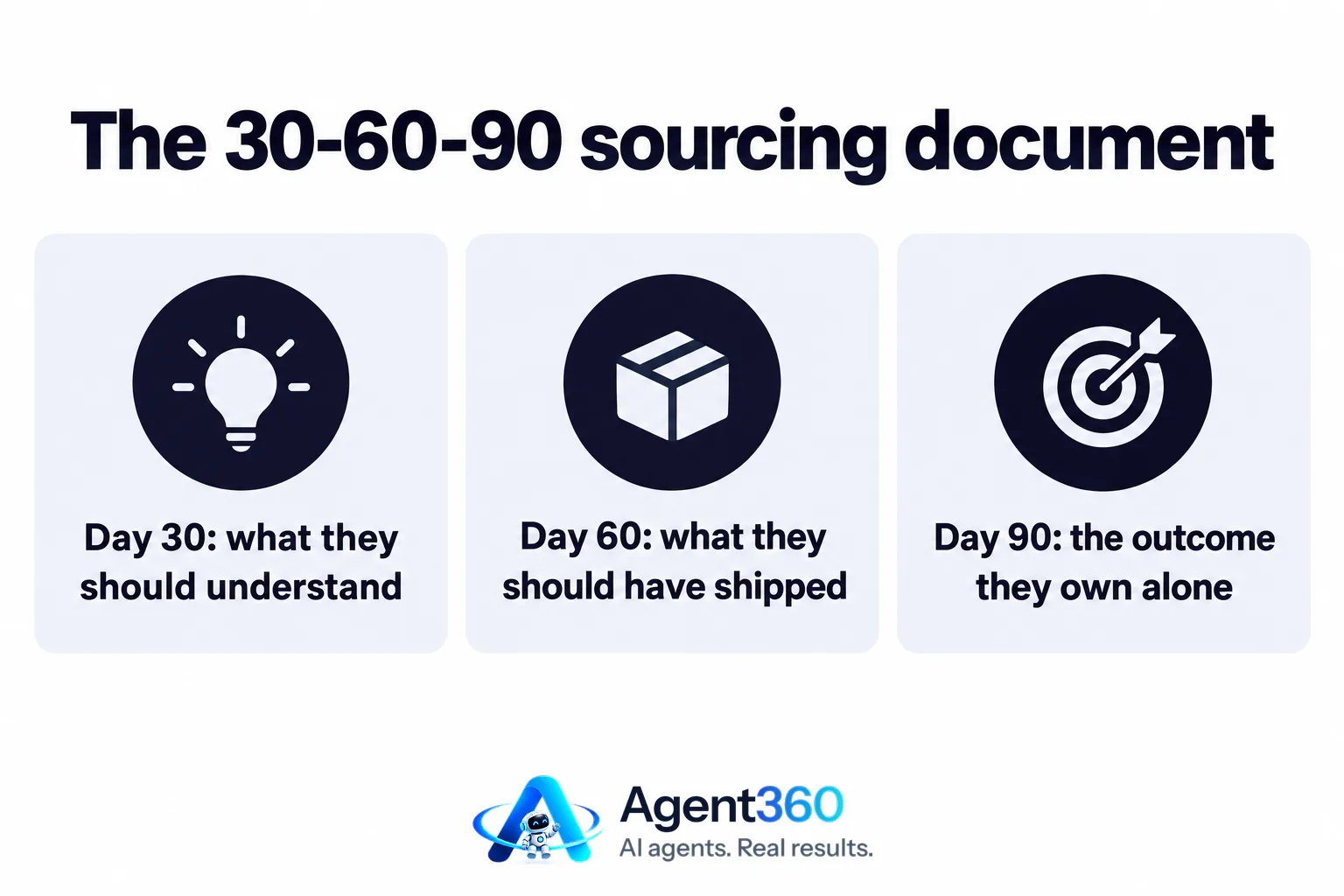
Write three lines before you open any search tool:
- Day 30: what they should understand (the product, the accounts, the codebase, the process).
- Day 60: what they should have shipped, closed or fixed with help.
- Day 90: the outcome they own alone, stated so you could tell whether it happened.
Now read your day-90 line and ask what someone must already have done elsewhere to hit it. That answer is your qualification. It is sharper than “five years of experience,” and it tells you what to look for in a profile: a similar scope, a similar kind of company, a similar tool or customer.
Can't write the day-90 line? Then you are not ready to source. No website will fix that.
What is the best way to find qualified candidates for a job?
Go where the evidence is, not where the traffic is. A job board gives you people who chose to respond to you. Searching public professional profiles gives you people who have visibly done the thing you need. Referrals give you people someone else already vouches for. The best way is a mix, weighted by how hard the role is to fill.
A rough rule: common roles with a large applicant pool can start with a posting. Scarce roles, such as senior engineers, specialist finance, or sales reps with a particular market, should start with search, because the right person may never see your posting. Our guide to what passive candidate sourcing actually takes covers that second case in detail.
Here we disagree with the standard advice to “cast a wide net.” A wide net produces volume, and volume costs you, because every irrelevant applicant eats review time. Cast a narrow net with a good filter. Widen it only if the shortlist runs dry.
What is the most effective way to find employees? Match the channel to the candidate’s state of mind
People are in one of two states. Some are actively looking: they check boards, update resumes, reply to messages fast. Others are employed and content enough that they will only move for a specific reason. The channel that works for one fails for the other.
- Active candidates: job boards, your own apply page linked from your site and social posts, and professional-network job listings. Speed to reply wins here, since these people are talking to several employers.
- Passive candidates: direct outreach after a targeted search, referrals from your team and customers, and niche communities for the craft. Relevance wins here. The message has to say why this role, for this person, now.
- People signaling they are open: a middle group. Some profiles show an open-to-work signal, which lets you put outreach first where people are more likely to answer. We cover how in how to find candidates who are open to work.
Pick one channel from each state that fits your role, not all of them. Two channels you work properly beat six you check on Fridays.
What is the best website for employers to find employees? It depends on the role, and anyone naming one site is selling it
People ask this constantly, and the honest answer is that no single site wins across roles. Here is how to choose without trusting a ranking:
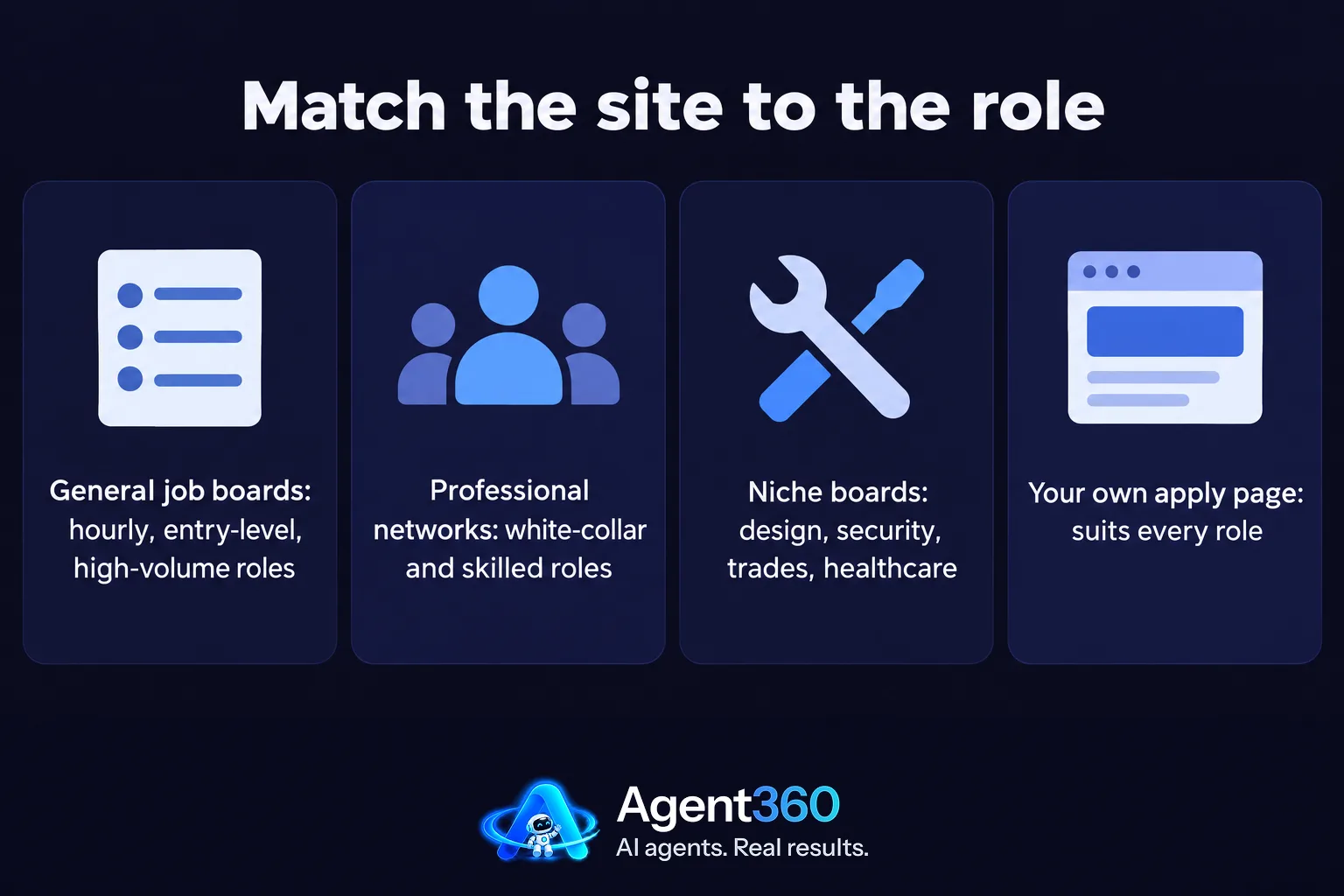
- General job boards suit hourly, entry-level and high-volume roles, where the pool is large and a posting reaches it.
- Professional networks suit white-collar and skilled roles, where candidates keep a profile with titles and history you can search.
- Niche boards and communities suit crafts with their own gathering places: design, security, trades, healthcare. They are smaller, and the signal is higher.
- Your own apply page suits every role. It is the one place you control the questions and the follow-up.
Test the choice cheaply. Run a role for a week on one channel and count one thing: how many people who reach your shortlist came from it. Not applicants. Shortlist. The channels with the cheapest clicks often have the lowest shortlist rate.
Write the posting to repel the wrong people
A posting that attracts everyone is a bad posting. Put in the day-90 outcome, the real scope, the location or time zone rules, and the one or two non-negotiables. Say what the role is not. The right candidates read that as honesty, and the wrong ones drop out before you spend a minute on them. Our post on writing a job description that attracts candidates walks through the structure.
Screen in a fixed order and set a clock
Qualified candidates online do not wait. A reasonable process, in order:

- Day 0 to 2: check each candidate against the one or two non-negotiables only. Do not read for polish yet.
- Day 2 to 4: a short first call built around the day-90 outcome, not general chat. See first-round interview questions that predict fit, not charm.
- Day 5 onward: only the people who passed the call get a deeper interview.
Treat those numbers as a starting point, not a law, and adjust for how fast your market moves. The principle holds. Qualified people drop out in the gap between their interest and your first reply, and you fully control that gap.
Where HiringAgent fits: the search and the first call
If steps two and four are what slow you down, HiringAgent’s sourcing handles that part. Paste the job description and it turns it into filters, searches a database of public professional profiles, and scores each candidate 0 to 100 against the role, where 80 and above is a strong match. Every job also gets a public apply page you can share anywhere. To be clear about the limits: it does not post to job boards, and the AI phone screen gives no transcript or score, so a person decides who moves on. Plans start at $197 a month with unlimited users; see pricing.
Questions people still ask
How long should it take to find a qualified employee online?
That depends on how scarce the role is and how fast you reply, so any fixed number would be a guess. What you can control is the gap between a candidate showing interest and your first reply. Shrink that first. It is the cheapest delay to remove.
Should I use a job board or search for candidates directly?
Use a job board when the role is common and the pool is large. Search directly when the role is scarce or senior, because the best fit may not be looking. Many hires need both: a posting for people who are active and a targeted search for those who are not.
What is the 30-60-90 rule, and how does it help me hire?
It is a plan for what a new hire learns by day 30, contributes by day 60 and owns by day 90. Write it before you hire, and the day-90 outcome tells you what past experience a candidate needs. That makes “qualified” something you can actually check on a profile.
More articles
- Filter Sales Candidates by Deal Size: Proxies, Then Proof
- A Phone Screening Agent Should Ask, Not Decide
- Pick a Talent Sourcing Tool by the Bottleneck It Removes
- Job Agent Meaning: Four Things the Term Can Mean
- Staffing Agency Tools: What You Actually Need, by Job
- Recruiting Reports That Actually Change a Hiring Decision
- Prospecting Tools for Recruitment Agencies That Earn Their Fee
- Are All Tracking Systems the Same? Not Even Close
