Staffing Agency Tools: What You Actually Need, by Job
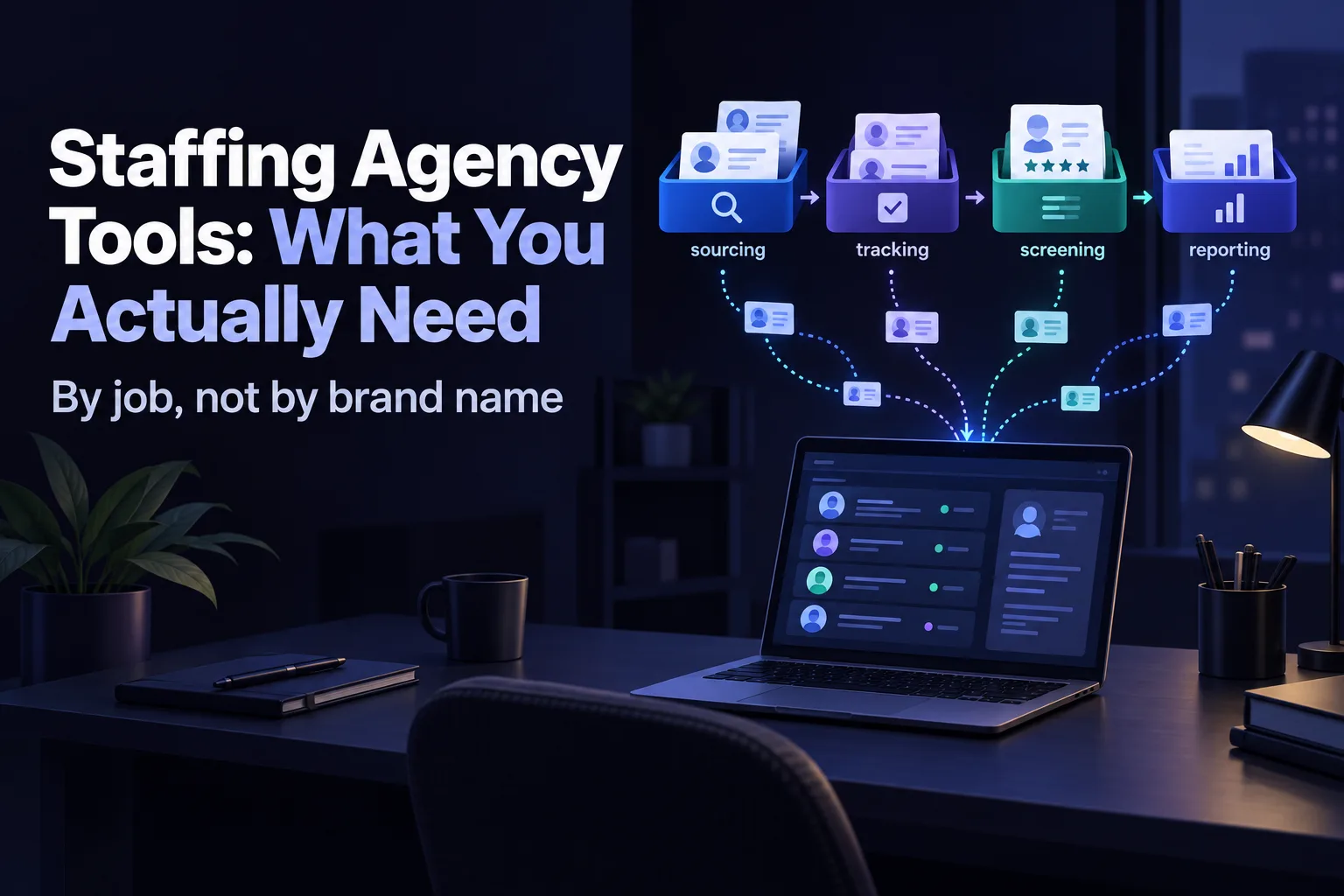
Staffing agencies don't run on one tool. They run on four jobs, repeated for every requisition: find people, track them, screen them, report on all of it back to the client. Most agencies cover those four jobs with three or four pieces of software that were never built to talk to each other. So the real question isn't which single tool to buy — it's which job each piece of your stack is doing, and what's falling through the gap between them.
You can usually spot that gap in one place: a recruiter re-typing a candidate's details from a spreadsheet into an ATS, or copying a phone number off LinkedIn into a texting app to book a screen. Every manual handoff is a place a candidate goes cold.
What software do staffing agencies use?
In practice, most agency stacks break down into four layers:
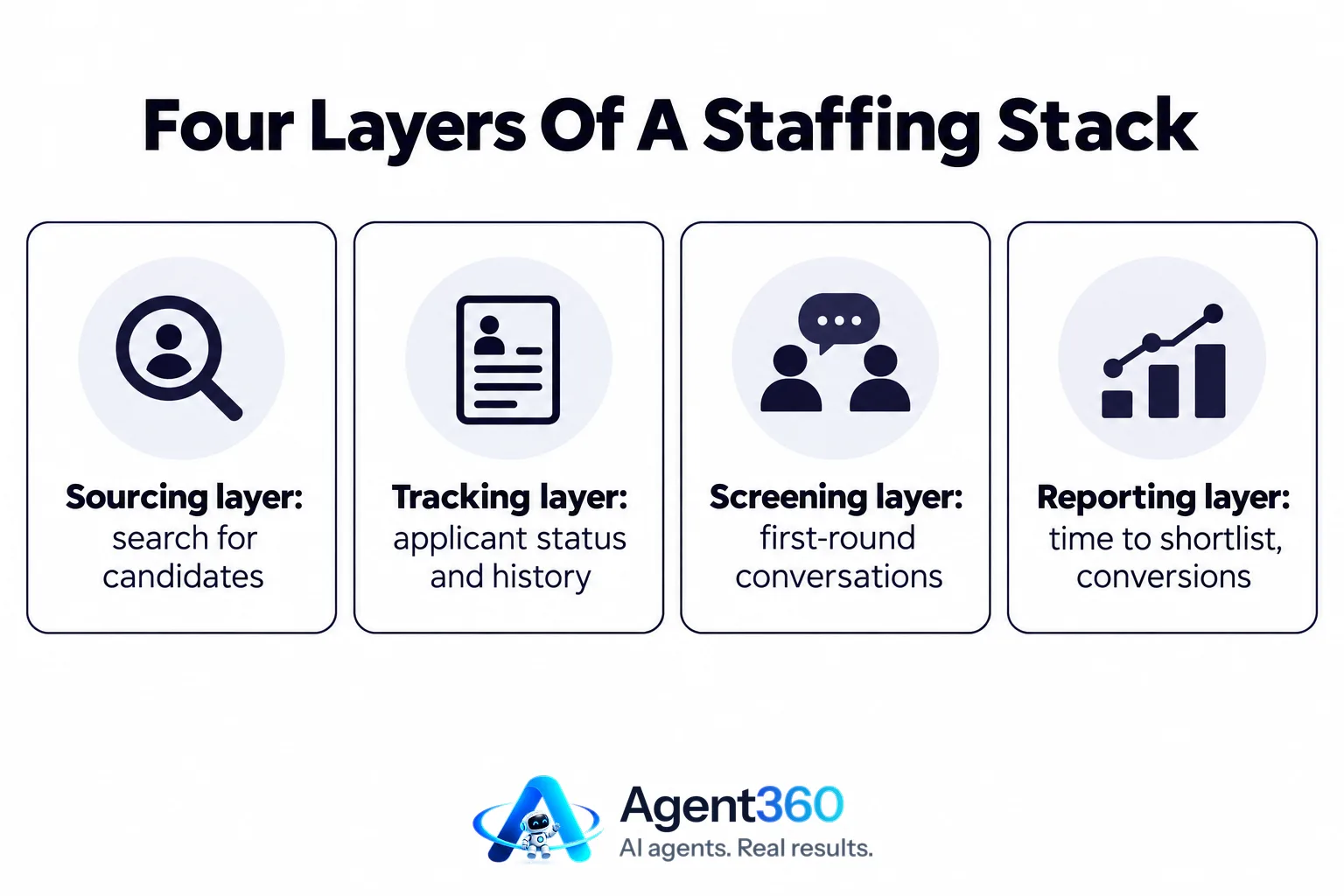
- A sourcing layer — somewhere to search for candidates against open roles, usually a professional network search or a paid database seat.
- A tracking layer — an applicant tracking system that holds every candidate's status, notes and history for a given job.
- A screening layer — however first-round conversations get scheduled and run, whether that's a recruiter's calendar, a scheduling link, or an automated call.
- A reporting layer — the numbers a client or account manager actually asks for: time to shortlist, stage conversion, submittals per req.
Lean agencies often buy these separately and connect them by hand: export from one, import into another, spreadsheet as the glue. It works — until volume climbs, and the glue is the first thing to snap. That's the real case for buying a stack that's actually three tools, not one, instead of one tool that claims to do everything and does most of it badly.
The top 10 recruiting tools question has the wrong unit
Search for a ranked list of the best recruiting tools and you'll get a list of company names — the wrong thing to compare first. A sourcing database and an ATS solve different problems; they don't compete with each other any more than a hammer competes with a tape measure. The useful comparison happens layer by layer:
- For sourcing, the question is whether the tool can turn a job description into search filters — titles, skills, seniority, location — without a recruiter hand-building a boolean string. See what each layer of a sourcing tool is actually supposed to do before comparing vendors.
- For tracking, the question is whether sourced candidates and inbound applicants land in the same pipeline, or whether you're maintaining two systems of record for one requisition.
- For screening, the question is how much recruiter time goes into scheduling a 20-minute first call, and whether that time scales as req count goes up.
- For reporting, the question is whether the numbers update themselves as candidates move, or whether someone is building a status report by hand every Friday.
Compare layer by layer, and most “top 10” lists collapse fast — two or three real choices per layer, no more. The choice usually comes down to one thing: how much manual re-entry each option removes.
What are the 5 C's of recruitment?
The 5 C's of recruitment is shorthand agency trainers use for what has to go right on every search, no matter which tools sit underneath. Candidate experience — does the process feel respectful of a busy person's time. Communication — does every candidate hear back, even the ones who don't move forward. Collaboration — can the recruiter, the account manager and the client see the same pipeline without a status email. Consistency — does every candidate for a role get asked the same questions, scored the same way. And Control — does the agency keep ownership of the data and the relationship, rather than losing candidates into a client's separate system.
Tools don't replace the 5 C's. At volume, they either make them easier to hold onto, or they quietly erode them — usually through the fourth one. Inconsistent screening is the most common failure in a growing agency, and it stays invisible until a client asks why three finalists for the same role got three different sets of questions.
Common tools used in recruitment, and where each one stops
The tools agencies reach for most often, and their actual limits:
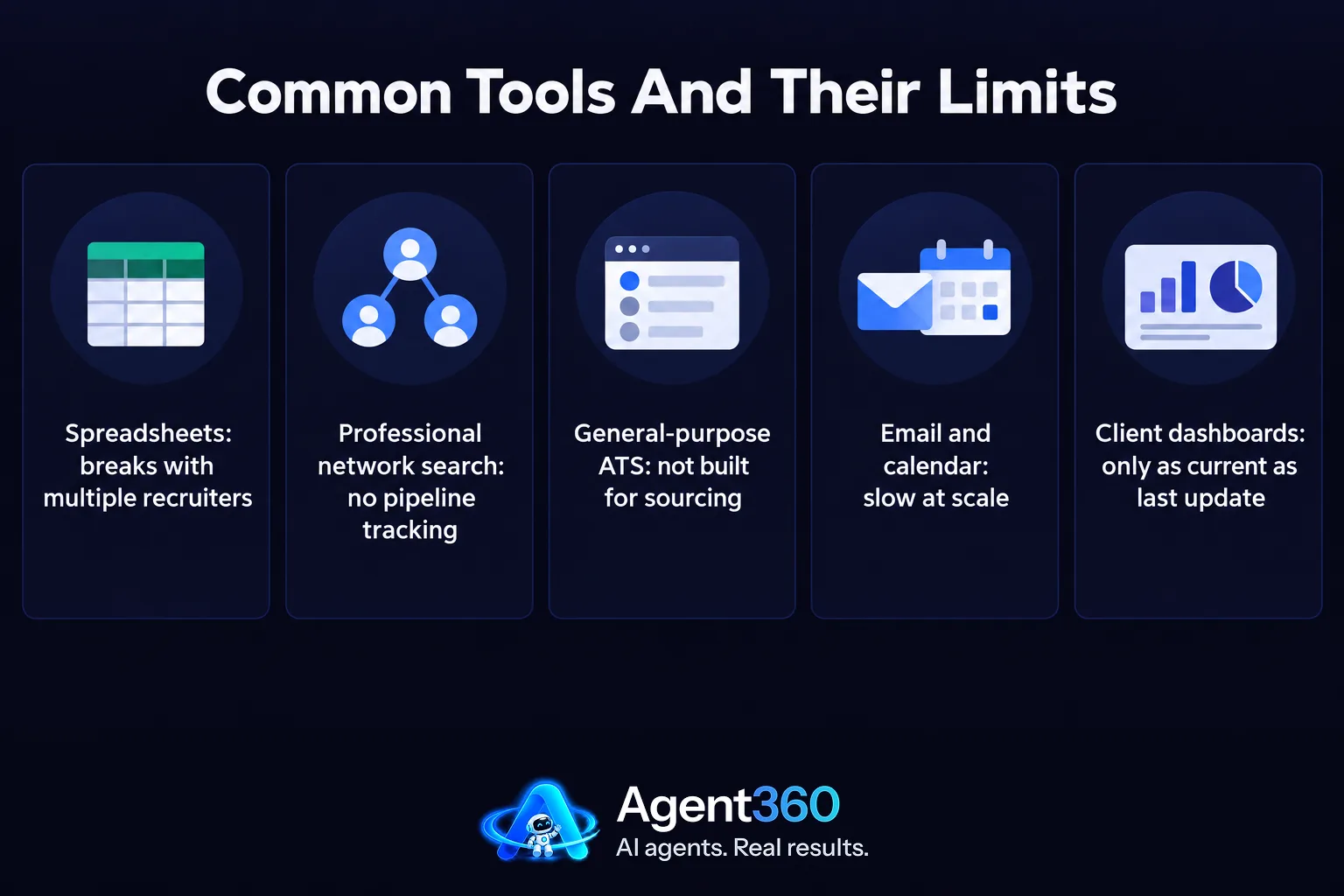
- Spreadsheets — free, flexible, and the first thing to break once more than one recruiter touches the same req.
- A professional network's paid search tier — strong for finding people, with no native way to track them through a pipeline or score them against a specific role.
- A general-purpose ATS — built for tracking applicants who come to you, not for going out and finding the ones who haven't applied anywhere.
- Email and calendar tools — fine for scheduling one call at a time, slow at scale, and dependent on the candidate replying promptly.
- Client-facing dashboards or shared docs — a manual substitute for reporting that's only as current as the last time someone updated it.
None of these is wrong on its own. The problem lives in the seams between them: the candidate sourced on the network who never makes it into the ATS, the screen booked by email that never shows up as a pipeline status.
Where a combined sourcing-and-tracking tool fits
HiringAgent is built to close that exact seam for agencies. It sources candidates from a client's job description, scores each one against the role, and drops sourced candidates and applicants into the same pipeline — one record per candidate, not one per system. First-round screens get booked and run by an AI voice agent instead of a recruiter's calendar, and reporting updates as candidates move instead of waiting for Friday. Plans start at $197 a month with unlimited users, worth weighing against the combined monthly cost of a sourcing seat, a separate ATS and a scheduling tool.

Frequently asked questions
Do staffing agencies need a separate ATS and sourcing tool?
Not necessarily. Some systems combine the two now, so sourced candidates and applicants share one pipeline. But if you buy separately, make sure data moves between them without manual export and import — otherwise you're re-entering the same candidate twice.
How many tools does a small staffing agency actually need?
Four jobs have to be covered — sourcing, tracking, screening, reporting — but that's not four separate subscriptions. A small agency running a handful of reqs at a time can often cover all four with two systems, as long as neither one needs manual re-entry to feed the other.
What's the biggest sign a staffing agency's tool stack is too fragmented?
A status report that eats more than a few minutes to assemble. Or a recruiter who can't say, off the top of their head, how many candidates sit in each stage for a given req without opening three different tools to check.
More articles
- Filter Sales Candidates by Deal Size: Proxies, Then Proof
- Steps to Find Qualified Employees Online, in Order
- A Phone Screening Agent Should Ask, Not Decide
- Pick a Talent Sourcing Tool by the Bottleneck It Removes
- Job Agent Meaning: Four Things the Term Can Mean
- Recruiting Reports That Actually Change a Hiring Decision
- Prospecting Tools for Recruitment Agencies That Earn Their Fee
- Are All Tracking Systems the Same? Not Even Close
