Filter Sales Candidates by Deal Size: Proxies, Then Proof

You can't filter sales candidates by deal size directly, because no public profile has a deal size field. Filter on the signals that produce a deal size instead: the segment they sold into, the title and seniority they held, the price of the product, and the length of the cycle. Then treat any number a candidate states as a claim, and test it with a handful of questions before anyone reaches a hiring manager.
The rest of this post is that method, in order.
Deal size isn't a field, so filter on what produces it
A search tool can match titles, locations, skills, seniority and years of experience. None of those say $40k average contract. But several of them are strong stand-ins for it:
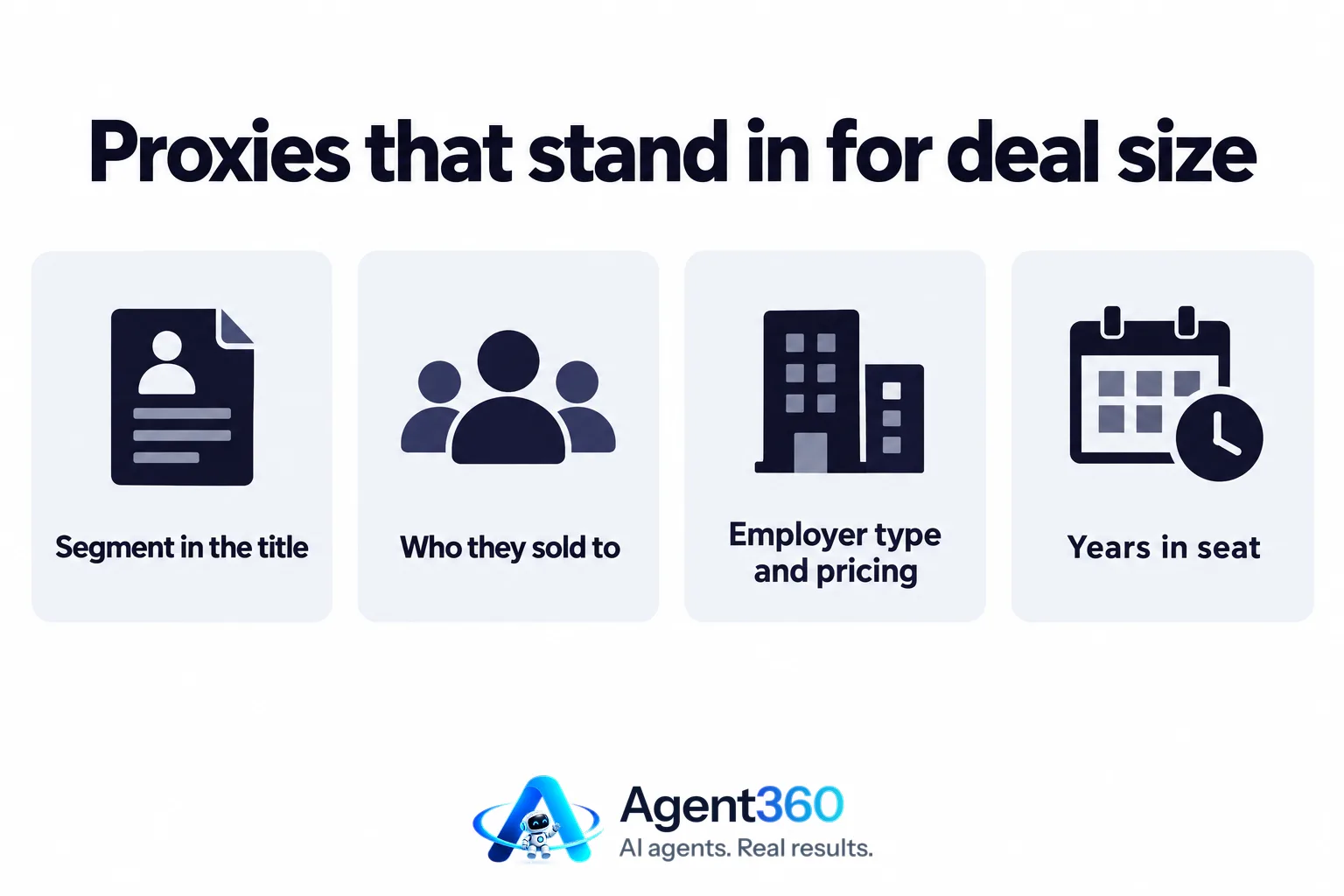
- Segment in the title. SMB, mid-market, commercial and enterprise usually show up in the title or the headline. A strategic or named-accounts rep and a velocity rep don't sell the same size of deal.
- Who they sold to. Selling to a founder, a department head or a procurement committee tells you the budget range better than any figure on a resume.
- Employer type. A seed-stage startup with a low-priced product and a public company with six-figure contracts produce different deal sizes. Look at the employer's pricing page, not just its name.
- Years in seat. Short stints at several companies mean a candidate rarely saw a full cycle at any of them. That matters most when your cycle runs for months.
- Skills and motion. Outbound, multi-threading, security reviews, RFPs and procurement language point up-market. High-volume inbound handling points down.
Be clear about what this buys you. It narrows the pool to people who plausibly sold at your size. It doesn't tell you what they actually sold. The number comes later.
Numbers on the resume count, but only as claims
Sales hiring managers keep asking whether to trust numbers on the resume at all. Read them. Just don't rank by them. A resume number has no audit trail, and the same figure can mean very different things.
Here is how a number misleads:
- Total versus deal. Closed $2M could be one deal or two hundred. Only the second says anything about volume skills.
- Attainment without a quota. 140% of quota means nothing without the quota. A reduced or easy quota produces the same line.
- Inherited pipeline. A rep handed a warm book of accounts and a rep who built pipeline from nothing can post the same figure.
- Team versus individual. Overlay and team-credited numbers look like personal wins.
A quick sanity check is arithmetic. Divide the claimed annual quota by the claimed average deal. Thirty deals a year means a short cycle and a high-volume motion. Four means each deal took months and several stakeholders. If that doesn't match the segment on the resume, one of the two is wrong. For more on reading a sales resume without guessing, see how to hire sales reps without guessing on resumes.
Make the number fall apart, or hold, with five questions
This step does the real filtering. Ask these in a live conversation, in this order.

- What was your quota, and what did you hit? Get both numbers, not the percentage.
- What was your typical deal, and your largest? The gap between typical and largest shows whether the big one was a fluke.
- How long from first contact to signature? The cycle length should fit the deal size. A $100k deal signed in two weeks needs an explanation.
- Who signed, and who else was involved? Real enterprise deals have names and roles. Vague answers here are the clearest tell.
- Where did the pipeline come from? Outbound, inbound, partner or inherited. This decides whether the number transfers to your company.
A candidate who sold at the size you need answers all five quickly, with detail they didn't rehearse. A candidate who inflated one figure usually stumbles on question four or five. Our guide to first-round interview questions that predict fit, not charm covers how to keep that conversation structured.
Set a ceiling as well as a floor
Most hiring managers filter for candidates who sold at least as big as the role. That's half the filter. The other half is where bad hires hide.
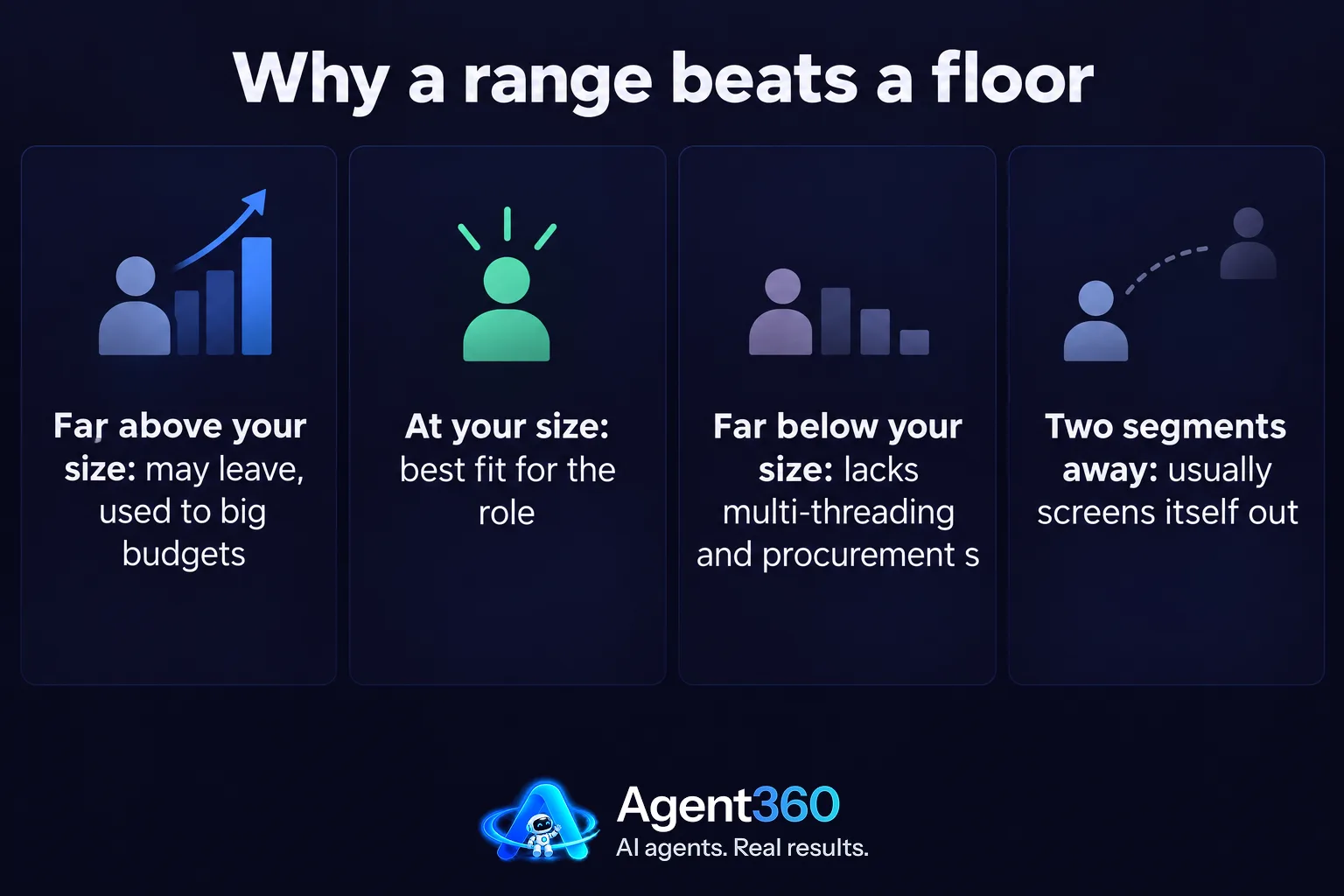
A rep whose average deal was far above yours may leave. They're used to long cycles, big budgets and support teams, and a high-volume role with small tickets can feel like a step down. A rep who sold far below your size has the opposite problem: the new motion demands skills they never needed, like multi-threading and handling procurement. Moving up-market is generally harder than moving down, because the extra stakeholders and longer cycle are skills, not just bigger numbers.
So write a range into the job description, with a floor and a ceiling. Name the typical deal, the typical cycle and the buyer's title. Candidates who sold two segments away in either direction will usually screen themselves out, and the ones left are worth a call. Not everyone will agree with the ceiling. If your product is hard to sell and your hiring manager would rather take a stretch candidate, widen it. But decide on purpose.
Where software helps, and where it stops
Software can do the proxy filtering. It can't verify the number.
HiringAgent's Sourcing Agent reads a job description and turns it into search filters: titles, locations, skills, seniority and years of experience. The Match Agent then scores each candidate from 0 to 100 against that description, with sub-scores for skills, experience and location, plus a one-line reason and the gap to check. If your description states the segment, buyer and cycle, the score has something to compare against. How well it can do that depends on what the candidate's profile actually says, so a profile that mentions no segment gets a weaker read. See how that works for sales roles.
There's no deal size filter, and the AI phone screen doesn't verify figures. It asks questions written from your job description, but it gives no transcript, recording, summary or score. The candidate is marked screened and a person decides who moves on. So the five questions above stay with your team, on a call you run yourself.
Questions people ask next
How do I filter sales candidates by deal size?
Filter on proxies: segment in the title, employer type and pricing, seniority, years in seat and the buyer's title. Public profiles don't carry a deal size field, so a search tool can't match one. Verify the number afterwards by asking for quota, attainment, typical and largest deal, cycle length and who signed.
Should I trust numbers on a sales resume?
Read them as claims, not facts. A total with no deal count, a percentage with no quota, or a figure with no cycle length can't be compared to anything. Check that quota divided by average deal gives a deal count that fits the stated cycle, then confirm on a live call.
Can an AI phone screen confirm a candidate's deal size?
Not reliably. In HiringAgent, the AI phone screen asks role-specific questions and marks the candidate as screened, but it provides no transcript or score. Checking a deal size is a conversation, and a person on your team has to have it.
More articles
- Steps to Find Qualified Employees Online, in Order
- A Phone Screening Agent Should Ask, Not Decide
- Pick a Talent Sourcing Tool by the Bottleneck It Removes
- Job Agent Meaning: Four Things the Term Can Mean
- Staffing Agency Tools: What You Actually Need, by Job
- Recruiting Reports That Actually Change a Hiring Decision
- Prospecting Tools for Recruitment Agencies That Earn Their Fee
- Are All Tracking Systems the Same? Not Even Close
