Recruiting Reports That Actually Change a Hiring Decision
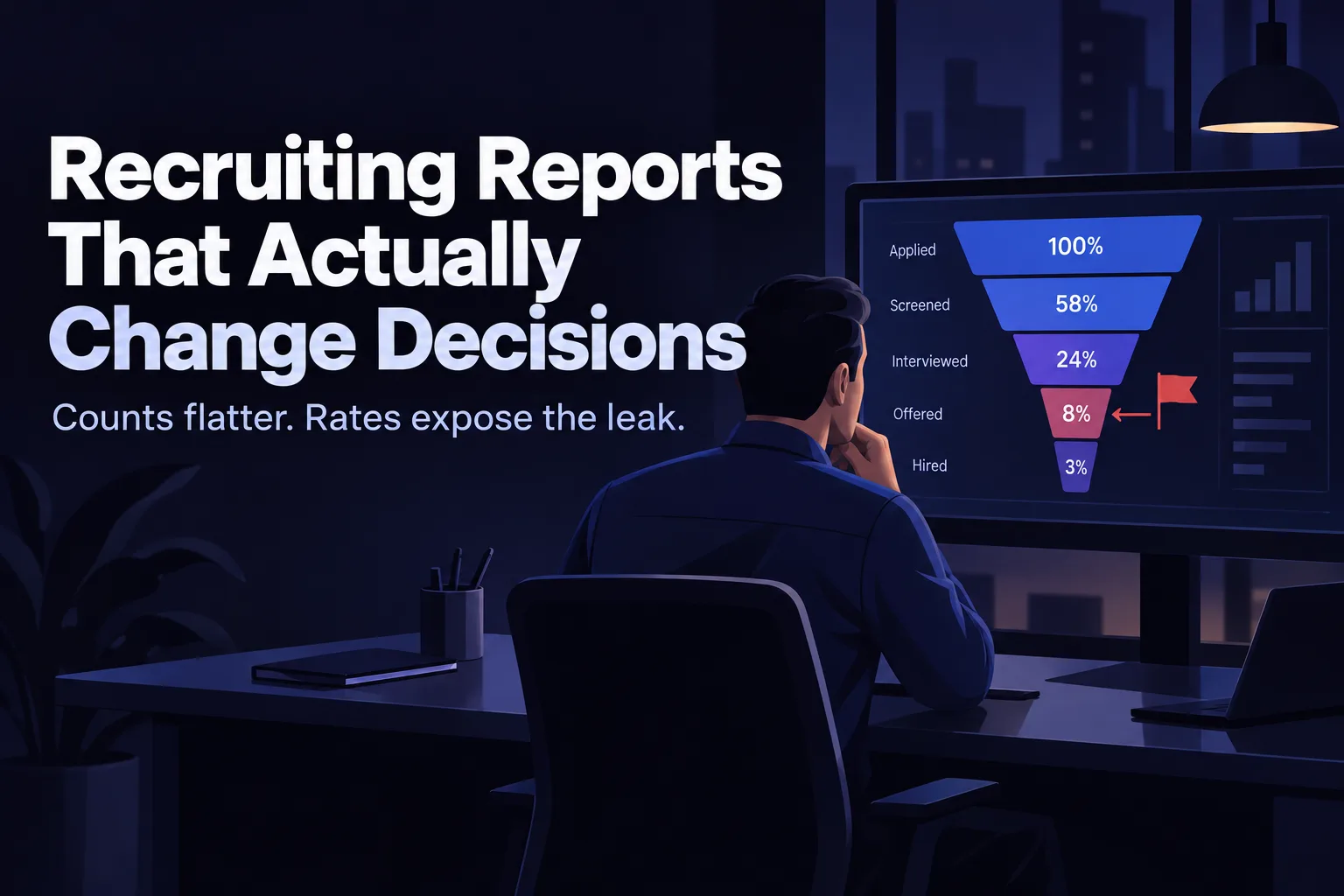
Counting resumes received tells you something happened. It doesn't tell you whether the pipeline will actually produce a hire, or where it's quietly falling apart. The gap between a report that gets a glance and one that changes a decision usually comes down to one thing: does it show a rate, or just a count?
Counts flatter everyone. 400 applicants sounds like a healthy funnel. Rates expose it. If those 400 applicants produce 6 interviews and 1 offer, the funnel isn't healthy — it's leaking somewhere between screen and interview, and nobody has looked closely enough to say where.
Report on conversion between stages, not volume at the top
The single most useful number in a hiring funnel is the conversion rate from one stage to the next — applied to screened, screened to interview, interview to offer, offer to accepted. A drop at applied-to-screened usually means the job description or the sourcing filters are too loose. A drop at interview-to-offer means something else: the panel and the job description disagree about what the role actually needs. Different problems, different fixes. A single top-line “time to hire” number hides both of them. A closer look at which funnel metrics actually predict a bad hire is worth more than a dashboard full of counts.
Time to hire by stage, not one blended number
“Time to hire: 34 days” reads fine on a slide. It's useless for a decision. What matters is which stage ate those 34 days. If 20 of them sit between application and first screen, the bottleneck is scheduling or sourcing speed — not interviewer availability. If 15 sit between final interview and offer, the bottleneck is internal: approvals, budget sign-off, a hiring manager who hasn't decided yet. A report that can't separate these is reporting an outcome, not a cause. See the full breakdown of what the time to hire metric measures and what it hides.
What are good KPIs for recruiters?
A short list that actually drives action instead of just filling a dashboard:
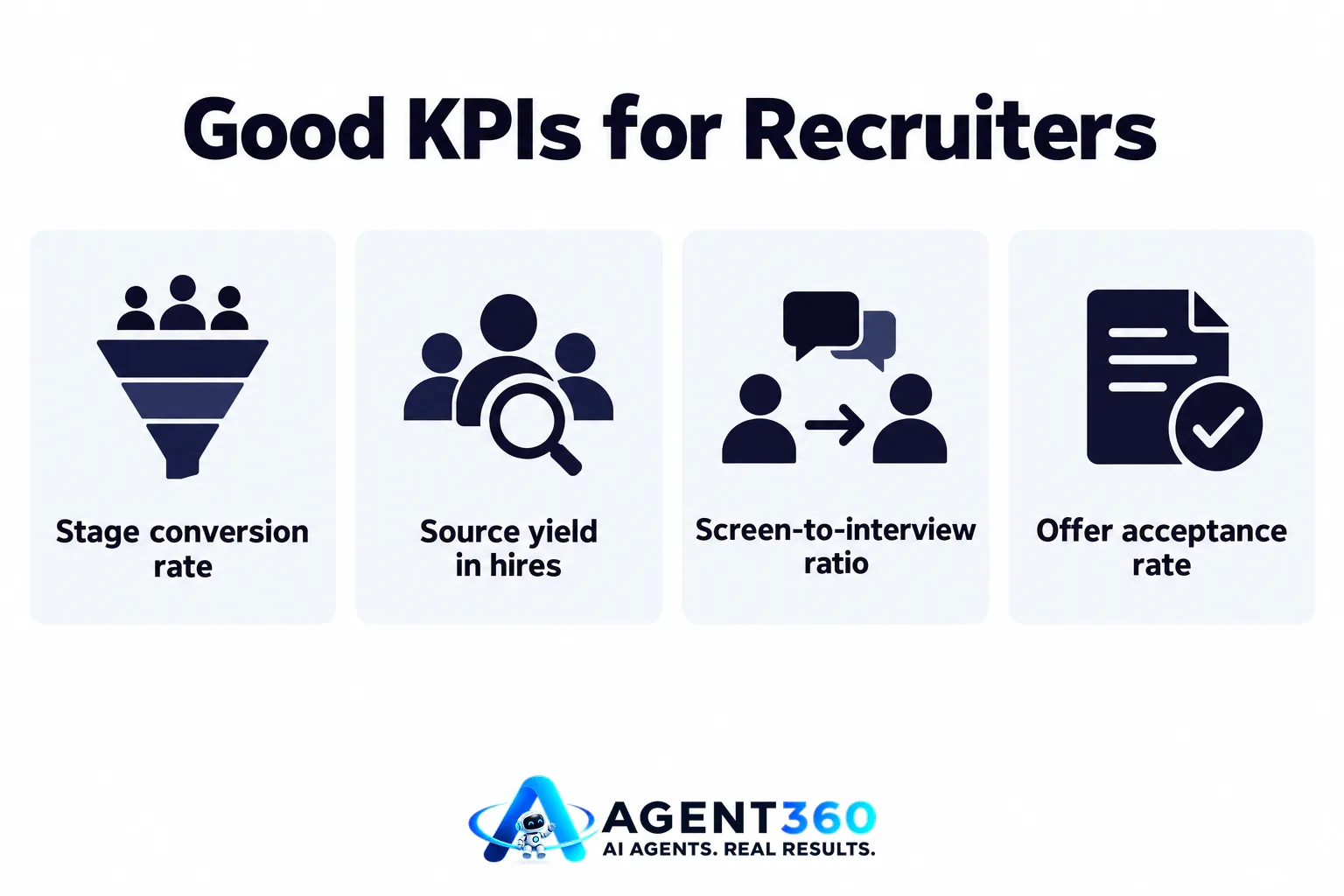
- Stage conversion rate — the percentage moving from each stage to the next, not a cumulative funnel percentage.
- Source yield — hires (not just applicants) per source, so a channel that produces volume but no offers gets cut.
- Screen-to-interview ratio — how many first-round screens turn into a second interview; a low ratio means the top of funnel is unqualified, not that interviewers are too picky.
- Offer acceptance rate — a drop here is a compensation or process problem, and it shows up weeks before anyone complains out loud.
- Time to hire by stage, as above, rather than one blended figure.
Cost per hire is worth tracking too — but only alongside these, never alone. A cheap hire that takes 70 days and quits in four months didn't actually save anything.
What is an ATS vs CRM?
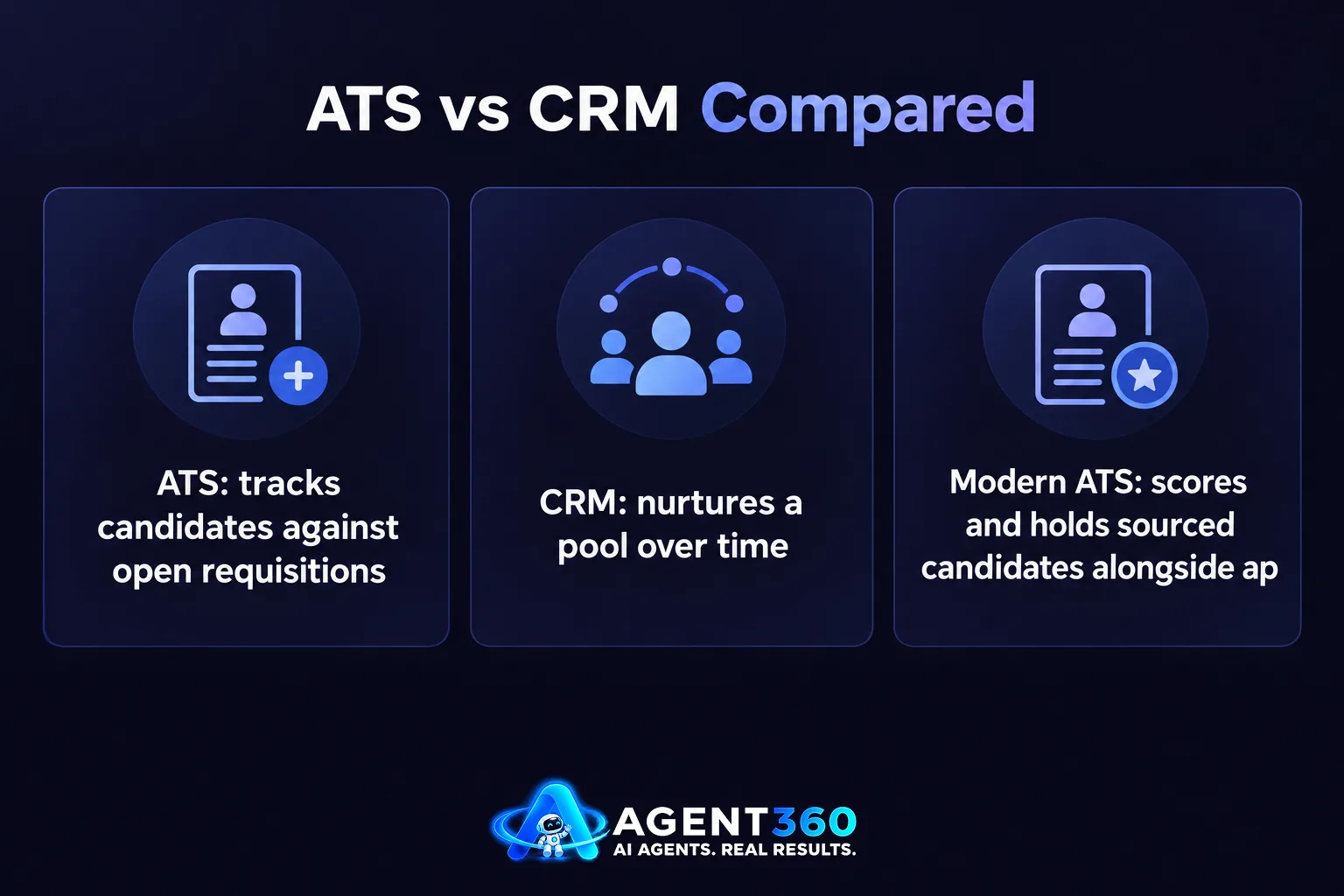
An ATS tracks candidates against open requisitions: applied, interviewed, offered, hired or rejected, tied to a specific job. A CRM, in a recruiting context, does something different — it nurtures a pool of people over time whether or not a role is open right now. Think of it as the relationship layer, the thing that keeps someone warm for six months until the right req opens. Most teams that feel like they're running two systems actually are: one tool for candidates in motion, another for everyone else. A modern ATS collapses that gap. It scores and holds sourced candidates in the same pipeline as applicants, so the report doesn't have to be stitched together from two exports. That's the core argument in what a modern ATS actually does, and in how it compares to a traditional ATS that only tracks the people who found you.
What are the 5 C's of recruitment?
The framework shows up in slightly different versions, but the common thread is Character, Competence, Compatibility (culture fit), Commitment and Career-fit (does this role actually fit where the person is headed). Worth naming, because most recruiting reports only measure the middle one — competence, usually as a skills match — and skip the rest entirely. A match score on skills and experience is a reasonable proxy for competence. It says nothing about commitment or career-fit. That's exactly why those two show up late, at the offer stage, as “declined for another offer” or “wasn't actually looking to leave.” A report that only tracks skill match will always be surprised by this.
A report is only effective if someone changes a decision because of it
Here's the honest test for any recruiting report: did a specific report, in the last 90 days, cause someone to cut a source, rewrite a job description, or push back on a hiring manager's timeline? If the answer is no, it's decoration. Activity reports — calls made, resumes reviewed, interviews scheduled — tend to get built first, because they're easy to pull and they make a team look busy. Decision reports — conversion drop-off, source yield, offer acceptance trend — take more work. They need stage-level data clean enough to trust. But they're the ones worth building. Ten built-in reports, from a monthly dashboard to stage conversion and offer acceptance, filtered by job and source, are part of how HiringAgent's reporting agent handles this without someone stitching spreadsheets together. The underlying question stays the same no matter what tool runs the numbers: does this report point at a cause, or just describe an outcome?

What are the 5 C's of recruitment?
What are good KPIs for recruiters?
What is an ATS vs CRM?
What are the 5 C's of recruitment?
Most versions name Character, Competence, Compatibility, Commitment and Career-fit. Skill-based match scores usually only cover competence — which is why strong-on-paper candidates still decline offers, or leave early, for the other four reasons.
What are good KPIs for recruiters?
Stage-by-stage conversion rate, source yield measured in hires rather than applicants, screen-to-interview ratio, offer acceptance rate, and time to hire broken out by stage rather than reported as one blended number.
What is an ATS vs CRM?
An ATS tracks candidates against a specific open role through defined hiring stages. A CRM nurtures a pool of people over time independent of any open req. A modern ATS that scores and holds sourced candidates alongside applicants means most teams don't need to run both.
More articles
- Filter Sales Candidates by Deal Size: Proxies, Then Proof
- Steps to Find Qualified Employees Online, in Order
- A Phone Screening Agent Should Ask, Not Decide
- Pick a Talent Sourcing Tool by the Bottleneck It Removes
- Job Agent Meaning: Four Things the Term Can Mean
- Staffing Agency Tools: What You Actually Need, by Job
- Prospecting Tools for Recruitment Agencies That Earn Their Fee
- Are All Tracking Systems the Same? Not Even Close
