A Phone Screening Agent Should Ask, Not Decide
A phone screening agent books a first-round call, phones the candidate at the agreed time in an AI voice, and asks role-specific questions so a recruiter doesn't burn half an hour on each person. It earns its place only if three things hold: the questions come from the actual role, the candidate chooses the time, and a person still decides who moves on. Most of the buying risk sits in that third one.
Here is how to judge one before it speaks to a single candidate on your behalf.
Decide what the call is for before you pick an agent
A first-round call does two different jobs, and an agent is good at only one of them.
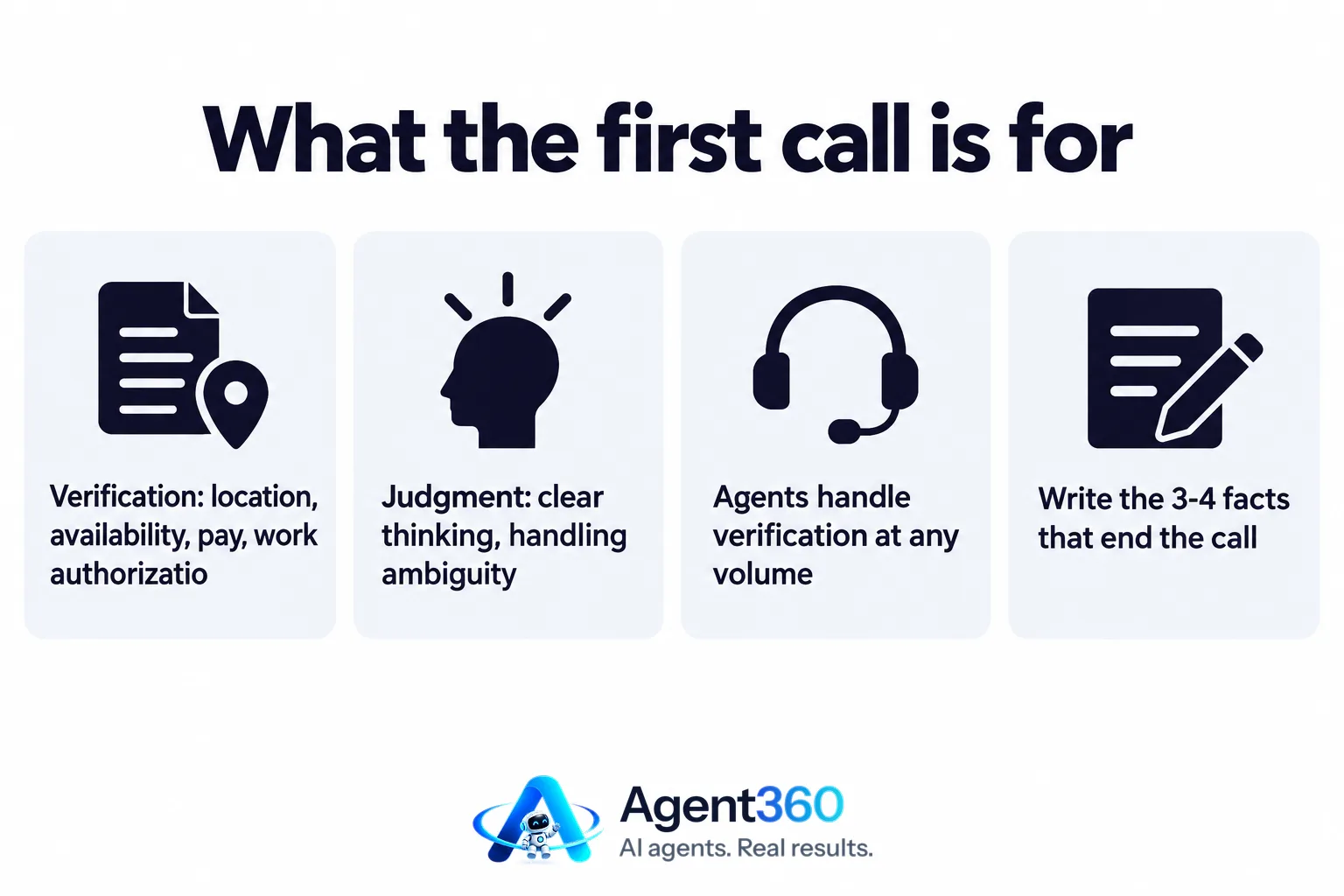
- Verification: Is the person in the right location, available on your timeline, within your pay range, authorized to work where the job is, and able to describe the specific experience their profile implies?
- Judgment: Do they think clearly, handle ambiguity, and sound like someone your team wants to work beside?
An agent can collect answers to verification questions the same way every time, at any volume, without getting tired on call forty. Judgment is where you should doubt it. A voice agent asks a scripted question, hears a rehearsed answer, and learns little about how the person reasons. If you expect the call to replace your read on a candidate, you'll be disappointed. If you expect it to clear the dead ends off your calendar, it will.
Write down the three or four facts that would end the conversation if they came back wrong. That list is your screen. Everything else belongs in a human interview.
Questions should be written from the job description, not pulled from a bank
Ask any vendor where the questions come from. A generic bank (tell me about a time you led a project) produces generic answers and tells you nothing about whether this person fits this role. The better design reads your job description and writes the questions from it: the tools you named, the seniority you asked for, the problem the hire will own.
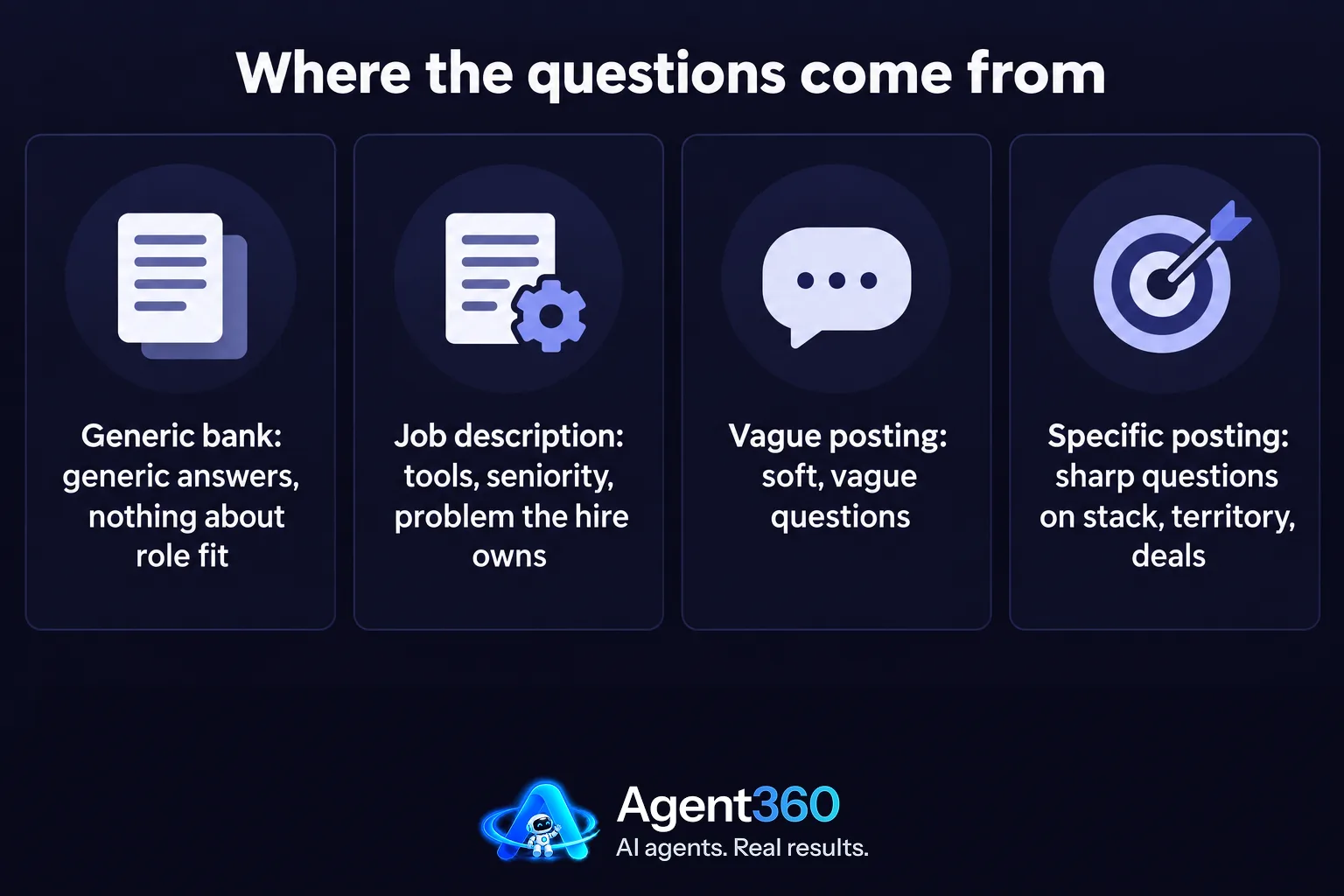
That makes the job description the real input. A vague one gets you a vague call. If the posting says fast-paced environment and strong communicator, the questions will be soft. If it names the stack, the territory, the deal size or the close process, the questions can be sharp. Fix the description first. Our post on first-round interview questions that predict fit, not charm covers what makes a question worth asking, whether a person or an agent asks it.
Let the candidate book the slot; never cold-call
Early phone screening bots had one big failure: the surprise call. Someone at work or behind the wheel picks up an unknown number and a synthetic voice starts quizzing them. They hang up, and now they dislike your company.

The fix is simple. The agent calls only at a time the candidate picked. A text with a booking link, a slot they select, a call at that time. It also filters on intent, since a person who won't spend ten seconds choosing a time was probably not going to give you a good conversation anyway.
Then check what happens when they don't book. Some systems send nothing further, so a no-booking is just silence. Plan for that. If a shortlisted candidate hasn't booked after a couple of days, a short personal note from a human will win some of them back, and it costs you one minute.
Ask what comes back after the call, and who reads it
This is where we'd push hardest, and where you may disagree. Vendors increasingly sell a score at the end of the call: pass, fail, 82 out of 100. Be wary. A number produced from a phone conversation looks more objective than it is, it's hard to audit, and it quietly becomes the filter nobody questions. The safer design has the agent gather answers and a person decide.
The counter-argument is real, though. Without a transcript or recording, you can't check what the candidate actually said, and some employers need a record for compliance or to settle disputes. So before you buy, find out exactly what you get back:
- Does the candidate's status change automatically when the call ends, so your pipeline stays accurate?
- Is there a transcript, a recording, a summary, or only a completed flag?
- If there is a score, can you see how it was made and override it?
Whichever way you go, name the human who looks at every completed screen and makes the call. Rules on automated tools in hiring differ by place and keep changing, so read what applies when you use AI in hiring, and tell candidates plainly that the first call is run by an AI.
Send it the right people, not everyone
Calls are cheap per candidate but not free, and a screen is only as useful as the list feeding it. Send an AI call to 300 unranked names and you've just moved the bottleneck from your calendar to your review queue. Rank first, by match to the role, and screen the top slice. The order that works: source, score, screen the strong matches, then interview the ones who clear the verification questions. The wider argument for that sequence is in how to screen candidates faster without lowering the bar.
Decide in advance, too, who you won't screen by phone. Senior candidates courted by several companies may read an AI call as a sign you haven't made time for them. For those, a short human call is worth the minutes.
Where HiringAgent fits
HiringAgent's Screening Agent follows the pattern above. You add candidates to the interview sequence and each gets a text with a link to book a 30-minute slot. At that time an AI voice agent calls and asks 8 to 12 questions written from your job description, the same one that drives sourcing and match scores. When the call ends, the candidate's status moves to screened in the ATS, and your team decides who goes forward. Details are on the AI phone screen page.
The limits matter, so here they are. There is no transcript, recording, summary or score from the call, and no reminder if a candidate never books. If you need a recorded record of every screen, this is the wrong tool. Plans are priced by the number of screens: 20 on Starter at $197 a month, 60 on Pro at $397 and 150 on Scale at $597. Quarterly billing takes 10% off and annual takes 20% off. Full details are on the pricing page.
Questions people ask about a phone screening agent
What is a phone screening agent?
A phone screening agent is an AI voice system that runs the first-round call with a candidate. It schedules the call, phones at the booked time, asks questions tied to the role, and records that the screen happened. A recruiter or hiring manager then decides who advances. The longer explainer is in AI phone screening, explained.
Does a phone screening agent replace a recruiter?
No. It replaces the repetitive first call, where the same factual questions go to every candidate. Judging fit, selling the role, handling objections and making the hiring decision stay with people. If an agent is making the final yes or no, you've handed off the part that carries the legal and cultural risk.
What should I check before using one?
Check five things: where the questions come from, whether the candidate picks the call time, what you receive after the call, what happens if the candidate never books, and who on your team reviews every completed screen. If a vendor can't answer all five plainly, keep looking.
Will candidates accept an AI call?
Many will, if it's disclosed up front, booked at a time they chose, and short. Resentment comes from surprise: an unannounced call, a voice pretending to be human, or silence afterward. Say it's an AI, say what happens next, and put your most-courted candidates on a human call.
More articles
- Filter Sales Candidates by Deal Size: Proxies, Then Proof
- Steps to Find Qualified Employees Online, in Order
- Pick a Talent Sourcing Tool by the Bottleneck It Removes
- Job Agent Meaning: Four Things the Term Can Mean
- Staffing Agency Tools: What You Actually Need, by Job
- Recruiting Reports That Actually Change a Hiring Decision
- Prospecting Tools for Recruitment Agencies That Earn Their Fee
- Are All Tracking Systems the Same? Not Even Close
