Prospecting Tools for Recruitment Agencies That Earn Their Fee
Prospecting tools for recruitment agencies exist to solve one problem: finding enough of the right people before a client starts asking why the shortlist is late. The tools that earn their subscription fee do three things. They shrink search time. They surface people who weren't actively looking. And they keep a usable record of everyone found, so the next search doesn't start from zero.
Most agencies already own a stack that half-does this: a job board login, a LinkedIn seat, a spreadsheet nobody trusts, and a database search that quietly rots because nobody has time to update it between placements. The fix isn't another login. It's fewer tools that each do more of the early work.
What is the 70/30 rule in hiring?
The rule recruiters cite most often is a reminder about where candidates actually sit. The large majority of professionals in any given market aren't applying anywhere. Only a minority are actively job hunting at a given moment. Depending on who's quoting it, the split lands somewhere around seventy percent passive to thirty percent active — the exact ratio moves by role and market, and no agency should treat it as a fixed number. But the direction holds everywhere. A prospecting stack built only to catch applicants is fishing in the smaller pond on purpose.
The practical consequence: a tool that only ranks inbound resumes is solving for the thirty percent. Candidate sourcing that reads a job description and goes looking in a wider pool is solving for the seventy percent — which is where the stronger candidates usually are, because they aren't competing against everyone else who saw the same posting.
What is a talent map in recruiting?
A talent map is a structured picture of where the people for a role actually sit — which companies employ them, under which titles, in which locations, at what seniority — built before a requisition opens, not after. For agencies working repeat roles (a VP of Sales search that comes up every eighteen months, a recurring Series A engineering hire), the map is reusable. You already know the five companies that train the talent you want and the three title variants they go by.
Where agencies trip up is maintaining the map by hand, in a document that goes stale the moment someone changes jobs. The map only earns its keep if it's attached to live search — titles and companies that automatically pull fresh, scored candidates each time a similar role opens, rather than a PDF from last year's search.
Which are the ATS tools?
This question usually means one of two things, and agencies need to answer both. A traditional applicant tracking system stores and moves along the people who apply — stages, notes, status changes. A newer category, sometimes called a modern ATS, does that plus the sourcing and scoring work that used to live in a separate tool entirely; see how a modern ATS differs from a traditional one for the practical split. For an agency, the second category matters more, because the client didn't hire you to track applicants — they hired you to find people who weren't applying anywhere.
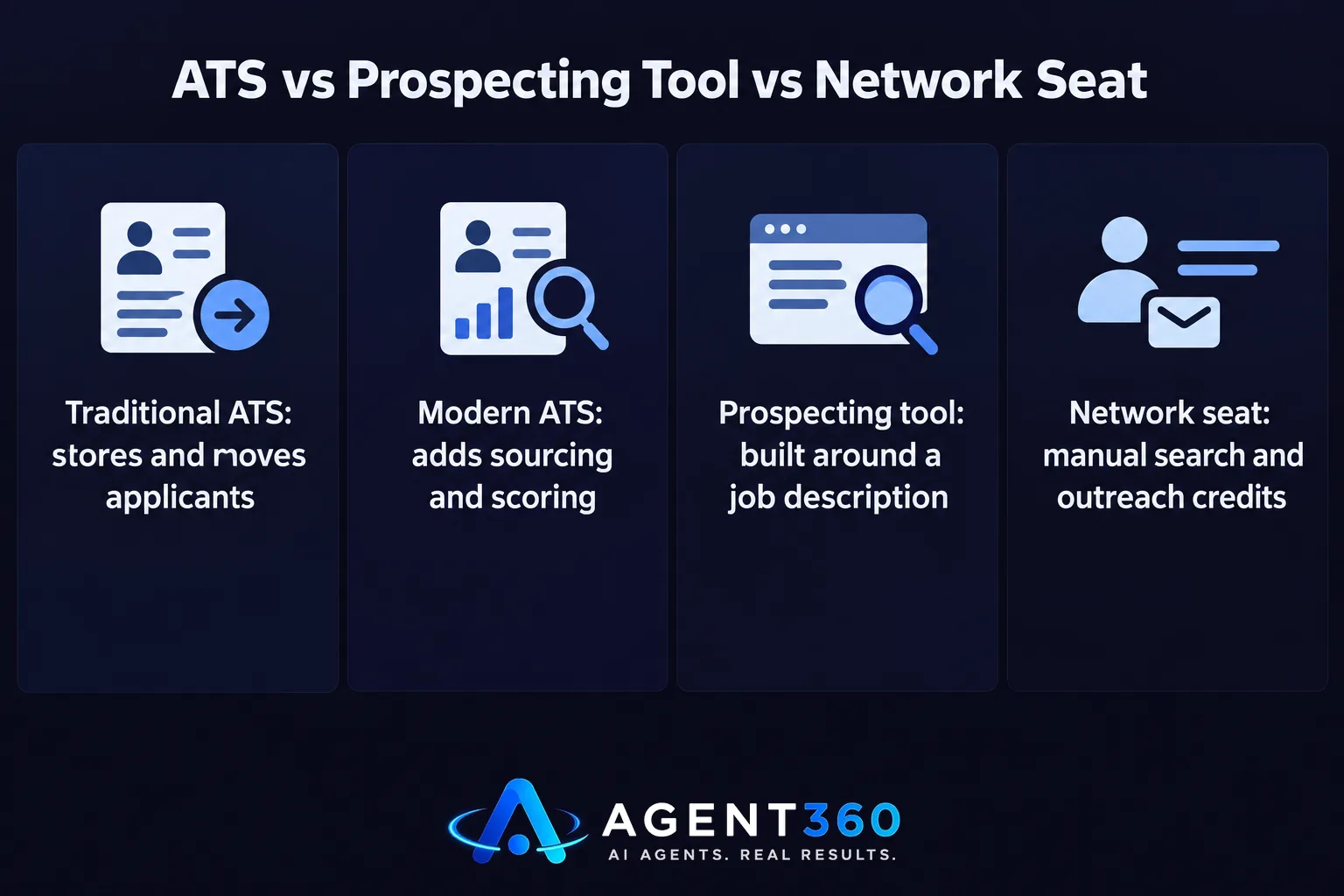
A separate comparison worth making before buying anything: a prospecting tool built around a job description does a different job than a seat on a professional network built around manual search and outreach credits. The difference between the two approaches is less about who has more profiles and more about how much of the search gets built for you versus typed by hand.
What are some effective sourcing techniques for recruiters?
A few techniques keep showing up in agencies that fill roles faster than the market average, regardless of what software sits underneath:
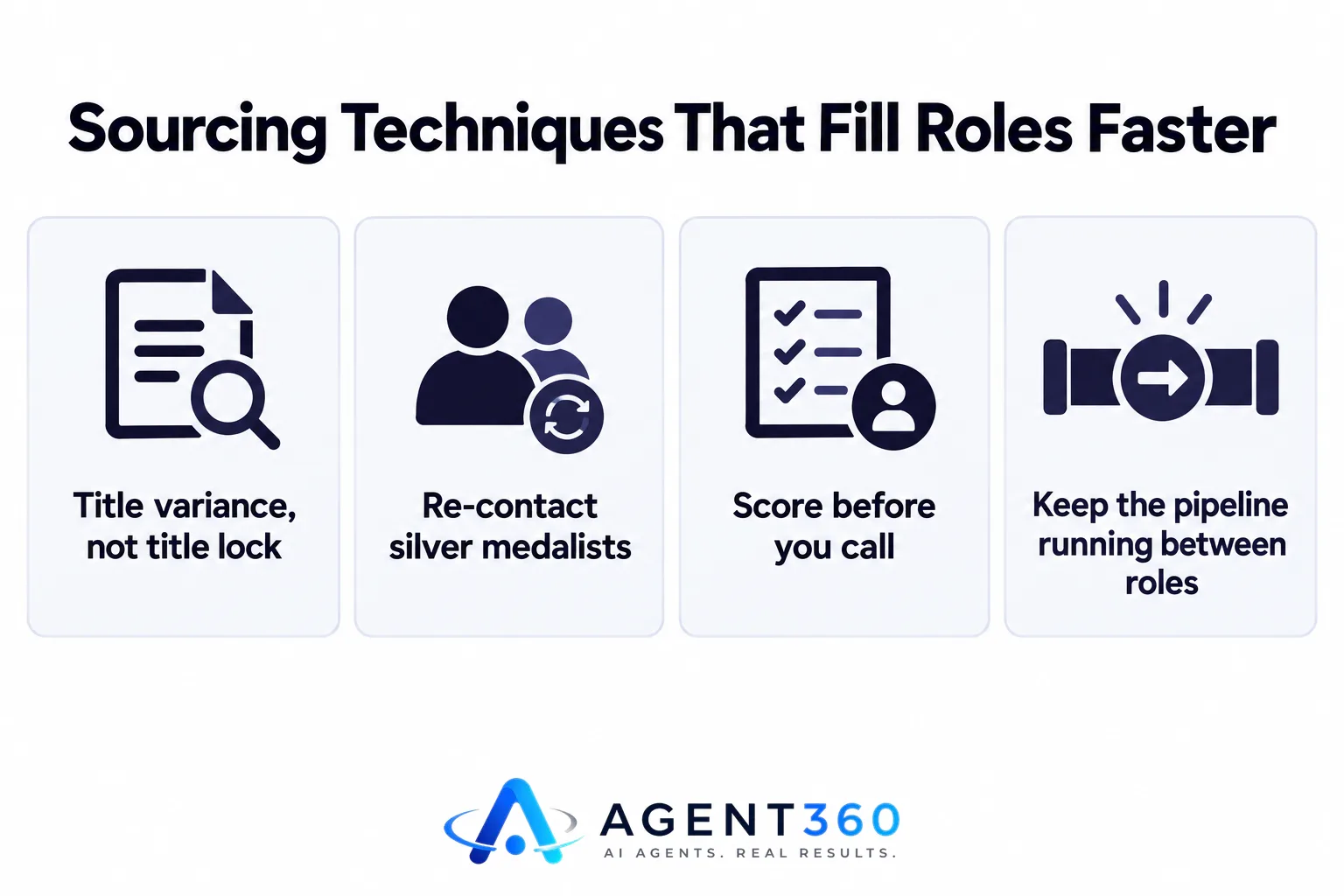
- Title variance, not title lock. A client's job title is rarely the only title the right person holds. Search the cluster — Head of Growth, VP Growth Marketing, Director of Demand Gen — rather than the single string in the req.
- Re-contact silver medalists before starting a fresh search. Anyone who made it to final round on a similar role in the last twelve months is a warmer lead than a cold profile, and most agencies never go back to that list.
- Score before you call, not after. Rank a batch of fifty candidates against the role before any outreach, and the first ten calls go to the strongest matches — not the first ten who happened to respond.
- Check for an open-to-work signal before spending outreach credits. A badge or headline change is a weak signal on its own, but combined with a strong match score it tells you who to call first.
- Keep the pipeline running between roles. A database that only gets touched when a req opens is always starting cold. One that stays warm from the last search is already a head start on the next.
The automation that actually helps is narrow, not broad
The honest answer to which automation tools help: the ones that remove a specific, repeatable task, not the ones that promise to replace judgment. Automating the search — turning a job description into filters for title, location, skill and years — removes hours of boolean-string guessing. Automating the first ranking pass removes the need to open fifty LinkedIn profiles to find the five worth a call. Automating first-round call booking removes the back-and-forth of scheduling.
None of that should automate the decision of who gets presented to a client. The tools worth paying for leave that call with a person, and most agencies that have tried handing it fully to a model have had to walk it back — not because the scoring was wrong, but because a client relationship survives on judgment a score can't carry.
Where HiringAgent fits in this stack
HiringAgent reads a job description, turns it into search filters, and sources and scores candidates from a database of public professional profiles — up to 300 in a single run, each ranked 0 to 100 with a reason attached. Checks for an open-to-work signal run on the same pass, and an AI phone screen handles first-round scheduling and questions once a candidate is worth a call. Every sourced candidate and every applicant lands in the same pipeline, which is useful for an agency running several client roles at once and needing one place to see all of them. Plans start at $197 a month with unlimited users and no contract; details are on the pricing page. For a closer look at how this changes a search built around a client's description and a recurring role, see what recruiting agencies typically use it for and how AI candidate sourcing works end to end.

Questions
What is the 70/30 rule in hiring? It's a rough, widely cited reminder that most professionals in a given market aren't actively applying anywhere at a given time — commonly put around seventy percent passive to thirty percent active, though the exact split varies by role and market. It argues against building a prospecting stack that only catches applicants.
What is a talent map in recruiting? A structured picture of where candidates for a role sit — target companies, title variants, seniority, location — built before a requisition opens so a recurring search doesn't start from a blank page each time.
Which ATS tools should a recruiting agency actually compare? Compare on whether the system only stores applicants or also sources and scores candidates before they apply. A traditional ATS does the first; a modern ATS does both — and that's the difference that matters for agencies running outbound searches, not inbound ones.
More articles
- Filter Sales Candidates by Deal Size: Proxies, Then Proof
- Steps to Find Qualified Employees Online, in Order
- A Phone Screening Agent Should Ask, Not Decide
- Pick a Talent Sourcing Tool by the Bottleneck It Removes
- Job Agent Meaning: Four Things the Term Can Mean
- Staffing Agency Tools: What You Actually Need, by Job
- Recruiting Reports That Actually Change a Hiring Decision
- Are All Tracking Systems the Same? Not Even Close
