Recruiting Funnel Metrics That Predict a Bad Hire
Most recruiting funnel metrics people report are vanity counts: applicants received, candidates sourced, interviews booked. None of that tells you much. What matters is conversion between stages — what share of sourced candidates get a screen, what share of screens turn into an interview, what share of offers get signed. Volume says the funnel is full. Conversion says where it leaks.
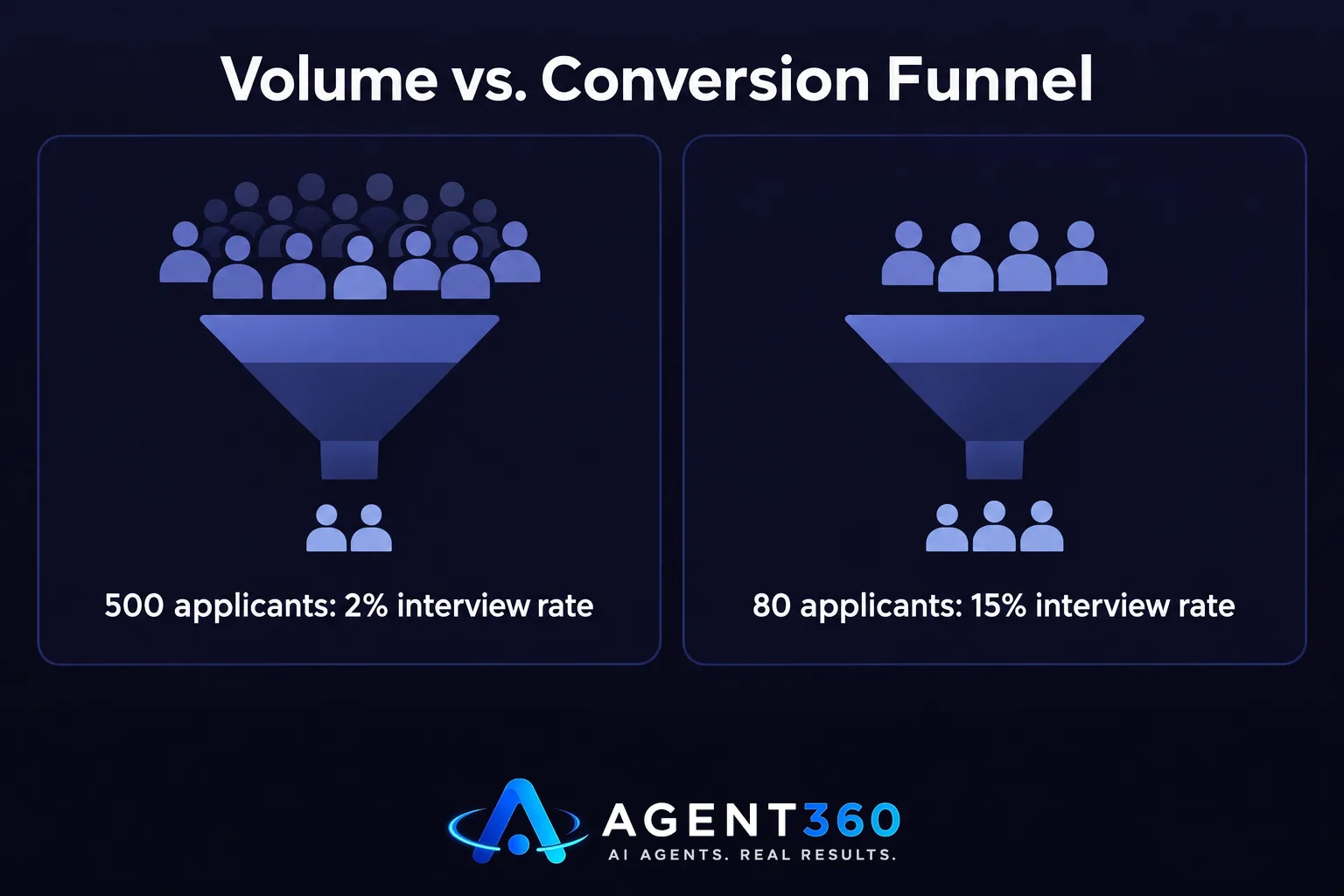
Here's the one thing worth remembering: 500 applicants at a 2% interview rate is not a healthier funnel than 80 applicants at 15%. The second funnel is finding the right people faster. The first one is a sourcing or screening problem dressed up as a big number.
What are KPI metrics in recruiting?
The short list that covers most of what matters:
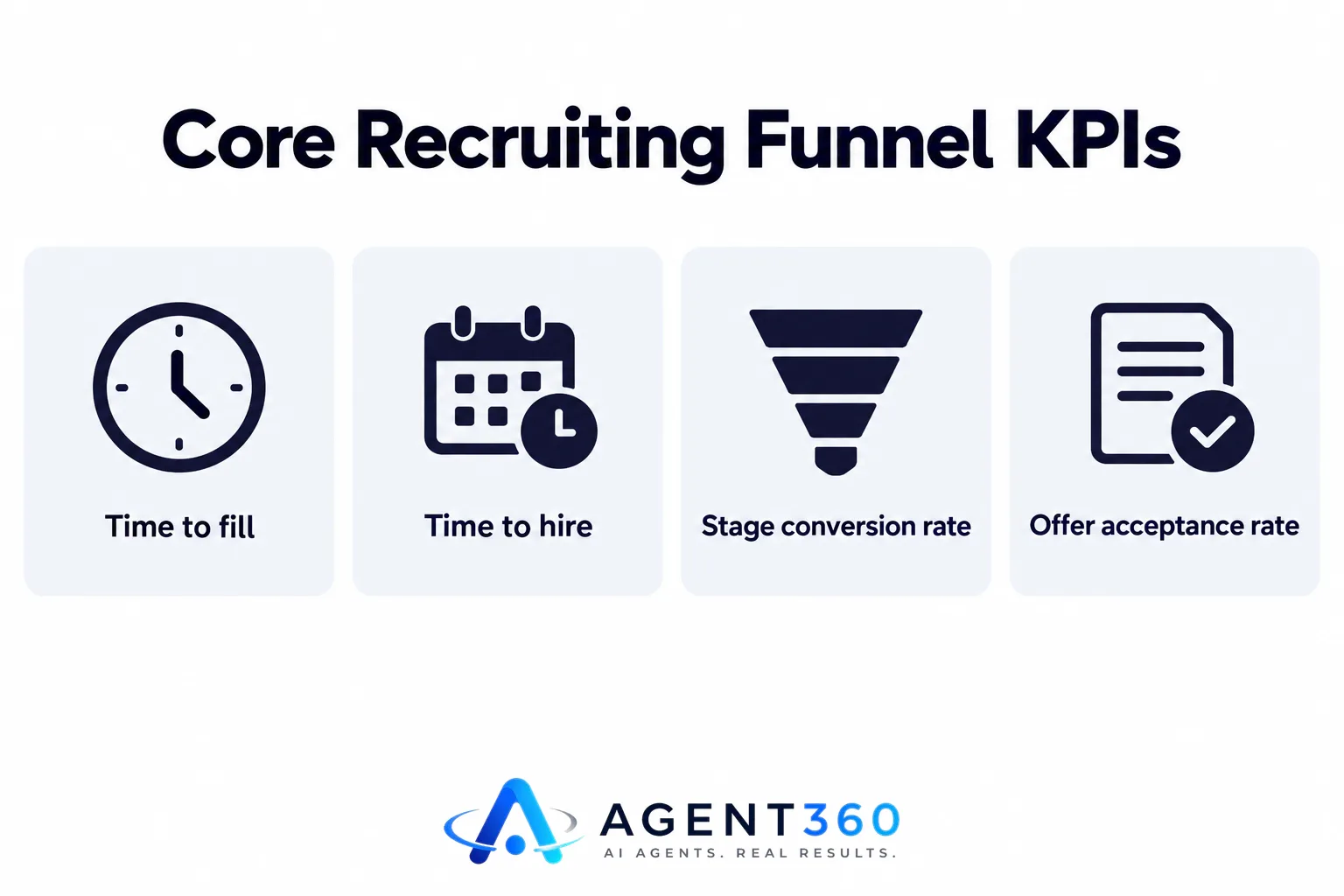
- Time to fill — days from job opening to offer accepted.
- Time to hire — days from a candidate entering the pipeline to their offer accepted. These two get confused constantly; the difference between them matters more than either number alone.
- Stage conversion rate — the percentage who move from sourced to screened, screened to interviewed, interviewed to offered, offered to accepted. Report these as a chain, not as isolated figures.
- Source of hire — which channel (sourced, inbound application, referral, agency) produced the hire, not just the applicant.
- Offer acceptance rate — a drop here usually means compensation misalignment or a slow process, not a weak offer letter.
- Cost per hire — useful for budget conversations, nearly useless for diagnosing a slow or low-quality funnel on its own.
Pick five, not fifteen. A twenty-metric dashboard gets glanced at once a quarter, at best. A five-metric one gets checked weekly — and weekly is the only cadence that actually changes behavior.
What is the 80/20 rule in recruiting?
In a recruiting funnel, it shows up two ways. First: a handful of your sourcing channels or job boards produce most of your qualified candidates, and the rest produce noise — worth knowing before you keep paying for all of them equally. Second, and more useful day to day, a handful of your open roles eat most of a recruiter's time, usually the ones with vague requirements or a comp band nobody signed off on realistically. One req open for 60 days while four others filled in three weeks? Stop re-sourcing it. Go fix the job description or the budget instead.
Treat it as direction, not formula — nobody has a clean dataset proving it's exactly 80/20 for your team. Use it as permission to stop spreading effort evenly across every open role and put it where the data says it's actually paying off.
What are red flags for recruiters?
A few patterns in the funnel itself are worth flagging before they turn into a quarter of bad numbers:
- A big gap between sourced-to-screened and screened-to-interviewed — candidates are passing a resume check but failing a real conversation, which usually means the job description oversells the role or undersells the bar.
- Time-in-stage climbing for one stage specifically, like candidates sitting at “awaiting interview” for two weeks — that's a scheduling bottleneck, not a candidate-quality problem, and it's an easy one to fix.
- Offer acceptance below roughly 80% — one decline is noise, three in a row from the same role is a signal about comp, timeline, or how the role was pitched.
- A hiring manager who can't name why a specific candidate scored low — if “I don't love it” is the only feedback after three rounds, the role's requirements were never actually written down anywhere everyone agreed on.
If you're interviewing for a talent acquisition role yourself and get asked which metrics you'd report to leadership, there's no single correct answer the interviewer is fishing for. But naming stage conversion, time to fill, and one quality signal — offer acceptance or hiring manager satisfaction — shows you treat the funnel as a pipeline with leaks, not a pile of applicants to count.
What are the 5 C's of recruitment?
Different lists use different words, but most land on five ideas worth building a process around: Candidate experience (how the process feels from their side, start to finish), Communication (how fast and how clearly you respond at each stage), Competency (whether the role's requirements are actually defined and testable), Cost (what the hire costs in time and money relative to the role's value), and Culture fit (whether the match runs both directions, not just skills on a résumé). None of the five shows up as a number on a dashboard. But each one eventually shows up as a symptom in your funnel metrics — poor candidate experience, for instance, surfaces as drop-off between screen and interview long before anyone names it directly.
Where this falls apart for most teams
The reason funnel metrics go unreported at most small and mid-size teams isn't that nobody cares. It's that pulling stage conversion and time-in-stage by hand, out of a spreadsheet or a bare-bones tracker, takes long enough that it only gets done once — after the fact, when there's nothing left to fix. HiringAgent keeps sourced candidates and applicants in a single pipeline and generates stage conversion, time to hire and offer acceptance as built-in reports filtered by job or date range, so the numbers are there to check mid-quarter, not just to explain away after a bad one. Plans start at $197 a month on the pricing page, with no setup fee and no contract.

What is the most important recruiting funnel metric to track first?
Stage conversion rate — specifically the drop between sourced or applied and screened. It's the earliest point in the funnel where a problem shows up, and fixing it upstream, with a clearer job description or tighter sourcing filters, saves wasted effort at every stage that follows.
How often should recruiting funnel metrics be reviewed?
Weekly, for active open roles. Monthly, for the aggregate view across every role. Weekly catches a stuck req before it's sat open for two months; monthly is what shows leadership the trend.
More articles
- The Time to Hire Metric: What It Measures, What It Hides
- How to Reduce Time to Hire Without Lowering the Bar
- How to Screen Candidates Faster Without Lowering the Bar
- A Boolean Search Alternative for Recruiters Who Are Done With Strings
- What Passive Candidate Sourcing Actually Takes
- How to Find Candidates Who Are Open to Work
- Resume Parsing Software: What It Gets Right (and Wrong)
- AI Resume Screening Scores Resumes, Not Hires
