Hiring With AI: What It Can and Can't Decide
Most vendors oversell what “hiring with AI” means. In practice it’s narrower: software that writes job descriptions, searches for candidates, scores resumes against a role, and runs first-round calls. It does not mean software that decides who gets hired. Most companies already use AI somewhere in the process, even if it’s just an applicant tracking system quietly ranking resumes by keyword match. The real question isn’t whether to use it. It’s which tasks to hand off, and which to keep.
That split matters more than the tools themselves. Get it wrong one way and you burn hours on work a model finishes in minutes. Get it wrong the other way and a score stands in for a judgment call it was never built to make.
AI is good at four hiring tasks, not the decision itself
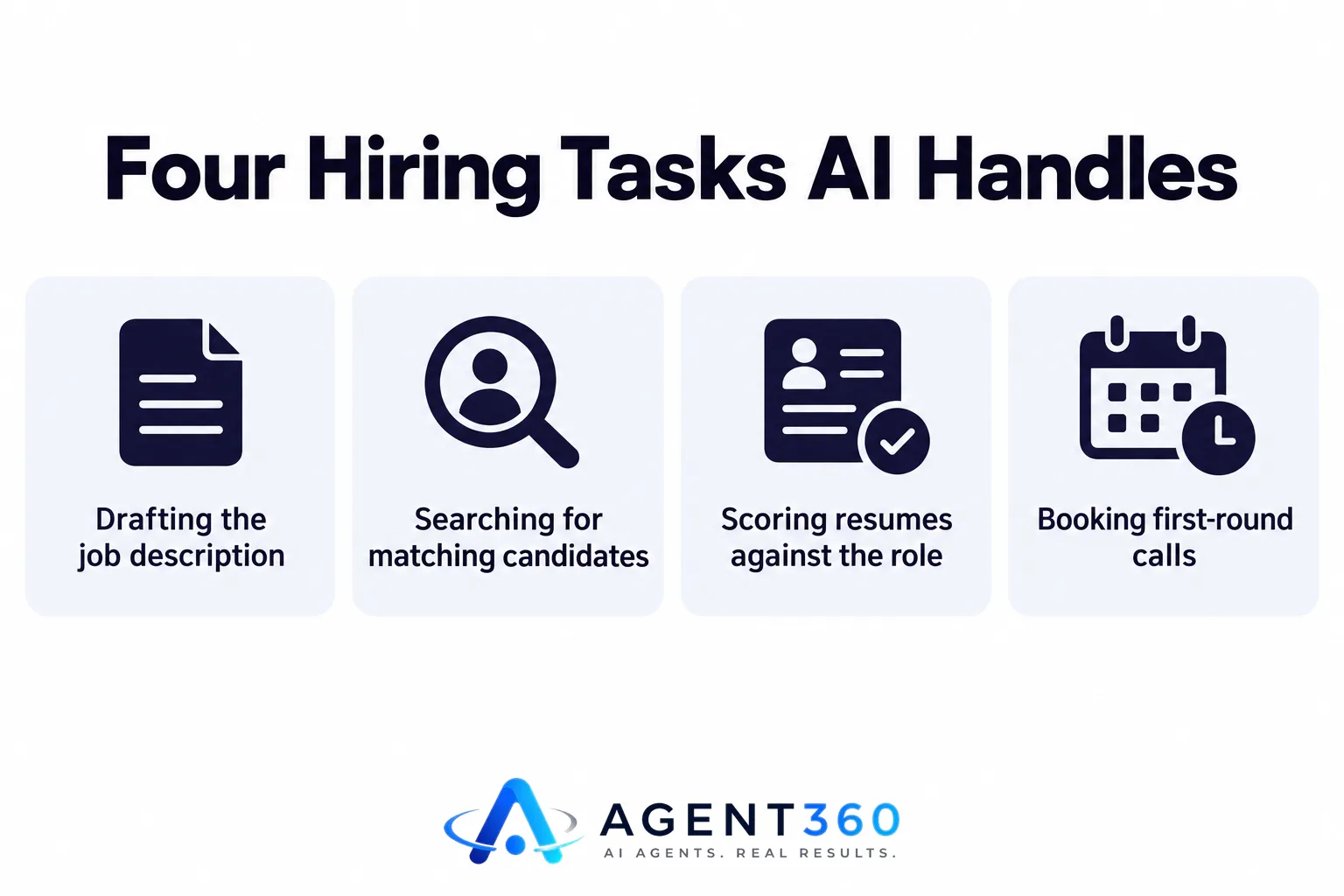
Four parts of hiring are mechanical enough to automate well: drafting the job description, turning that description into a search across public profiles, scoring resumes and applicants against the role, and booking first-round calls. Each has a clear input — the job description — a repeatable process, and an output a person can check fast. A recruiter can glance at a 0–100 score and a one-line reason and know in seconds whether to trust it.
What AI should not do is decide who gets an offer. It can’t sit in a room and read whether someone will hold up on a hard customer call, or whether an answer to a behavioral question was rehearsed. Even a well-built AI phone screen is built to gather first answers, not grade them — a person still listens and decides who moves forward. If your process lets a model’s score auto-reject candidates with no human review, you’ve handed off a decision the tool was never built to make.
What is the 30% rule for AI?
There is no codified “30% rule” for AI in hiring. Not in federal law, not in a major state statute, not in any standard people cite consistently. If you’ve seen the phrase, it’s usually a loose paraphrase of a broader idea: don’t let an automated score make up the majority of a hiring decision without human review. Sound practice. Not a legal threshold. Treat it like one and you’ll end up with false confidence instead of real protection.
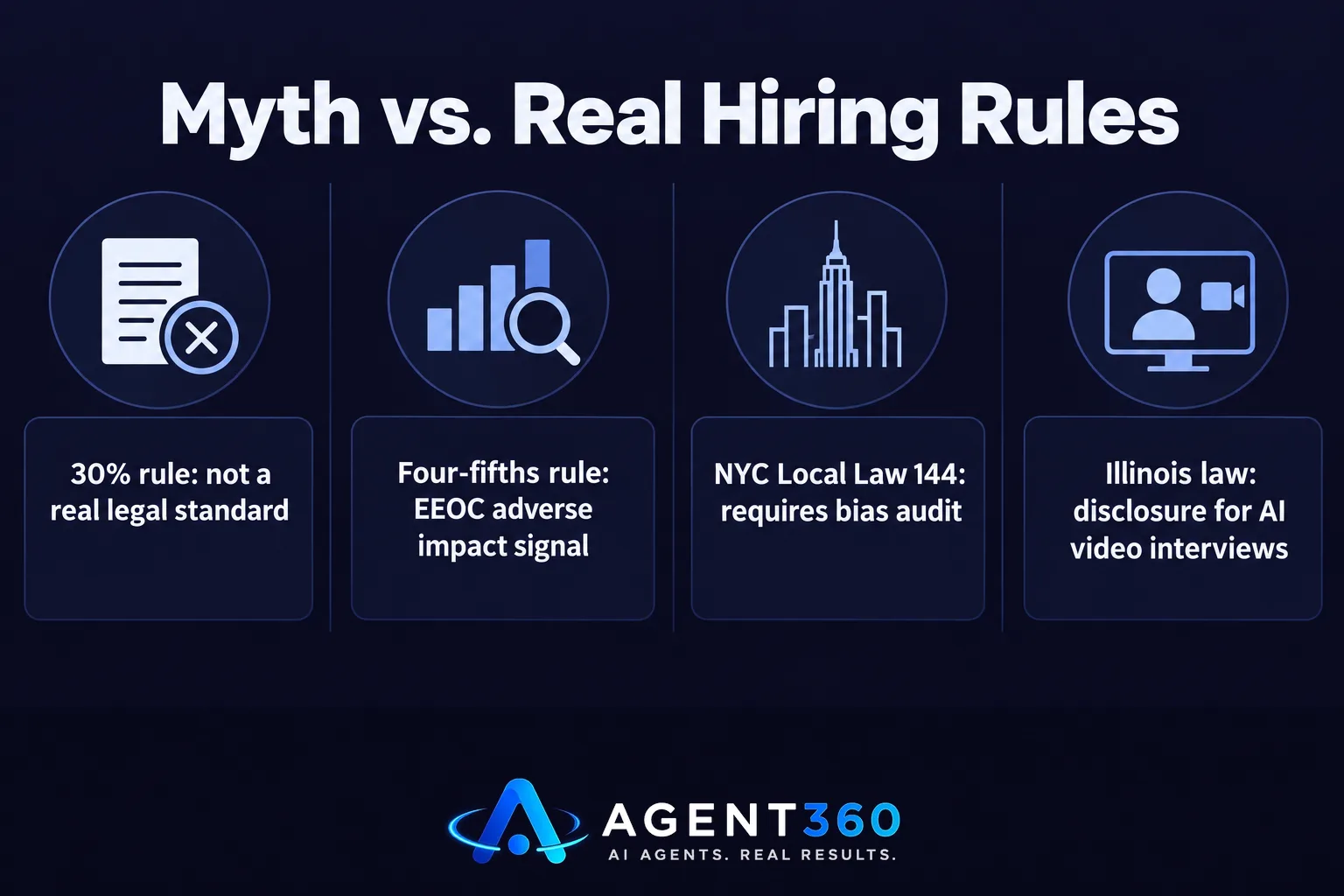
The number that actually exists, and has existed for decades, is the “four-fifths rule” the EEOC uses to flag adverse impact: if the selection rate for any protected group falls below 80% of the rate for the group with the highest selection rate, that’s a signal worth investigating — not a hard pass/fail test. Separately, New York City’s Local Law 144 requires employers using an “automated employment decision tool” to run an independent bias audit and publish a summary before using it to screen candidates. Illinois has its own disclosure requirement specifically for AI-driven video interview analysis. None of these set a 30% figure. What they share is the same instinct: measure whether the tool treats groups differently, and keep a person accountable for the outcome. That’s the actual guardrail worth building into your process — see our guide to splitting hiring work between AI and people for where the line should sit, task by task.
Is Hirevue AI-based?
Yes, a meaningful part of it. HireVue is a video-interview and assessment vendor that has used AI models to score candidate responses. For several years it also ran facial-analysis models on video interviews — a practice that drew public criticism and legal scrutiny over bias and transparency, and that the company eventually dropped in favor of scoring based on what candidates say rather than how they look on camera. It still uses AI-driven scoring on structured interview answers today. The lesson for anyone evaluating hiring tools isn’t “avoid AI vendors.” It’s to ask exactly what the model is scoring, whether that scoring has been audited for bias, and whether a person reviews the result before it touches a candidate’s status.

What percentage of companies use AI to filter resumes?
There isn’t a single trustworthy number here, and any post that hands you one without a source is guessing. Surveys on this swing wildly depending on how they define “AI” — some count basic keyword matching that applicant tracking systems have done for twenty years, others count only newer models that generate a fit score or summary. What’s true directionally: keyword-based resume filtering has been standard in high-volume hiring for a long time, and newer AI scoring — the kind that ranks a resume against a full job description rather than just matching terms — is spreading fastest among larger employers and anyone hiring for roles that draw hundreds of applicants. If a vendor quotes you a precise percentage of “companies using AI,” ask which survey and which definition they’re using before you repeat it.
Where this fits if you’re choosing tools
If you’re building this split into a real process rather than a policy document, the practical version is simple: let AI handle the sourcing, the scoring and the scheduling, and keep every decision that ends in a yes or no with a person. HiringAgent is built around that line — its Sourcing Agent turns a job description into search filters and pulls candidates from a database of public profiles, its Match Agent scores each one from 0 to 100 with sub-scores and a one-line reason, and its AI phone screen books and runs the first call without ever producing a score or a recommendation — a person decides who moves on. Plans start at $197 a month with unlimited users; see pricing for what each tier includes.
Questions
Can AI help with my job? If your job involves hiring, yes — for the mechanical parts. It can draft a job description, search for matching candidates, score resumes and applicants against the role, and handle first-round scheduling. It should not be trusted to make the final call on who gets hired; that judgment still belongs to a person.
Is Hirevue AI-based? Yes. HireVue has used AI to score candidate video and audio responses, previously including facial-analysis models it later discontinued after criticism, and it continues to use AI-driven scoring on structured interview content today.
What percentage of companies use AI to filter resumes? There is no single reliable figure, because surveys define “AI filtering” differently — some count basic keyword matching, others only newer scoring models. Adoption is growing fastest in high-volume hiring, but check the source and the definition before you trust any percentage someone quotes you.
More articles
- First-Round Interview Questions That Predict Fit, Not Charm
- How to Write a Job Description That Attracts Candidates
- What a Job Description Generator Should Actually Write
- How to Hire Your First Employee Without Guessing
- Hiring Without a Recruiter: What It Actually Takes
- Recruitment Agency Software Is Usually Three Tools, Not One
- Recruiting Software for Agencies: What to Buy
- Recruiting Funnel Metrics That Predict a Bad Hire
