A Boolean Search Alternative for Recruiters Who Are Done With Strings

A Boolean string is a syntax, not a strategy — a way to query a search box, not a way to find people. The real alternative isn't a cleverer string. It's skipping the string-building step entirely and letting something else turn a job description straight into a search. That's a different workflow, not a sharper version of the old one, and it's worth seeing exactly where strings break before replacing them.
Here's the failure mode nobody puts in the training deck: you write a tight string for “Senior Backend Engineer,” test it, get forty decent results, then realize the best candidate at the target company has the title “Staff Software Engineer, Platform” and never shows up. You didn't write a bad string. You wrote a string for a title that doesn't exist everywhere the same way.
Boolean strings decay the day you write them
A string is a snapshot — how you think people describe themselves right now, for this one role, nothing more. Titles drift. “Account Executive” becomes “AE,” “Enterprise AE,” “Named Account Executive,” “Growth AE,” depending on the company's stage. Skills drift too: a React string from 2021 won't catch “Next.js” or “React Native” unless you remembered to add them yourself. Every OR group you didn't think of is a candidate you never see — and you only find out about the gap when someone forwards you a resume that should have matched and didn't.
Nested parentheses compound the problem. Past four or five levels of AND/OR/NOT logic, most recruiters can no longer predict what a string will actually return without running it — and most platforms silently cap how many terms or how much nesting they'll parse before truncating the query. You don't get an error. You get fewer results and no explanation.
How do recruiters search for candidates
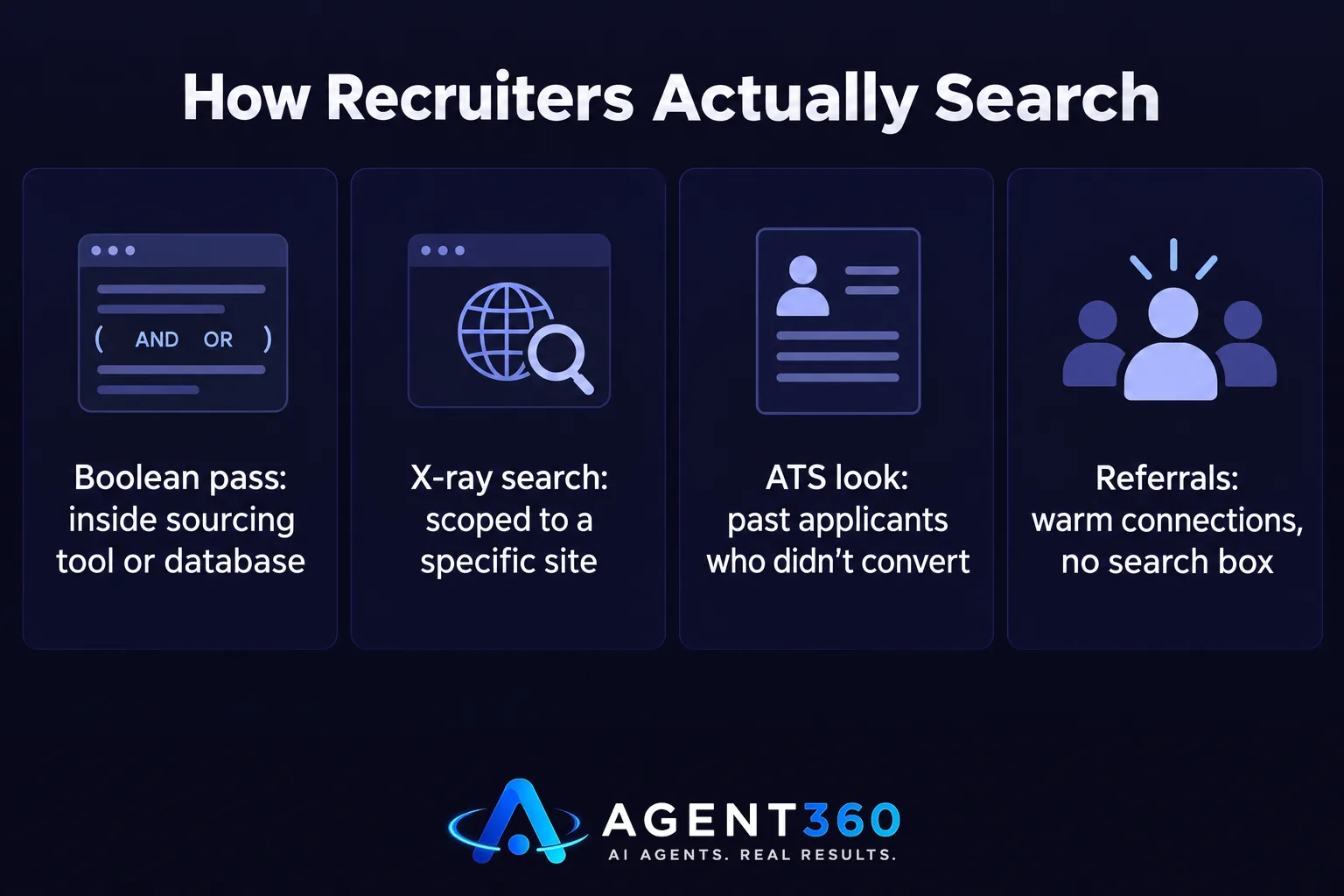
In practice, most recruiters aren't relying on one Boolean string — they're stacking several lighter techniques and treating Boolean as one tool among them, not the whole method. A typical search mixes a loose Boolean pass inside a sourcing tool or applicant database, an X-ray search through a general search engine scoped to a specific site, a look at who's already in the ATS from a past role that didn't convert, and outreach through referrals and warm connections that never touch a search box at all. Boolean finds strangers who match on paper. Referrals and past applicants find people who are already somewhat known. Neither replaces the other, which is why relying on strings alone usually produces a shortlist that's wide but shallow.
The other thing recruiters do, and this part rarely makes it into the training deck, is search on multiple titles at once and let a human — or a score — sort the results, instead of trying to write one perfect string that returns only qualified people. That's effectively what a title-heavy function like engineering requires: the string can't be precise enough to filter for fit, so something downstream has to do that filtering instead.
How to make a good Boolean search
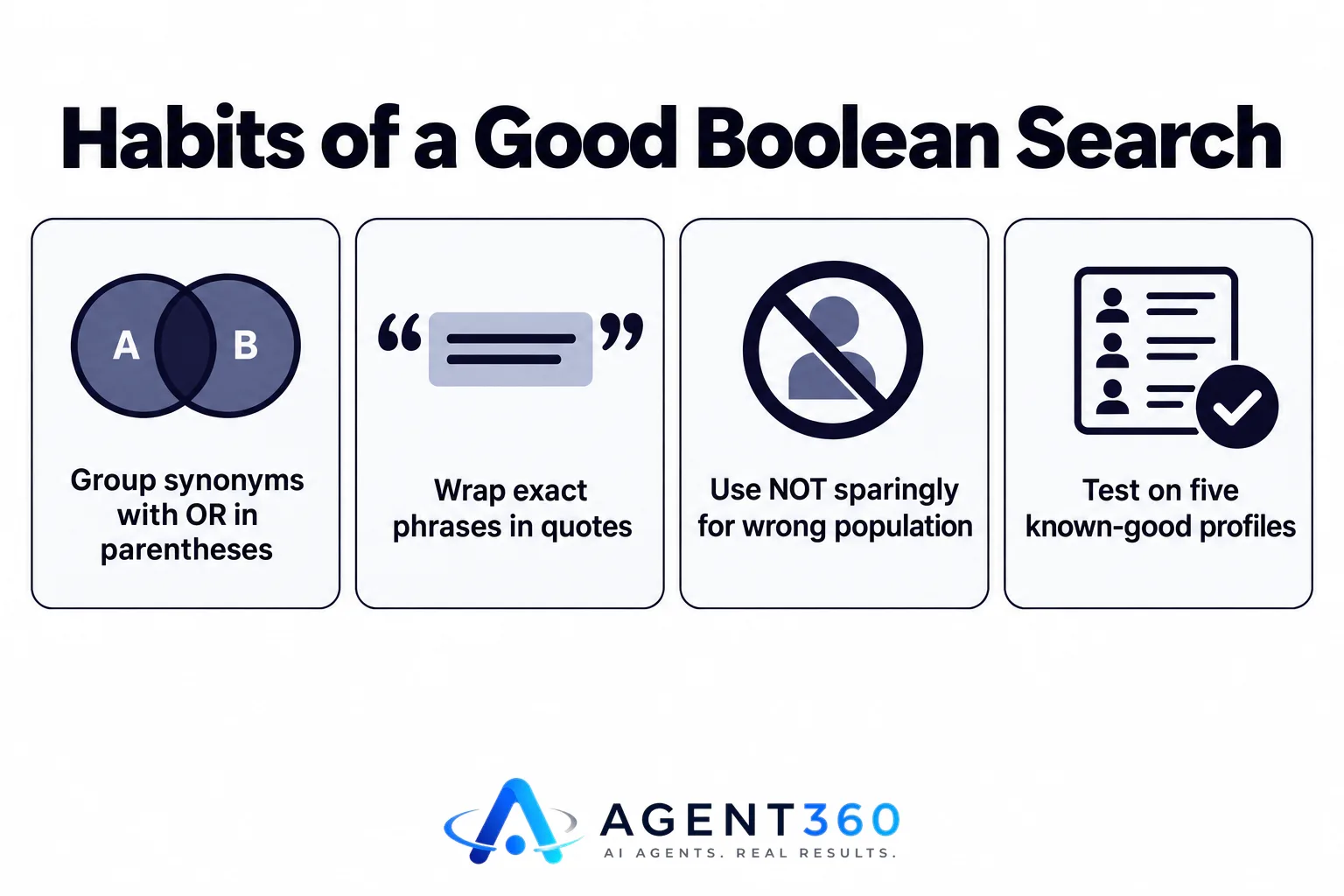
If you're building a string by hand, a few habits separate a usable one from a frustrating one. Group every synonym for the same concept in one set of parentheses joined by OR — titles, skill names, tool names — so you're not relying on memory to catch every variant. Wrap exact phrases in quotes so the engine doesn't split “project manager” into two words it matches independently. Use NOT sparingly, and only for terms that reliably indicate the wrong population — excluding “intern” or “assistant” from a senior search, say — because NOT also quietly removes anyone whose profile happens to mention that word in an unrelated context. And test on a small, known-good sample before trusting the string on a live search: run it against five profiles you already know should match. If any of them don't show up, the string is wrong, not the pool.
The limit isn't skill, it's scale. A recruiter can write a good string. A recruiter cannot write and retune a good string for twelve open roles a week, every time a title shifts or a role picks up a new must-have skill.
Can I do a Boolean search on Indeed?
Partially, and with caveats most people don't learn until mid-search. Indeed's resume database search supports Boolean operators for employers with paid access to search resumes directly, but the general job-search box that candidates use was built for keyword matching, not nested logic, and doesn't reliably honor complex AND/OR/NOT combinations the way a dedicated resume database or LinkedIn Recruiter does. If you're searching for candidates rather than jobs, you're almost always in the resume-search product, not the public job board — and the syntax that works in one doesn't carry over cleanly to the other.
Where this leaves the search box
The honest alternative to writing Boolean strings isn't a different syntax. It's not writing the search yourself at all. AI candidate sourcing takes the job description you already have and generates the filters — titles, skills, seniority, years, location — the way a sourcer would, then scores each result against the role instead of leaving you to guess from a title alone. HiringAgent's Sourcing Agent does this directly from a pasted job description, up to 300 candidates per run, each one scored 0–100 rather than dumped back as an undifferentiated list — which solves the problem Boolean never could: the string tells you who matched the words, not who's actually a fit. Compared with a search-and-InMail tool like LinkedIn Recruiter, the difference isn't the database. It's that you stop maintaining the query.

Questions
Is Boolean search still worth learning if there are AI alternatives?
Yes, for anyone doing manual outreach, X-ray searches, or working inside a tool that doesn't build filters for you. It's a foundational skill, not an obsolete one — it's just no longer the only way to get from a job description to a candidate list.
Why does the same Boolean string return different results on different days?
Most platforms index new profiles continuously, and some apply relevance ranking rather than exhaustive matching, so the same query can surface a different slice of the same underlying pool depending on when you run it and how the platform currently weights recency or activity.
What should I do instead of debugging a broken string?
Rebuild the search from the job description instead of patching the string term by term: list every title variant, every must-have skill, and the acceptable seniority range as plain requirements first, then translate that list into filters or a query — not into edits on a string you no longer trust.
More articles
- What Passive Candidate Sourcing Actually Takes
- How to Find Candidates Who Are Open to Work
- Resume Parsing Software: What It Gets Right (and Wrong)
- AI Resume Screening Scores Resumes, Not Hires
- Automated Phone Screening Interviews: What They Replace
- AI Phone Screening for Recruiters: What the Call Should Do
- What an ATS With AI Candidate Matching Should Actually Do
- The Best ATS for Startups Finds Candidates Too
