How to Find Candidates Who Are Open to Work
Filter on the open-to-work signal — LinkedIn's green “#OpenToWork” frame, the headline phrase, or a connected recruiter view that shows the same intent privately — and you'll find candidates fast. Then stop. That filter is not your whole search, it's one corner of it. Open-to-work candidates are real and worth prioritizing. They're also a minority of anyone qualified for your role. Build your search around the badge alone and you'll only ever see the people who were already looking.
Here is what the signal actually is, what it isn't, and where the rest of the market is hiding.
Is open to work a red flag?
No. Treating it as one costs you candidates for no good reason. The badge means someone decided to be visible about a job search. That's it. People turn it on after a layoff, after a company sells, after a manager leaves, after a parental leave ends — or just because they're curious what's out there. None of that tells you a thing about their skill level or how they'd perform in your role.
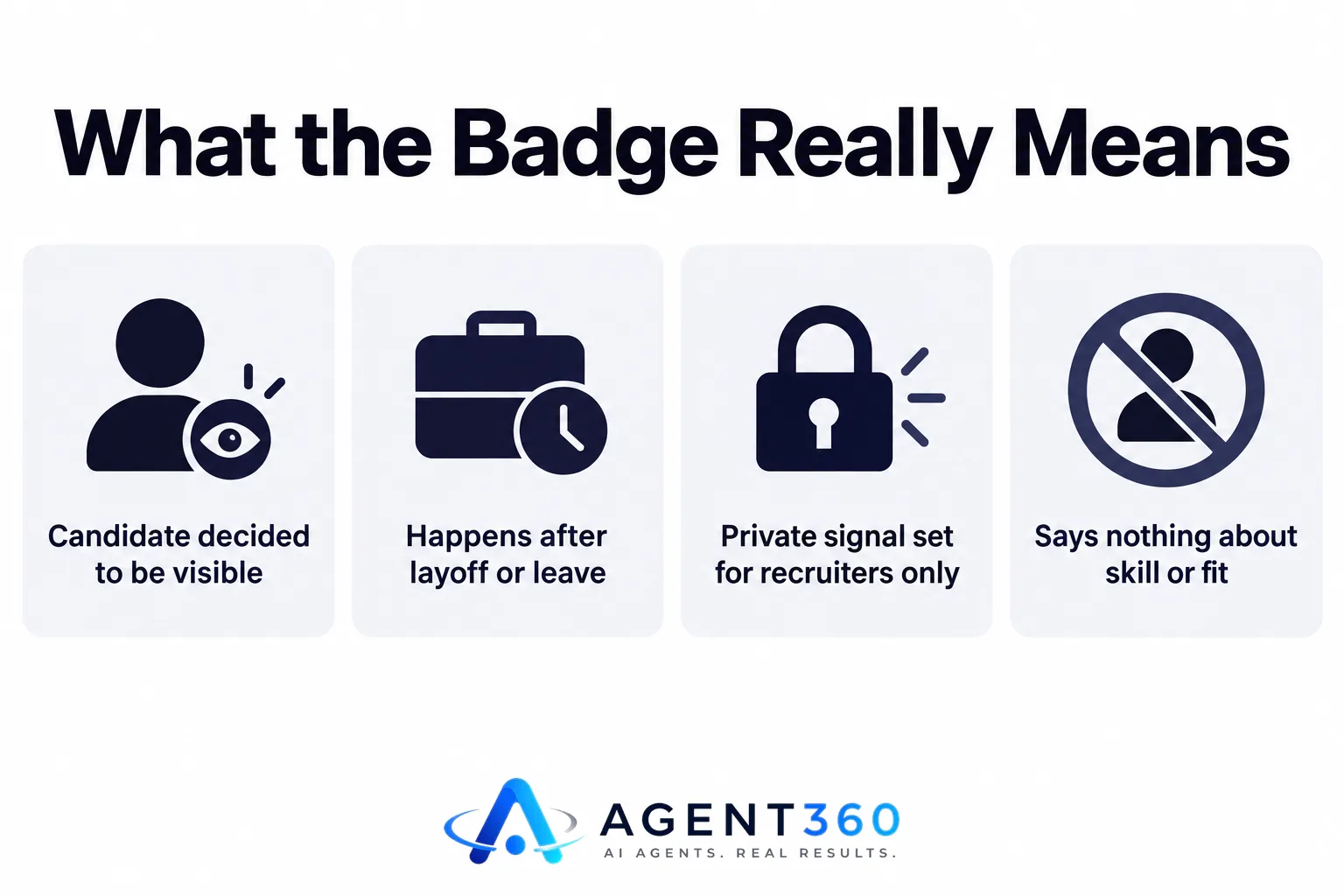
The signal worth reading more closely is the private version. Some candidates set open-to-work visibility so only accounts with recruiting tools can see it, rather than flashing it to their own network — often because they're employed and don't want their manager to notice. That group tends to be further along and more serious than the public badge wearers, who skew toward people between jobs who want everyone to know. If your tooling distinguishes the two, weight the private signal higher.
What is the 70/30 rule in hiring?
It's a rough, widely repeated heuristic, not a measured statistic you can cite with confidence. The rule of thumb holds that roughly a third of the workforce is actively job hunting at any given time, while the remaining two-thirds would consider a move if the right opportunity reached them — but they're not out there applying. Nobody publishes a hard number behind this, and it shifts by role, industry and the economy. Still, the shape of it holds up against anyone who's actually run a search: the open-to-work badge only exposes the smaller group.
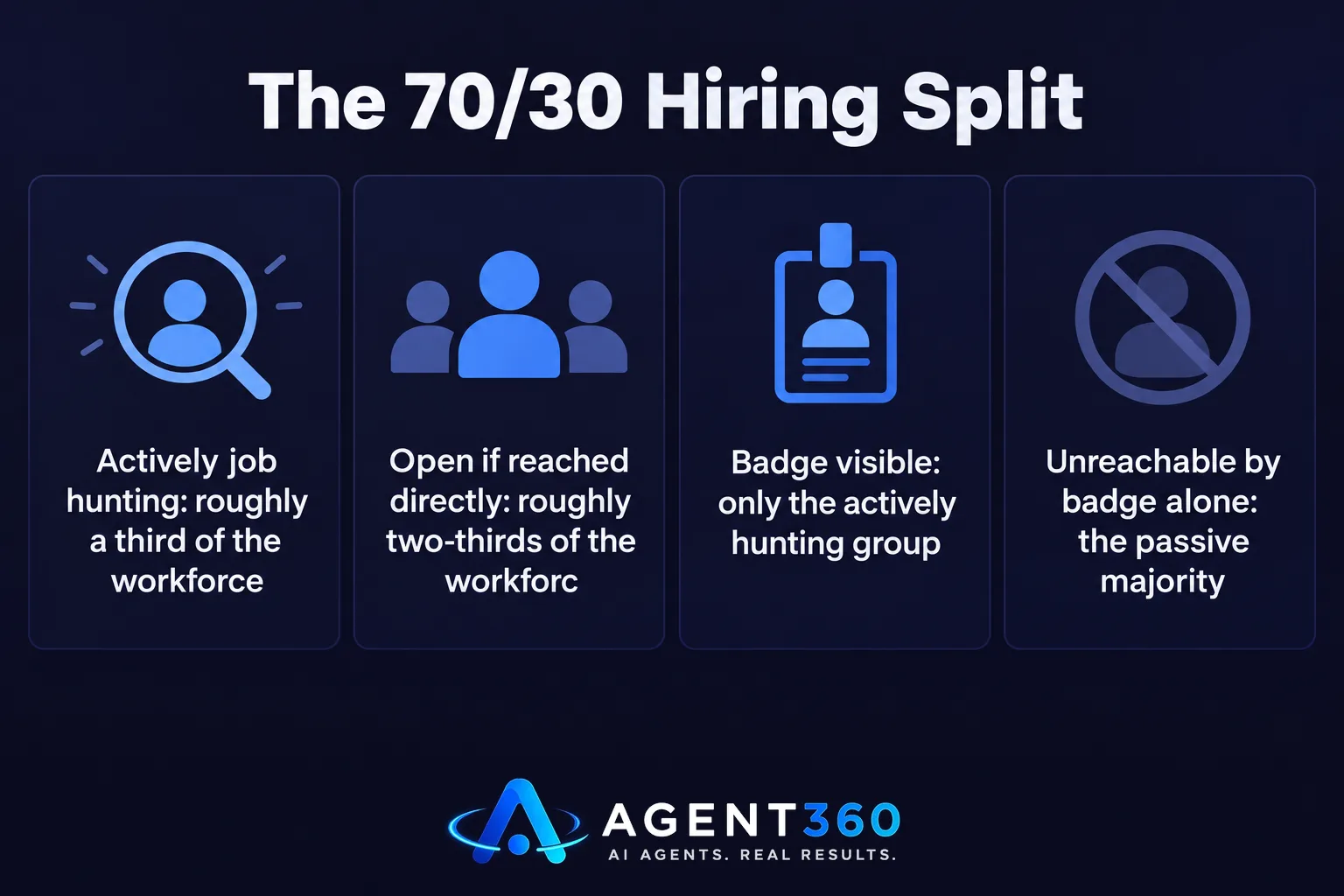
The practical consequence is blunt. A search strategy built entirely around badges and job-board applicants caps itself at a fraction of your real candidate pool. The strongest person for a senior or specialized role is statistically more likely to be the one not wearing the badge — employed, not browsing, unreachable by anything that waits for candidates to raise their hand.
How to find passive candidates
Passive candidates don't announce themselves. So you go find the proxies for intent instead of the intent statement itself:

- Tenure patterns. Someone who's held three roles of 14 to 20 months each is a different conversation than someone eight years into one job. Neither is wrong, but the first group is statistically more reachable.
- Title and seniority drift. People who've outgrown their title — doing the work of a role one level up without the promotion — respond to outreach at a noticeably higher rate than people recently promoted.
- Company-stage signals. A hiring freeze, a leadership departure, an acquisition, or a down round at someone's current employer are all better predictors of openness than any badge.
- A direct outreach channel that doesn't require a badge. A short, specific message referencing their actual background outperforms a templated one by a wide margin, badge or no badge.
None of this replaces direct search the way filters built from your own sales or engineering job description do — titles, years in seat, skills, location. But it should run alongside that search, not instead of it. A tool built around turning a job description into search filters can surface both groups in the same pass, since the filters that find an active candidate are mostly the same ones that find a passive one with the right background.
How to show recruiters you're open to work
If you're reading this to interpret a candidate's own signal, the mechanics are worth knowing. Candidates have two visibility choices: a public frame on their profile photo that any visitor can see, or a private setting visible only to accounts using recruiting tools. Trust the private one more. It means someone made a deliberate choice to be findable without broadcasting it to their current employer — a stronger tell of real intent than a public badge switched on the week after a layoff. Neither setting tells you anything about fit, though. That still has to come from the job description against the resume, not the badge.
Don't let the badge do your sourcing for you
The badge is a useful filter, not a search strategy. HiringAgent's Open-to-Work Agent checks every candidate it sources for the signal — through a connected LinkedIn account and headline language — and badges the ones who are looking, so you can filter down to them or ignore the filter entirely and see everyone the search turned up. The same job description also drives the sourcing search itself, so you're not running two separate processes for active and passive candidates. One search covers both, and the open-to-work flag is just one more thing you know about each person it finds. Plans start at $197 a month on the pricing page, with no separate tool needed for the badge check.
Open to work visibility, answered plainly
What does the open-to-work badge actually show? It shows that a candidate flagged job-search intent to either the public or to recruiting-tool users, depending on which privacy setting they chose. It says nothing about skill, seniority fit, or how recently they made the choice.
Should I filter out candidates without the badge? No. Filtering to badge-only candidates removes the majority of people qualified for most roles — including the ones most likely to be strong: employed, not actively applying, but open if reached directly.
Is the private open-to-work setting more reliable than the public one? Generally, yes. It requires a candidate to deliberately signal intent to recruiting tools without alerting their own network, which tends to correlate with more serious, further-along job seekers than a public badge worn casually. A badge tells you someone's willing to be found. It never tells you whether they're the right person once you find them.
More articles
- Resume Parsing Software: What It Gets Right (and Wrong)
- AI Resume Screening Scores Resumes, Not Hires
- Automated Phone Screening Interviews: What They Replace
- AI Phone Screening for Recruiters: What the Call Should Do
- What an ATS With AI Candidate Matching Should Actually Do
- The Best ATS for Startups Finds Candidates Too
- What a Modern Applicant Tracking System Actually Does
- What an Applicant Tracking System for Small Business Costs
