How to Write a Job Description That Attracts Candidates

Name the real title. Say what the person will own in the first six months. Make it obvious who shouldn't bother applying. Do those three things in the first two sentences and you've written the hard part of a job description that actually attracts candidates. Everything after — the requirements list, the pay line, the benefits paragraph — either backs up that promise or quietly breaks it. Most postings break it by line four, the moment a generic mission statement shows up where the actual job should be.
Strong candidates skim. They decide to keep reading or close the tab in about ten seconds, well before they ever reach your requirements list. If the opening reads like last month's posting with the title swapped out, you lose exactly the candidates worth attracting — the ones with other options.
Cut the requirements list to five things that actually block a hire
Every line past the fifth requirement does two things. It narrows your pool. And it narrows it toward people comfortable claiming things they haven't actually done. Meanwhile the candidates most likely to be a genuinely strong fit are often the ones who read a ten-item wish list and quietly decide they're not qualified enough to bother.
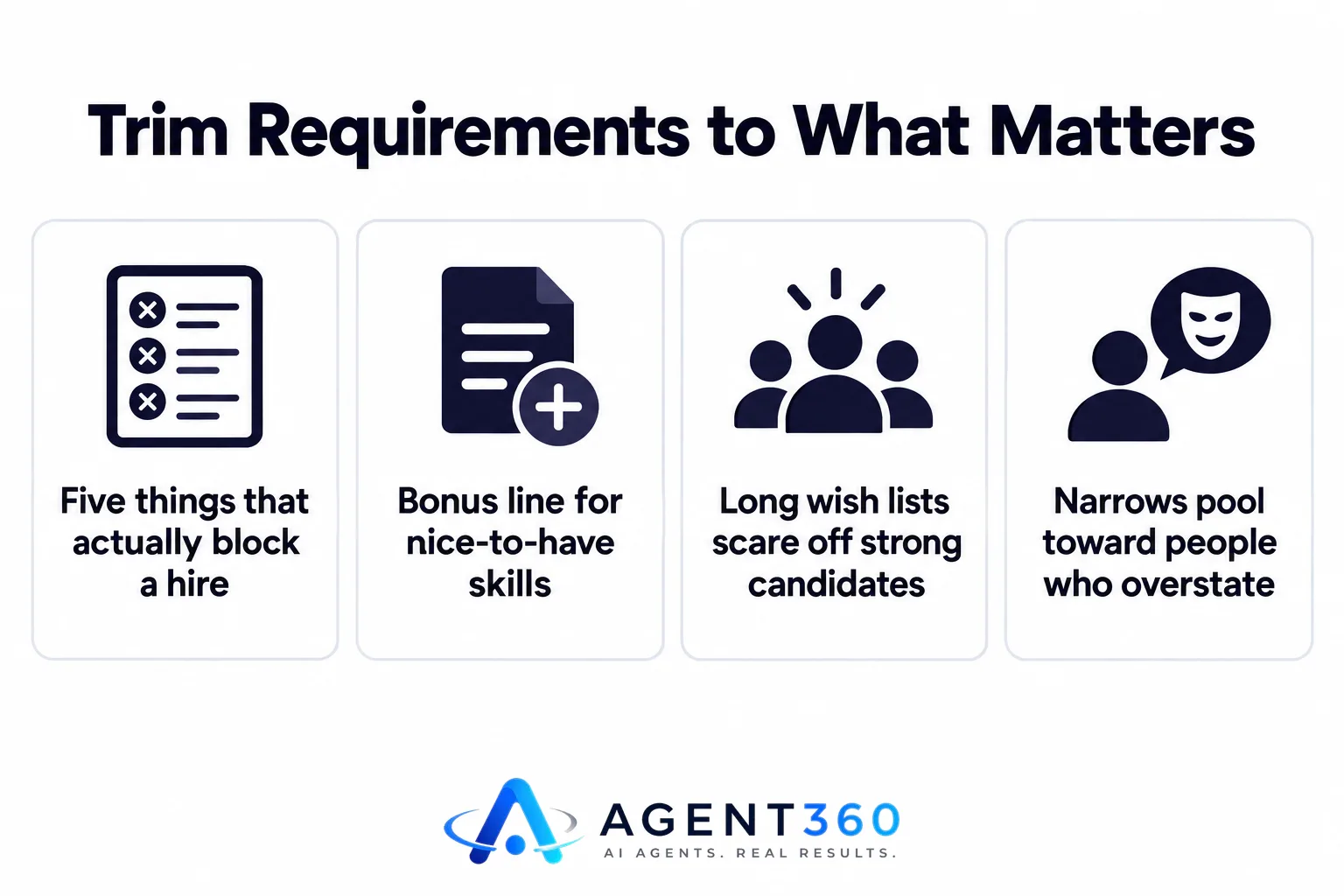
So make two lists before you write a word. List one: the handful of things that would truly stop someone from doing the job — a certification the law requires, a tool the team lives in daily, a language the role runs in. List two: things that would be nice, that a good hire could pick up in a month. List one goes in the posting as requirements. List two gets folded into a single line near the bottom: “bonus if you've also done X.” That one change widens your pool more than any amount of polishing the mission paragraph ever will.
This holds whether you're writing for a sales role with a quota attached or an engineering role with a stack attached. The discipline doesn't change: five real requirements, everything else is a bonus line.
How to write a great job description?
Order matters more than wording. A description that attracts candidates runs in this sequence: title that matches how people actually search for the role, not an internal nickname; two sentences on what the person owns; the five requirements that actually block a hire; the pay range; what the first 90 days look like; and a closing line on where this role can go in two years. Benefits and company history go last, if they go in at all — nobody deciding whether to apply needs your founding story before they've seen the salary band.
Write the “what you'll own” section in verbs, not nouns. “Owns the onboarding funnel from signup to activation” tells a candidate more in eight words than a paragraph of “responsible for cross-functional collaboration” ever will. And keep the whole thing under 400 words. Past that, you're writing for your legal team or your own comfort, not for the person deciding in ten seconds whether to keep reading.
How do you create a job posting on LinkedIn?
Posting is a different job from writing. LinkedIn's form asks for a title, location, employment type and description — paste in what you wrote for your own site, but trim the opening to the two sentences the platform shows before someone taps “see more,” since that's the only part most people read before scrolling on. Pick the closest standard title LinkedIn offers even if your internal title is something else. The platform's search and recommendation engine matches on that standard title, and an odd internal one can mean the posting never surfaces to the right people at all.
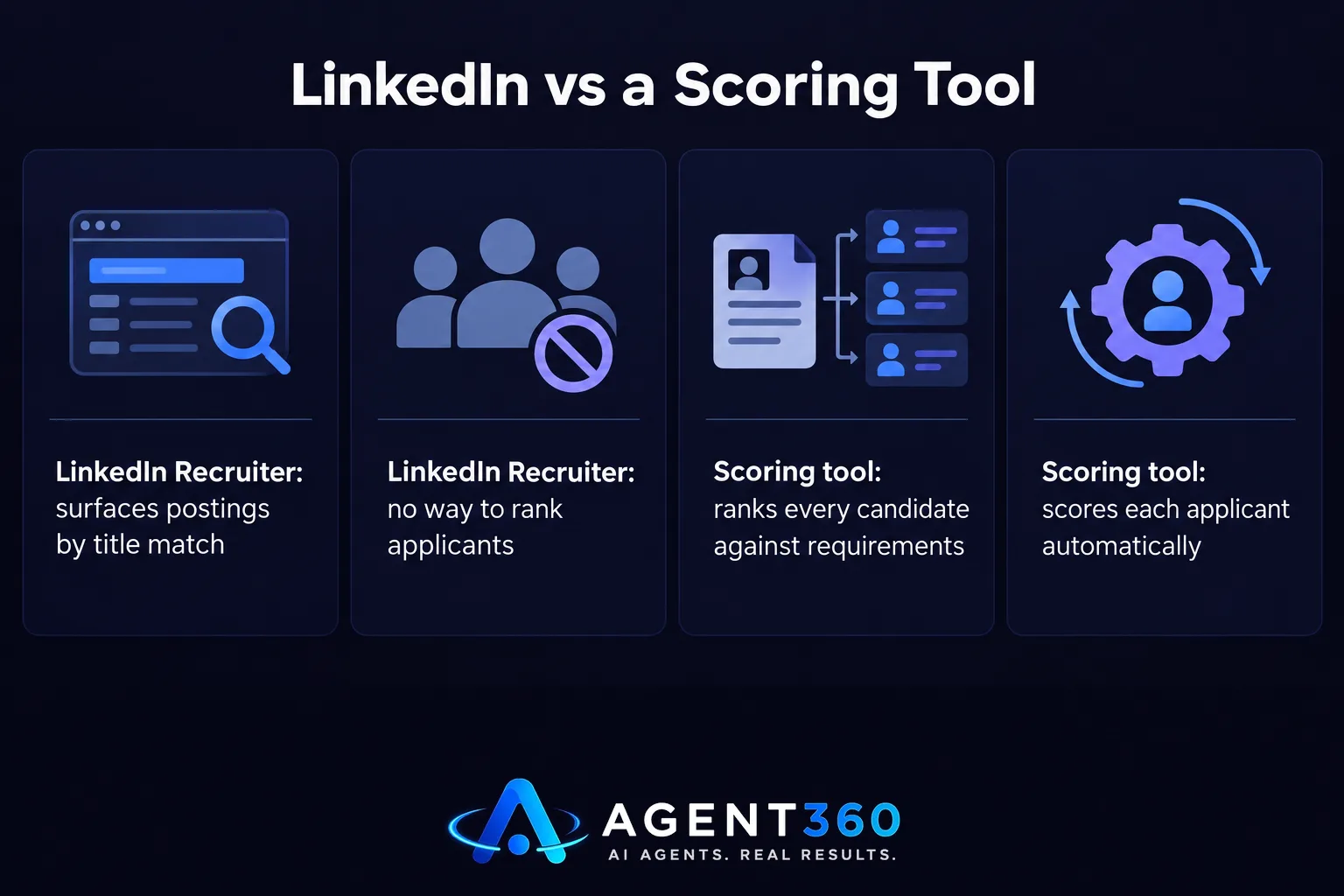
Where LinkedIn posting runs out of road is reach beyond its own network and anything resembling scoring. It'll show your posting to people who search for it; it won't tell you which of the fifty applicants who show up actually match the five requirements you wrote. Worth knowing before you're three weeks in with eighty applicants and no way to rank them — see the fuller comparison of LinkedIn Recruiter against a tool built to score every candidate against your description.
Can ChatGPT write a job description?
It can write the shape in about ten seconds — the sections, the tone, a plausible-sounding list of requirements. What it can't do is know which five requirements actually block a hire at your company, what your pay band is, or what the first 90 days genuinely look like. Ask it to write a job description from a title alone and you'll get a posting that reads like every other posting for that title. Which is the problem: candidates who've read a hundred of these recognize the pattern and skim right past it, the same way they skim a template email.

The fix isn't to avoid AI here. It's to feed it the specifics it can't invent — the actual stack, the actual quota, the actual manager — and let it draft around those, the way a job description generator should work. HiringAgent writes the description from a title and your notes with its Job Writer Agent, but the more useful detail is what happens next: that same description also drives the search filters that source candidates and the score every applicant gets against the role. A vague description doesn't just read poorly — it produces a weaker search and a sloppier score downstream. Writing the description well is step one of a pipeline, not a task you finish and forget.
What's the biggest mistake people make writing a job description?
Treating the requirements list as a wish list instead of a filter. A posting with twelve requirements doesn't attract twelve-requirement candidates. It attracts people comfortable overstating themselves, and scares off the ones who read it literally and conclude they fall short. Five real requirements plus one “bonus if” line consistently pulls a wider, stronger pool than a longer list ever does.
Should I include a salary range?
Yes — a specific range, not “competitive.” Candidates deciding whether a role is worth their time will often skip a posting with no number rather than apply and find out later the range doesn't work. You lose those candidates silently, with no way to measure what you lost.
How long should a job description be?
Under 400 words, with the role and requirements covered in the first half. Anything longer is written for the people who sat in the approval meeting, not for the candidate still deciding, ten seconds in, whether you're worth their time.
More articles
- What a Job Description Generator Should Actually Write
- How to Hire Your First Employee Without Guessing
- Hiring Without a Recruiter: What It Actually Takes
- Recruitment Agency Software Is Usually Three Tools, Not One
- Recruiting Software for Agencies: What to Buy
- Recruiting Funnel Metrics That Predict a Bad Hire
- The Time to Hire Metric: What It Measures, What It Hides
- How to Reduce Time to Hire Without Lowering the Bar
