How to Screen Candidates Faster Without Lowering the Bar

Most hiring teams don't have a slow interview problem. They have a slow everything-before-the-interview problem — resumes read in the wrong order, scheduling emails that take four days to land a time, and the same borderline candidate argued over three separate times. Fix those three points and the interviews you actually run get shorter and better, not just fewer.
Rank the pile before you read a single resume
Open resumes in the order they arrived, give each thirty to sixty seconds, and a stack of 150 applicants costs you somewhere between an hour and a half and two and a half hours before anyone's asked a single question. Reading faster barely helps. The number of resumes is the problem, not your reading speed.
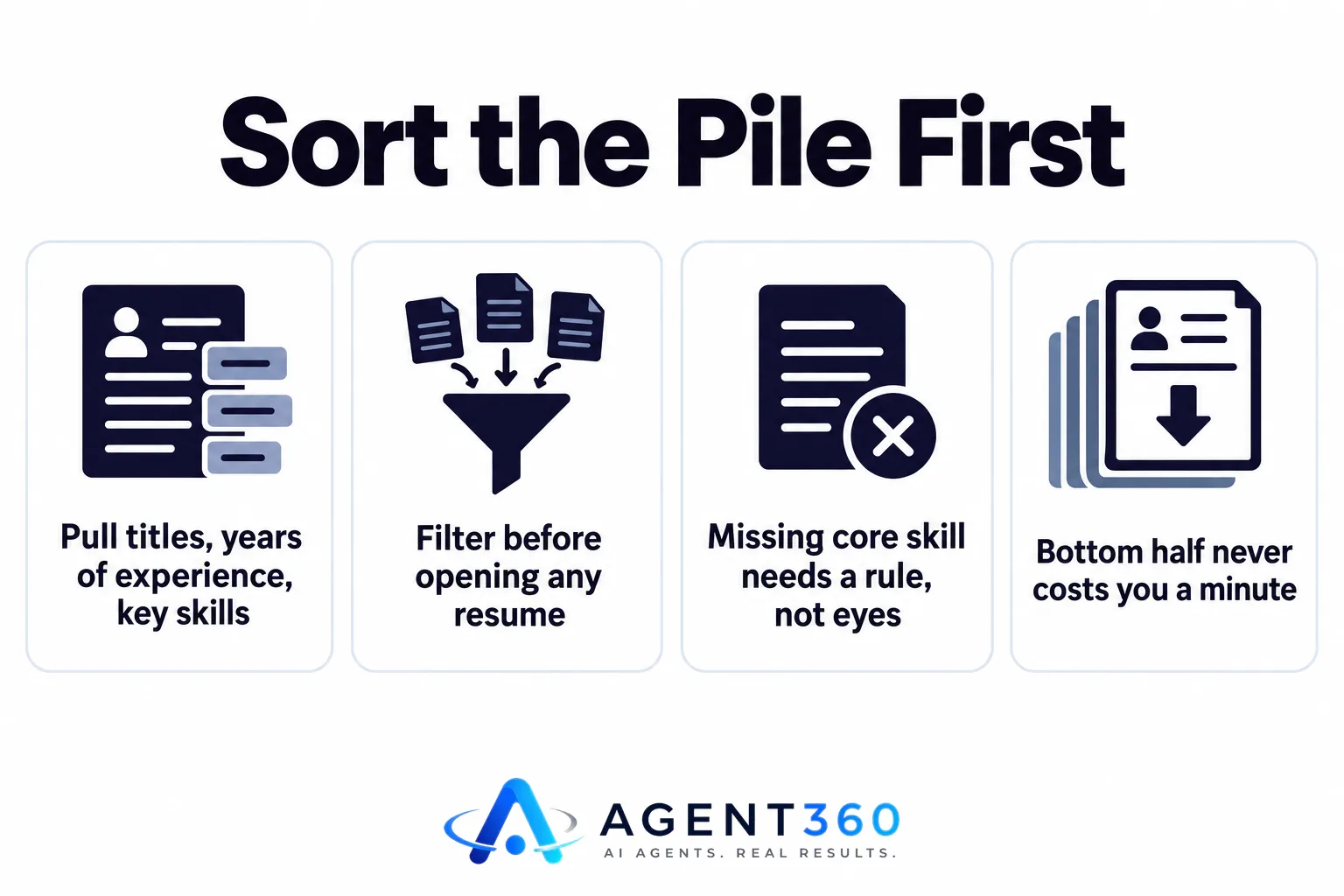
So sort first. Pull out titles, years of experience, and the two or three skills that actually separate a strong candidate from a weak one, and filter on those before you open anything. A resume missing the core skill or the minimum years doesn't need your eyes at all — it needs a rule. Software that scores every resume against the job description on arrival does the same sort automatically, so you open resumes in order of fit instead of order of arrival. The bottom half of the pile never costs you a minute.
Give every candidate one link instead of three emails
A big chunk of screening delay isn't the call. It's the four or five emails it takes to land on a time both sides can do. Each round trip adds a day, and every added day is a day a good candidate can take another offer instead. Replace the back-and-forth with a single booking link sent the moment a candidate clears your first filter: they pick a slot, it lands on your calendar, done. For a role with a lot of applicants — sales and support roles especially — this one change usually removes more calendar time than any other step in the funnel.

Don't make the first call a scheduling test
Make a candidate call you, leave a voicemail, and wait for a callback window, and you've built a filter that screens out people with inflexible day jobs — which is most employed candidates — before you've learned a thing about their skills. A booking link that offers slots across a few days, including evenings, keeps that filter from doing damage you never intended.
Run the first round before a human ever gets on the phone
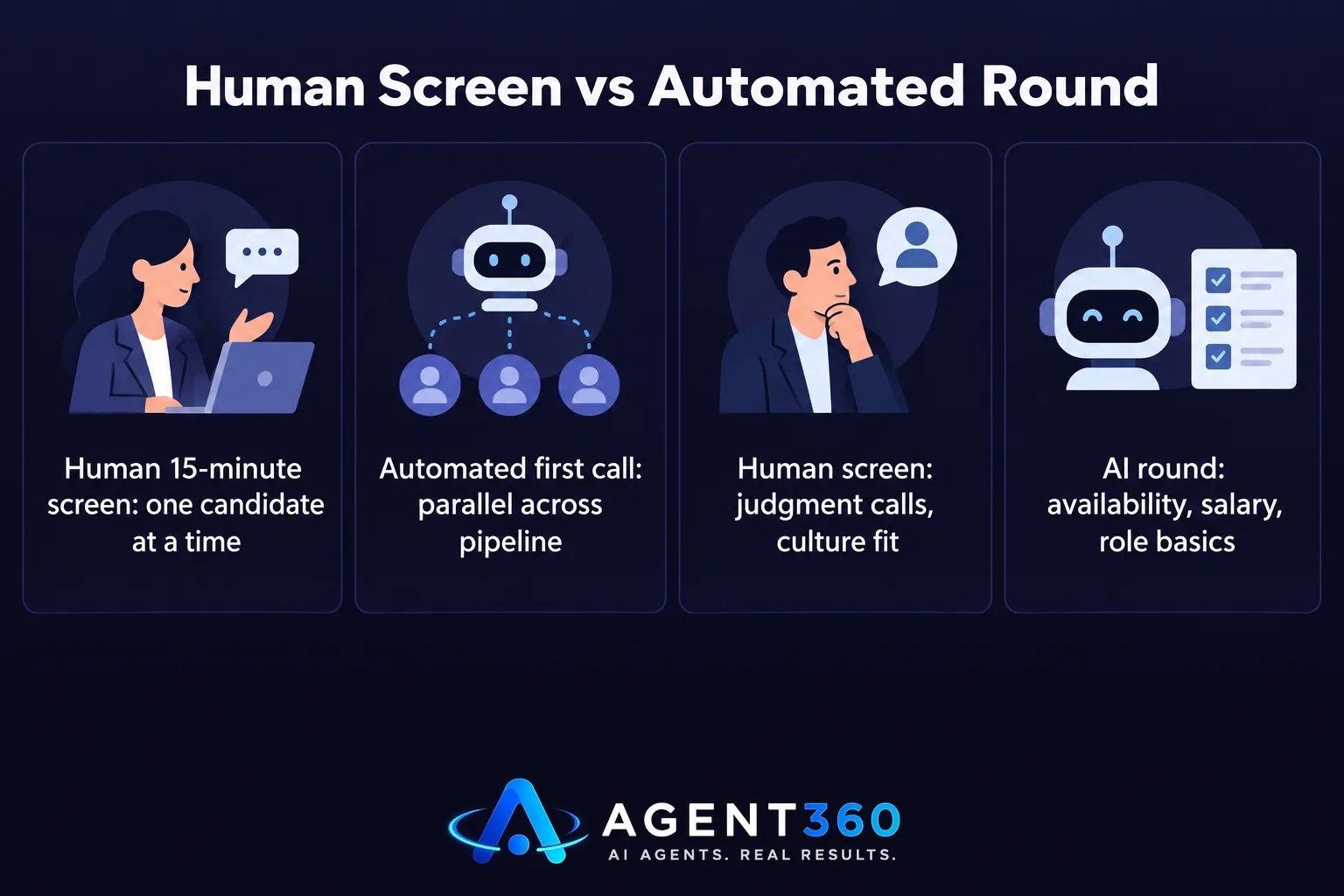
Not every first-round question needs a person asking it. Availability, salary range, notice period, and two or three role-specific basics can be asked and answered with no recruiter's calendar involved at all. An automated first call — candidate books a slot, gets a call at that time, answers eight to twelve questions built from the job description — does the filtering work a 15-minute human screen usually does, and does it in parallel across every candidate in the pipeline instead of one at a time. The mechanics are worth understanding before you set one up; here's what one actually covers. The part that still needs a person is deciding who moves on afterward. The call should gather answers, not make the call on them.
Set a cutoff score before you see a single candidate, not after
The slowest part of many screening processes isn't the reading or the scheduling. It's the committee meeting where three people re-debate the same five borderline resumes because nobody agreed on a bar beforehand. Decide the cutoff before you look: a minimum years requirement, a must-have skill, a score threshold if you're scoring. Then hold to it. A candidate at 62 doesn't get reconsidered because someone likes their cover letter; a candidate at 85 doesn't get held up because someone wants to “just double check.” The debate you're avoiding isn't about the candidate — it's about the process, and it happens exactly once, at the start, instead of every week.
Where this gets automated instead of just organized
Most of the above can be done by hand with a spreadsheet and a booking tool, and it'll still beat reading every resume in order. HiringAgent does the three steps together: it scores every applicant and sourced candidate 0–100 against your job description the moment they land in the pipeline, sends a booking link so candidates schedule their own first-round call, and runs that call as an AI phone screen built from the same job description — so the cutoff you set gets applied consistently instead of re-decided per resume. Plans start at $197 a month with unlimited users, which matters if more than one person is supposed to be screening against the same bar.
FAQ
How many resumes should one person screen per hour?
There's no fixed number worth repeating as fact — it depends on role complexity and how good your filters are before the reading starts. The more useful target: don't read resumes that fail an obvious threshold at all, whether that's a missing skill or the wrong experience level. Filter those out first and the number of resumes a person actually reads drops sharply, regardless of how fast they read.
Is a 15-minute phone screen still worth doing if there's an AI first round?
Usually, yes — just later in the process. An automated first round is good at confirming basics and role-specific answers at volume. A human screen is better spent on judgment calls: culture fit, communication style, the follow-up question no script can anticipate. Put the automated step first and the human step gets shorter, because it's only meeting people who already cleared the basics.
What's the biggest mistake teams make trying to screen faster?
They cut the interview short instead of cutting the pile that leads to it. Shaving two minutes off every call saves less than removing the bottom half of candidates before anyone talks to them — and it costs you more in conversation quality than it saves in time.
More articles
- How to Reduce Time to Hire Without Lowering the Bar
- A Boolean Search Alternative for Recruiters Who Are Done With Strings
- What Passive Candidate Sourcing Actually Takes
- How to Find Candidates Who Are Open to Work
- Resume Parsing Software: What It Gets Right (and Wrong)
- AI Resume Screening Scores Resumes, Not Hires
- Automated Phone Screening Interviews: What They Replace
- AI Phone Screening for Recruiters: What the Call Should Do
