Is It Legal to Use AI in Hiring? Here's What Applies
Short answer: yes, you can use AI in hiring in the United States. No federal law bans it. What actually changes the answer is where you operate and what the tool is doing with a candidate's data. A handful of states and cities now require notice to candidates, bias testing, or both, before an employer can use AI to screen, score or rank people for a job. The EU treats hiring AI as high-risk and regulates it directly. The exposure was never the AI itself. It's what happens if the tool produces a result that looks like discrimination and you can't show your process.
The real legal question is disparate impact, not AI
Title VII of the Civil Rights Act doesn't care whether a human or a model rejected a candidate. If a hiring process — AI-assisted or not — screens out a protected group at a meaningfully higher rate than everyone else, it can be challenged as disparate impact. “The software did it” is not a defense.
This is why New York City's Local Law 144 requires employers using an “automated employment decision tool” to run an independent bias audit and publish the results before using the tool to hire or promote in the city. Illinois has a separate law covering AI analysis of recorded video interviews, requiring notice and consent before an employer can use AI to evaluate how a candidate looks or sounds on camera. Colorado's AI Act, once it takes effect, will require impact assessments for high-risk AI systems used in employment decisions. None of these laws say “don't use AI.” They say: tell candidates, document what the tool does, and be able to show it doesn't screen out people unfairly.
How does artificial intelligence contribute to the recruitment process?
In practice, AI in hiring shows up in four places, and each carries different legal weight.
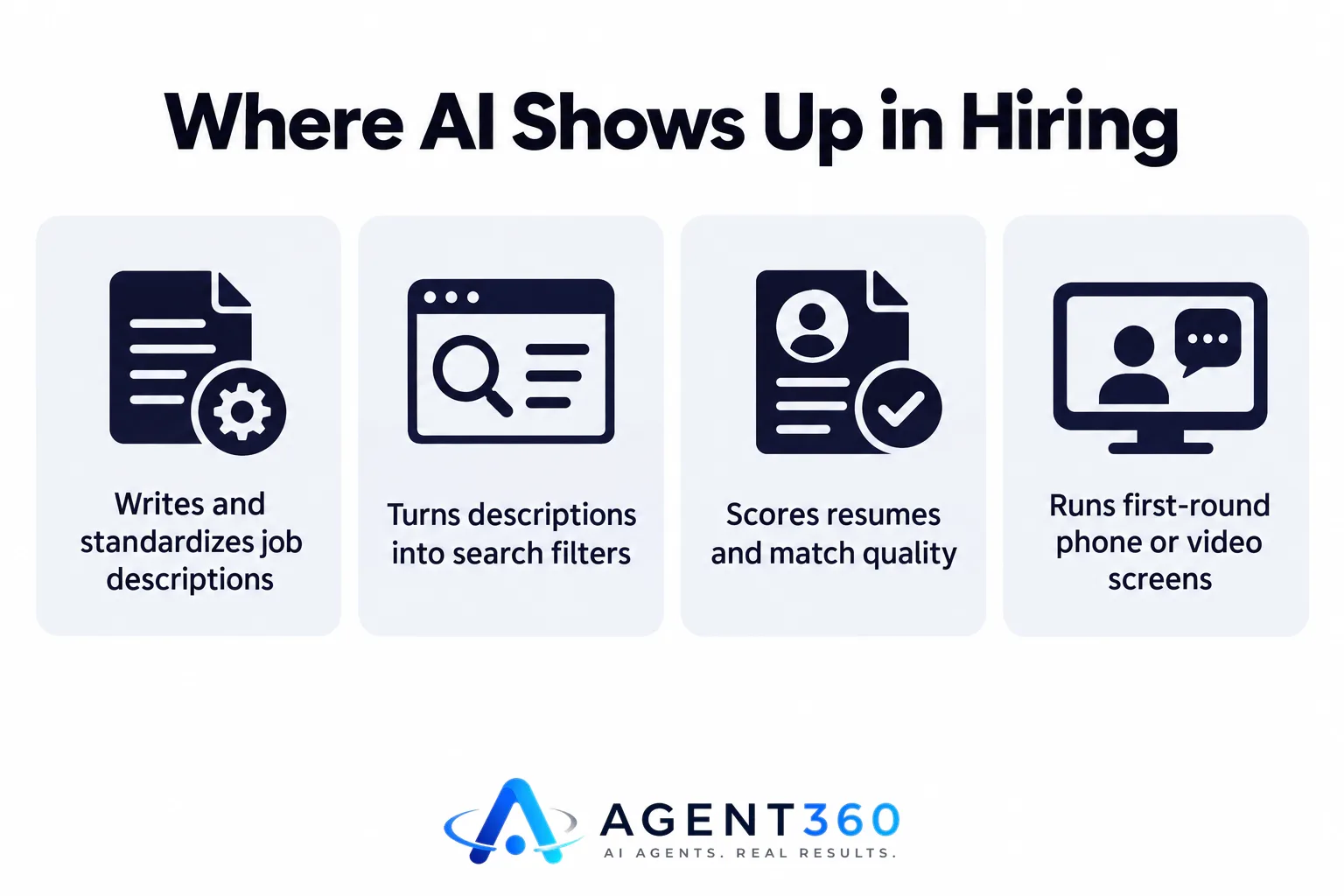
It writes and standardizes job descriptions — almost no legal risk on its own. It turns a job description into search filters and ranks candidates against it, the mechanism behind most AI candidate sourcing tools, which carries disparate-impact risk if the filters correlate with a protected class. Requiring an unbroken employment history, for instance, can quietly disadvantage people who took parental leave. It scores resumes and match quality, which is exactly where the NYC audit requirement and similar rules point: a 0–100 score is a decision input even if a person makes the final call. And it runs first-round phone or video screens, which Illinois specifically regulates when video and voice analysis is involved.
The common thread: AI handles the slow, repeatable parts — matching, ranking, scheduling — while a person is still supposed to own the actual decision. That split is the difference between a defensible process and a legal problem, and it's worth reading in more detail if you're building or buying any of these tools.
Can my company make me use AI?
Generally, yes. If a sourcing, scoring or scheduling tool is part of how your employer runs hiring, requiring staff to use it is no different from requiring use of any other work software. There's no general employee right to opt out of a tool just because it's AI.
The exceptions are narrow and specific: a union contract that restricts changes to evaluation criteria, a state law that gives employees particular rights over automated decision-making about them (a few states are moving this direction for workplace monitoring, separate from hiring), or a situation where the tool evaluates the employee rather than candidates they're screening. For recruiters and hiring managers specifically, “my company wants me to use an AI tool to source and score candidates” is not, on its own, a legal problem for the employee using it. The compliance burden sits with the employer deploying the tool.
What is the 30% rule for AI?
There isn't one. If you've seen the phrase “30% rule,” it's likely a mix-up with the actual standard regulators use: the four-fifths rule, also called the 80% rule.
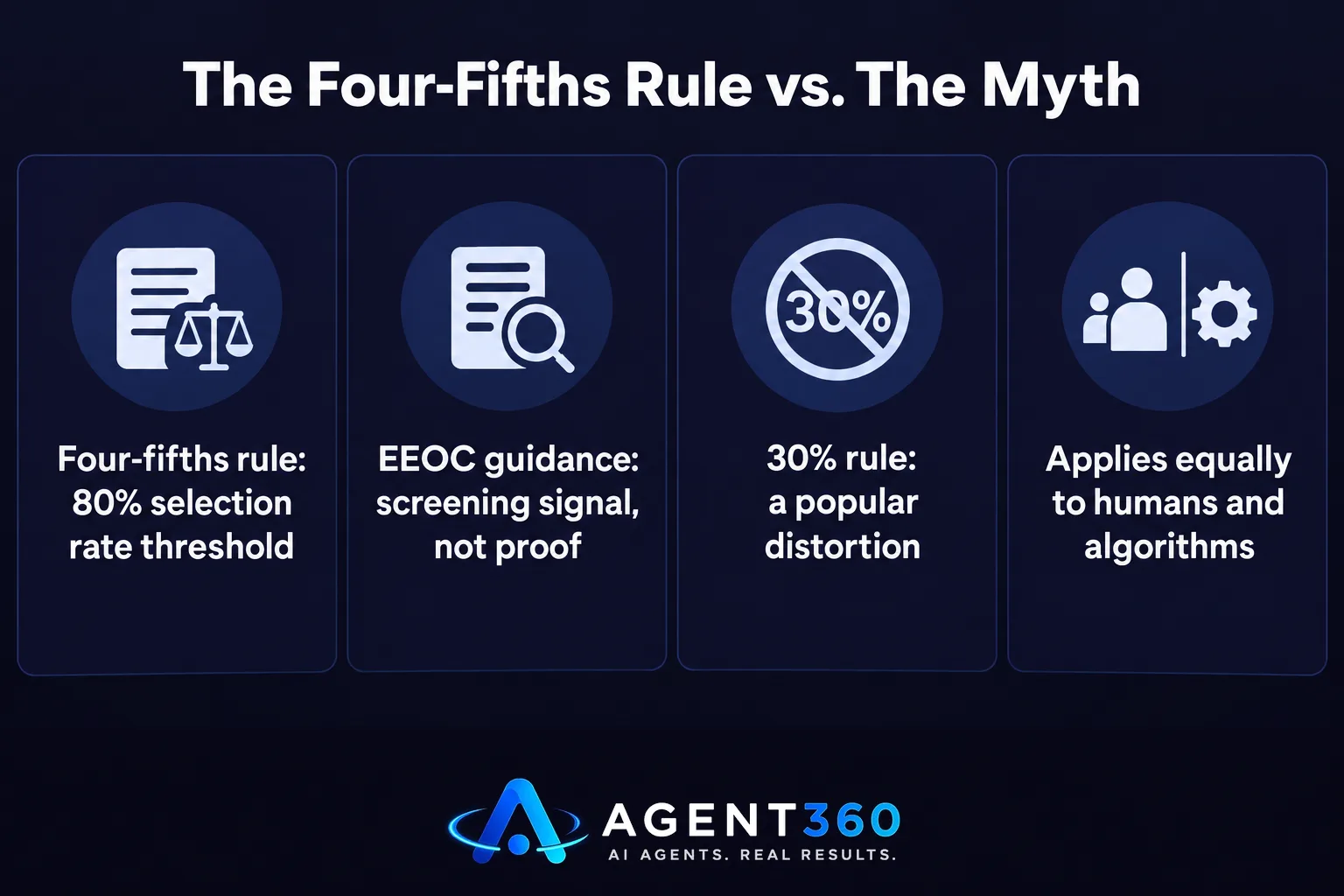
Under longstanding EEOC guidance, if the selection rate for any group falls below four-fifths (80%) of the rate for the highest-scoring group, that's treated as a signal of possible adverse impact worth investigating — not automatic proof of discrimination. It's a screening threshold, not a hard legal line, and it applies the same way whether a human recruiter or an algorithm made the selections. If a number like “30%” is circulating, treat it as a popular distortion of this threshold rather than a rule to comply with.
What this means for the tools you actually buy
Compliance risk concentrates wherever a tool makes or materially influences a decision about a specific person — rank, score, pass/fail — and shrinks wherever it's doing research or drafting.
A score from an AI match score that ranks candidates from 0 to 100 is a decision input and should be treated like one: documented, reviewed periodically for skew, and never the sole reason someone is rejected without a person looking at the file. A tool that drafts a job description or schedules a call carries lower risk, because it isn't ranking people against each other. When you evaluate any hiring tool, ask the vendor plainly what data trains the scoring, whether it's been checked for disparate impact across groups, and whether a person is required to review before rejection. Whether it's “AI-powered” tells you nothing about legal exposure.
Where HiringAgent fits
HiringAgent sources candidates from public professional profiles, scores each one from 0 to 100 against your job description with sub-scores for skills, experience and location, and runs first-round AI phone screens. But the score never makes the hire. A person decides who moves forward at every stage, which keeps the judgment call where disparate-impact law expects it to sit. If you want the fuller breakdown of where AI should and shouldn't make the call in a hiring process, this is worth reading in full.
Do employers really check your social media?
Often, yes, and it's generally legal when the information is public. Reviewing a candidate's public LinkedIn profile or a published post is different from demanding a private account password, which several states explicitly prohibit employers from requesting.

The legal risk shows up when a recruiter sees protected information through social media — age, religion, pregnancy, disability — and that information appears to influence the decision, whether or not AI was involved in surfacing it. Tools that pull from public professional profiles to find and score candidates are operating in the same space as a recruiter manually checking LinkedIn. The exposure comes from what's done with what's found, not from the fact that a profile was viewed.
Frequently asked
Is AI hiring software banned anywhere in the US?
No US state or city bans AI in hiring outright. New York City requires a bias audit and public notice before using an automated tool to screen or score candidates there; Illinois requires notice and consent for AI analysis of video interviews. Compliance means meeting those specific requirements, not avoiding AI altogether.
Do I have to tell candidates I'm using AI to screen them?
In some jurisdictions, yes — NYC's Local Law 144 and Illinois's video interview law both require disclosure. Even where it isn't legally required, disclosing it in the job post or apply page avoids surprises and complaints later.
Can a candidate sue if an AI tool rejects them?
They can bring the same discrimination claim they could against a human-made decision — disparate treatment or disparate impact under Title VII or state equivalents. The AI doesn't create a new cause of action. It gets evaluated under the employment discrimination law that already exists.
More articles
- Hiring With AI: What It Can and Can't Decide
- First-Round Interview Questions That Predict Fit, Not Charm
- How to Write a Job Description That Attracts Candidates
- What a Job Description Generator Should Actually Write
- How to Hire Your First Employee Without Guessing
- Hiring Without a Recruiter: What It Actually Takes
- Recruitment Agency Software Is Usually Three Tools, Not One
- Recruiting Software for Agencies: What to Buy
