Gen AI Direct Sourcing: What It Actually Automates
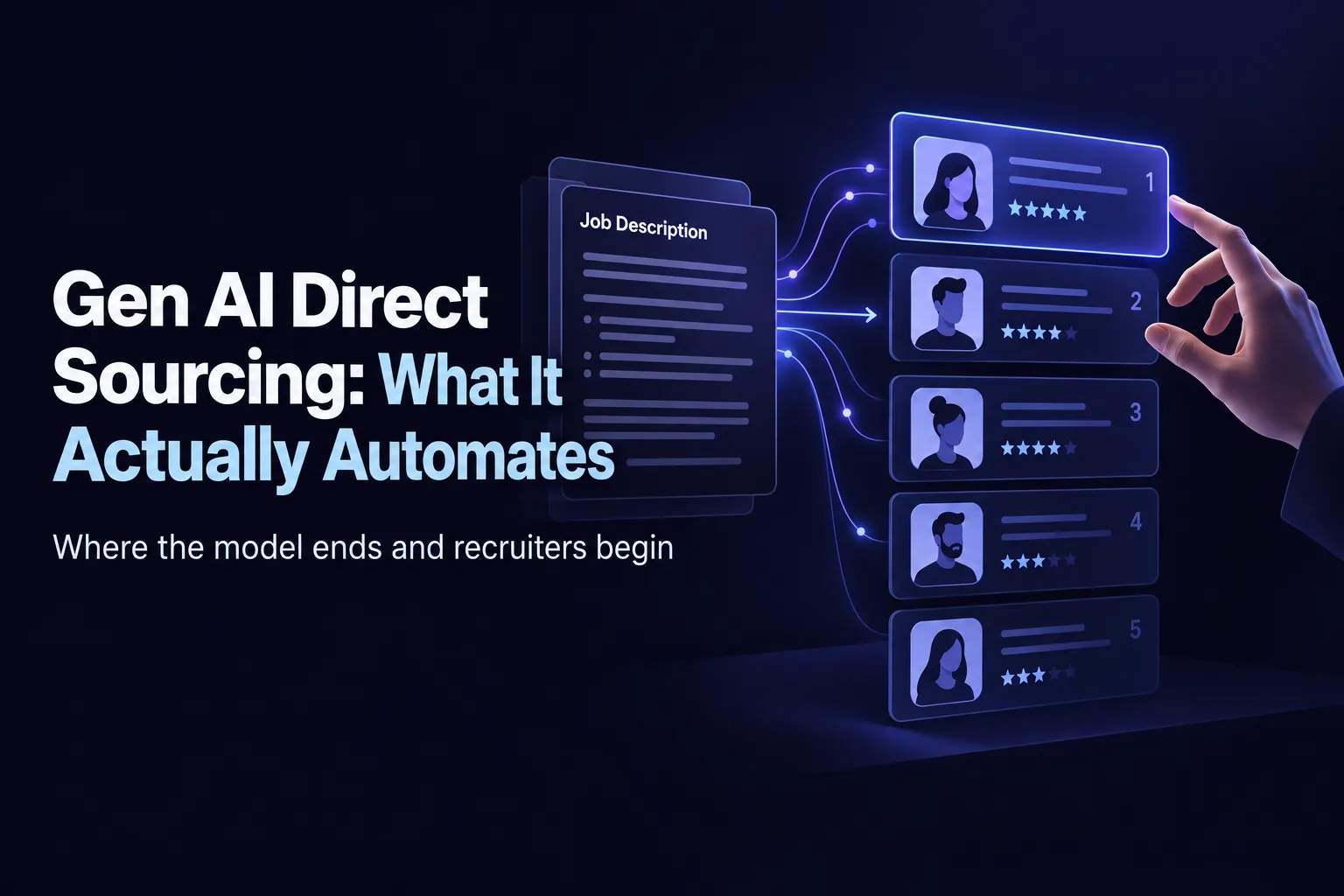
Paste a job description in, get a ranked candidate list out. That is gen AI direct sourcing in one sentence: a language model reads the text — titles, skills, seniority, location — turns it into search logic, and ranks the people it finds, instead of a recruiter hand-building a boolean string and scrolling results one profile at a time. The input is a block of text. The output is a scored list. That is the whole shift. It is worth being precise about what it does and does not touch, because the term gets stretched to cover everything from outreach automation to resume parsing.
Direct sourcing itself is not new — it just means going straight to candidates, passive or active, instead of waiting for applications to land. What gen AI changes is the labor sitting between “we have a role open” and “here is a list of forty people worth a look.” That labor used to be a person translating a job description into search logic by hand. Now a model does the translation.
The job description is the search, not a cover page
A traditional search starts with a recruiter reading the description, pulling out the real requirements, and building a string: title variants, must-have skills, years of experience, maybe a location radius. Gen AI direct sourcing does that extraction on its own — it reads the description and produces the same kind of filters a sourcer would have typed, then runs them against a pool of profiles. The output is only as good as the input. Feed it a vague posting and you get vague filters back. That is why tools in this category usually bundle a description generator with the sourcing step: the same text that goes out publicly is the text the search logic gets built from. For a closer look at that mechanism, this explainer on AI candidate sourcing skips the marketing gloss.
This is also where the approach departs from a boolean search alternative that just offers better keyword matching. Keyword matching still asks you to already know the right keywords. Gen AI direct sourcing infers them from context instead — it can tell that “owns the full sales cycle” implies a quota-carrying title even when the word “quota” never shows up.
Scoring narrows the list, it doesn't make the decision
Once candidates are found, the second half of the job is ranking them. Usually that means a 0–100 match score built from sub-scores on skills, experience and location, plus a one-line reason for the number. That score sorts, it doesn't recommend — it tells you which forty of three hundred profiles deserve a human's attention first, not which one to hire. A score of 80 and above is usually treated as a strong match in tools that use this scale, but the sub-scores matter more than the headline number. A candidate can score high on skills and low on location, and that gap is exactly what a recruiter needs to see before picking up the phone. The mechanics of this kind of scoring are worth understanding on their own terms — see how AI match scoring works for the breakdown.
Where this breaks: scoring is only as sharp as the description that fed it. A generic description produces generic scores that don't actually separate the strong candidates from the merely plausible ones. If every candidate in a run lands between 60 and 75, the description needs more detail before the ranking means anything.
Outreach and screening are a different layer, and treating them as one step causes problems
Sourcing finds and ranks people. It does not have a relationship with them. Gen AI can draft an opening message using the job description as context, but a templated message sent to forty passive candidates reads like exactly that — and the response rate has nothing to do with how good the sourcing was underneath it. Teams that get the most out of this category treat sourcing as the research step, and keep message writing, timing and follow-up as a separate, slower, more human task — closer to what good passive candidate sourcing has always required: patience, not volume.
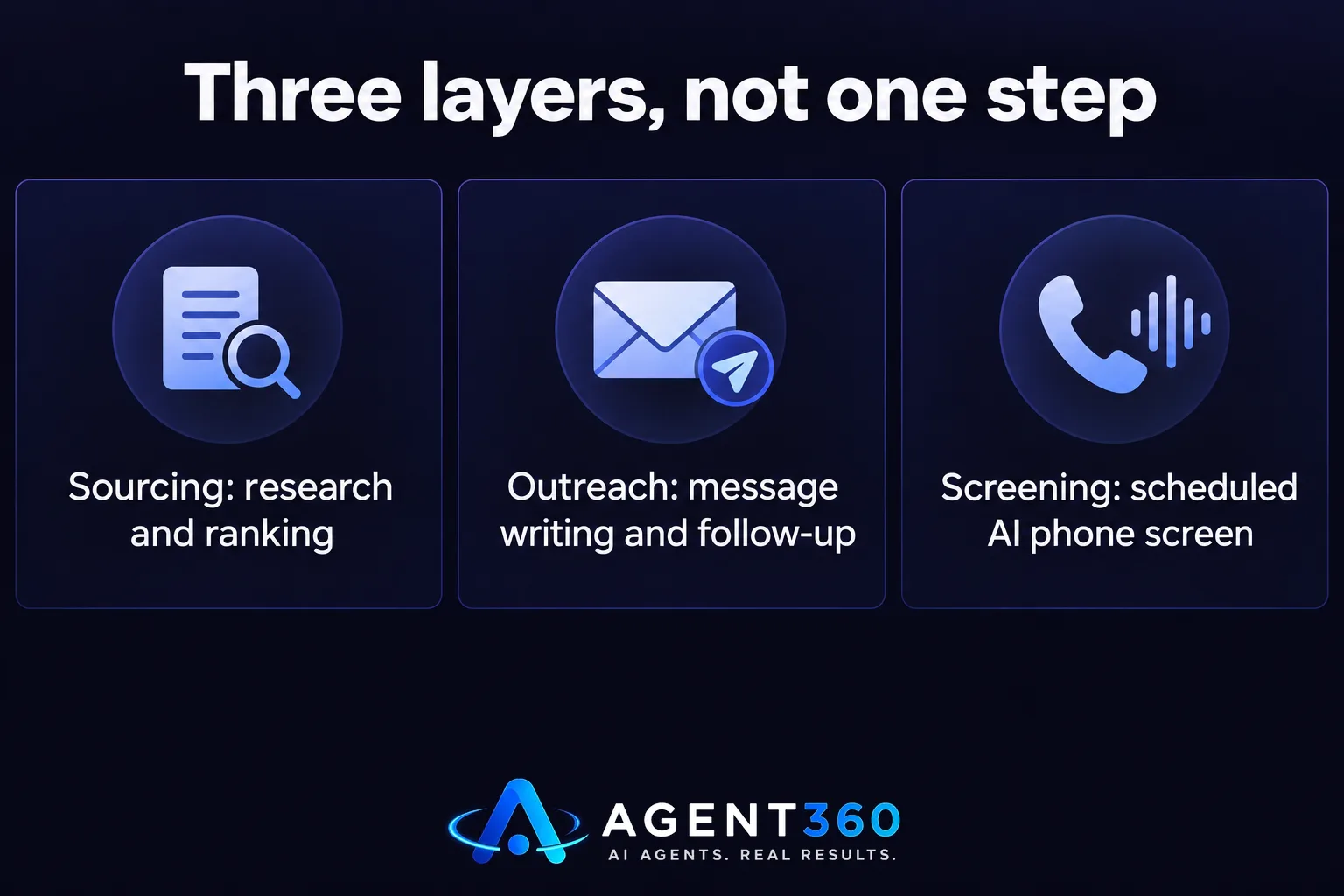
Screening is a third layer again. An AI phone screen can ask role-specific questions on a scheduled call once a candidate agrees to one, but it runs on a different system than the one that found the candidate. Conflating the two leads buyers to expect a single tool to do research, outreach, persuasion and evaluation end to end. No current product does all four well.
Named failure modes worth checking before you trust a list
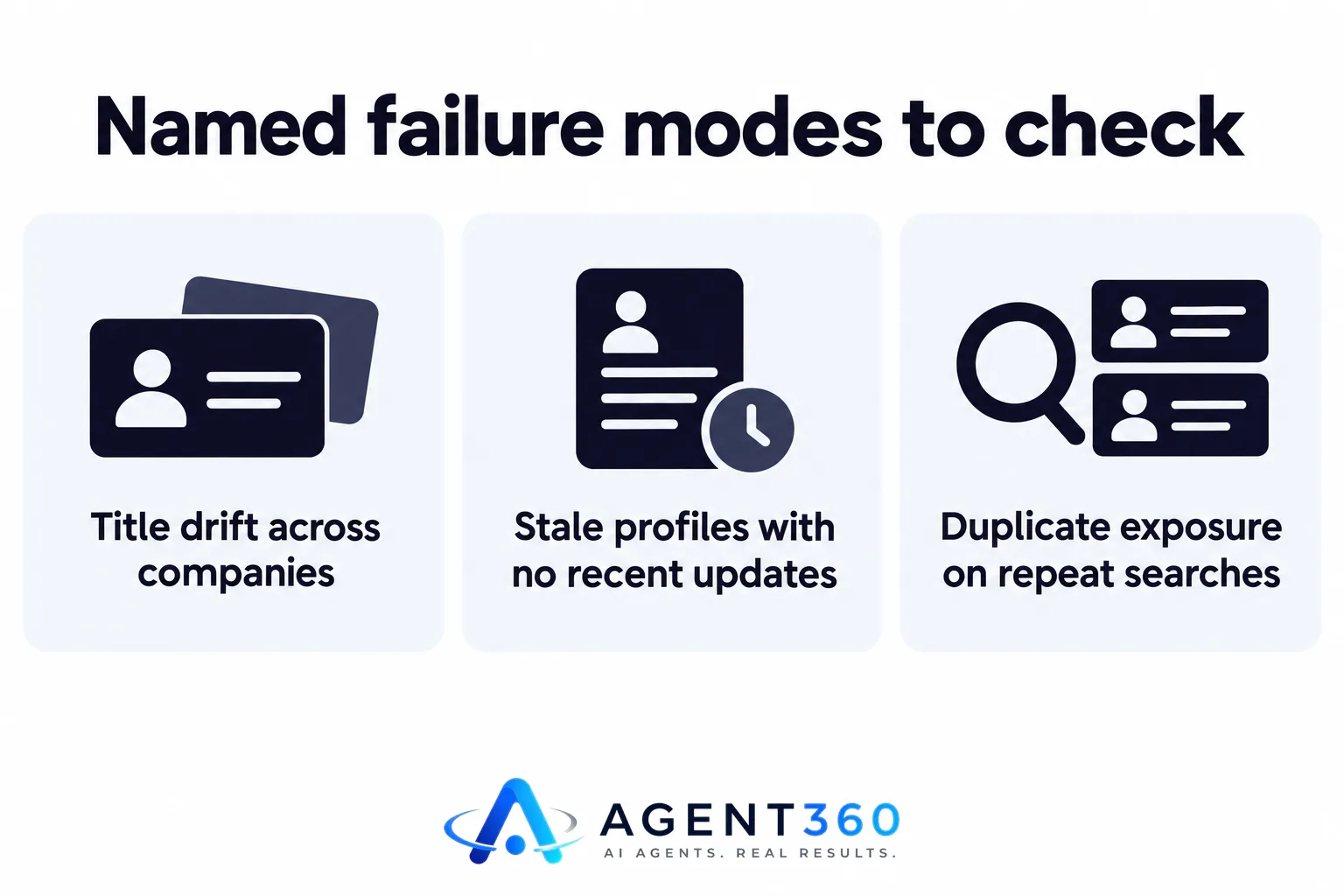
Title drift is the most common one: a “Head of Growth” at one company is doing a VP of Marketing's job at another, and a search built purely on title will miss people or over-include them depending on how literally it is written. Stale profiles come second — a profile updated two years ago tells you nothing about current availability, which is why open-to-work signals matter as a filter layer on top of the match score, not a substitute for it; see how open-to-work checks are built for what that signal actually catches and misses. Third is duplicate exposure: run the same role through a tool twice in a month without touching the description, and you tend to surface the same names. That can look like a shrinking market when really it's just a search that's already been wrung out.
Where HiringAgent fits
HiringAgent runs this exact sequence. Paste a job description, and its Sourcing Agent turns it into filters and pulls up to 300 candidates from a database of public professional profiles — each one scored 0–100 with sub-scores and a one-line reason before anyone reaches out. Open-to-work checks, AI phone screens booked by the candidate, and a modern ATS to track the whole pipeline sit in the same workspace, with plans starting at $197 a month. It won't post to job boards for you, and it doesn't run outreach sequencing beyond a candidate-facing apply page. It's the sourcing-and-scoring-and-screening layer, not a full outbound campaign tool.

What is gen AI direct sourcing?
It's the use of generative AI to turn a job description into search filters — titles, skills, seniority, location — then find and rank matching candidates, replacing the manual work of building a boolean string and reading resumes by hand.
How is it different from traditional direct sourcing?
Traditional direct sourcing still means reaching out to candidates directly rather than waiting for applications. Gen AI changes how the candidate list gets built, not the fact that a human still decides who to message and what to say.
Does gen AI direct sourcing replace a recruiter?
No. It replaces the time spent translating a job description into a search and reading resumes to rank candidates. Deciding who's worth a conversation, writing a message that actually gets a reply, and judging fit beyond a score — that's still a person's job, a split covered in more depth in how to split hiring work between AI and people.
More articles
- Are All Tracking Systems the Same? Not Even Close
- Recruiting Agency Software: Judge It by Time to Shortlist
- ATS Tracking Price: What the Number on the Page Means
- ATS Tracking Cost: What You Actually Pay For
- A Confidential Job Search for Employers, Done Right
- How to Hire Software Engineers: A Level-First Playbook
- How to Hire Sales Reps Without Guessing on Resumes
- A Talent Sourcing Strategy That Doesn't Start at Zero
