ATS Tracking Cost: What You Actually Pay For
An applicant tracking system can cost nothing — a bare free tier with a handful of open jobs — or several thousand dollars a month for an enterprise suite billed per recruiter seat. Most small and mid-size teams land somewhere between $100 and $600 a month once they add the modules they actually need, and the number on the pricing page almost never matches what shows up on the invoice. That's because most ATS vendors charge on more than one axis at once.
So if you're trying to budget for one, the honest answer is: it depends which of four pricing levers the vendor pulls, and how many they pull at the same time.
How much does an applicant tracking system cost?
For a small team hiring a handful of roles at a time, figure roughly $100 to $400 a month for a standalone ATS with core tracking, a careers page and basic reporting. Add sourcing, AI matching or phone screening and the range climbs, usually $200 to $600 a month, because those tend to get sold as a higher tier rather than a toggle you flip on. Enterprise suites built for hundreds of open roles and multiple hiring teams price differently — often by seat, by job slot, or both — and can run into the thousands once a company adds more than a few recruiter logins.
The variable that moves the number most isn't features. It's scale: how many open roles you run at once, how many people need a login, how many candidates pass through in a month. A system that looks cheap at three open roles can double in price the moment you open a tenth.
What are ATS charges?
Four charging models show up again and again, often stacked together:
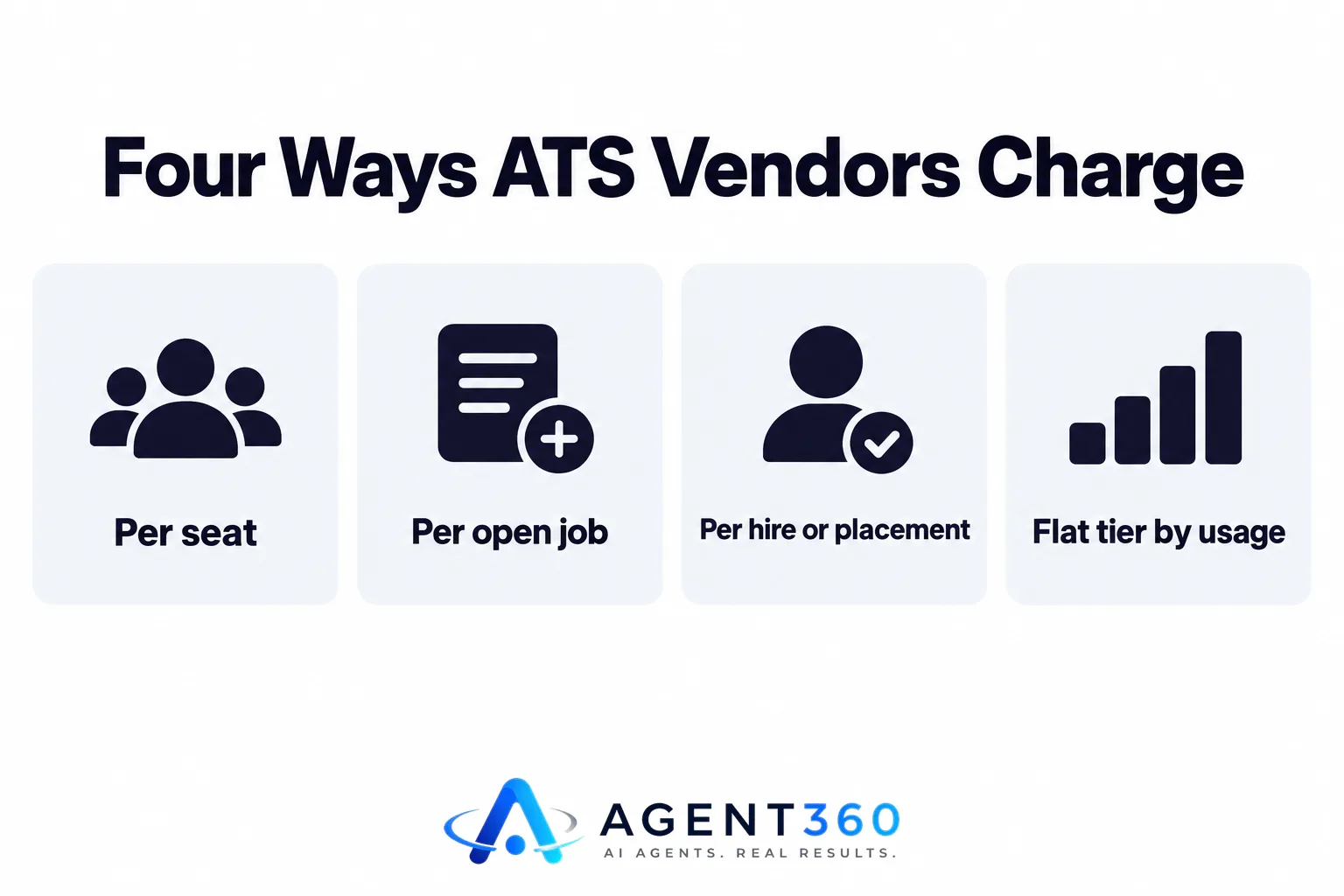
- Per seat. You pay per hiring manager or recruiter with a login. This punishes companies that want every hiring manager involved, since adding people adds cost even if nobody sources a single extra candidate.
- Per open job. You pay for the number of active requisitions, which punishes companies hiring for many roles at once regardless of headcount.
- Per hire or per placement. Common in recruiting-agency tools and some ATS-plus-payroll bundles — you pay when someone is hired, which gets expensive fast at volume.
- Flat tier by usage. A fixed monthly price for a bucket of usage — candidates sourced, interviews scheduled, reports run — with the next tier up once you cross the limit.
On top of the base charge, watch for line items billed separately: job-board posting credits, background-check integrations, e-signature for offer letters, premium support. A quote that sounds like one price on a sales call can arrive as three or four line items on the first invoice. Before you sign anything, make the vendor write out every charge against a real 90-day hiring plan — three roles, two hiring managers, one offer — instead of trusting the sticker price on the homepage.
Is the ATS free?
Some are, within limits. Free ATS tiers exist, usually capped at one or two open jobs, a small number of users, and basic tracking with no sourcing or scoring. Fine for a company hiring one role a year. The moment you need more than a couple of simultaneous openings, a public apply page that actually gets maintained, or any reporting beyond a candidate list, the free tier runs out and you're looking at a paid plan anyway.
The more useful question isn't “is it free,” it's “what does free leave out.” Free tiers almost never include candidate sourcing, AI-assisted screening, or more than a handful of pipeline stages — the parts of hiring that actually eat time. A modern ATS that also sources and scores candidates is a different product category from a free tracker, and the price gap reflects that, not just a longer feature list.
Can you give me some examples of applicant tracking systems?
Broadly, ATS products fall into three groups:
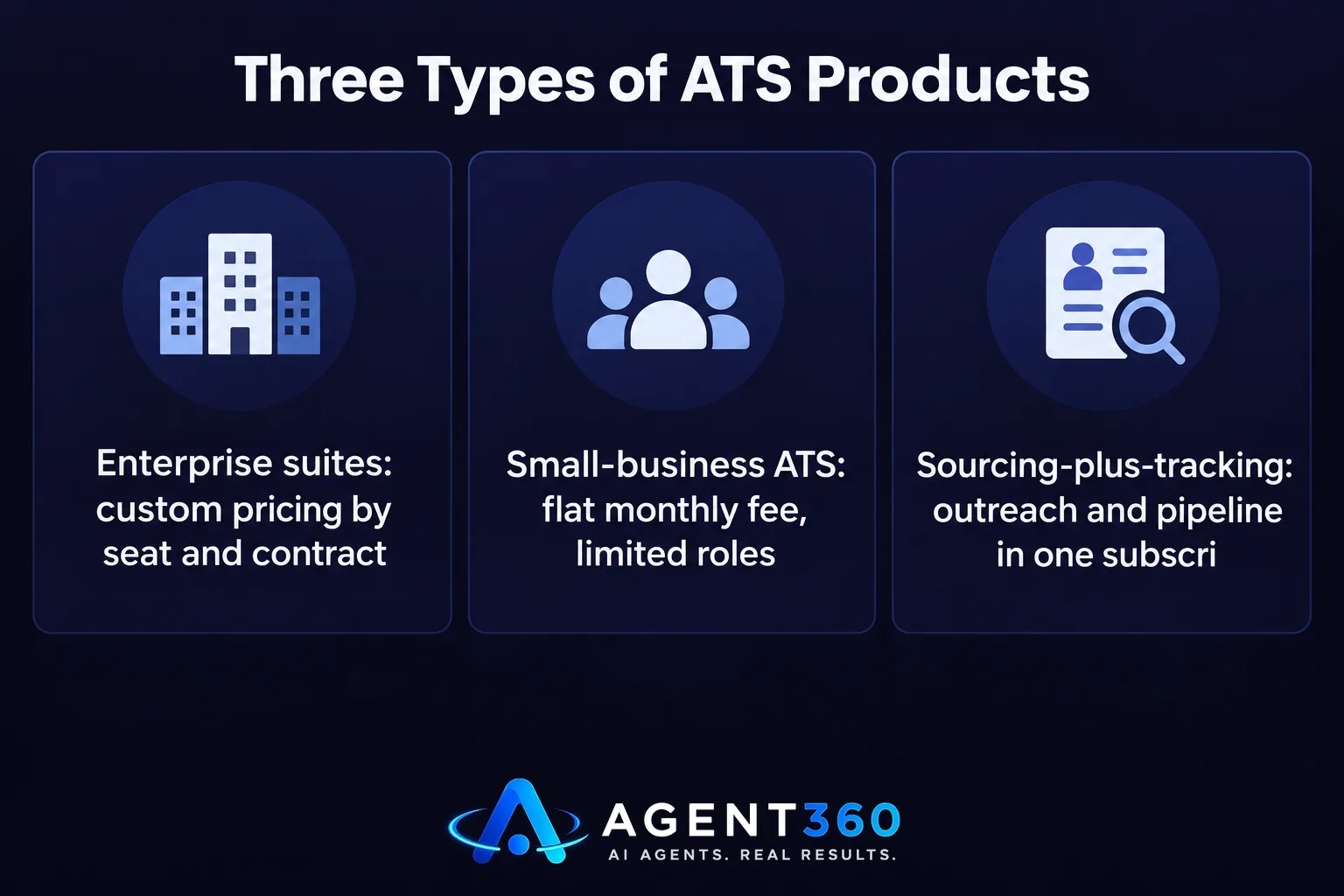
- Enterprise suites built for large talent teams with multiple departments, compliance workflows and dozens of integrations. These quote custom pricing, usually by seat and contract term.
- Small-business ATS tools priced as a flat monthly fee for a limited number of open roles and users, often bundled into a broader HR platform.
- Sourcing-plus-tracking platforms that combine candidate outreach or AI sourcing with pipeline tracking in one subscription, aimed at teams that don't want to buy a sourcing tool and a tracker separately.
Which category fits depends less on company size than on how candidates reach you. If most candidates apply on their own, a tracking-only tool is enough. If you need to go find people who haven't applied, a tracking-only ATS still leaves that work undone — the gap a traditional ATS never closes on its own.
Price it against what it replaces, not against the sticker
The right comparison for ATS cost isn't “what's cheapest.” It's what the system replaces. A $200-a-month tool that also sources and scores candidates can replace a sourcer's time and a chunk of a recruiter's screening hours. A $50-a-month tracker that only logs applicants still leaves someone building a boolean search by hand and sorting resumes manually. Price per seat or per job is a budgeting detail. Price per hour saved on sourcing and first-round screening is the number that actually matters once you're running more than one open role.

HiringAgent prices as a flat monthly plan rather than per seat: $197, $397 or $597 a month with unlimited users, covering sourcing, AI match scoring, AI phone screens and the pipeline itself, with candidate volume and screen counts scaling by tier rather than headcount. Full detail on what's in each tier is on the pricing page.
Questions
What are ATS charges, in plain terms?
Most ATS tools charge by one or more of: number of users with a login, number of open jobs, number of hires made, or a flat tier with a usage cap. Add-ons like job-board posting, background checks and e-signature are often billed separately from the base plan.
Is the ATS free?
Some ATS products offer a free tier, but it's usually capped at one or two open jobs and basic tracking with no sourcing, scoring or advanced reporting. Teams hiring for more than a role or two at a time tend to outgrow it fast.
How much does an applicant tracking system cost?
Standalone tracking tools for small teams generally run $100 to $400 a month. Tools that add sourcing or AI screening run higher, often $200 to $600 a month. Enterprise suites price by seat and contract and can run well into the thousands for larger teams.
More articles
- A Confidential Job Search for Employers, Done Right
- How to Hire Software Engineers: A Level-First Playbook
- How to Hire Sales Reps Without Guessing on Resumes
- A Talent Sourcing Strategy That Doesn't Start at Zero
- Sourcing Tools for Recruiters: What Each Layer Actually Does
- Is It Legal to Use AI in Hiring? Here's What Applies
- Hiring With AI: What It Can and Can't Decide
- First-Round Interview Questions That Predict Fit, Not Charm
