ATS Tracking Price: What the Number on the Page Means
There is no single ATS tracking price, because vendors do not price the same thing. Some charge per recruiter seat, some charge per open job, some charge per candidate or application volume, and some blend all three with a cap that only shows up once you hit it. The sticker number on a pricing page tells you almost nothing until you know which of those units it's measuring.
That's the actual answer to “how much does ATS cost” — not a dollar figure, but a question: cost per what? Get that wrong and you compare a $99 plan to a $400 plan and think you found a bargain, when the $99 plan caps you at one open role and the $400 plan doesn't cap you at all.
How much does ATS charge for tracking?
Three pricing units cover most of the market, and each one rewards a different kind of company. Per-seat pricing charges for every person who logs in — hiring managers, interviewers, even the office manager who just wants to see the pipeline. It punishes the exact collaboration an ATS is supposed to encourage: add a stakeholder to the hire, and the bill goes up. Per-job pricing charges for the number of open roles live at once. Fine if you're hiring one role a quarter. Bad if you're running five searches in parallel. Per-candidate or per-application pricing charges by volume moving through the system. It rewards a lean funnel and punishes a popular posting that pulls in three hundred applicants you never meant to pay for.
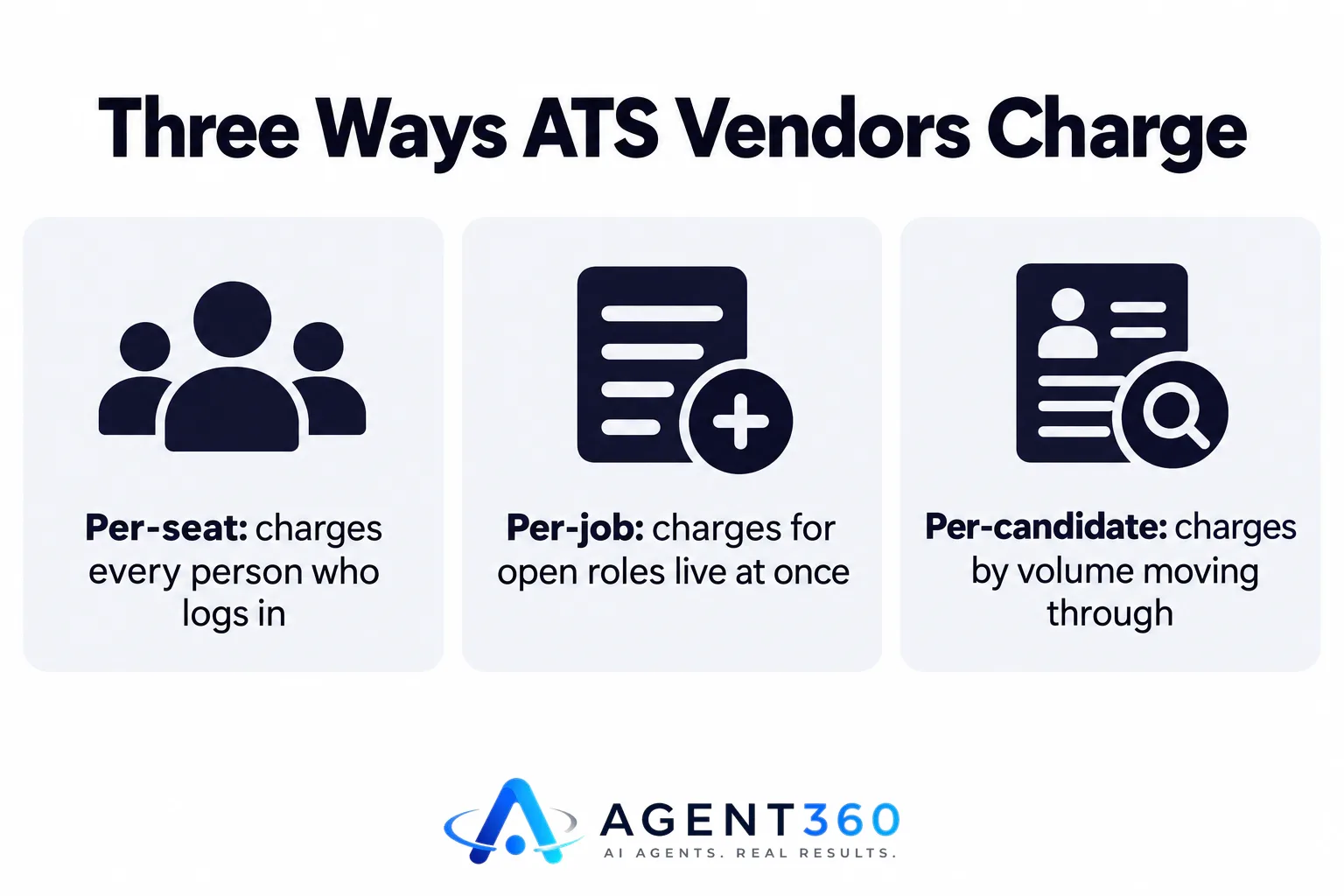
Most vendors pick one of these as the primary lever and use the other two as soft caps buried in the plan details — “unlimited users” on a plan that caps you at 200 candidates a month, or “unlimited candidates” on a plan that charges per seat. Read the caps before you read the price.
The cheapest ATS on the pricing page rarely stays the cheapest plan you use
Entry-tier ATS plans are built to look cheap in a feature comparison, and for a narrow use case, they are. A single hiring manager running one search, no reporting needs, no second reviewer — that person can run on the bottom tier for a long time. Then a second person needs to see candidates. Or a second role opens. Or someone wants to filter a report by source. The plan that looked cheapest turns into an upgrade conversation. That's where the real price of the tool shows up — not on the page you compared against three competitors.

Annual contracts compress the sticker price further — 10 to 20 percent off is common — but they lock in whatever unit you picked a year ago. Double your hiring volume mid-contract and you're either paying overage fees or waiting out the term to switch to a plan that fits. Month-to-month costs a bit more per month. It costs nothing to walk away, and that matters more than the discount if your hiring volume isn't flat.
What is the cheapest ATS?
The cheapest ATS, in absolute terms, is the one priced for a single user tracking a single role. It stays cheap only as long as you stay there. Hiring for the first time with no recruiter on staff? That tier can be the right call — a plan built for exactly that situation is covered in what an applicant tracking system for small business costs. Already know you'll run more than one search a quarter? Price the plan you'll be on in six months, not the one you'd be on this week.
The more useful question than “what's the cheapest ATS” is “what does the next tier cost, and what triggers it.” A vendor that answers that cleanly on the pricing page is usually pricing honestly. A vendor that makes you talk to sales to find out is usually pricing around your willingness to switch once you're in.
Tracking is the baseline price — sourcing and screening are where it actually goes up
A pure tracking tool — the kind compared directly in this breakdown of a traditional ATS — only has to price the pipeline itself: stages, statuses, candidate records. The price climbs once a vendor adds sourcing, resume parsing, interview scheduling or reporting, because each of those is effectively a second product bundled into the number. That's a fair reason to charge more. But it's worth knowing which features are driving the number before you accept it — tracking, done well, is still just one job among several.
HiringAgent prices the whole hiring motion, not just the tracker
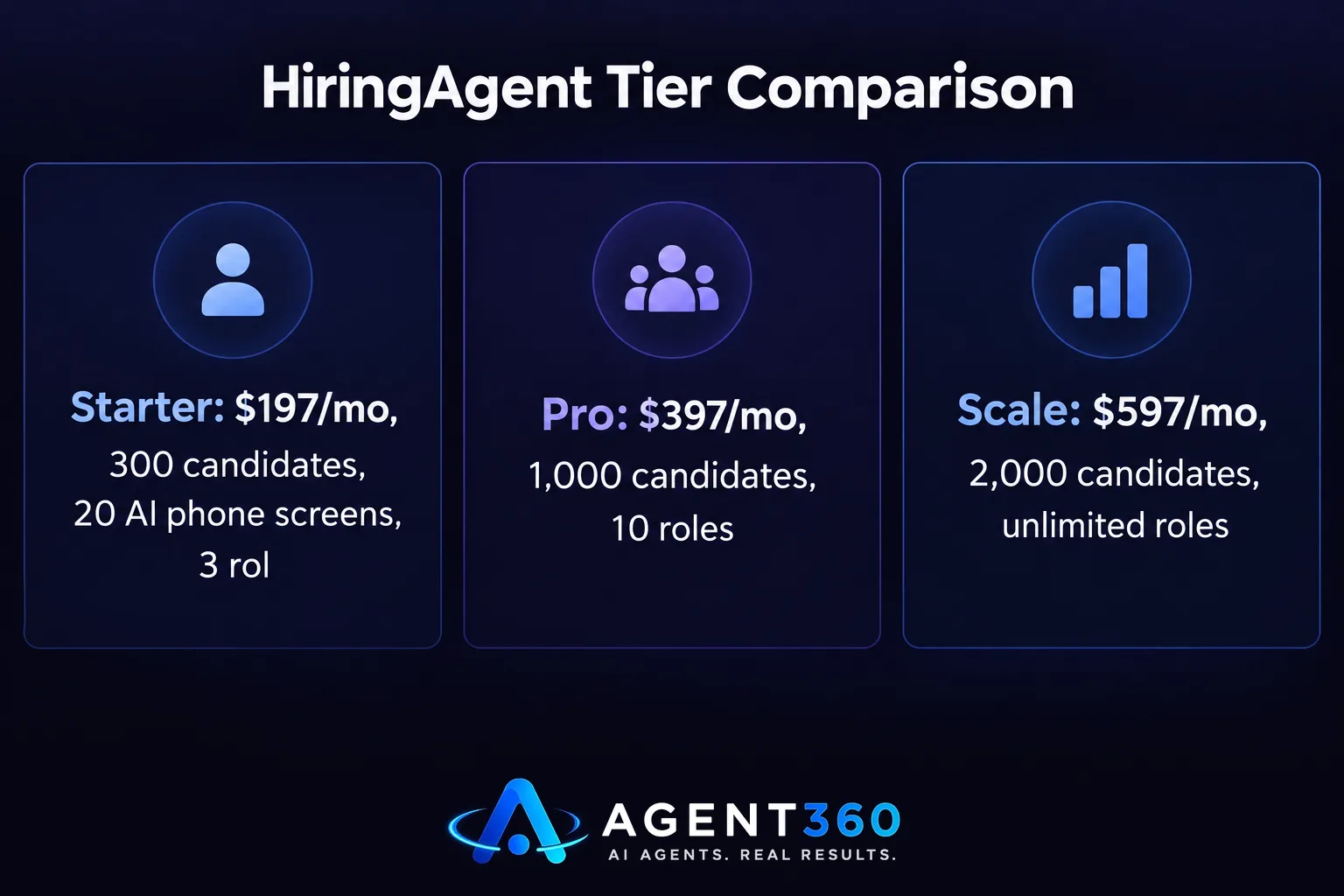
HiringAgent folds sourcing, match scoring and first-round AI phone screens into the same three tiers as the modern ATS pipeline, so the monthly number covers more of the hire than tracking alone. Starter is $197 a month for 300 candidates sourced and scored, 20 AI phone screens and 3 open roles; Pro is $397 for 1,000 candidates and 10 roles; Scale is $597 for 2,000 candidates and unlimited roles. Users are unlimited on every tier, there's no setup fee, and quarterly or annual billing takes 10 or 20 percent off if you want the discount without the lock-in risk. Full tier details are on the pricing page.
How much does ATS cost?
ATS pricing spans a wide range — from tools built for a single hiring manager on one role, up to agency-grade platforms pricing by seat and volume for large recruiting teams. The honest answer is that cost tracks to the pricing unit — seats, job slots, candidate volume — more than to any brand name. So the right question isn't which vendor's cheapest. It's which unit matches how you actually hire.
What is the ATS amount?
If you mean the specific number you'll be billed, it's set by whichever unit your plan caps — the seat count, the open-role count, or the candidate volume — and by whether you're billed monthly, quarterly or annually. There's no fixed “ATS amount” across vendors. Two companies on the same-named tier — both calling it “Pro,” both paying monthly — can end up with totals $200 apart, just because one of them hired twice as fast.
More articles
- Are All Tracking Systems the Same? Not Even Close
- Gen AI Direct Sourcing: What It Actually Automates
- Recruiting Agency Software: Judge It by Time to Shortlist
- ATS Tracking Cost: What You Actually Pay For
- A Confidential Job Search for Employers, Done Right
- How to Hire Software Engineers: A Level-First Playbook
- How to Hire Sales Reps Without Guessing on Resumes
- A Talent Sourcing Strategy That Doesn't Start at Zero
