A Confidential Job Search for Employers, Done Right
No company name, no job board listing, just a recruiter reaching out directly — that's a confidential job search for employers, and it's a normal way to fill a role you can't talk about yet. You're sourcing and screening candidates directly instead of putting the job on a careers page. Maybe you're replacing someone who doesn't know they're being replaced. Maybe the role sits above a public org chart, or naming the company would tip off a competitor or a customer. None of that is a red flag by itself. What makes candidates suspicious isn't the confidentiality — it's everything employers do instead of explaining it.
If you typed this phrase into Google, you're probably weighing two questions: whether to run the search this way at all, and how to do it without candidates bouncing the second they see no company name. Both have the same answer. Say why it's confidential, and build the process so the confidentiality is the only unusual thing about it.
Run it for a reason you can say out loud
Every legitimate confidential search has a one-sentence explanation that makes sense to a stranger. The incumbent hasn't been told. The role is a backfill for a planned departure. The company hasn't announced a product, a location, or a funding round tied to the hire. The seat is senior enough that a public posting would alert the market before the board does. If you can't finish the sentence “this is confidential because ___,” the search isn't confidential — it's just unexplained, and candidates will treat it that way.
Compare that to the searches that stay vague on purpose: no stated reason, a shifting story about the company, a recruiter who can't name the industry when you ask directly. That pattern reads as evasive because it is.
Source candidates directly instead of posting the role
A confidential search skips the public posting, not the pipeline. You still need a written job description, a way to find people who fit it, and a way to track them — you just don't put a link on a job board or your careers page. In practice that means sourcing candidates directly from the job description rather than waiting for applicants to find a listing, and sending the strongest matches a private link instead of a public one.

This is also where a lot of confidential searches fall apart. Someone builds a shortlist in a spreadsheet, loses track of who was contacted, and ends up re-pitching the same person twice under two different descriptions of the same role. A search run without a public posting still needs the same tracking discipline as one that is — the same stages, the same notes on who said no and why. Read more on what AI candidate sourcing actually does if you're deciding whether to build this list by hand.
Name the real cause of confidentiality, or candidates will invent one
Silence gets filled. If you don't tell a candidate why the company is unnamed, they'll assume the worst available explanation — that the role doesn't really exist, that it's a pretext for market research, that the company is in trouble and hiding it. You don't have to name the employer to kill that assumption. You have to name the reason.
A version that works: “This is a confidential search for a [industry] company replacing a departing VP who hasn't yet told their team. I can share the company name once we're past the first conversation.” That sentence does three things a vague one doesn't — it gives a reason, a timeline for when the mystery ends, and proof the recruiter isn't hiding behind the format.
These three things make a confidential posting an actual red flag
Confidentiality itself isn't the warning sign. These are:
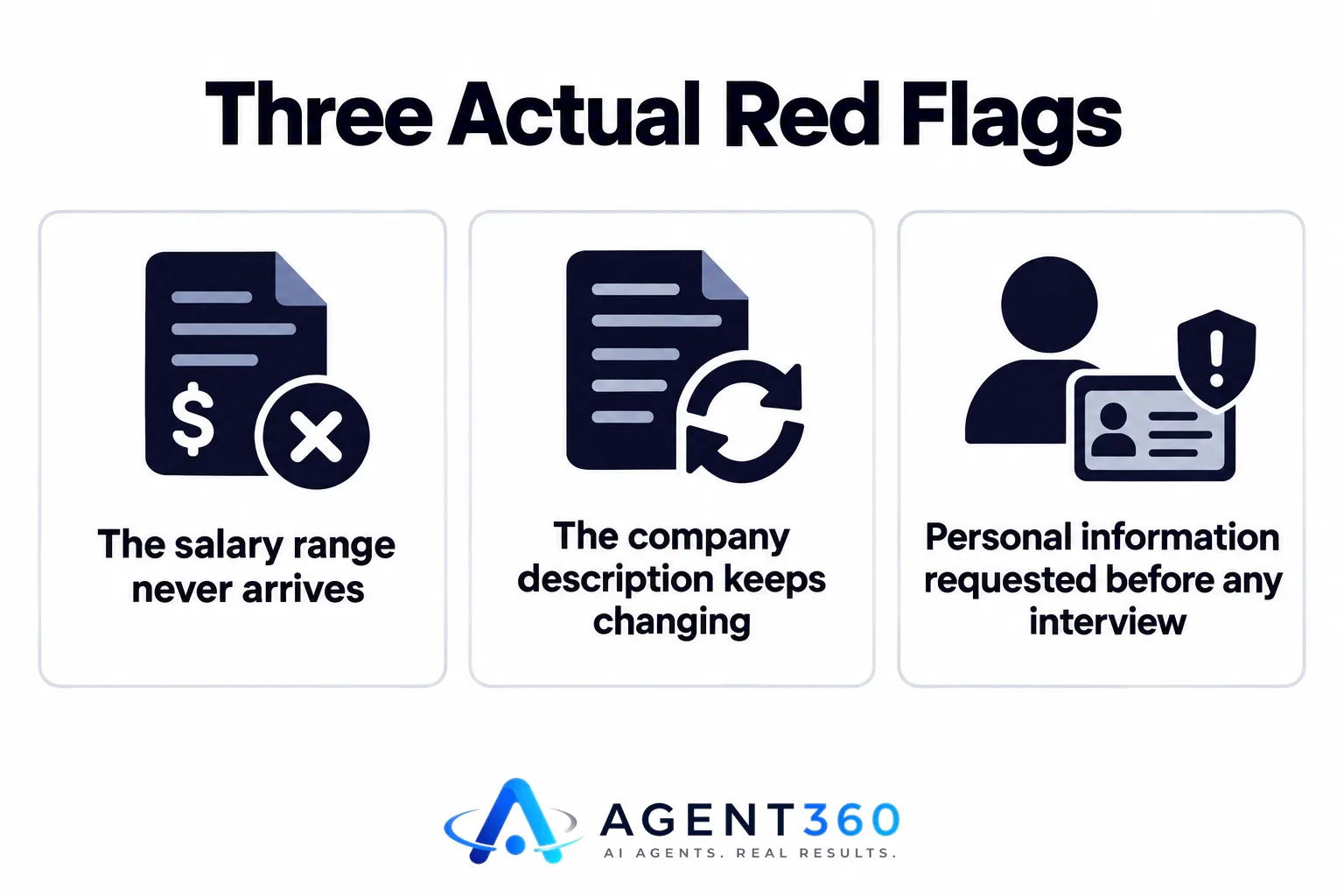
- The salary range never arrives. A legitimate confidential search can still quote a range before the company name — withholding comp indefinitely usually means the range is worse than market, not that the company is sensitive.
- The company description keeps changing. If the industry, size, or stage shifts between conversations, the recruiter is either sloppy or running more than one story at once.
- Personal information is requested before any real interview. A confidential search still follows a normal sequence — intro call, screen, interview. If someone asks for a social security number, bank details, or a copy of an ID before any of that has happened, stop.
None of these are about the confidentiality format. A search can tick every box above and still never reveal the company until an offer, and it's still a legitimate process.
How the mechanics change when you can't name the company
A few practical adjustments make a confidential search easier to run without looking evasive. Use a generic but accurate job description — industry, size range, stage, and the real scope of the role, with the company name held back. If you use an apply page for inbound interest, note on it that this is a confidential search and when the name will be shared, rather than leaving candidates to guess. And keep the first conversation short and low-pressure. A confidential search earns trust by being normal in every way except the one thing it's withholding.
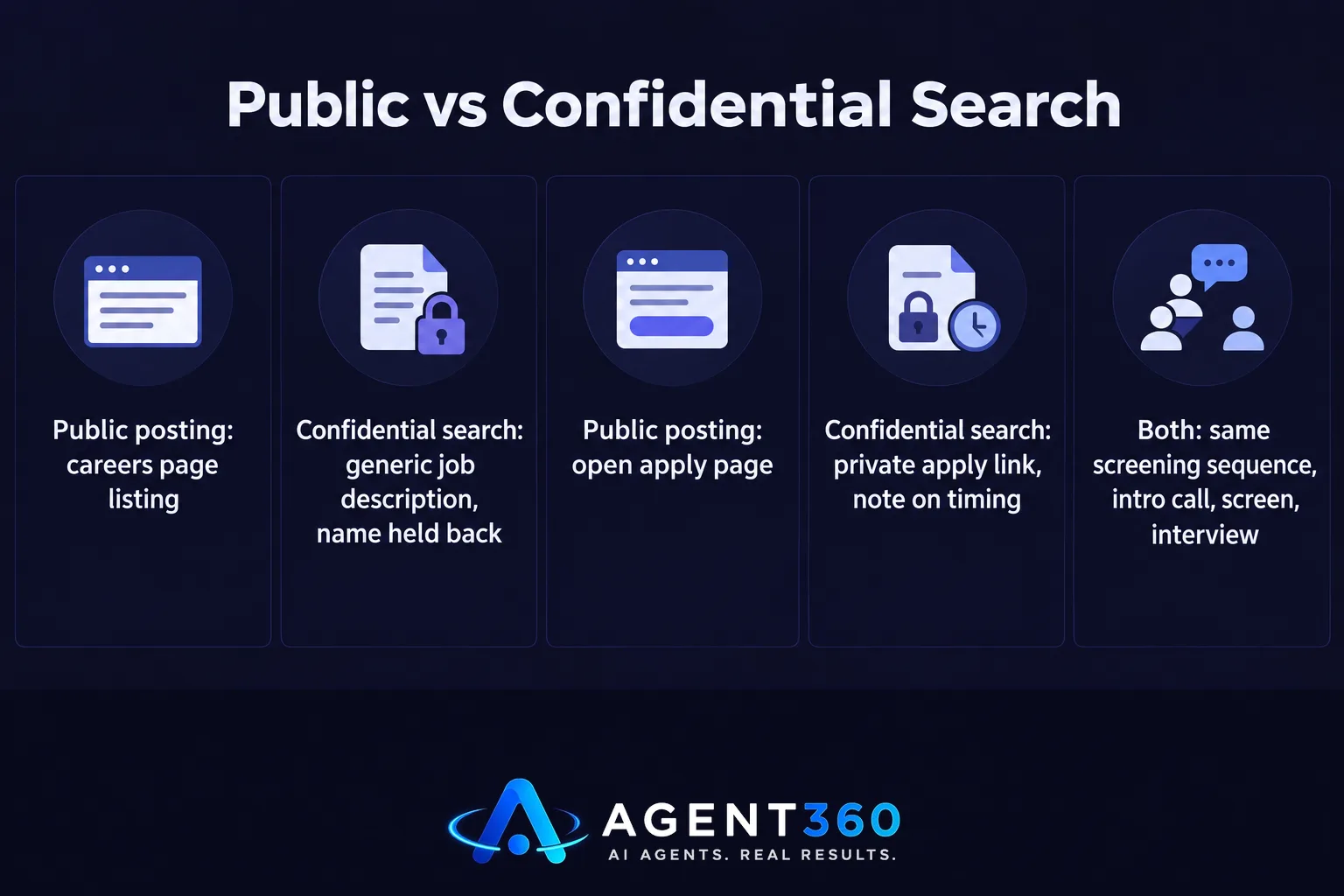
This is also where screening earns its keep. A confidential search still needs a first-round filter — you're not going to reveal the company name to everyone who clicks a link. Running that first screen by phone, with role-specific questions and no company name attached, keeps the confidentiality intact while still moving real candidates forward. Agencies running confidential searches for clients deal with this constantly: the shortlist has to move without the client's name attached to it until late in the process.
Where HiringAgent fits
HiringAgent sources candidates from a job description rather than a public listing — the apply page for each role can stay private and shared only with the people you contact directly, and the AI phone screen runs the same role-specific first round whether or not the company name is attached yet. Everyone sourced or applied lands in the same pipeline, tracked from first contact to offer, which matters more on a confidential search than a public one — there's no job board data to fall back on if your own tracking slips. Plans start at $197 a month; see what's included on the pricing page.
Are “confidential” job postings a red flag?
Not by themselves. A confidential posting becomes a red flag when the employer never gives a reason for the confidentiality, never states a compensation range, or asks for sensitive personal information before any real interview has happened. A legitimate confidential search has a stated cause — an undisclosed incumbent, an unannounced role, a competitive-sensitivity reason — and follows a normal interview sequence once contact is made.
How do I tell candidates it's confidential without naming the company?
State the reason, not just the fact. Instead of leaving the listing blank, say why the company is unnamed and when that will change — for example, after a first conversation or once an offer is extended. Pair that with a real salary range and an accurate description of the industry and size, so the only missing piece is the name itself.
Will running a confidential search hurt my response rate?
It can cut inbound applications, since there's no public listing to attract them — which is exactly why confidential searches lean on direct outreach to sourced candidates instead of waiting for people to apply. Response rates to that outreach tend to hold up fine, as long as the reason for confidentiality, the role, and the compensation are clear from the first message.
More articles
- How to Hire Software Engineers: A Level-First Playbook
- How to Hire Sales Reps Without Guessing on Resumes
- A Talent Sourcing Strategy That Doesn't Start at Zero
- Sourcing Tools for Recruiters: What Each Layer Actually Does
- Is It Legal to Use AI in Hiring? Here's What Applies
- Hiring With AI: What It Can and Can't Decide
- First-Round Interview Questions That Predict Fit, Not Charm
- How to Write a Job Description That Attracts Candidates
