How to Hire Sales Reps Without Guessing on Resumes

Hiring sales reps goes wrong for one reason more than any other: the interview rewards how someone talks about selling, not how they actually sell. A candidate who sounds confident, tells a good story about one big deal, and handles objections smoothly will beat someone who quietly hit 110% of quota for six straight quarters — unless your process is built to catch that. Hiring reps well means testing for quota history, pipeline discipline, and coachability before anyone gets charmed by a pitch.
That starts earlier than most hiring managers think — before the job post goes up, not after the first resume lands.
How to recruit sales reps without widening the net too soon
Most sales hiring fails at sourcing, not interviewing. A generic “Account Executive” post pulls in people who've carried that title without ever carrying a number — titles tell you almost nothing about what someone actually did. Write the job description around the number instead: quota size, deal size, sales cycle length, inbound versus outbound split. Then search on that, not the title.

Sales profiles carry stronger signals than most roles: years in seat, quota size, whether someone stayed through a full ramp or left mid-cycle. Specify those details in the job description and you've got something to filter on, whether you're searching by hand or letting software build the filters. Sales roles behave differently from other functions in a pipeline for exactly this reason — the data that predicts success is more concrete, and easier to check, than it is for most other hires.
Recruit in two lanes at once: post publicly for the people actively looking, and search for the ones who aren't. Reps who are hitting number but might move for a better territory or a bigger comp plan rarely apply to anything. If inbound applicants are your only source, you're choosing from the subset of good reps who happen to be unhappy right now — a much smaller, noisier pool than it needs to be.
Ten qualities of a bad salesman show up before the interview ends
None of this takes months to find out. Most of it shows up in the first conversation, if you're listening for it instead of for charisma.
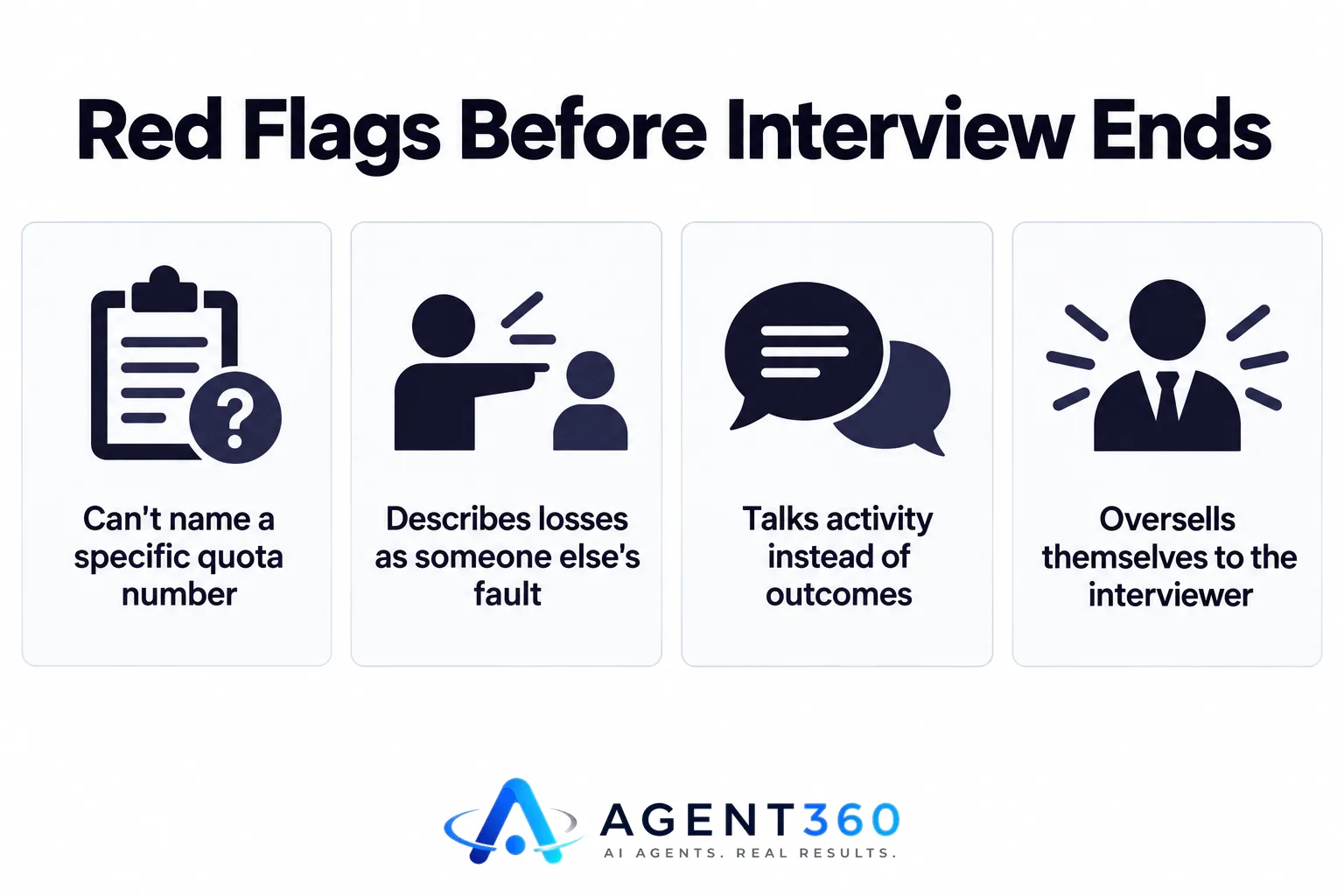
- They can't name a specific quota number from their last two roles — only “I was always top performer.”
- They describe losses as someone else's fault: bad leads, bad marketing, bad territory, every time.
- They talk about activity (calls made, meetings booked) instead of outcomes (deals closed, revenue retained).
- They can't walk you through their actual sales process step by step, only the result.
- They avoid specifics about a deal that fell through, pivoting to a win instead.
- They've changed jobs every 10-14 months with no pattern of promotion or expansion of responsibility.
- They ask nothing about your product, market, or buyer in the interview itself.
- They oversell themselves to you, the interviewer — which is often a preview of how they'll oversell your product.
- They can't describe how they handle a “no” that isn't final, only how they handle a clean yes.
- They have no answer for what they'd do in their first 30 days beyond “learn the product.”
Any one of these alone isn't disqualifying. Three or more in a single conversation usually is. The first-round questions that catch this ask for specifics — not “tell me about a time,” but “walk me through the actual numbers on your last quarter.”
What the 3-3-3 rule actually tells you about a candidate's pipeline habits
The version most reps and sales managers use: three touches by phone, three by email, three by social or video, spread across a set window — usually a week to ten days — before a lead converts to a conversation or moves to a different cadence. It's a prospecting discipline, not a hiring framework. But it's worth asking about directly.
Ask a candidate to walk you through their own cadence for a cold or lukewarm lead. A rep with a real system — however they define it — answers in seconds, with specifics: channel order, timing, what changes the message between touch two and touch five. A rep who's never built pipeline from scratch, or who's only worked warm inbound leads, answers in generalities instead. That gap matters most when the role requires outbound prospecting rather than managing an existing book.
The 80/20 rule in recruiting explains why your shortlist is too long
Applied to hiring, the Pareto principle shows up like this: a small share of your sourced or applicant pool accounts for most of the candidates actually worth a phone call. Finding enough sales candidates isn't the problem — job posts for sales roles pull plenty of applicants. The problem is that maybe one in five is worth fifteen minutes of a hiring manager's time, and nothing in a resume stack tells you which fifth without reading every line.
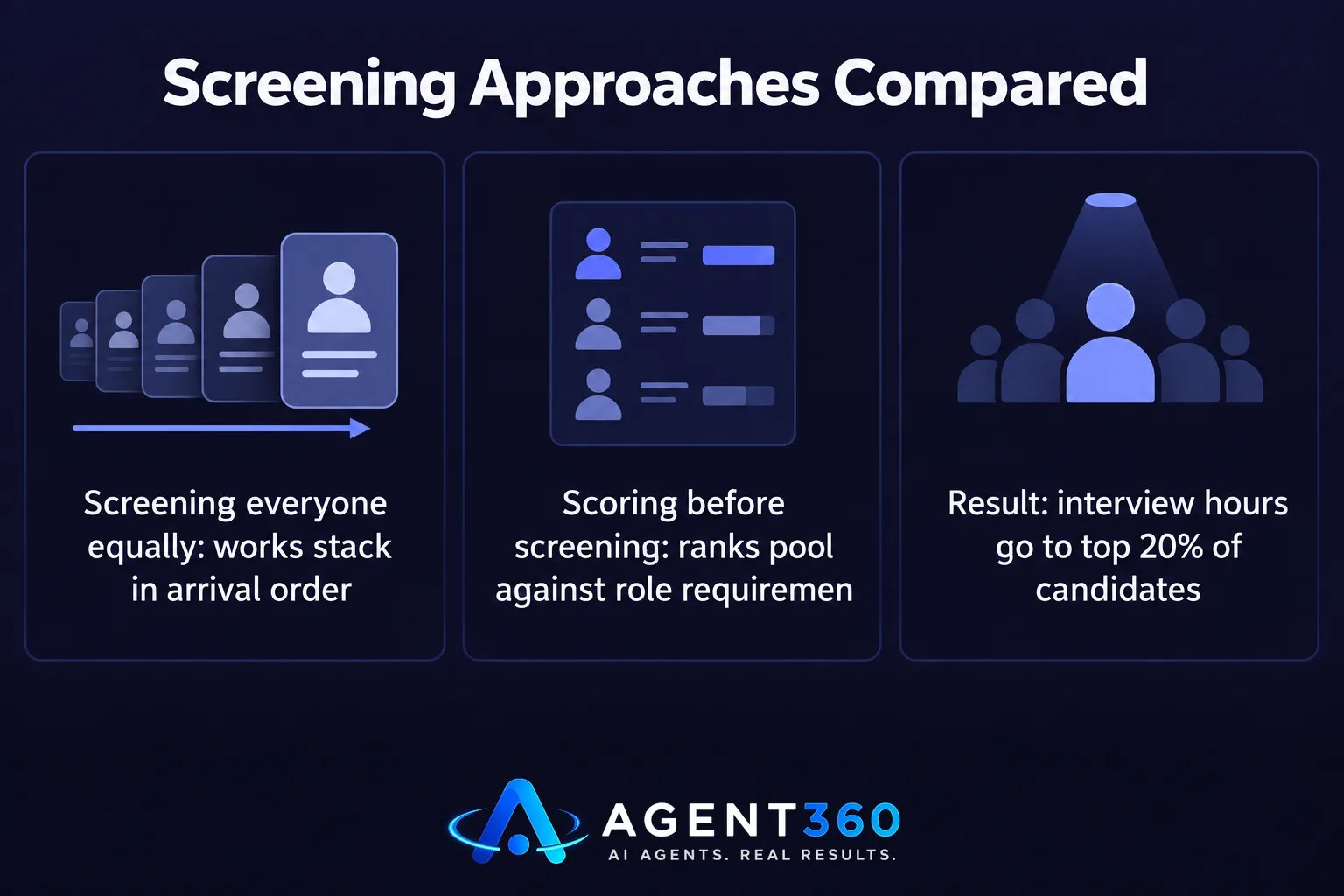
That's the case for scoring before screening, rather than screening everyone equally. Rank a pool of 100 candidates against the actual requirements of the role — quota size, industry, deal complexity, tenure pattern — before anyone picks up the phone, and your interview hours go to the top 20% instead of a stack worked in the order it arrived. The funnel metrics that matter here are less about total applicant count and more about which stage conversions predict a bad hire down the line — a sales req that burns through 80 resumes to land three finalists is telling you something about where the filter is set, not just about the market.
HiringAgent turns a sales job description into a ranked shortlist
HiringAgent reads a sales job description and turns it into search filters — title, seniority, years carrying quota, location — then pulls and scores candidates from 0 to 100 against that specific role, with sub-scores for skills, experience, and location, plus a one-line reason for each score. Candidates who book a slot get a first-round AI phone screen built from the same description, so your team only takes calls with people who've already answered 8 to 12 role-specific questions. It runs as its own applicant tracking system — sourced candidates and inbound applicants land in the same pipeline — starting at $197 a month with unlimited users.
Questions
How to recruit sales reps?
Write the job description around a specific number — quota size, deal size, sales cycle — then source on that instead of title alone, searching both active applicants and people not currently looking. Titles like “Account Executive” mean too many different things to filter on by themselves.
What are 10 qualities of a bad salesman?
Common signals include vague quota numbers, blaming leads or territory for losses, talking about activity instead of outcomes, no real answer for how they handle an unclear “no,” frequent short tenures with no upward pattern, and oversell toward the interviewer rather than straight answers. Three or more in one conversation is a stronger signal than any single one alone.
What is the 3-3-3 rule in sales?
It's a prospecting cadence: three touches by phone, three by email, and three by another channel like social or video, spread over about a week to ten days before a lead moves to a different sequence. It's a self-management tool, useful in interviews as a way to ask candidates how they actually structure outbound work.
What is the 80/20 rule in recruiting?
Applied to hiring, it means a small share of a sourced or applicant pool accounts for most of the candidates worth interviewing. The fix isn't more applicants — it's ranking the pool before screening, so interview time goes to the top fifth instead of whoever happened to apply first.
More articles
- A Talent Sourcing Strategy That Doesn't Start at Zero
- Sourcing Tools for Recruiters: What Each Layer Actually Does
- Is It Legal to Use AI in Hiring? Here's What Applies
- Hiring With AI: What It Can and Can't Decide
- First-Round Interview Questions That Predict Fit, Not Charm
- How to Write a Job Description That Attracts Candidates
- What a Job Description Generator Should Actually Write
- How to Hire Your First Employee Without Guessing
