The Time to Hire Metric: What It Measures, What It Hides

Time to hire is the number of days between a candidate entering your pipeline and accepting an offer. That's it. Offer-accept date minus application or sourced date, averaged across hires in a period. Almost all the confusion around this metric comes from people quietly swapping in a different start date, then comparing their number to someone else's as if it meant the same thing.
Get the start date wrong and every benchmark you read is noise. Get it right and time to hire becomes one of the few recruiting numbers that actually predicts whether you're about to lose candidates to a faster competitor.
How do I calculate the time to hire?
Take every hire closed in a period — a month, a quarter — and subtract the date they entered your process from the date they accepted an offer. Entered your process means the day they applied, the day a sourced candidate agreed to a first conversation, or the day a referral landed in your pipeline. Average those day counts across all hires in the period. That's time to hire for that period.
The part people skip: segment it by role and by source before you trust the average. A single blended number across an engineering req that took 51 days and a support req that took 11 tells you nothing you can act on. Run it by role family instead, and the number starts pointing at specific stages — usually scheduling and offer approval — instead of hiding behind an average.
Does anyone feel the time to fill metric is unfair?
Time to fill and time to hire get used interchangeably, and they shouldn't be. Time to fill starts the clock when a requisition is approved — before a single candidate has entered the pipeline — so it's measuring your intake and sourcing lag as much as your actual hiring speed. A recruiter can run a fast, disciplined process and still post a bad time to fill number because the hiring manager sat on the req for three weeks before approving it.
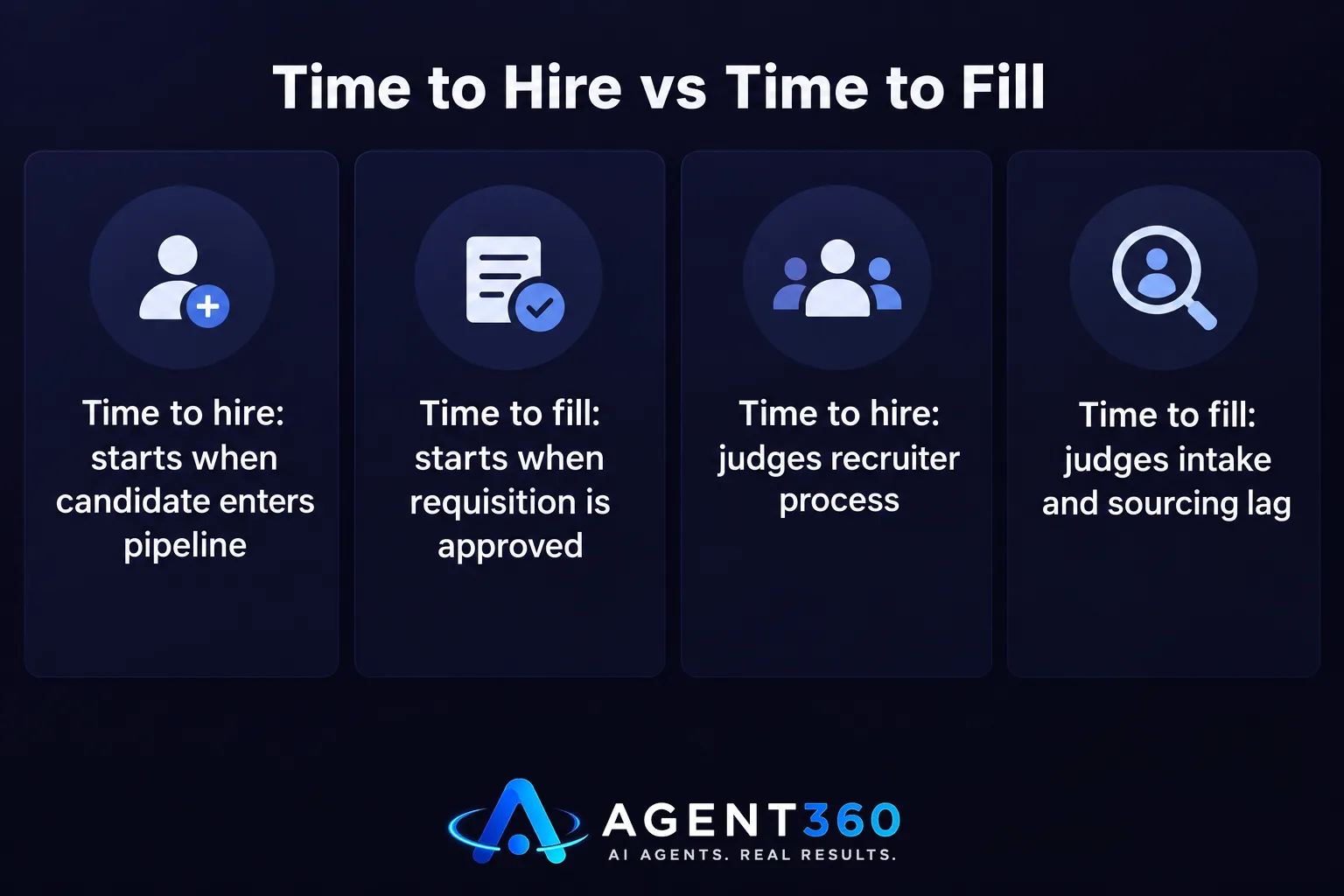
That's the fairness complaint, and it's a fair one. If you're judging recruiter performance, time to hire is the cleaner number — it starts once the recruiter actually has a live candidate to work. Time to fill is better for judging whether your intake process — getting a req approved, a job description finalized, a role posted — is the bottleneck. Use both. Don't let one grade the other's work.
What's your time-to-offer?
Time to offer is the sub-metric inside time to hire that most teams never isolate. It's usually where the days actually go. It's the gap between a candidate's final interview and an offer being extended. If your overall time to hire is 38 days and time to offer alone eats up 9 of them, that's not a sourcing problem or an interview problem. That's an internal approval problem, and no amount of faster candidate sourcing fixes it.
Pull this number separately before you diagnose anything else. Teams that only look at the top-line time to hire tend to invest in speeding up the part that was never slow.
What formula do you use for quality of hire?
There isn't one agreed formula, and anyone who hands you a single clean number is making a choice you should know about. Quality of hire usually gets built from some combination of manager satisfaction scores at 90 days, performance review ratings at six or twelve months, and retention past the first year — weighted however the company decides matters most. The honest version of this metric takes months to produce and depends on inputs a recruiting team doesn't fully control.
The practical move is to stop letting time to hire and quality of hire compete for the same decision. Speed up a process that was cutting corners on screening, and it'll show up as a faster time to hire — and a worse quality of hire a year later. Read the two together. Don't optimize one at a time.
What are the 5 key HR metrics?
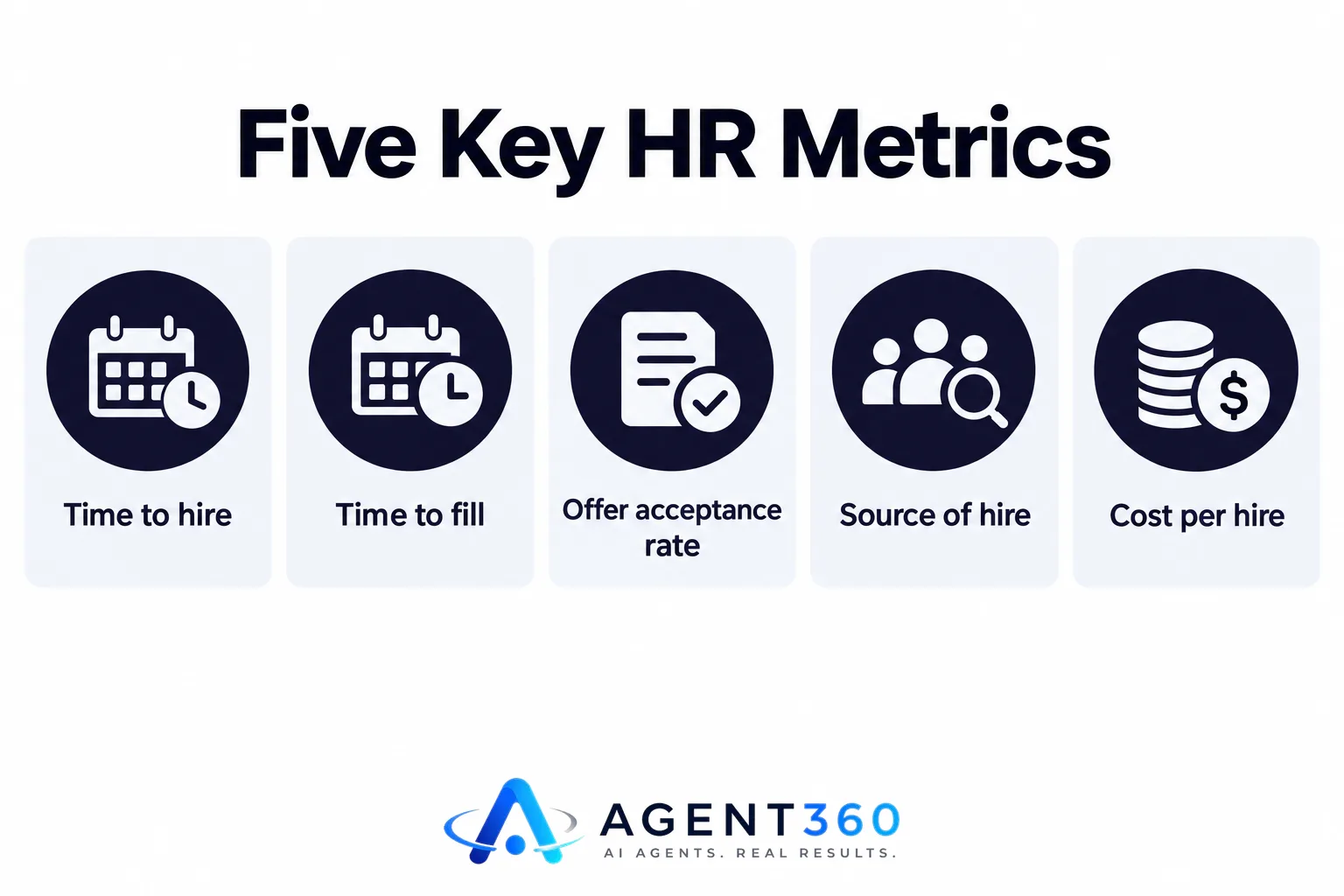
The set that shows up most consistently across recruiting teams: time to hire, time to fill, offer acceptance rate, source of hire, and cost per hire. Each answers a different question — speed, intake lag, candidate experience and offer competitiveness, channel effectiveness, budget efficiency. None substitutes for the others, which is the actual argument for tracking a short dashboard instead of chasing one headline number.
Stage conversion — the percentage of candidates who move from applied to interview to offer — is worth adding as a sixth if you're trying to find where a pipeline leaks. It points at specific stages instead of an average across the whole process.
What is the 70/30 rule in hiring?
There's no standardized, widely cited definition of a 70/30 rule in recruiting. It shows up informally in a few different contexts, most often as a rough split between structured interview questions and open conversation, or between time spent sourcing versus time spent on everything else in the process. If someone cites it to you as an industry standard, ask where the number comes from. Treat it as a heuristic worth testing against your own funnel, not a rule to adopt on faith.
What is the 80/20 rule in recruiting?
Same caveat here. The 80/20 framing gets applied loosely — most commonly as the idea that a small share of your sourcing channels or candidates produce most of your quality hires. Worth checking against your own source-of-hire data, because it's often true in practice even without a formal rule behind it: a handful of channels or search criteria tend to carry a disproportionate share of your strong matches. That's a reason to track source of hire alongside time to hire, not a fixed ratio to plan around.
Shrink the stage that's actually slow
Once you've segmented time to hire by role and isolated time to offer, most teams find the slow stage is sourcing a first shortlist or scheduling that first screen — not the final decision. HiringAgent sources and scores candidates straight from your job description and lets candidates book their own first-round AI phone screen slot, which cuts the back-and-forth that usually stalls week one. The built-in hiring reports break time to hire out by job and stage automatically, so you're not rebuilding the calculation in a spreadsheet every month.

If you want the fuller breakdown of where days get lost and what to do about each one, that's covered in how to reduce time to hire without lowering the bar.
Frequently asked questions
How do I calculate the time to hire? Subtract the date a candidate entered your pipeline from the date they accepted an offer, then average that across hires in a period, ideally segmented by role.
What's the difference between time to hire and time to fill? Time to fill starts when a requisition is approved and includes intake lag; time to hire starts once a candidate is actually in your process. Use time to fill to judge intake speed, time to hire to judge the process itself.
Is a lower time to hire always better? No. A number that drops because screening got skipped shows up later as worse quality of hire or higher early turnover — so read it next to acceptance rate and retention, never alone.
More articles
- How to Reduce Time to Hire Without Lowering the Bar
- How to Screen Candidates Faster Without Lowering the Bar
- A Boolean Search Alternative for Recruiters Who Are Done With Strings
- What Passive Candidate Sourcing Actually Takes
- How to Find Candidates Who Are Open to Work
- Resume Parsing Software: What It Gets Right (and Wrong)
- AI Resume Screening Scores Resumes, Not Hires
- Automated Phone Screening Interviews: What They Replace
