AI Candidate Sourcing: What It Replaces, What It Doesn't
AI candidate sourcing takes a job description, builds a search from it, runs that search against a database of professional profiles, and ranks who comes back against the role. That's the whole trick. It's the work a sourcer does with a boolean string and a spreadsheet, compressed into minutes instead of a day. It doesn't decide who gets hired, and it's only as good as the database underneath it and the description you feed it.
That second part trips up most people evaluating this category. They judge the AI. They should be judging the search and the source.
It turns a job description into search filters, not a wishlist
Under the hood, this is a parsing problem before it's an AI problem. The system reads your description and pulls out titles, title variants, locations, seniority, years of experience and named skills, then turns those into the filters a search engine actually runs on. A sourcer building this by hand for a single requisition — picking title synonyms, deciding whether \"5+ years\" means a hard cutoff or a guideline, working out which skills are must-haves versus nice-to-haves — can easily spend two to four hours getting one search right. And it still misses variants a human would think to add later.
The AI version does the same translation instantly. Which means the quality of your job description now matters more, not less. A vague title, no seniority range, a skills list copied from three postings ago — that produces a vague search. Garbage in, ranked garbage out. This is the one place the old recruiting advice still holds, whether a person or a model is searching off it: write the job description like you mean it.
The database it searches sets the ceiling, not the model
Two tools can run the same filters and return different candidates, because they're not searching the same pool. Some products search a single professional network. Others pull from a broader database of public profiles. This is the variable worth asking about before you ask about the AI — no amount of smart ranking fixes a thin source. If you're evaluating a sourcing tool, ask what it searches and how many profiles a single run can return. A tool capped at ten or twenty results per search is doing keyword matching with extra steps, not sourcing.
A score is only useful if you read what's under it
A single number — 0 to 100, or stars, or a percentage — tells you almost nothing on its own. Two candidates can land at 72 for completely different reasons: one is missing a required skill, the other is three states away from an onsite role. Treating the headline score as the whole verdict is the most common way teams waste a sourcing tool's output. The useful version breaks the score into sub-scores for skills, experience and location, adds a one-line reason, and flags the specific gap to check — so a 72 with a location mismatch and a 72 with a skills gap get looked at differently instead of both getting dropped at the same cutoff. As a rough rule, treat anything above 80 as worth a first look and anything below 50 as not worth your time. The band in between gets decided by which sub-score is actually missing.
It still fails on three things a sourcer catches
Context the description never captured. A candidate who switched industries for reasons that make them a better fit, not a worse one, won't show up as a match — their resume reads like a career change, not a step up.
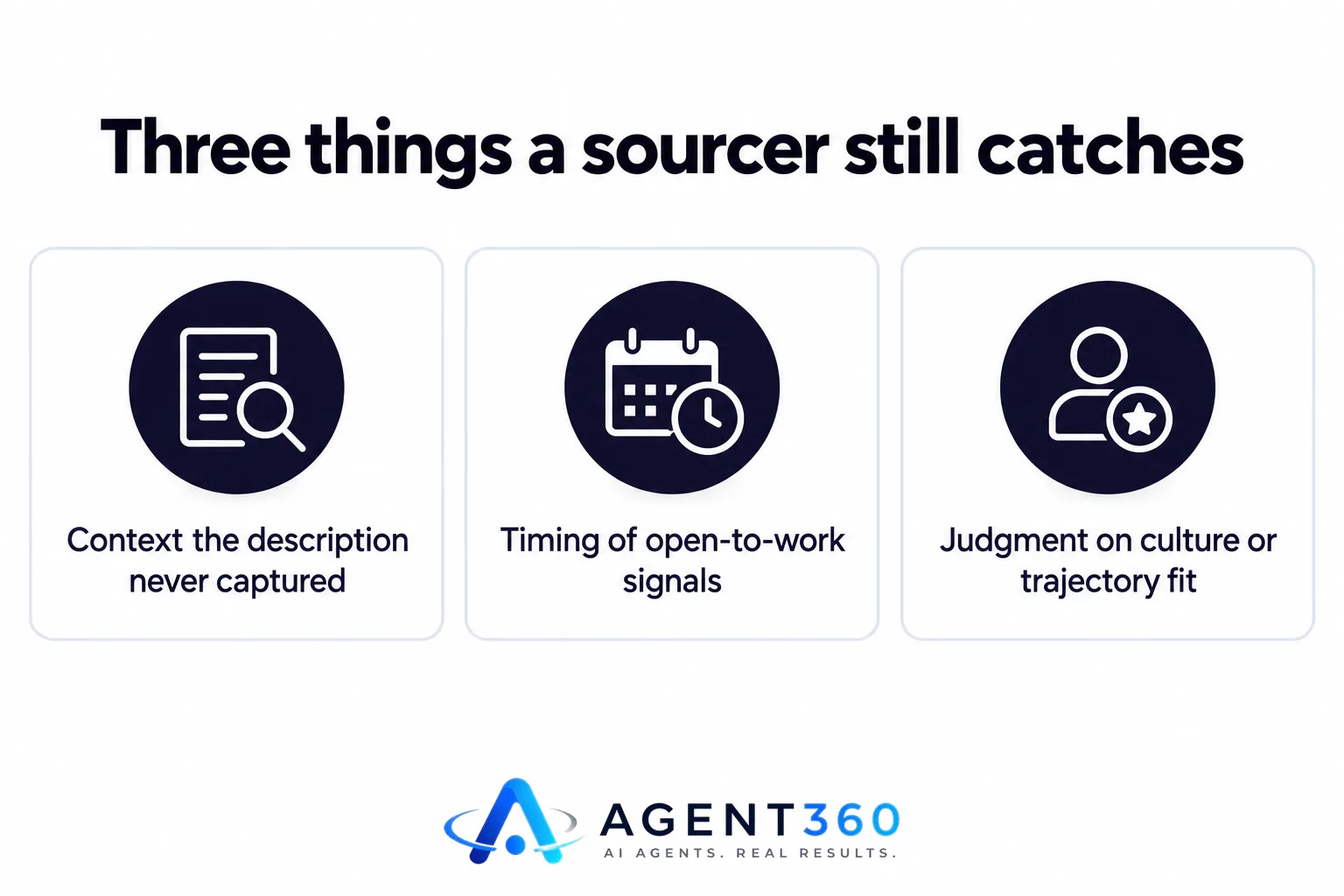
Timing. Open-to-work signals help, but a signal on a profile is a snapshot, not a conversation. Someone can look passive and be two weeks from accepting another offer.
And judgment on culture or trajectory fit, which no filter set captures because it was never going to be written into the job description in the first place. None of this means the sourcing step failed. It means sourcing produces a shortlist, not a decision, and the gap between the two is still a person's job.
Where this fits in an actual hiring process
Sourcing is one stage. For it to save time instead of just moving the bottleneck, the candidates it finds need to land in the same pipeline as the people who apply on their own, get the same scoring treatment, and move into a first-round screen without someone manually re-entering them into a spreadsheet. This is the part most sourcing-only tools skip, and it's where HiringAgent is built differently: the Sourcing Agent pulls from a database of public profiles using filters built off your actual job description, every candidate gets an AI match score with sub-scores and a stated gap, and sourced candidates land in the same applicant tracking pipeline as inbound applicants rather than a separate list someone has to reconcile later. Plans start at $197 a month with up to 300 candidates sourced and scored; details are on the pricing page.

How it compares to searching LinkedIn yourself
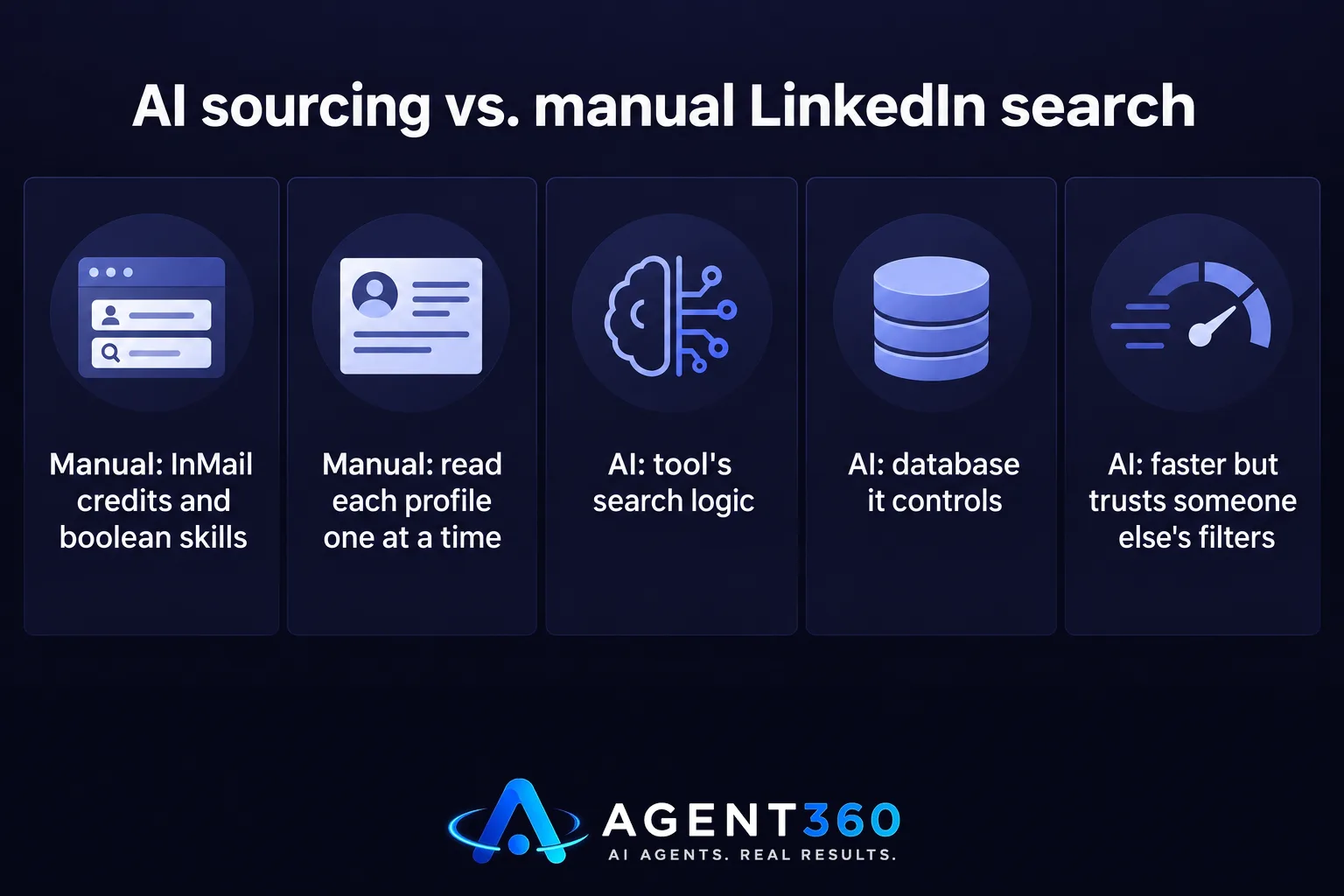
Manual search on a professional network depends on InMail credits, your own boolean skills, and how much time you have to read each profile one at a time. AI sourcing trades that time for a tool's search logic and a database it controls — faster, yes, but it also means you're trusting someone else's filters and someone else's source. If you're weighing the two directly, the fuller breakdown is in this comparison against LinkedIn Recruiter. For specialized searches — engineering titles in particular tend to live in long, specific boolean strings — the gap between a hand-built search and an AI-generated one is usually smaller than the gap between a thin database and a deep one. See how that plays out for engineering roles specifically.
Frequently asked questions
How is AI candidate sourcing different from a job board?
A job board waits for candidates to apply. AI candidate sourcing searches a database of existing profiles and ranks people against your role whether or not they've applied anywhere — it goes to the candidates instead of waiting for them to come to you.
Does AI candidate sourcing replace a recruiter?
No. It replaces the manual search step — building boolean strings and reading profiles one by one — but someone still needs to write the job description well, read the shortlist with judgment, and make the hiring call. It compresses hours of search into minutes. It doesn't compress the decision.
How many candidates should a single sourcing run return?
Enough to give a real shortlist without drowning the reviewer. In practice, somewhere between 50 and 300 candidates per run, filtered and scored, is the useful range. Fewer than that and you're probably searching too narrow a database or too narrow a filter set. More than that, and the score — not the raw count — is doing the real work of narrowing things down.
More articles
- Resume Parsing Software: What It Gets Right (and Wrong)
- AI Resume Screening Scores Resumes, Not Hires
- Automated Phone Screening Interviews: What They Replace
- AI Phone Screening for Recruiters: What the Call Should Do
- What an ATS With AI Candidate Matching Should Actually Do
- The Best ATS for Startups Finds Candidates Too
- What a Modern Applicant Tracking System Actually Does
- What an Applicant Tracking System for Small Business Costs
