AI Phone Interview: Where It Fits and Where It Shouldn't
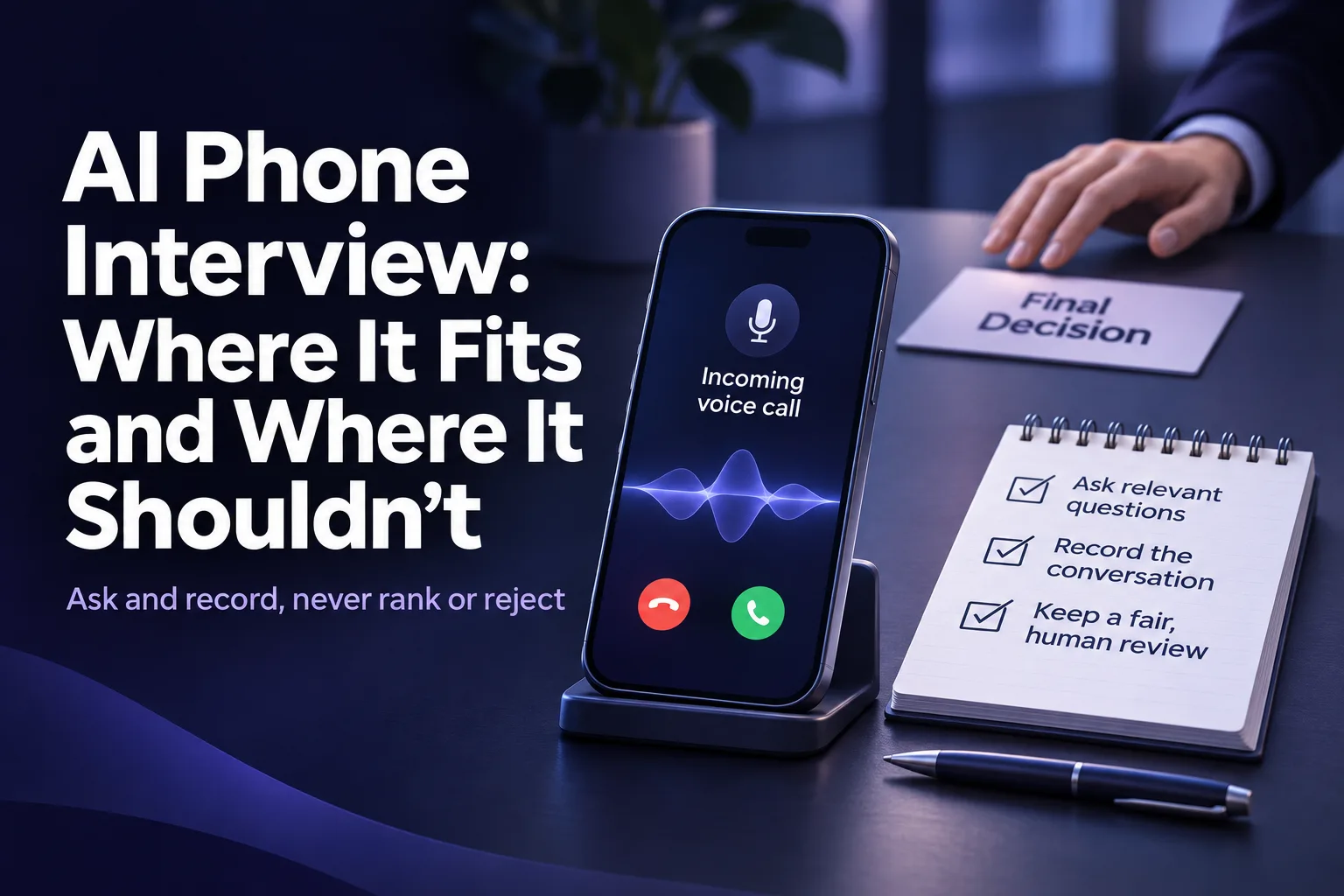
An AI phone interview is a first-round call where a voice agent rings the candidate, asks a fixed set of role-specific questions and records that the call happened. It does that one job well. It should not rank people, reject people or stand in for the conversation where you decide whether to hire someone. Everything below follows from that line.
How is AI used in interviews?
Four different things get called “AI interviewing”, and they carry very different risk:
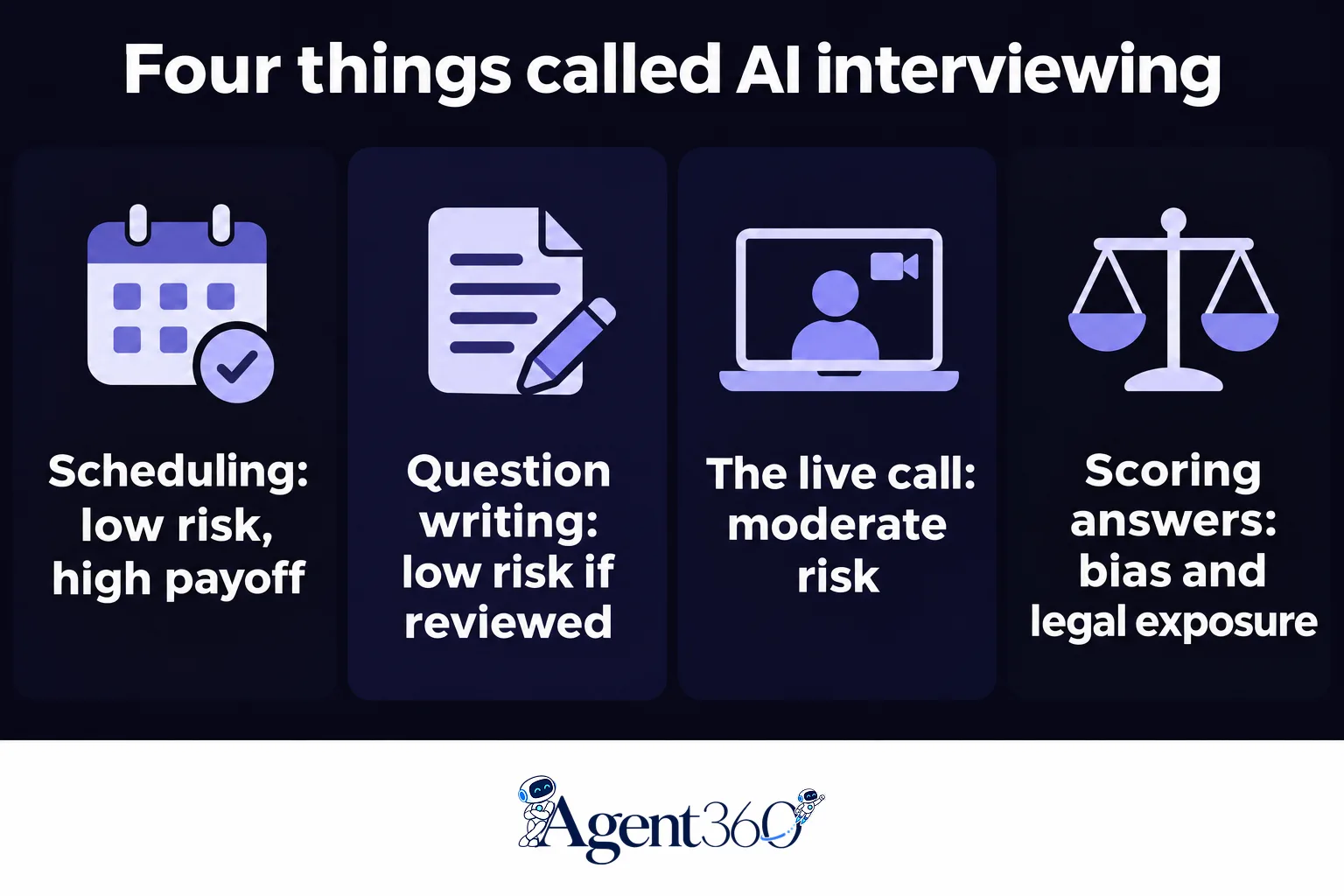
- Scheduling. The candidate gets a link, picks a slot, and nobody trades emails. Low risk, high payoff.
- Question writing. AI drafts questions from the job description so every candidate for the role is asked the same things. Low risk if a person reads the questions first.
- The live call. A voice agent phones the candidate and asks the questions. This is the AI phone interview proper. Moderate risk, mostly about candidate experience and disclosure.
- Scoring the answers. Software grades what the candidate said, or how they said it. Bias and legal exposure pile up here, and it is the part we would skip. The legal picture for AI in hiring depends on where you hire, so check it before you automate anything that evaluates people.
Most of the value sits in items one to three. A first call mostly costs you hours of calendar juggling and the same opening questions, asked again and again. Scoring is the tempting extra, and it carries the most downside. We cover the same boundary from the decision side in what AI can and can’t decide.
What is the 80/20 rule in interviewing?
The usual version: the candidate talks about 80% of the time, the interviewer about 20%. It is a rule of thumb, not a measured law, but it catches a real failure. Interviewers who talk too much learn nothing, and they hand the candidate the answers by describing what they want.
An AI caller is naturally good at the 20%. It does not riff, sell the company at length or fish for rapport. The rule only holds if the questions are built for it, so here is the math. A 30-minute slot with 8 to 12 questions leaves roughly two and a half to three and a half minutes per answer. That rules out yes/no questions and anything a resume already answers. What works instead:
- Ask for a specific episode. “Walk me through the last time you did X” beats “Do you have experience with X?”
- Ask for the constraint. “What was the team size, the volume, the deadline?” Vague answers show up fast when you ask for numbers.
- Ask one logistics question, not five. Start date, location and pay range belong in a single block, not scattered through the call.
If you want a starting list, first-round interview questions that predict fit, not charm is built for exactly this format.
What is the 30% rule for AI?
There is no standard 30% rule for AI in hiring. The phrase circulates as an informal idea. Sometimes it means AI should handle about 30% of a workload, sometimes the reverse, and different people mean different things by it. Treat any version as a slogan, not a policy.
We would argue against the percentage framing altogether. A percentage measures how much work is automated, not how much risk you took on. Automating 70% of a recruiter’s week by booking calls and drafting questions is safe. Automating 5% by letting software reject people is not. Split by type of task instead:
- AI does repeatable pre-work: searching, scheduling, asking the same opening questions of everyone.
- People do judgment: who advances, who gets an offer, how to read an unusual career path, any exception to the rules.
Write that split down before you buy anything. When a vendor demo blurs it, you will notice.
What is a $900000 AI job?
It refers to headlines about extraordinarily paid AI roles. We cannot verify any specific listing, and the topic has nothing to do with how AI phone interviews work. It matters for one reason. A candidate who gets a text or call about an AI phone interview may wonder whether it is a scam, and outsized pay promises are a classic scam hook.
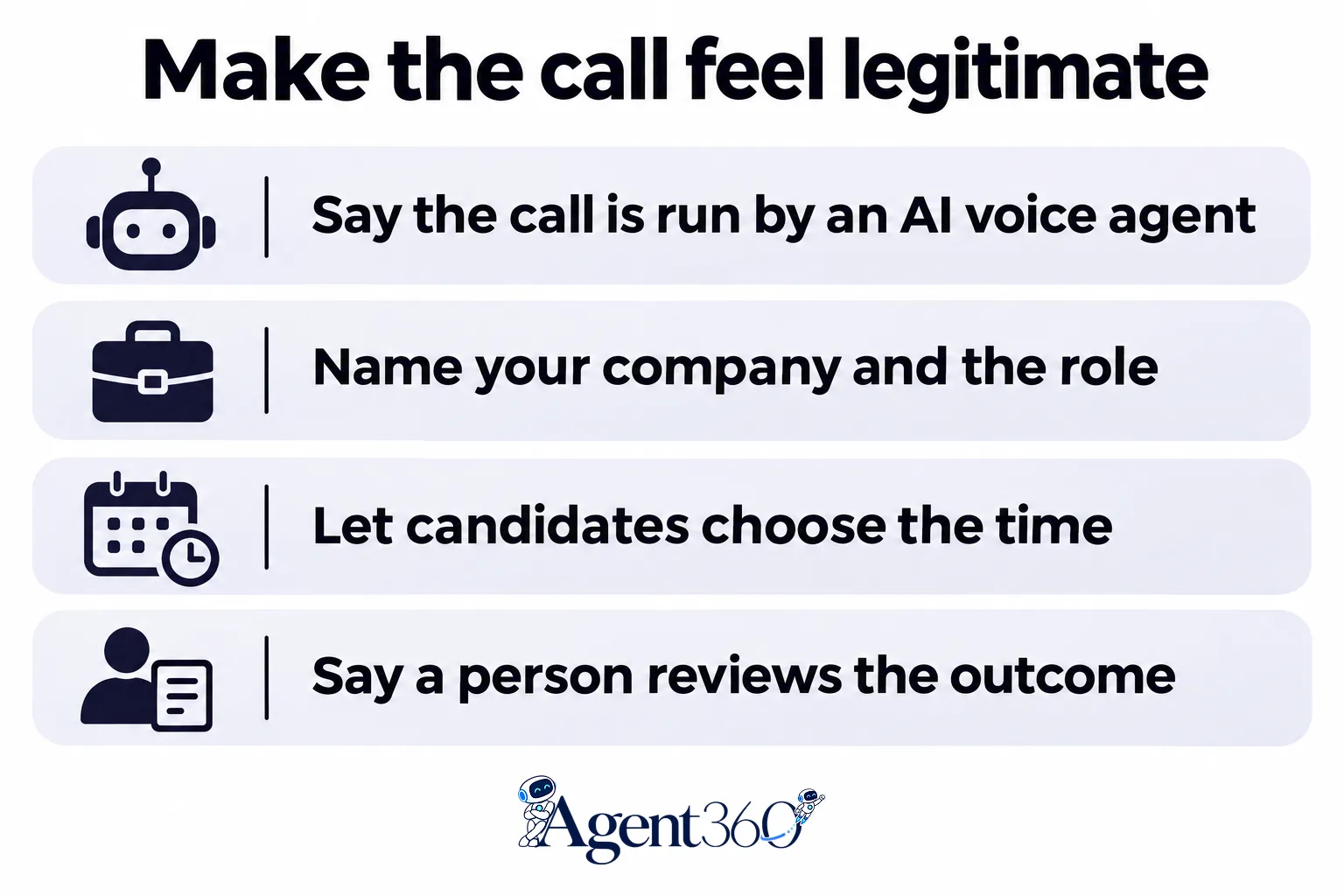
Candidates ask constantly whether an AI phone interview is even real. Answer that before they ask:
- Say in the first message that the call is run by an AI voice agent.
- Name your company and the role, and link to the job’s apply page so they can confirm it exists.
- Let them choose the time instead of calling cold.
- Tell them a person reviews the outcome, and say who to contact for a human alternative.
A candidate who feels ambushed by a robot will drop out, or answer in one-word sentences. Disclosure costs you nothing and protects your response rate.
Set five rules you could defend to a rejected candidate
- Same questions, same order, for everyone in the role. This is the one thing automation does better than people.
- Questions come from the job description, not from a generic bank. If a question cannot be tied to a requirement, cut it.
- The candidate books the slot. Surprise calls break trust and disadvantage anyone who cannot pick up at work.
- A person decides who moves on. Our longer argument is in a phone screening agent should ask, not decide.
- Offer a human route. Some candidates have accessibility needs or simply refuse. Losing them is cheaper than a process nobody can explain.
Disagree if you like. But look at what the alternative demands: if the call itself rejects people, you have to explain why, and many tools cannot.
Where HiringAgent fits
HiringAgent’s AI phone screen follows the design above. You add candidates to the interview sequence, and each gets a text with a link to book a 30-minute slot. At that time an AI voice agent calls and asks 8 to 12 questions written from your job description. When the call ends, the candidate’s status moves to screened. It lives in the same product that sources candidates and scores them 0 to 100 against the role, so the questions come from the description that drove the search.

Know the limits before you buy. The call produces no transcript, recording, summary or score, so it does not rank anyone, and a person decides who moves on. There is no reminder if a candidate never books, and no calendar sync or video-call links. If you need recordings to audit every screen, this is the wrong fit. If you want a first round that saves you the scheduling and the repeated opening questions, plans start at $197 a month, with 20 AI phone screens on Starter.
Questions people still ask
Does an AI phone interview decide who passes?
It should not. A well-built one asks the same role-specific questions of every candidate and records that the screen happened. A person reviews and decides who advances. Tools that score or reject from the call alone leave you to explain the decision.
Should candidates be told the interviewer is AI?
Yes, in the invitation, before they book. Disclosure cuts no-shows and the “is this a scam?” reaction, and some jurisdictions require notice when automated tools are used in hiring. Check the rules where you hire.
Does an AI phone interview replace the recruiter call?
No. It replaces the first, repetitive pass, where someone asks every candidate the same opening questions. The conversation about motivation, compensation, team fit and exceptions still needs a person. That call also goes better once the first pass has cleared out the obvious mismatches.
More articles
- Candidate Sourcing VA: What to Hand Off and What to Keep
- Systems for a Recruitment Agency: Five You Actually Need
- Resume OCR: Why Scanned Resumes Fail and How to Check Yours
- Come trovare candidati qualificati che non cercano lavoro
- Search for Candidates Without Boolean Strings: 3 Ways
- Filter Sales Candidates by Deal Size: Proxies, Then Proof
- Steps to Find Qualified Employees Online, in Order
- A Phone Screening Agent Should Ask, Not Decide
