Candidate Sourcing VA: What to Hand Off and What to Keep

A candidate sourcing VA is a remote assistant who finds people who fit an open role and hands you a list you can act on: name, current title, profile link, and a note on why they fit. Give them a written spec and judge the output by the profiles you accept, and it works. Give them a job title and pay by the hour, and it doesn't. Below: what the job is, what to keep for yourself, whether virtual recruiters are legit, and whether this makes a decent side hustle.
Candidate sourcing is finding people before they apply
Sourcing is the step before screening. A recruiter or hiring manager decides who is worth contacting; sourcing produces the pool they pick from. It means searching professional networks and databases, reading profiles, and building a list of people who match the role on paper. Interviewing, assessing and making offers are not part of it.
That boundary matters when you hire a VA. Sourcing is a search-and-read job with an output you can check, which is why it hands off so well. For the passive-candidate side in more depth, see what passive candidate sourcing actually takes.
Hand a VA the search and keep the judgment
Delegate the parts that are repetitive and verifiable:

- Running searches across titles, locations and skills, including the odd title variants a boolean string would miss.
- Reading each profile against your must-haves and logging a yes, no or maybe.
- Recording the source, date found and profile link in one shared sheet or your ATS.
- Drafting first-touch messages for you to approve.
Keep these yourself:
- The must-have list. A VA who guesses what matters will guess wrong, and you won't find out until you've read forty bad profiles.
- The final yes. A VA can say a profile meets the written criteria. Whether this person is worth a call is your decision.
- Sending messages under your name. Do this only after you've approved the copy and the list.
- Any call about a candidate’s fit beyond the page. Profiles are thin evidence. Treat a VA’s “maybe” as a prompt to look, not a recommendation.
Write the brief in four lines or expect a spreadsheet of noise
Most disappointing VA batches trace back to a vague brief. Give them four things in writing:
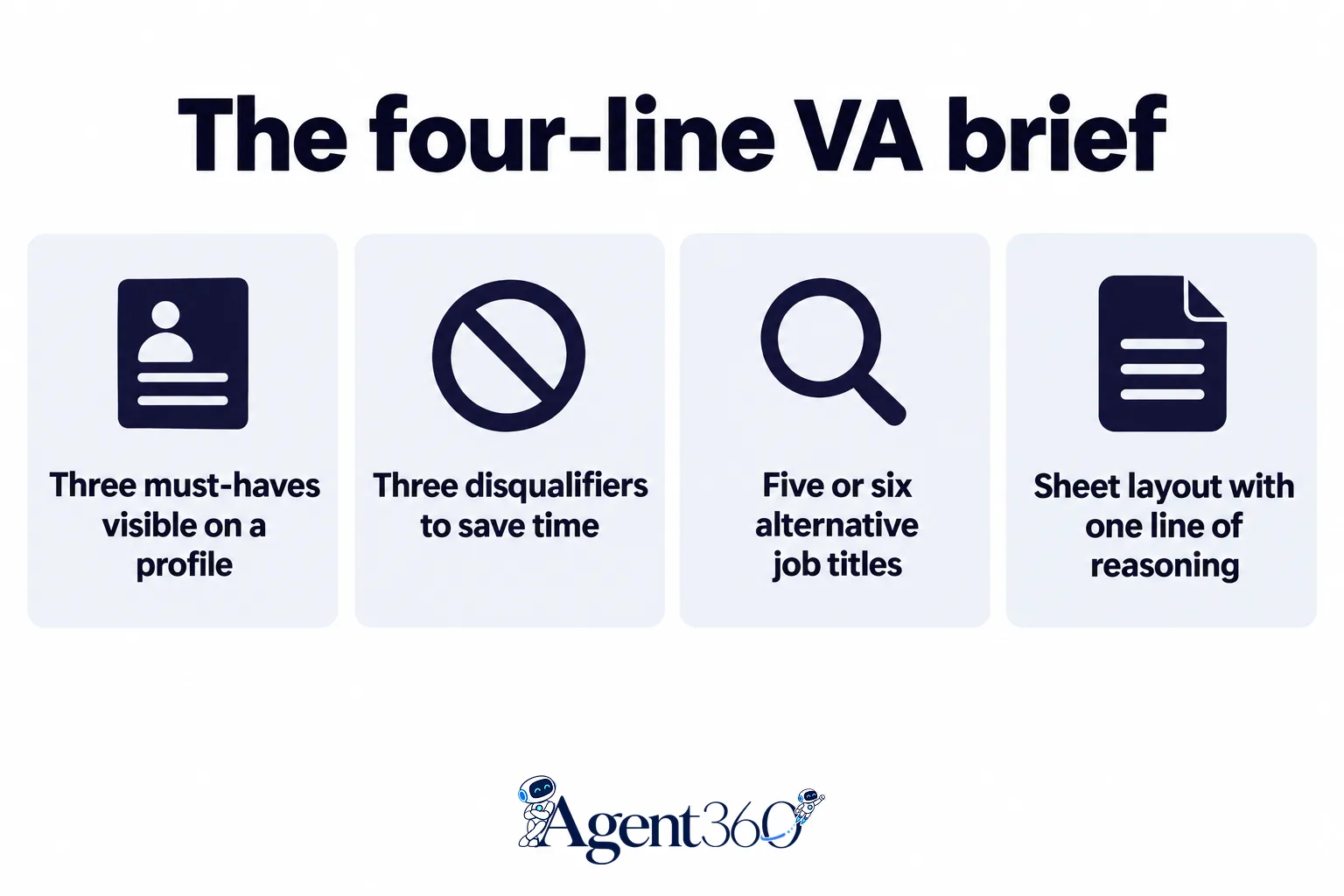
- Three must-haves. For example: has carried a quota, has sold to finance teams, has been in seat at least two years. Pick things visible on a profile.
- Three disqualifiers. Wrong region, wrong seniority, current employer is a competitor you cannot approach. Disqualifiers save more time than must-haves.
- The title list. Give five or six titles that could mean the same job at different companies. Titles vary, and a VA who searches only your exact title misses people.
- The sheet layout. Name, link, current title, current company, years in role, yes/no/maybe, one line of reasoning. If “reasoning” is empty, you can't audit the work.
Before the full run, ask for a test batch of about 25 profiles, and read every one. If more than a handful are clear misses, the problem is the brief or the person. You learn that in an hour instead of a week. If the VA is searching without strings, three ways to search without boolean strings shows what that looks like in practice.
Pay for profiles you accept, not hours worked
Hourly pay rewards slow work that looks thorough. Per-profile pay rewards volume and junk. What tends to hold up is a rate per profile you accept, with “accept” defined: it meets all three must-haves and hits none of the disqualifiers. The VA then has a reason to read carefully, and you have a number to compare against what a good batch should cost.
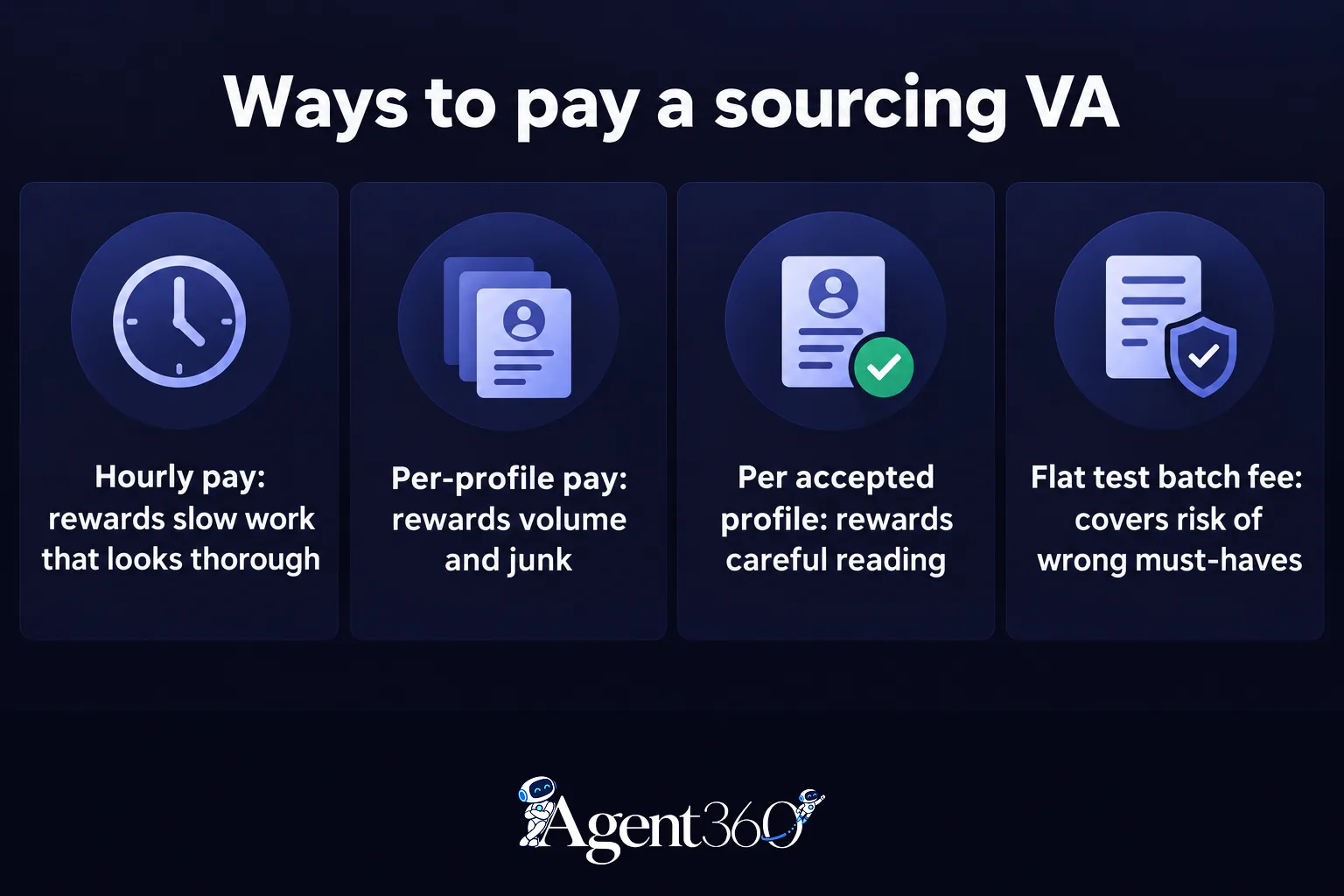
VAs will push back on this, and fairly: if your must-haves are wrong, they do unpaid work. Fix that by paying a small flat fee for the test batch whatever the outcome. The brief is your job. The reading is theirs.
Is a virtual recruiter legit? Check these five things
“Virtual recruiter” covers everything from an established staffing firm to a freelancer with a good profile to a scam. The label tells you nothing, so check the arrangement:
- Who gets paid by whom. You pay the recruiter or VA. If candidates are asked to pay a fee or buy training to be considered, walk away.
- A named, checkable person. Real work history, a profile you can verify, references you can call.
- A paid test batch first. Anyone legitimate will do one. Anyone who refuses and wants a monthly retainer up front is selling comfort, not work.
- Who owns the candidate data. Put in writing that the list and every note belong to you, and that candidate details are not reused or sold. Candidate data is personal data, and privacy rules vary by region, so confirm what applies to you.
- How they access platforms. If the plan is for the VA to log into your professional network account, read that platform’s terms first. Shared logins and heavy automated activity can put the account at risk, and each platform sets its own limits.
A traditional staffing firm is a different model from a freelancer. It usually charges a fee per hire and owns more of the process. If you're weighing a VA against that model, how an agency compares with doing sourcing in-house sets out the trade-off.
VA work is a good side hustle only if you already read roles well
For anyone eyeing sourcing as a side hustle, the honest answer is mixed. It's easy to start: a laptop, a search habit and a spreadsheet. The work is real and clients do need it. But three things hold it back.
- It is not passive. Every hour of income is an hour of work, and sourcing is reading that eats your attention.
- Generic sourcing is a crowded offer. “I will find you candidates” competes with every other VA and with software. A niche you actually understand, such as sales hires for B2B software or finance roles in a specific region, is what lets you charge for accuracy rather than hours.
- Software is eating the search step. The value is shifting toward checking, judgment and outreach. If your pitch is just running searches, you're selling the weakest part of the job.
It makes sense if you have recruiting, sales or HR experience and want to build toward recruiting work. It's a poor fit if you're hoping for easy hours with no domain knowledge.
Software now does the search; your VA’s time moves to checking
The slow part of sourcing is turning a job description into filters and reading the first few hundred profiles. AI tools now handle that. AI candidate sourcing reads the description, builds the search, and ranks results against the role.
HiringAgent does this. Paste a job description and the Sourcing Agent turns it into filters for titles, locations, skills, seniority and years of experience, pulls matching people from a database of public professional profiles, and scores each from 0 to 100 with a one-line reason and the gap to check. A run returns up to 100 candidates on Starter and up to 300 on Pro and Scale. Plans start at $197 a month with unlimited users and no contract (pricing). It does not send LinkedIn InMail or post to job boards, and a person still decides who moves forward. The practical split: software for the list, a person for the review and the outreach.
Quick answers
What is candidate sourcing?
Candidate sourcing is the work of finding and listing potential candidates for a role before they apply, usually by searching professional networks and databases against a set of requirements. It comes before screening and interviewing, and its output is a shortlist of people worth contacting.
Is Robert Half a real company?
Yes. Robert Half is a real, long-established staffing and recruiting firm that places finance, accounting, technology and administrative talent. It is a traditional agency, which is a different arrangement from a freelance sourcing VA, so check the fee structure before you compare the two.
Is being a VA a good side hustle?
It can be, if you bring domain knowledge such as recruiting, sales or finance and sell accurate shortlists rather than hours. It isn't passive income, and generic search-only offers are the easiest part of the job for software to replace.
Is a virtual recruiter legit?
It can be. Make sure you are the one paying, not candidates, and that the person is named and verifiable. They should do a paid test batch, you should own the candidate data in writing, and any plan for accessing platforms should follow each platform’s terms.
More articles
- Systems for a Recruitment Agency: Five You Actually Need
- Resume OCR: Why Scanned Resumes Fail and How to Check Yours
- Come trovare candidati qualificati che non cercano lavoro
- Search for Candidates Without Boolean Strings: 3 Ways
- Filter Sales Candidates by Deal Size: Proxies, Then Proof
- Steps to Find Qualified Employees Online, in Order
- A Phone Screening Agent Should Ask, Not Decide
- Pick a Talent Sourcing Tool by the Bottleneck It Removes
