How to Hire Your First Employee Without Guessing
Most first hires fail for the same boring reason: the job gets defined during the interview instead of before it. You post something close to a job description, talk to a few people who seem fine, and pick the one you liked best. That's not a hiring process. That's a conversation with a hire attached. The fix is sequencing — write the role down precisely, decide how you'll judge candidates against it, then go find people. Do it in that order and everything downstream gets easier.
Here's the order that actually works, and the parts of it worth borrowing from larger hiring teams even when you're a company of one.
Decide what the role needs before you write anything candidates will read
Before a job description exists, write a shorter document only you will see: the three to five things this person must be able to do in month one, not month twelve. Cut everything else. A first-hire description that lists twelve required skills isn't a job description — it's a wish list. And it will cost you candidates who would have been great at the three things that actually mattered.
Decide a few other things in writing, before you talk to anyone: the salary range, whether this is full-time or contract, and who signs off on the offer. If the answer to that last one is “whoever's in the room at the time,” you don't have a hiring process yet. You have a mood.
The 80% rule: stop waiting for someone who checks every box
Borrow this from larger hiring teams: hire the person who matches roughly 80% of what you listed, not the one who matches 100%, because that second person is not applying to a first-hire role at a company nobody's heard of yet. The useful work isn't hitting an exact percentage. It's deciding in advance which 20% is trainable and which isn't. Software stack, internal process, your specific CRM — trainable. Domain judgment in a regulated area, a sales rep who's never carried quota, a bookkeeper who's never closed a month — usually not trainable fast enough to matter in a one-person finance function. Write down which gaps you'll accept before you meet anyone with a gap. Otherwise you'll talk yourself into whichever gap belongs to the person you liked.
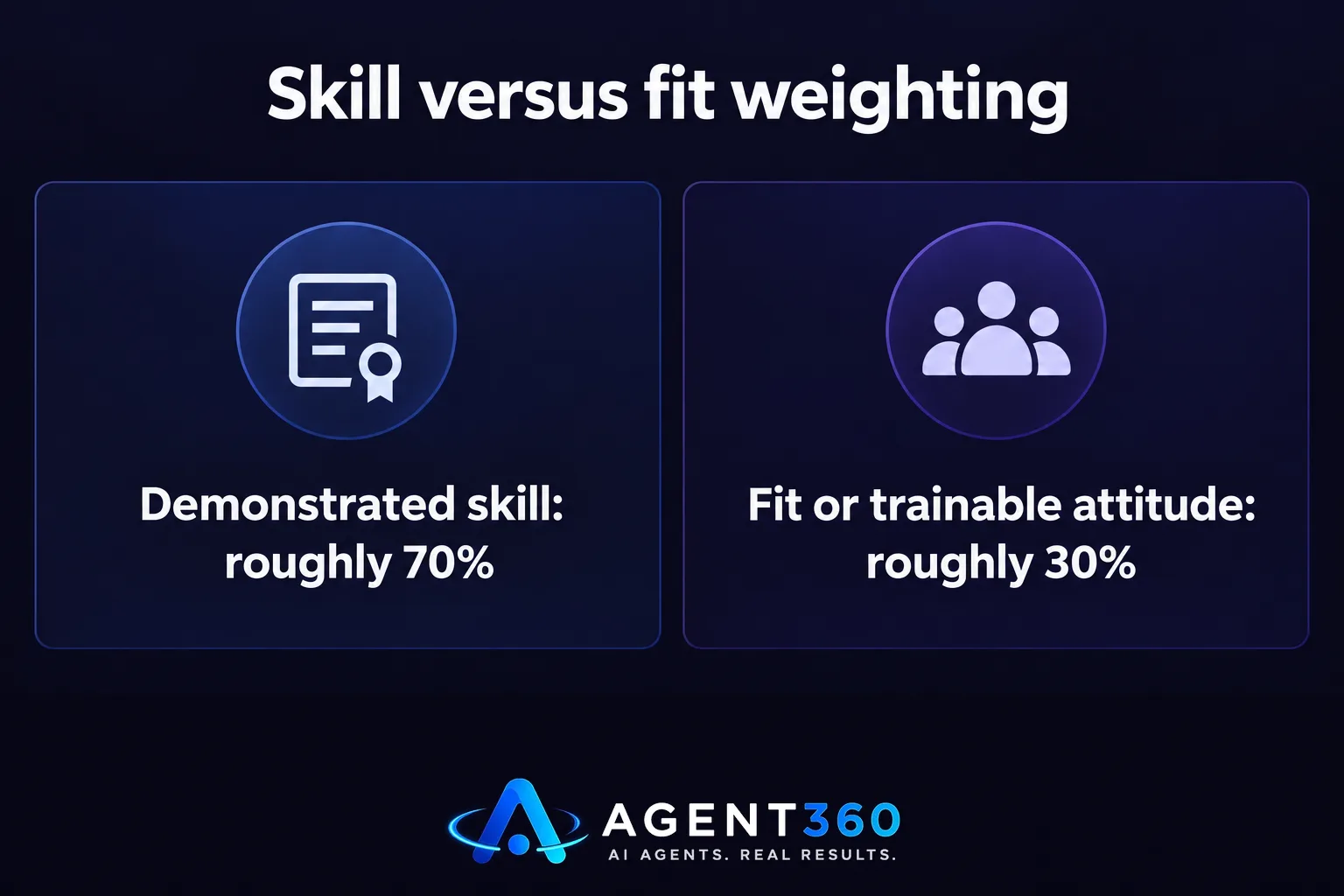
The 70/30 rule: weigh skill over fit, but not entirely
Another version commonly cited in hiring guides: weigh demonstrated skill around 70% and fit or trainable attitude around 30%. Treat it as a reminder, not a formula — there's no study behind the exact split. But what it corrects for is real. Founders hiring their first employee tend to over-index on “I like talking to this person,” because there's no team yet to check that instinct against. You are the entire culture at this stage, so your read on fit is doing double duty. Give skill the larger weight on purpose. Fit is the easier thing to fool yourself about in a single conversation.
The 5 C's keep one interview honest instead of three vague ones
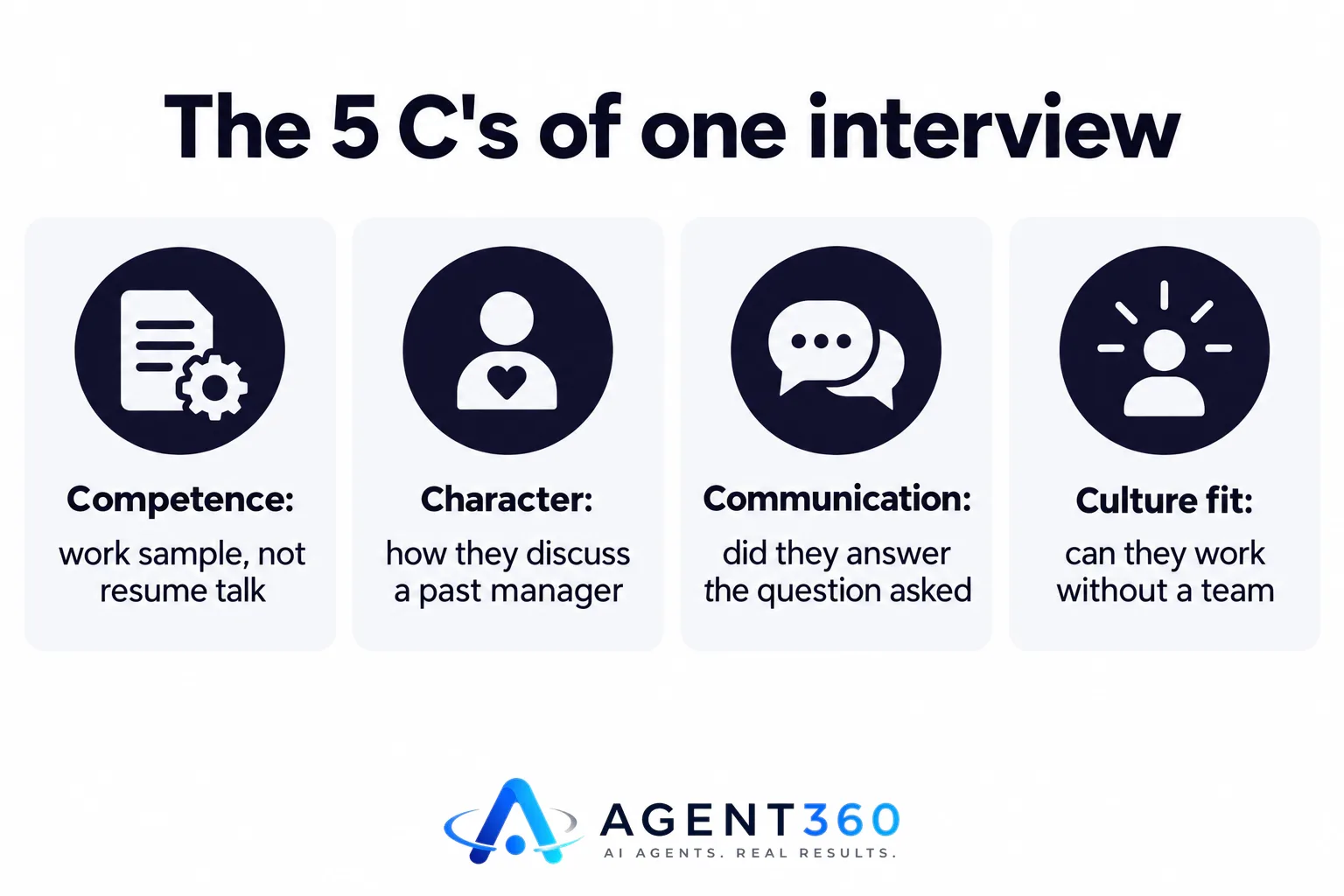
Use this for a single structured conversation, since a first hire rarely gets three rounds: competence, character, communication, culture fit, and commitment. Competence is a work sample or a scenario question specific to the role, not “tell me about your experience.” Character and commitment show up in how someone talks about a past manager or a past exit, not in a hypothetical. Communication is observable right there in the interview — did they answer the question you asked, or a different one. Culture fit, for a company this small, mostly means: can this person work without a team around them, because for a while there won't be one.
Ask the same five questions, in the same order, to every candidate. It's the single cheapest thing you can do to make a first hire less of a coin flip — letting the structure, not your mood that day, decide who moves forward.
Check two references before the offer, not after you have already decided
Call two people who managed this person directly. Not people they listed as a favor. Ask what they did, not how they were as a person — “what did they own, and what happened to it” beats “would you recommend them.” If a candidate can't produce two people who managed them, that's information too, especially for someone with several years of claimed experience.
Finding candidates is the part most first-time hiring managers skip entirely
Most founders hiring their first employee post one ad, wait, and interview whoever applies — which means the hire comes from whoever happened to be looking that week, not the strongest person who could do the job. Turning a role into a real search instead of a posted ad finds people who aren't actively applying anywhere. For a first hire that's often the better candidate, since the best people are rarely unemployed and browsing job boards.

Where HiringAgent fits, if you want the sourcing and first screen done for you
HiringAgent is built for exactly this situation: no recruiter on staff, one or two roles open, not a lot of spare hours. Paste the job description and its Sourcing Agent turns it into search filters and pulls matching candidates, each scored 0–100 against the role. Add the strongest ones to the interview sequence and the Screening Agent runs a first-round AI phone call before you ever get on the line yourself. The Starter plan runs $197 a month, covers 300 candidates sourced and scored and three open roles, with no setup fee and no contract — full details are on the pricing page.
What is the 70/30 rule in hiring?
It's a commonly cited guideline to weigh demonstrated skill or experience around 70% of a hiring decision and fit or trainable attitude around 30%, as a check against over-weighting personal chemistry in an interview. There's no single authoritative source for the exact split — treat it as a reminder of proportion, not a formula to calculate.
What is the 80% rule in hiring?
It's the guideline to hire a candidate who matches roughly 80% of a role's requirements rather than waiting for a perfect match, because few real candidates check every box. The useful discipline behind it is deciding in advance which gaps are trainable on the job and which aren't, before you meet anyone with a gap.
What are the 5 C's of hiring?
A common version is competence, character, communication, culture fit, and commitment — five things one structured interview can check with the same questions asked of every candidate, instead of three separate rounds that each test something slightly different.
More articles
- Hiring Without a Recruiter: What It Actually Takes
- Recruitment Agency Software Is Usually Three Tools, Not One
- Recruiting Software for Agencies: What to Buy
- Recruiting Funnel Metrics That Predict a Bad Hire
- The Time to Hire Metric: What It Measures, What It Hides
- How to Reduce Time to Hire Without Lowering the Bar
- How to Screen Candidates Faster Without Lowering the Bar
- A Boolean Search Alternative for Recruiters Who Are Done With Strings
