What an Applicant Tracking System for Small Business Costs
A small business applicant tracking system can cost anywhere from nothing to several hundred dollars a month — and the number has less to do with the brand than with three things: how many people on your team need a login, how many roles are open at once, and whether the system just stores applicants or also goes out and finds them. Most of the confusion buyers run into — rejected resumes, bloated feature lists, “top 5” roundups that don't match their hiring volume — comes from skipping those three questions.
Here's what each one means in practice, and what it actually costs.
Why is my resume getting rejected by ATS?
Candidates ask this one, usually in frustration. But buyers should ask it too, because the answer tells you exactly what to test before signing anything. Older systems reject resumes with a binary keyword match — no exact phrase, no visibility, no matter how qualified the person is. A sales manager who wrote “pipeline ownership” can get filtered out of a search for “pipeline management.” Nobody notices. The candidate just disappears.

The fix isn't a bigger keyword list. It's a system that scores resumes on a gradient instead of a pass/fail gate, with a reason attached so a human can see why someone landed where they did. When you evaluate a system, ask what happens to a resume that's a strong match but phrased differently from the job post. If the vendor can't show you a resume parsing step that produces a score and a reason instead of a silent drop, you'll lose candidates you never even knew applied.
Most “top 5” lists rank features you'll never use
Search “top 5 applicant tracking systems” and the results read like a checklist for a hundred-person HR department: custom workflow builders, HRIS integrations, compliance modules for multi-state payroll. None of it moves the needle for a company filling three to ten roles a year with no dedicated recruiter.
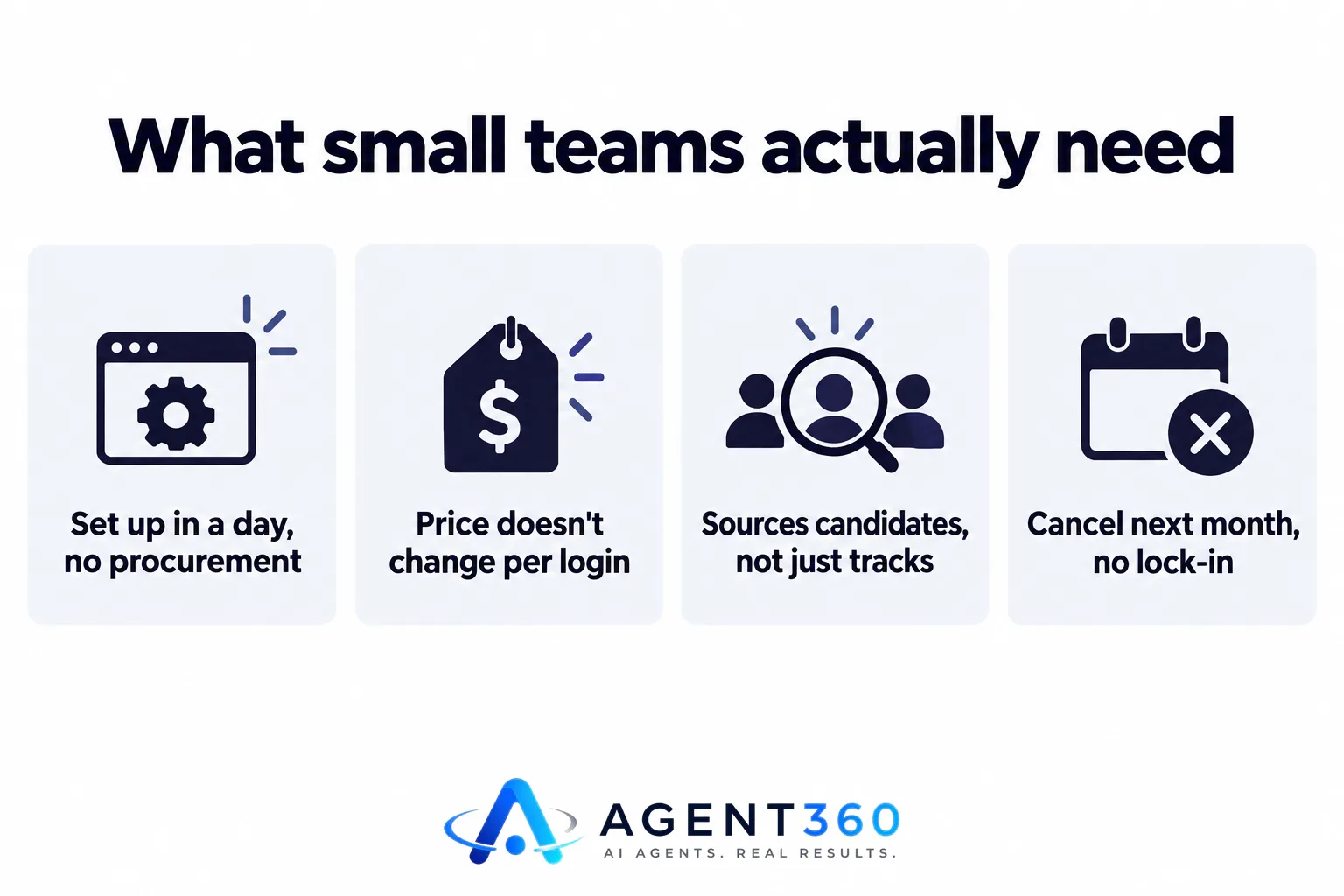
What actually matters at that size:
- Can one person set it up in a day, without a procurement process?
- Does the price change if a second hiring manager needs a login?
- Does it only track applicants, or does it also find candidates who haven't applied?
- Can you cancel next month if it's not working, or are you locked into a year?
A traditional system answers only the third question, and the answer is always the same: it tracks who applies. A modern ATS does more — it sources, scores and tracks in one place, which matters far more to a five-person team than a custom approval workflow ever will.
Applicant tracking system cost for a small business runs $0 to $600+ a month
The spread is wide because vendors price on entirely different axes:
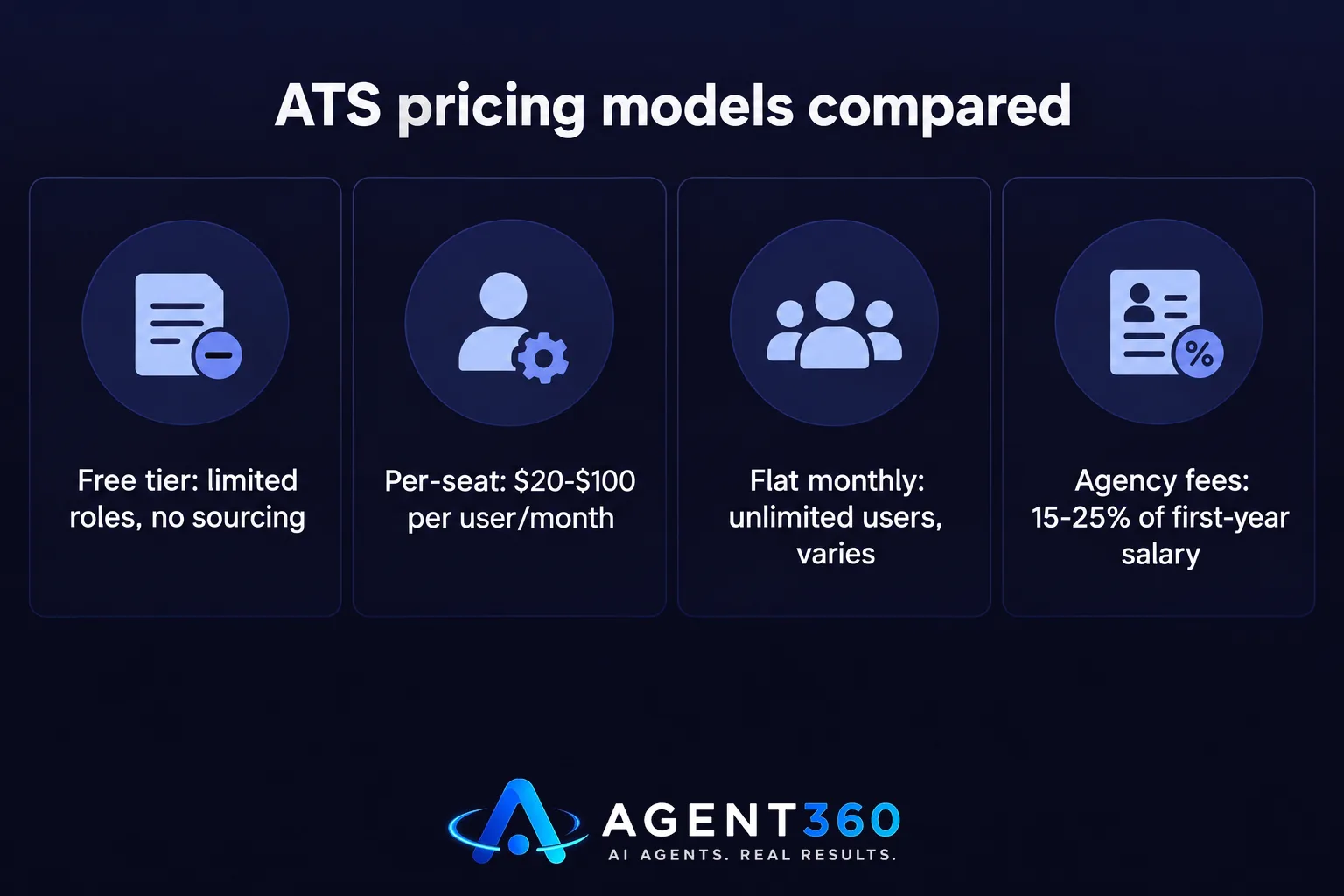
- Free tiers exist (often bundled into job boards or payroll software) but cap you at one or two open roles and offer no sourcing — you post the job, then you wait.
- Per-seat pricing shows up a lot in mid-market tools, typically $20 to $100 per user per month. It looks cheap with one hiring manager and turns expensive fast the moment a founder, a department head and an assistant all need logins — three seats on a $79 per-seat plan already runs $237 a month, before a single candidate is sourced.
- Flat monthly pricing with unlimited users sidesteps that math, but still ranges widely depending on whether sourcing and screening come bundled or get sold as add-ons.
- Agency fees, as a comparison point, run 15–25% of a hire's first-year salary — a single hire at that rate often costs more than a year of software.
When you compare quotes, ask vendors for the all-in monthly number with your actual team size and open-role count plugged in — not the number on their homepage.
The “most popular” ATS isn't the right question for 20 roles a year
Search volume and market share answer a different question than the one you're asking. They tell you what the most companies use, not what fits a company your size. The systems with the most seats sold are usually enterprise platforms, built for recruiting teams running dozens of requisitions with dedicated sourcers, compliance officers and layers of approval. That popularity reflects enterprise contracts — not fit for a ten-person company trying to fill a sales role and two engineering seats this quarter.
A better filter than popularity: look at what the system does between “job posted” and “candidate applies.” If the answer is “nothing — you wait,” it's built for a world where some other team is already generating pipeline. If it also turns your job description into a search and ranks the people it finds, it's built for teams that don't have that luxury. Checking how a vendor handles sourcing versus tracking will tell you more than any popularity ranking ever could.
One option built for this size of team
HiringAgent is AI candidate sourcing and a modern applicant tracking system in one. Paste a job description and its agents source candidates, score each 0–100 against the role, run AI phone screens, and track everyone from applicant to hire — set up with the team behind it. Plans start at $197 a month with unlimited users, month to month, scaling by candidate volume instead of seats. Full breakdown on the pricing page.
Common questions
How much does an applicant tracking system cost?
Anywhere from free — with limited roles and no sourcing — to $600 or more a month, depending on whether pricing runs per-seat, flat with unlimited users, or bundled with candidate sourcing. Get an all-in quote using your actual team size and open-role count before you compare vendors.
What are the top 5 applicant tracking systems?
Generic rankings answer this question for enterprise recruiting teams, not small businesses. A more useful question: does the system only track applicants, or does it also source and score them? That one difference matters more at this size than any feature checklist.
What is the most popular ATS?
Market share reflects enterprise contracts, not fit for a small team. The system built for a company with its own recruiting department isn't automatically the right one for a founder filling three roles alone.
More articles
- Resume Parsing Software: What It Gets Right (and Wrong)
- AI Resume Screening Scores Resumes, Not Hires
- Automated Phone Screening Interviews: What They Replace
- AI Phone Screening for Recruiters: What the Call Should Do
- What an ATS With AI Candidate Matching Should Actually Do
- The Best ATS for Startups Finds Candidates Too
- What a Modern Applicant Tracking System Actually Does
- AI Recruiting Software Won't Pick Your Hire — Here's What It Does
