How to Reduce Time to Hire Without Lowering the Bar

Find the single stage where candidates sit the longest, fix that stage, and leave the rest alone. That's how time to hire actually drops. Most hiring teams do the opposite: they add urgency everywhere, which mostly produces stressed recruiters and the same calendar they started with.
Time to hire is the number of days from a requisition opening (or a job going live) to an accepted offer. It is not time to fill, which starts the clock when the job posts, and it is not days-to-source, which only covers getting a candidate in the door. Confuse these three and you'll think you have a sourcing problem when you actually have an approval problem. Or the other way around.
Time to hire is the sum of waiting, not working
Add up the hours a candidate actually spends being evaluated — a resume read, a 30-minute screen, two interviews, a reference check — and for most roles that's under four hours of real work. Everything else is gap. The three days before anyone opens the resume. The week of calendar back-and-forth to book round one. The five business days a hiring manager sits on feedback before scoring it. The gaps, not the evaluation, are where your 30 or 45 days actually go.
This matters because it tells you where fixing effort pays off. Training interviewers to decide faster saves minutes. Closing a scheduling gap saves days.
Find the one stage eating your days, then fix only that one
Pull your last 10 to 20 closed requisitions and timestamp every stage change: applied, screened, interviewed, offer, accepted. Most applicant tracking systems log this whether or not anyone looks at it. Average the days spent in each stage, not the days from start to finish — you need the breakdown, and a stage-by-stage report does this faster than a spreadsheet pivot ever will.
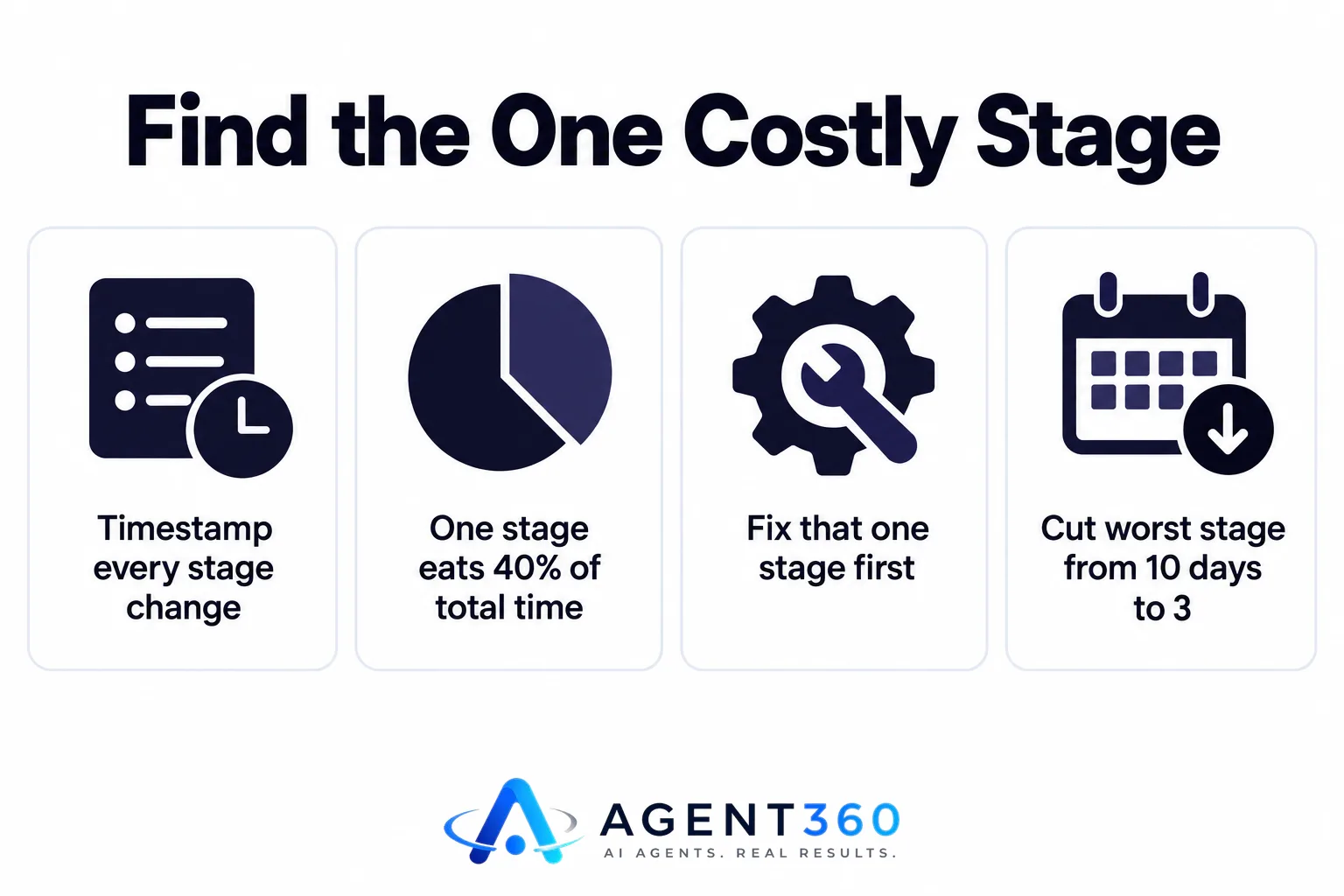
One stage usually accounts for 40% or more of total time to hire. For a lot of teams it's the gap between application and first recruiter contact — candidates apply, then wait four, five, six business days before anyone looks at the resume. For others it's scheduling the first interview, or sitting in an offer-approval queue. Fix that one stage before touching anything else. A team that cuts its worst stage from 10 days to 3 moves the whole metric more than a team that shaves a day off five different stages.
Cut the gap between apply and first contact — it is usually the biggest one
If resumes sit in a queue because someone has to manually open each one, compare it to the role, and decide whether to move it forward, that queue grows every time the recruiter is in interviews or on vacation. The fix is to score resumes against the job description the moment they arrive, so the recruiter opens a ranked list instead of a raw inbox. That's the entire argument for sourcing and scoring candidates automatically rather than reading every resume in order of arrival: the queue stops growing because nothing waits for a human to triage it first.
Same logic applies to outbound sourcing. If a recruiter is still building boolean strings and messaging people one at a time, the first qualified candidate might not show up for a week. Turning a job description straight into search filters compresses that to a same-day list, which moves the whole clock forward before a single interview gets scheduled.
Replace email back-and-forth with self-service booking
Five or six emails to land one 30-minute call is normal. It's also where days 8 through 15 of a typical hiring timeline disappear. A text with a booking link, where the candidate picks a slot that already works for your team, removes that entire exchange. It won't make a candidate respond faster if they're not interested — but it removes the scheduling tax on everyone who is.

This is also where a first-round screen that doesn't need a human calendar helps. If the first interview is a structured call that runs on its own schedule, the hiring manager's availability stops being the bottleneck for round one. A first-round screen that books and runs itself only removes one gap, not the whole timeline — your team still decides who moves to round two. But it's usually a three-to-five day gap, and removing it is free.
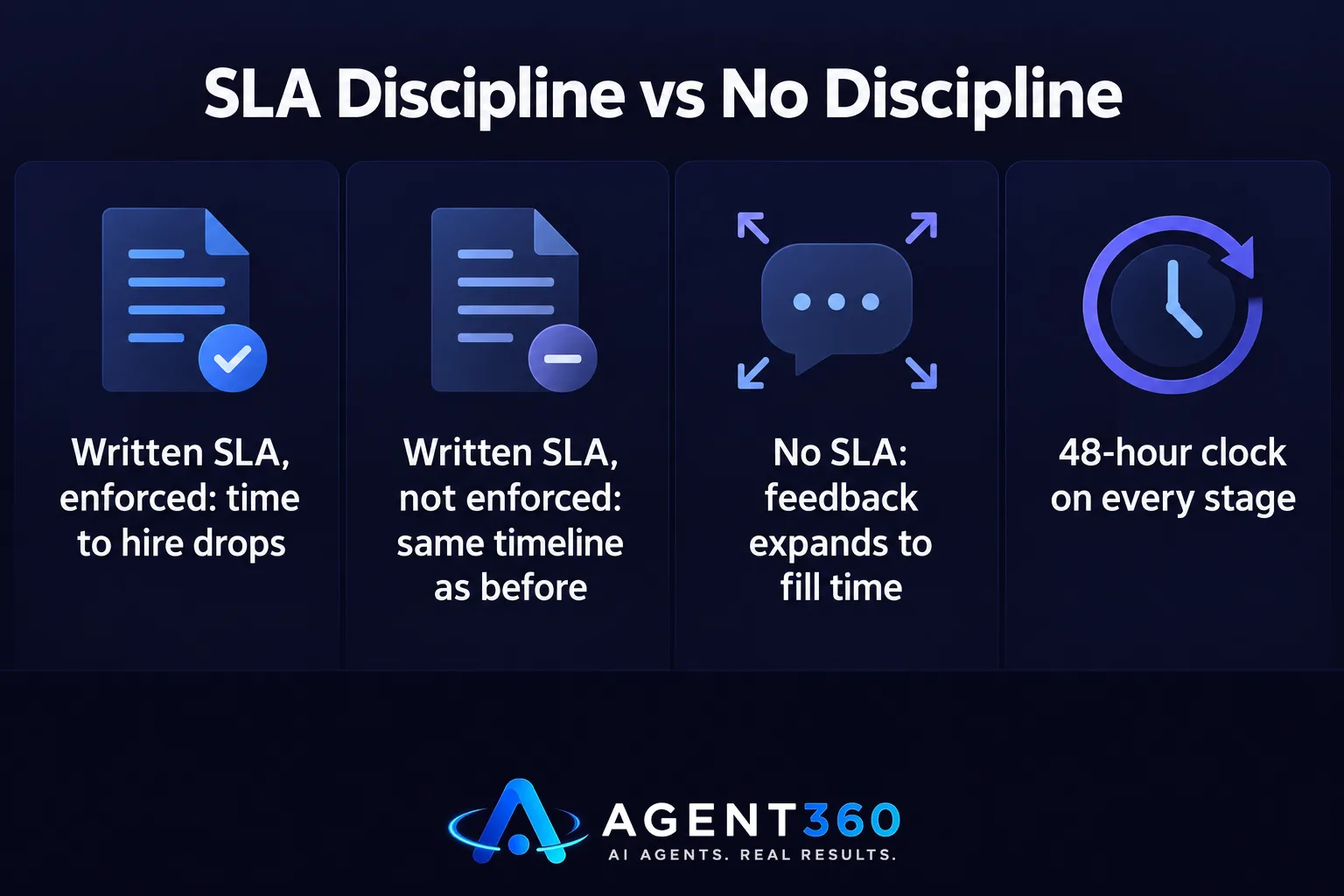
Set a 48-hour clock on every stage, and enforce it
Without a deadline, feedback and decisions expand to fill whatever time is available. Give every stage — resume review, interview feedback, offer approval — a 48-hour service level, post it somewhere the hiring manager sees it, and follow up the moment it's missed rather than at the end of the week. This is a management habit, not a tool. Teams that write down a stage SLA and actually chase misses cut time to hire noticeably. Teams that write one down and never enforce it get the same timeline they had before, with a document nobody reads.
Do not cut interview rounds to save days you don't have
The fastest way to blow up a time-to-hire number is to cut a round of interviews, then rehire for the same seat six months later because the bar slipped. If your loop has four or five rounds for an individual-contributor role, that's usually a structural problem worth fixing — but fix it by combining rounds that cover overlapping ground, not by removing the round that actually tests the skill the job needs. Reducing time to hire and keeping quality of hire are the same project only if the days you remove were waiting, not evaluating.
Where software actually moves the number
Most of what drives time to hire down is process — stage SLAs, same-day resume triage, self-service booking — and most teams can do a version of it with a shared inbox and a calendar. Where it breaks down is scale: triaging resumes by hand works until you have three open roles at once, and a shared calendar works until five people need to book the same hiring manager in the same week. HiringAgent exists for that point. It turns a job description into a scored, ranked candidate list the same day, puts sourced candidates and applicants in one pipeline instead of two spreadsheets, and runs first-round screens on a booking link so the first interview doesn't wait on a shared calendar. None of that replaces the SLA discipline above — it just removes the two or three gaps that discipline alone can't close. Plans start at $197 a month, detailed on the pricing page.
What is a good time to hire?
There's no single good number — it depends heavily on role and seniority. A high-volume individual-contributor role might reasonably close in 20 to 25 days; a specialized or senior role often runs 45 days or more without that being a problem. The more useful benchmark is your own history: track your median time to hire by role family and treat a meaningful move off that median, in either direction, as a signal worth investigating.
Does a faster time to hire mean worse hires?
Not if the days you cut were spent waiting rather than evaluating. Most time-to-hire improvement comes from closing gaps between stages — faster resume triage, easier scheduling, enforced feedback deadlines — none of which touches how rigorously a candidate is assessed. It only hurts quality of hire when teams cut an evaluation step itself, like skipping a reference check or combining two interviews that were each testing something different.
How do you measure time to hire?
Count calendar days from the requisition's approval date (or the job posting live date, if you don't track approvals) to the candidate's accepted offer date, per role, then look at the median rather than the average since a few extreme outliers will otherwise distort small samples. Breaking that total down by stage — time to first contact, time to first interview, time in offer approval — matters more than the headline number, because it shows which stage to fix first.
More articles
- How to Screen Candidates Faster Without Lowering the Bar
- A Boolean Search Alternative for Recruiters Who Are Done With Strings
- What Passive Candidate Sourcing Actually Takes
- How to Find Candidates Who Are Open to Work
- Resume Parsing Software: What It Gets Right (and Wrong)
- AI Resume Screening Scores Resumes, Not Hires
- Automated Phone Screening Interviews: What They Replace
- AI Phone Screening for Recruiters: What the Call Should Do
