Automated Phone Screening Interviews: What They Replace
An automated phone screening interview swaps the recruiter for software: the candidate books a slot, an AI voice agent calls at that time, runs through a fixed set of role-specific questions, and the candidate is marked screened when the call ends. It replaces the fifteen-minute call that checks basics and gauges interest. It does not replace the interview where someone actually decides to hire. Two different jobs — most of the confusion here comes from treating them as one.
The useful distinction: a phone screen is a filter, not a verdict. It exists to remove people who are clearly wrong for the role — bad location, salary mismatch, no real experience behind a matching title — before anyone burns forty-five minutes on video. Automating the filter doesn't change its job. It changes who runs it, and how fast.
What does a phone screening interview consist of?
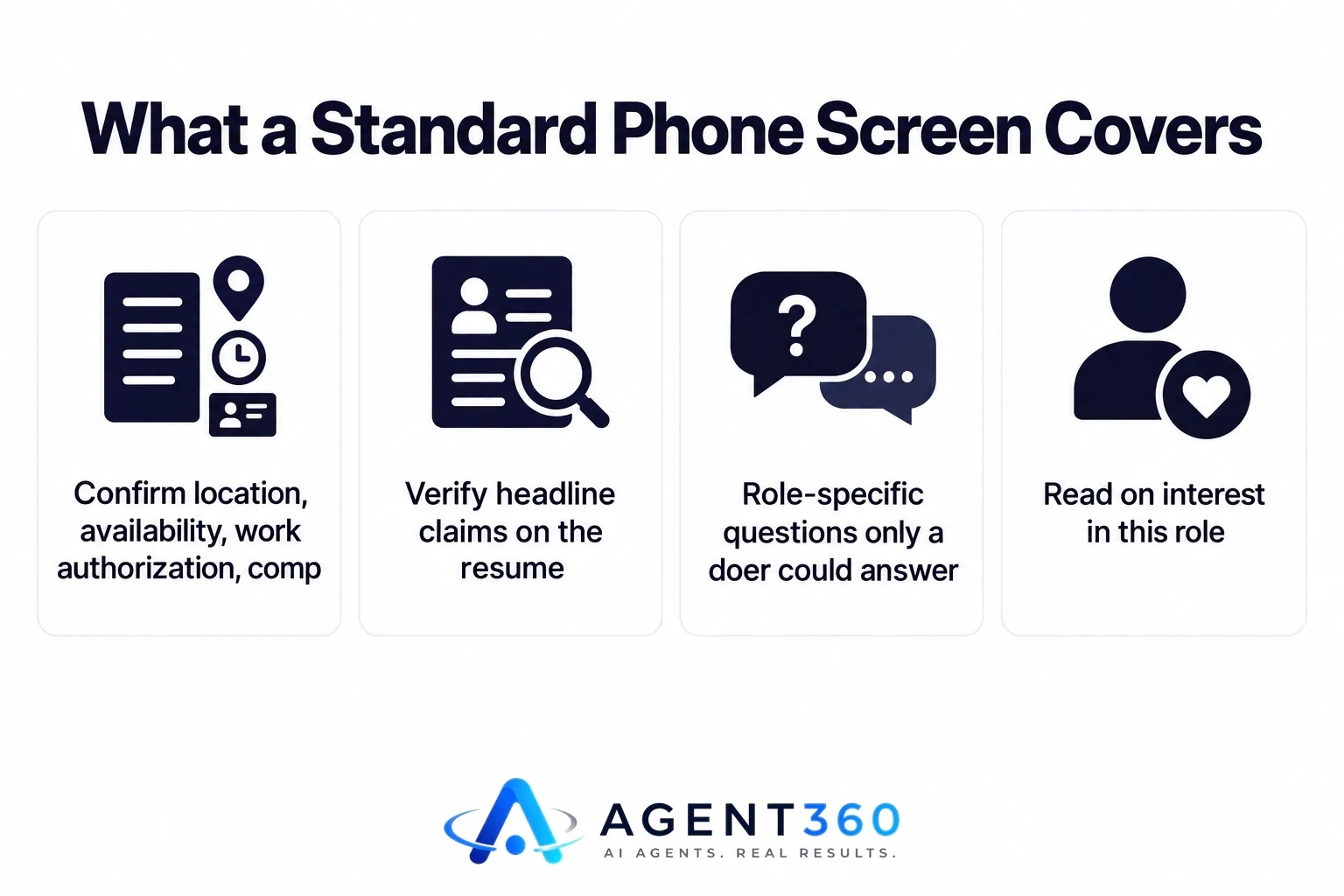
A standard screen, automated or not, covers the same ground: confirm the basics — location, availability, work authorization, comp range — verify the headline claims on the resume, ask two or three questions only someone who's actually done the job could answer well, and get a read on interest in this role, not roles in general. The automated version runs 8 to 12 questions pulled from the job description instead of a generic template, and that matters more than it sounds. “Walk me through how you'd handle a renewal at risk” filters differently than “tell me about your sales experience.” The call fits in a 30-minute slot, and it ends without a decision.
What it skips, in a well-run process: salary negotiation, culture fit, anything that needs reading tone and hesitation the way a second-round interviewer would. Save that for the human conversation. An automated screen trying to do both jobs ends up doing neither one well.
Are AI phone interviews real?
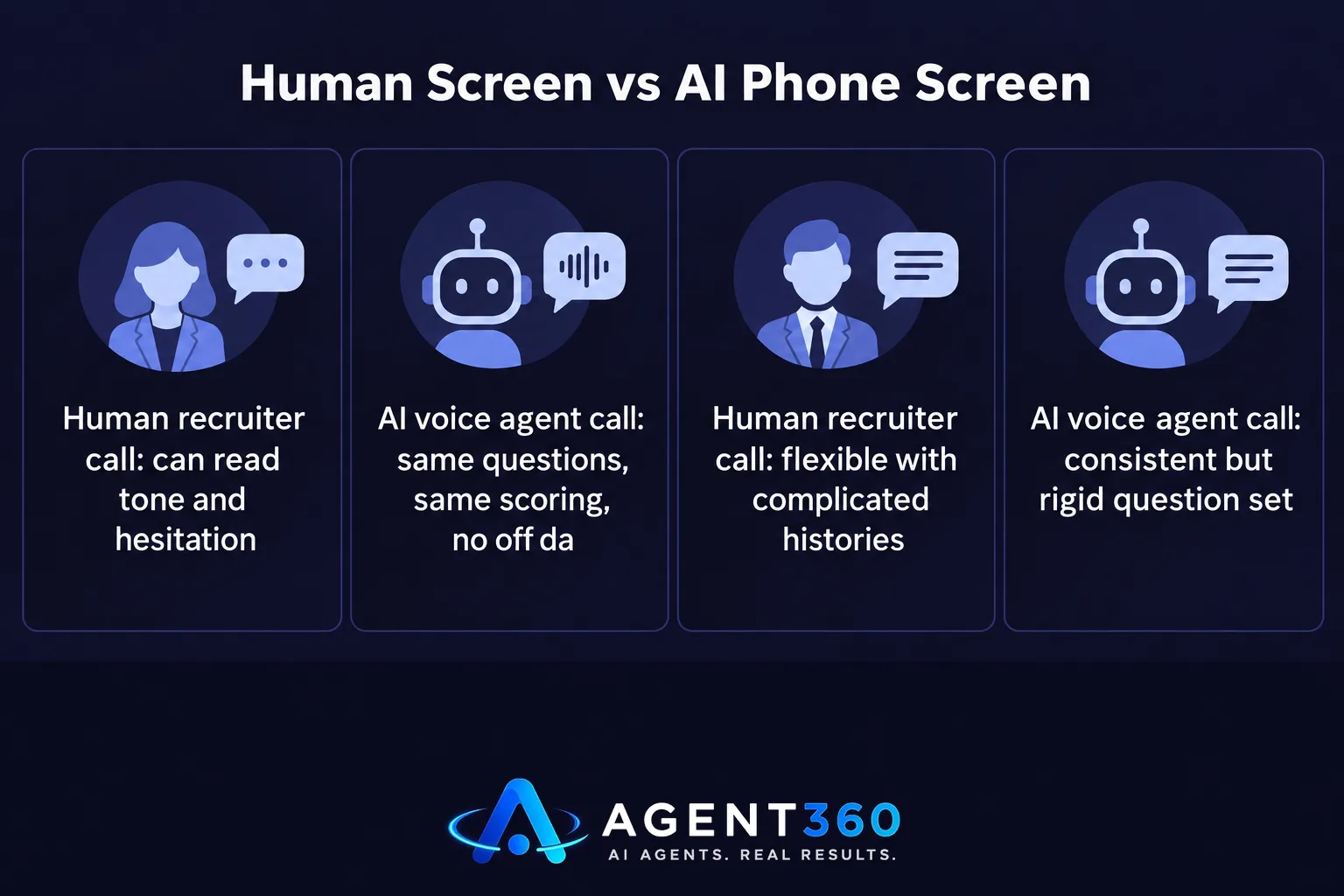
Yes, and the mechanism is simple enough: the candidate gets a text with a booking link, picks a slot, and at that time gets an actual phone call from a voice agent that asks questions and listens to the answers. Not a chatbot reading a script into voicemail. The mechanics of an AI phone screen sit closer to a structured interview than a cold call — same questions for every candidate, same scoring, no interviewer having an off day. The honest tradeoff is that it's consistent, not empathetic. A candidate with a complicated but legitimate work history — a gap, a career change, a layoff — gets the same rigid question set as everyone else. Fine when you're screening volume. Not fine when a resume needs an actual conversation to make sense.
A skipped phone screen costs more than a bad hire
The argument over whether the recruiter phone screen matters usually traces back to one bad experience — a hiring manager who felt it was a rubber stamp, or a candidate grilled for twenty minutes on trivia that had nothing to do with the job. Both are symptoms of a badly designed screen, not proof that screening is pointless. Skip it and the real cost shows up later: hiring managers burning hours on first-round video calls with people who should've been filtered out in ten minutes, and slots going to candidates who were never going to take the job while someone closer to an offer waits. Tie the screen to the actual job description, not a generic competency list, and most of that waste gets caught before it ever reaches a calendar.

Does a screening phone call determine getting an interview?
It decides whether a candidate advances to the interview that actually matters — it isn't that interview itself. Think pass/fail gate with a narrow bar: does this person meet the stated requirements, and can they talk about their own experience in a way that matches the resume. Clear it, and you move to a hiring manager. Don't, and nobody pretends otherwise. The mistake some teams make is skipping straight from resume to final interview, which means every disqualifying detail surfaces an hour in — discovered by someone whose time costs a lot more than a recruiter's.
Where this fits in a hiring process
HiringAgent builds this step into one pipeline instead of handing you a separate tool: candidates get a text with a booking link once they're added to the interview sequence, and the Screening Agent calls at the chosen time with questions written from the same job description that drove sourcing and match scoring. The result updates the candidate's status in the same applicant tracking view your team already works from, so nobody's copying notes out of a separate screening tool. Plans start at $197 a month and include phone screens by volume rather than charging per call — details live on the pricing page.
FAQ
What does a phone screening interview consist of?
Basic verification — location, availability, compensation range — a handful of role-specific questions pulled from the job description, and a read on genuine interest in the role. Typically 20 to 30 minutes, ending in a pass or fail, not an offer decision.
Does a screening phone call determine getting an interview?
It decides whether a candidate reaches the interview that actually decides anything. It's a filter against stated requirements, not the conversation where the hiring decision gets made.
Are AI phone interviews real?
Yes. The candidate books a real time slot and gets an actual phone call from a voice agent that asks a fixed set of role-specific questions and records the answers for the hiring team to review. Consistent by design — that's both its strength and its limit.
More articles
- Resume Parsing Software: What It Gets Right (and Wrong)
- AI Resume Screening Scores Resumes, Not Hires
- AI Phone Screening for Recruiters: What the Call Should Do
- What an ATS With AI Candidate Matching Should Actually Do
- The Best ATS for Startups Finds Candidates Too
- What a Modern Applicant Tracking System Actually Does
- What an Applicant Tracking System for Small Business Costs
- AI Recruiting Software Won't Pick Your Hire — Here's What It Does
