AI Phone Screening for Recruiters: What the Call Should Do
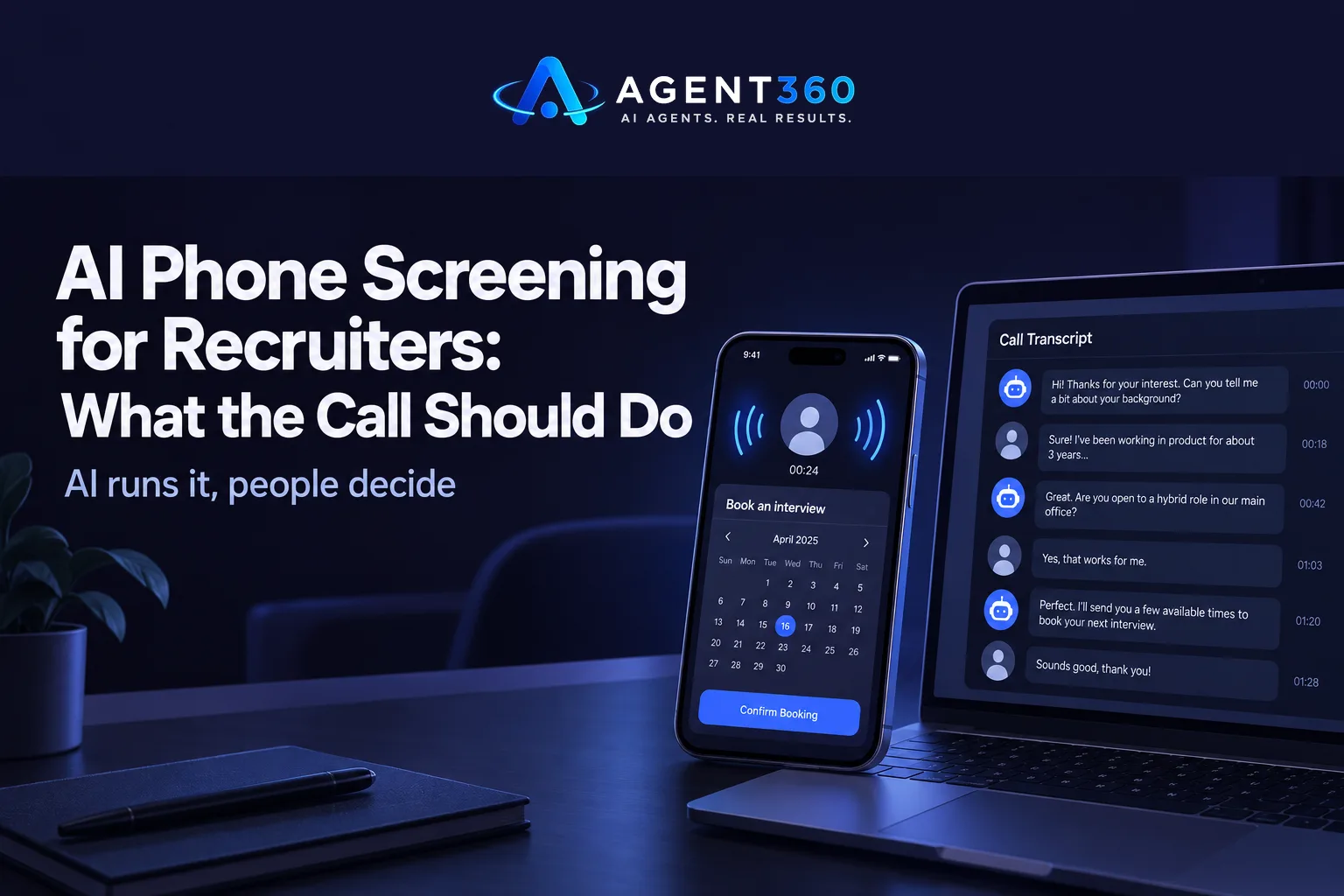
A good AI phone screen is a scripted first-round call that a voice agent runs after a candidate books their own time, with questions pulled from the job description instead of a generic bank. That's the whole idea. It replaces the scheduling back-and-forth and the ten minutes of small talk and resume-reading that every live screen starts with. It does not replace the person who decides whether this candidate moves forward. Get that split wrong, in either direction, and the tool makes more work than it saves.
Most of the complaints about this format come from candidates, not recruiters, and they're worth reading before you turn one on. The common thread isn't that people object to being screened by AI. It's that they get a text with a booking link, show up for a call, and only then realize there's no human on the other end, with nobody having told them what was coming or how to act. That confusion shows up as no-shows, short answers, and candidates who treat the call as a trick to survive rather than a conversation to have. All of it is avoidable. It's on the recruiter to avoid it.
Tell candidates what's coming, in the text itself
The booking text is the first and only chance to set expectations before the call happens. If it just says “pick a time for your interview,” the candidate assumes a person, and the mismatch costs you answer quality even if they show up. Say plainly that this is a short AI-run screening call, how many minutes it runs, and roughly how many questions to expect. Candidates who know what they're walking into stop trying to perform for an invisible evaluator. They just answer the question, which is the data you actually want.
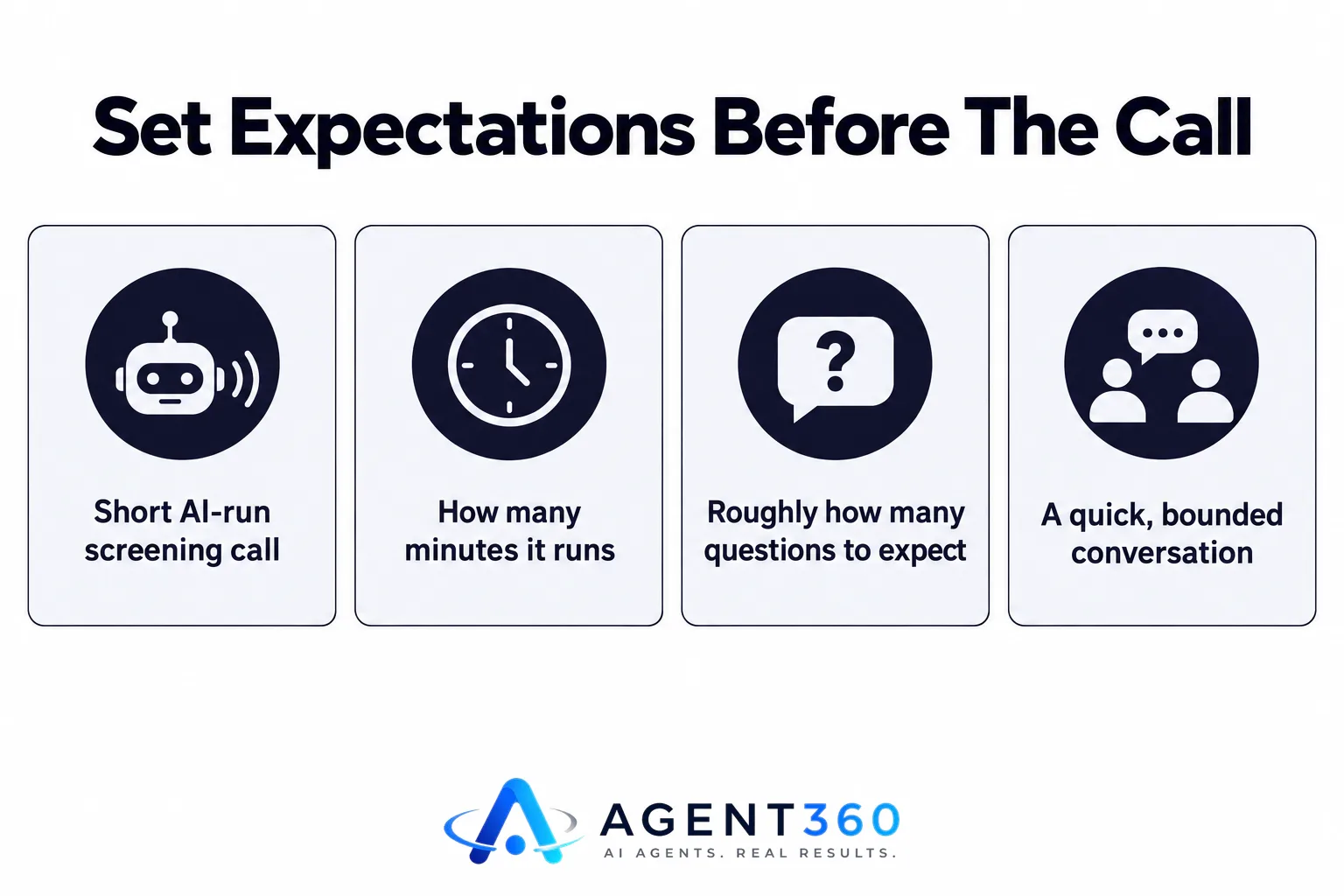
This isn't a courtesy. It's a yield problem. A candidate who's blindsided is more likely to hang up, give one-word answers, or decline the next step out of annoyance. A candidate who was told exactly what to expect treats it like what it is: a quick, bounded conversation, not an ambush.
The questions should test role fit, not catch people out
Every AI phone screen is only as good as the questions behind it. Pull them straight from the job description, the actual tools, the actual scope, the actual years of a specific kind of work, and you get answers you can compare across candidates. Generic questions, the kind that could sit in any script for any role, produce generic answers and tell you nothing the resume didn't already say. Worse, they read to candidates as filler, and filler is exactly what makes a screen feel like a hoop rather than a conversation.
If you're sourcing and screening for a title where the words vary by company, marketing is the clearest example, write the questions to probe for the actual work behind the title, not the title itself. “Tell me about a campaign you ran” beats “describe your marketing experience” because it forces a specific answer instead of a rehearsed one.
Know where AI screening stops and judgment starts
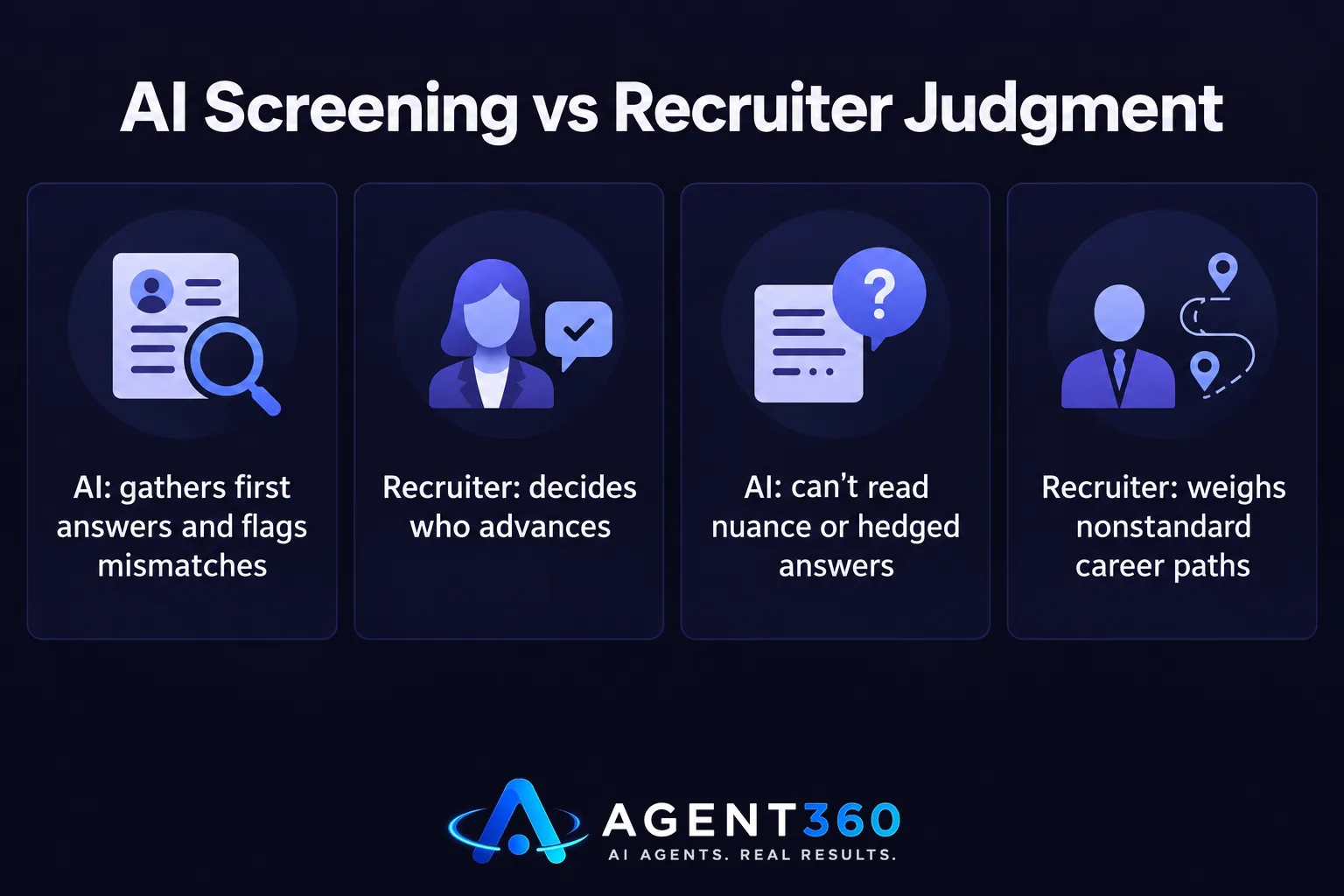
An AI phone screen gathers first answers. It does not, and should not, decide who advances. Its job is to surface the obvious mismatches early: wrong location, no experience with a required tool, availability that doesn't work. What it can't do is read the room, catch the nuance in a hedged answer, or weigh a nonstandard career path the way a person would. Splitting the work this way, AI for the repetitive first pass, people for the calls that decide outcomes, is what keeps the process fast and fair at the same time. Using the call as a final gate instead of a first filter is the single most common way teams misuse this tool, and it shows up fastest in roles that reward judgment over checklist fit: anything senior, anything client-facing, anything where the “right” answer isn't obvious from a short call.
Keep the call bounded — a fixed number of questions, a fixed time
Open-ended AI calls fail in a specific way: they ramble, candidates don't know when they're done, and the ones who hang up do it mid-sentence out of confusion rather than rudeness. A bounded format, a known number of questions inside a known time window, gives the candidate a reason to stay on the line and gives you a consistent unit to compare across every person you screen for the role. It also makes the no-show problem easier to diagnose. If a short, clearly-scoped call still gets skipped at a high rate, the issue is upstream, in how the invite was written or who it was sent to, not the format itself.
Where this fits for a recruiting team
HiringAgent's AI phone screens work this way by design: candidates get a text with a booking link, pick their own 30-minute slot, and the agent asks 8 to 12 questions written from the job description that's already driving sourcing and match scoring for that role. The call marks the candidate screened and moves them along in the same pipeline as everyone sourced or applied for the role, and your team decides who gets a live interview. Plans start at $197 a month and include phone screens as part of the package; see pricing for what each tier includes.

Do I need to tell candidates it's an AI call?
Yes, and doing it well helps you, not just them. Stating clearly in the booking text that the call is run by an AI voice agent, with the length and rough question count, cuts no-shows and produces better answers, because candidates stop guessing and start answering. Leaving it ambiguous just buys you a worse first impression and worse answers.
What if the AI mishears or mistranscribes an answer?
It happens, the same way a human interviewer occasionally mishears a candidate. The fix is the same for both: don't make a final decision off one answer. Treat the call as a first read, bring your follow-up questions to the live interview, and never treat it as the sole record of what a candidate can do.
Should I use AI phone screening for every open role?
Not necessarily. It earns its keep fastest on roles with real volume, several candidates per opening where a first filter saves meaningful recruiter hours. For a single senior or executive search, where every candidate deserves a tailored conversation from the start, a live first call is often the better use of time. See how AI phone screening works in practice for a longer look at the mechanics before deciding where to use it. The booking link is cheap; a bad first impression on a candidate you actually want isn't.
More articles
- Resume Parsing Software: What It Gets Right (and Wrong)
- AI Resume Screening Scores Resumes, Not Hires
- Automated Phone Screening Interviews: What They Replace
- What an ATS With AI Candidate Matching Should Actually Do
- The Best ATS for Startups Finds Candidates Too
- What a Modern Applicant Tracking System Actually Does
- What an Applicant Tracking System for Small Business Costs
- AI Recruiting Software Won't Pick Your Hire — Here's What It Does
