What an ATS With AI Candidate Matching Should Actually Do
Every vendor on this market says their ATS ranks candidates against the job instead of just listing them in application order. Whether that's true comes down to three things: what the system reads to build the match, what it scores beyond keywords, and whether it tells you why a candidate got the number they got.
Most of the disappointment with “AI matching” traces back to one of those three. Here's what to check before you trust a score enough to skip a resume.
A keyword match and a role match are not the same thing
The oldest version of candidate matching is a keyword overlap: does the resume contain the words in the job post? That catches people who wrote their resume to your exact phrasing. It misses everyone else — the “Head of Growth” who did exactly what your “VP Marketing” posting describes, the engineer whose resume says Golang where your post says Go.
Matching worth the name starts from the job description itself, not a list of required tags. It should pull out titles, skills, seniority and years of experience, build adjacent search terms from them, and apply that logic to every resume and profile it scores — the same work a sourcer does by hand turning a role into a boolean search, just run automatically instead of once, tiredly, at 6pm.
A score without sub-scores is a guess dressed up as data
A single number — “82% match” — tells you almost nothing about what to do next. Is that candidate strong on skills and weak on location? Heavy on experience but light on the one tool your team actually uses daily? Without a breakdown, a match score is just a sort order with false precision.
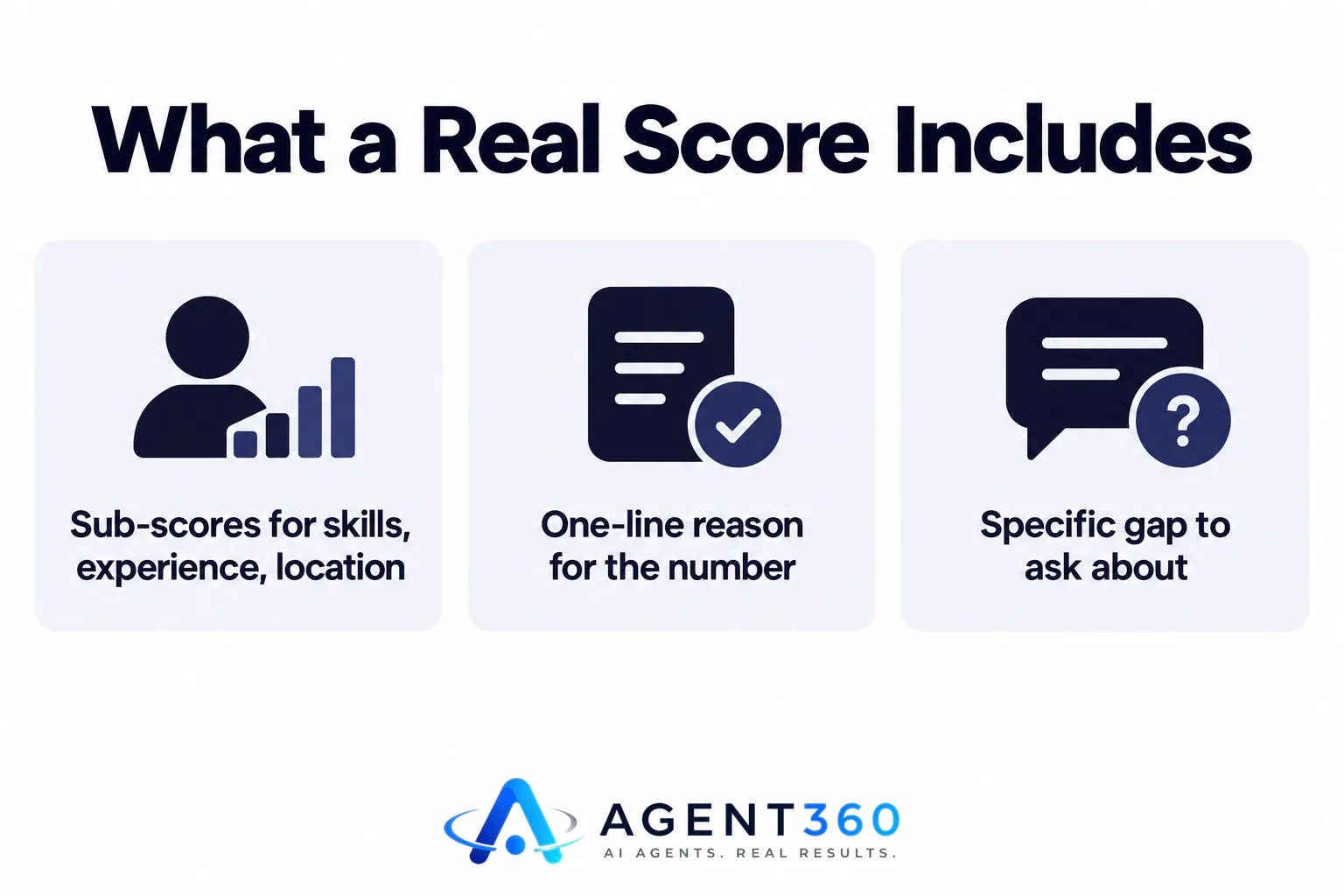
Ask any matching tool you're evaluating three questions. Does it break the score into sub-scores for skills, experience and location? Does it give a one-line reason for the number? And does it name the specific gap a hiring manager should ask about in the first conversation? A match score built to explain itself saves the hiring manager the fifteen minutes they'd otherwise spend rereading the resume to find what the AI already knew.
Sourced candidates and applicants need to be scored the same way
This is where a lot of “AI matching” quietly falls apart. Plenty of systems score inbound applicants off their resume but have no mechanism to score the candidates a recruiter finds through search — or they score sourced profiles against a generic title match instead of the actual job description. Two different scales end up living in one pipeline, and a recruiter still has to eyeball which list to trust.
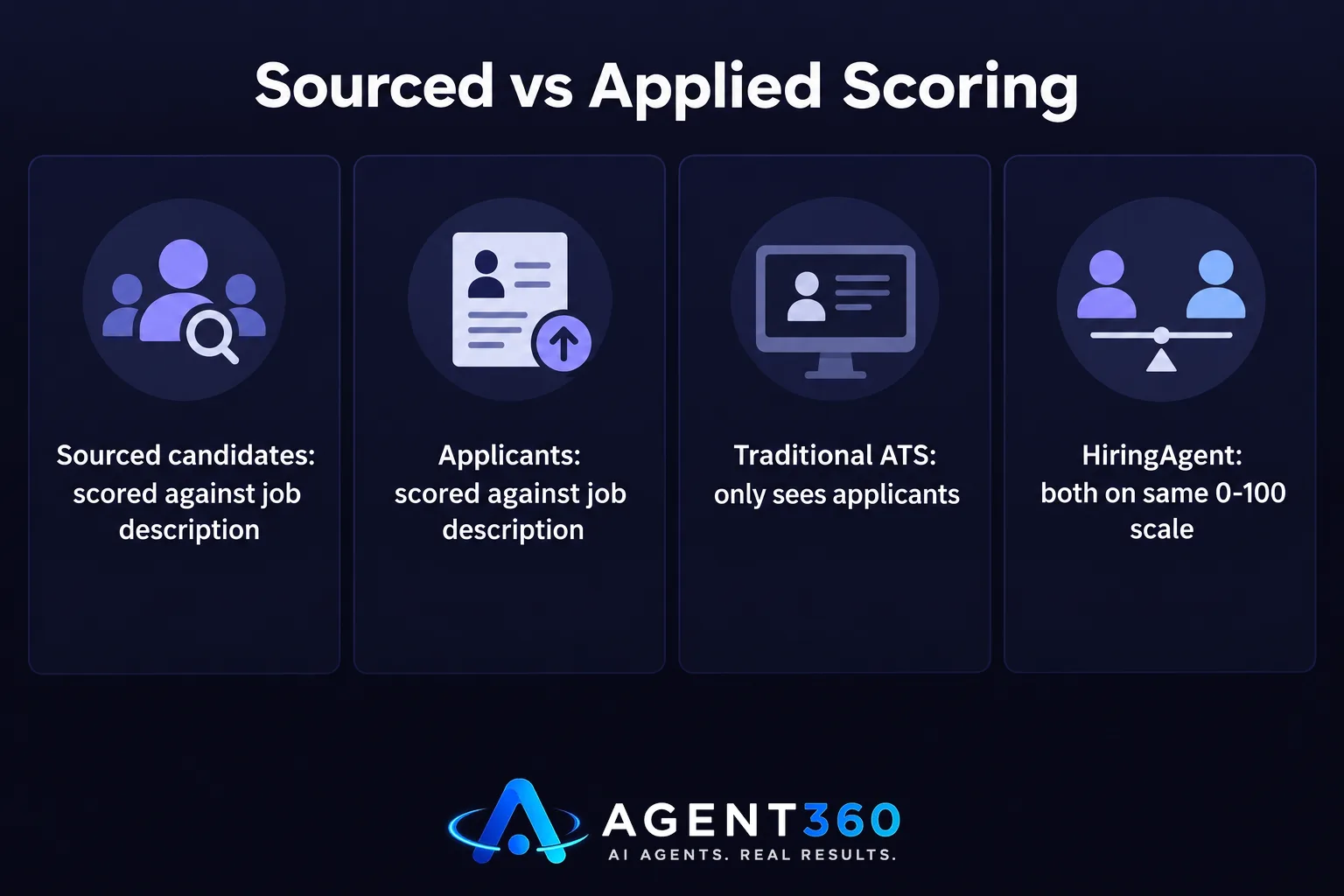
A matching layer worth using treats both populations the same: the person who applied through your apply page and the person a sourcing run found on a public profile both get scored against the identical job description, land in the identical pipeline, and sit on the identical 0–100 scale. That's also the difference between a traditional ATS, which only ever sees the applicants who found you, and a system built to score and track both groups together.
Set a threshold before you look at a single profile
Scores only help if you decide, ahead of time, what they mean for your search. For most individual-contributor roles, a score in the 80s or above is worth a recruiter's attention on sight; anything in the 60s is a maybe, worth a glance at the stated gap before deciding. Tighten that bar for senior or highly specialized roles — a 75 on a director-level search carries more risk than a 75 on an entry-level one, because a bad senior hire costs more and the pool of true fits is smaller.

Write the threshold down before the first batch of scored candidates lands in front of you. It's easier to hold a line you set in advance than to talk yourself into “this one's probably fine” candidate by candidate.
Where HiringAgent fits
HiringAgent scores every candidate 0–100 against your job description — sourced or applied, resume or profile — with sub-scores for skills, experience and location, a one-line reason, and the specific gap to check, so the number arrives with the context to act on it. Pipelines run from applicant through final outcome, sourcing and screening live in the same system, and plans start at $197 a month with unlimited users, month to month.
Questions
How does the AI match score work?
Each candidate gets a 0–100 score against the job description, with skills, experience and location sub-scores, a one-line reason and the gap to check. Resumes sent through the apply page are scored the same way. 80 and above generally marks a strong match.
Does AI decide who gets hired?
No. A match score ranks candidates and surfaces what to check first; the hiring decision stays with your team. The score is a filter for attention, not a verdict.
Where do the candidates being matched come from?
From a database of public professional profiles searched using filters built from the job description, plus everyone who applies directly and anyone imported by CSV — matched on the same description and scale either way, so a profile found on day one and a resume that arrives on day thirty sit on the same list.
More articles
- Resume Parsing Software: What It Gets Right (and Wrong)
- AI Resume Screening Scores Resumes, Not Hires
- Automated Phone Screening Interviews: What They Replace
- AI Phone Screening for Recruiters: What the Call Should Do
- The Best ATS for Startups Finds Candidates Too
- What a Modern Applicant Tracking System Actually Does
- What an Applicant Tracking System for Small Business Costs
- AI Recruiting Software Won't Pick Your Hire — Here's What It Does
