The Best ATS for Startups Finds Candidates Too
Three open roles, no recruiter, forty minutes a week for hiring — that's the real test for an ATS, not the feature list. For most startups, passing that test means two things: the system has to help you find candidates, because job boards alone won't fill a senior engineering role fast, and it has to track them without someone updating a spreadsheet by hand. Most “applicant tracking systems” only do the second part.
That gap is why searching for the best ATS for startups usually lands you somewhere disappointing: enterprise systems built for companies with a recruiting team, or free tools built for companies barely hiring at all. Neither one is built for the five-to-fifty-person company doing its own sourcing.
A startup's ATS has to find candidates, not just file them
A traditional ATS was built around one assumption: candidates show up. Post the job, applications land in a pipeline, move them through stages. That holds up fine for a company with brand recognition and a steady flow of inbound applicants. It falls apart for a startup hiring its first few sales reps or a senior engineer nobody outside the company has heard of. You'll get a trickle of applicants, and most won't be close.

That's the real difference between a traditional ATS and what's worth calling a modern ATS: whether it goes looking for candidates or waits for them. If your shortlist depends on outbound, the tracking tool and the sourcing tool need to be the same system. Otherwise you're copying candidates between two places by hand — the exact manual work an ATS is supposed to remove.
Free ATS tools work until you need to find anyone, not just track them
A spreadsheet, a Notion board, or the free tier of a tracking tool will get a startup through its first few hires. They're fine for organizing the handful of applicants who show up on their own and remembering who you already talked to. What they won't do is tell you who else is out there. Need five strong candidates and only two applied in three weeks? A free tracker just shows you an empty pipeline. It doesn't fill it.
So the honest answer to “what's the best free ATS for startups” is this: free tools solve the filing problem, not the finding problem. And the finding problem is the one that actually slows down a startup's hiring, because the people you most want for a senior or specialized role are rarely the ones submitting applications.
There's no ATS “most companies” use — company size decides the shortlist
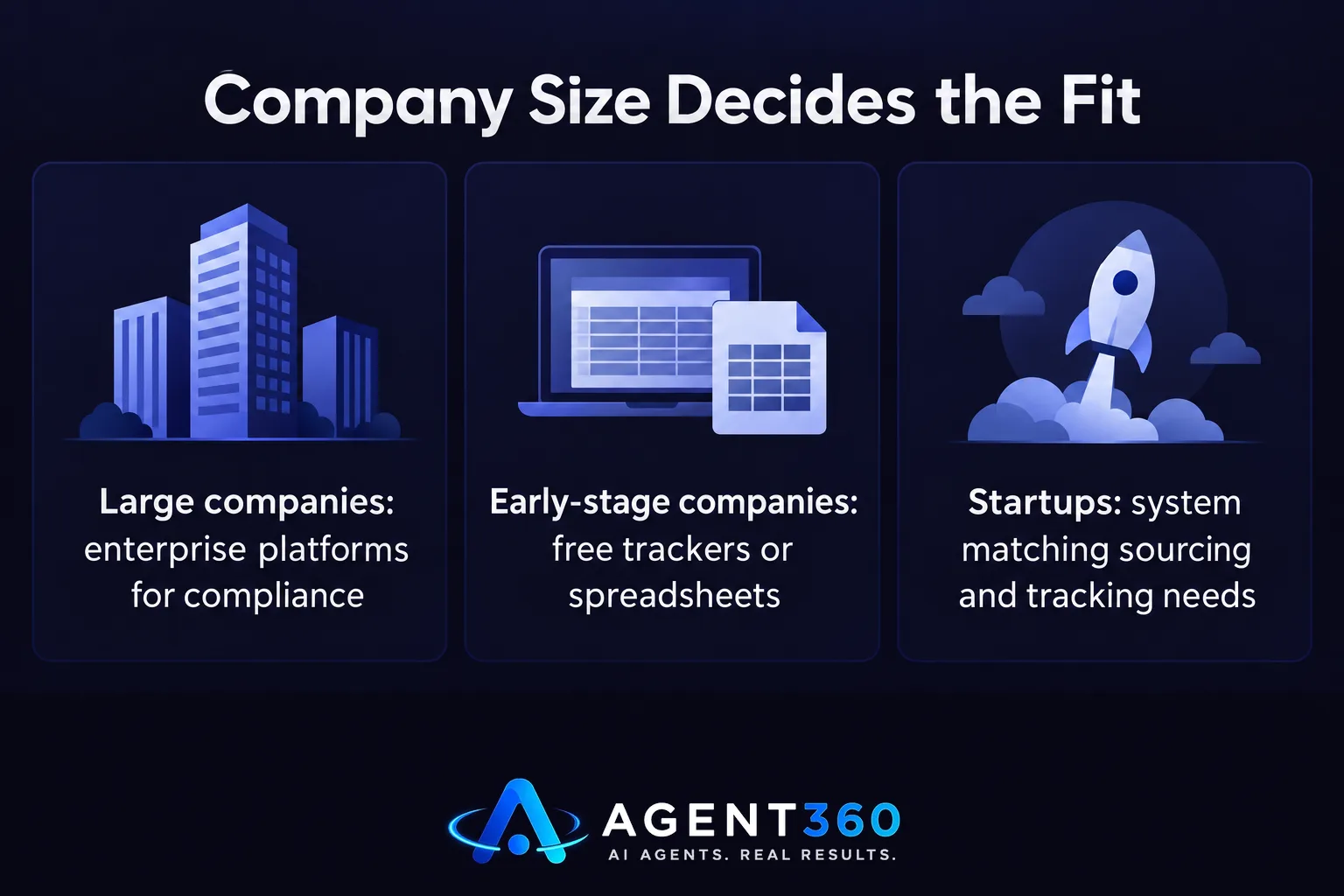
No single system dominates hiring the way one spreadsheet program dominates spreadsheets. Large companies run enterprise platforms built for compliance, approval chains, and integration with payroll and HR software across thousands of employees — tools that assume a recruiting department, not a founder doing hiring between other jobs. Early-stage companies are more likely running a free tracker, a handful of spreadsheets, or nothing formal at all. The “top 5 ATS” framing assumes one ranking fits every company, but the right system for a 2,000-person company and the right one for a 12-person company solve almost entirely different problems.
For a startup, the useful comparison isn't “which system is biggest” but “which system matches how I actually hire” — few open roles at once, little to no dedicated recruiting headcount, and a need to source as much as track. That's a narrower, more answerable question than ranking ATS systems in general. Worth reading an honest comparison against a traditional ATS before assuming a bigger name means a better fit.
Four questions to ask before you buy, not after
Demos are built to make every system look capable. Before signing anything, get specific answers to these:
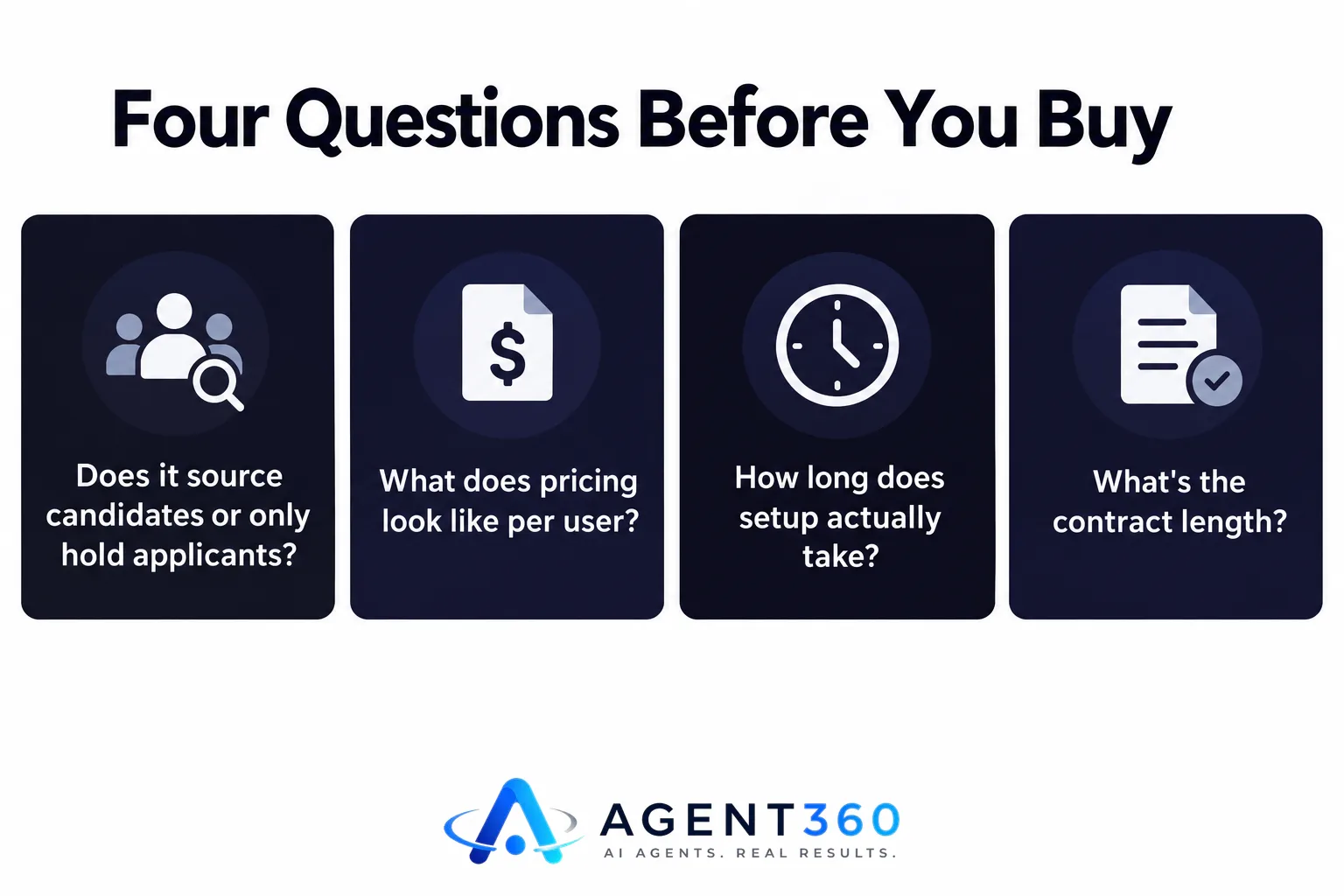
- Does it source candidates, or only hold the ones who apply? If the answer is “you can connect it to a sourcing tool,” that's two subscriptions and two logins, not one system.
- What does pricing look like per user, and does it change as the team grows? A startup adding a hiring manager or a founder as a second reviewer shouldn't pay more for it — check whether users are unlimited or priced per seat before you scale the team.
- How long does setup actually take? If it requires weeks of configuration before the first candidate can move through a stage, that cost shows up in your first quarter of hiring, not in the contract.
- What's the contract length? Startups hire in bursts — three roles this quarter, none next quarter. A monthly plan with no long-term commitment matches that pattern; a one-year contract doesn't.
Run every option you're considering through those four questions before you even look at feature lists, and the field narrows fast.
Where HiringAgent fits
HiringAgent is built around the startup version of this problem: paste a job description and its agents source candidates from a database of public professional profiles, score each one 0–100 against the role, run AI phone screens so your team only talks to people worth the call, and track everyone — sourced or applied — in one pipeline. Plans start at $197 a month with unlimited users and no contract, which matters for a team whose hiring volume changes every quarter. It's set up with the HiringAgent team rather than left for you to configure alone, and it's built specifically for teams without a dedicated recruiter — see how it fits founders and small teams or check current plans and pricing directly.
Questions worth asking before you buy
What is the best free ATS for startups? Free trackers and spreadsheets work for organizing a small, mostly inbound pipeline, but none of them source candidates for you. Once a role needs outbound sourcing to fill — which is most roles that aren't entry-level — a free tool becomes a place to store candidates you still have to find elsewhere.
Which ATS do most companies use? There's no single dominant system across all company sizes. Large companies run enterprise platforms built for compliance and HR integration; early-stage companies are more likely using free trackers, spreadsheets, or nothing formal. The right question for a startup is which system matches a small team doing its own sourcing, not which one has the most total users.
What are the top 5 ATS systems? Ranking systems by popularity doesn't answer much, because an enterprise platform and a startup tool solve different problems. More useful than a ranked list: sort options into three groups — free manual trackers, legacy enterprise systems, and modern tools that combine sourcing and tracking — and pick from the group that matches your hiring volume and team size.
More articles
- Resume Parsing Software: What It Gets Right (and Wrong)
- AI Resume Screening Scores Resumes, Not Hires
- Automated Phone Screening Interviews: What They Replace
- AI Phone Screening for Recruiters: What the Call Should Do
- What an ATS With AI Candidate Matching Should Actually Do
- What a Modern Applicant Tracking System Actually Does
- What an Applicant Tracking System for Small Business Costs
- AI Recruiting Software Won't Pick Your Hire — Here's What It Does
