AI Recruiting Software Won't Pick Your Hire — Here's What It Does
No AI recruiting tool on the market today does the whole hiring job end to end. Each one automates a slice — writing the post, building the search, reading resumes, scoring candidates against a role, running a first call, moving people through a pipeline — and the slices vary a lot between vendors. So the question worth asking before you buy isn't “is this AI good.” It's “which slice of my hiring process is actually slow, and does this tool automate that slice or a different one.”
AI recruiting software does four jobs, not one
Vendors bundle these differently, so separate them before you compare anything:
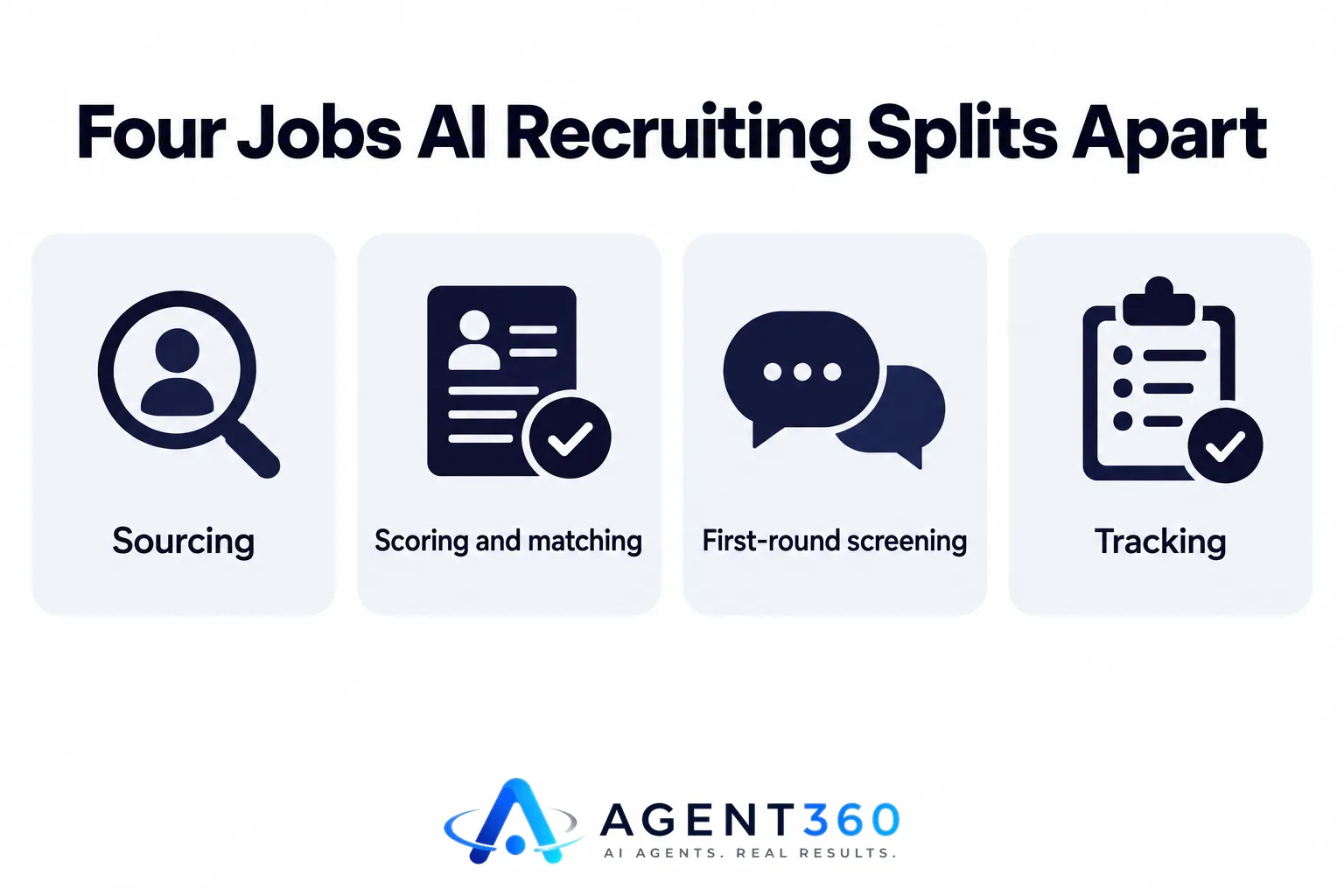
- Sourcing. Turning a job description into search filters — titles, skills, seniority, location, years of experience — and pulling matching people from a database of profiles, instead of a person building a boolean string by hand.
- Scoring and matching. Ranking sourced candidates and inbound resumes against the role, usually with a number and sub-scores for skills, experience and location, so a recruiter opens the top of the list instead of all of it.
- First-round screening. Either resume parsing that fills in a profile automatically, or a voice agent that calls a candidate at a booked time and asks role-specific questions — see how an AI phone screen actually runs.
- Tracking. Moving candidates through stages, logging outcomes, and reporting on where every open role stands — the applicant tracking layer, now expected to score and sort rather than just store.
A tool that's great at sourcing and mediocre at tracking is still worth buying if sourcing is your bottleneck. Match the category to the problem. Not the other way around.
The AI underneath is pattern matching, not judgment
Two kinds of models do almost all the work in recruiting software today. Language models read unstructured text — job descriptions, resumes, LinkedIn headlines — and turn it into structured fields: a title becomes a seniority level, a bullet point becomes a skill, a paragraph becomes a one-line summary. Scoring models then compare those structured fields against the job and produce a number, usually with a short written reason attached so a human can check it rather than trust it blindly.
Neither kind of model is deciding who gets hired. They're doing retrieval and ranking — the same two tasks a sourcer and a resume screener already do, just faster and applied the same way across every candidate. That matters because it sets expectations right: the output is a shortlist and a score, not a hiring decision, and someone on your team still has to run the interview and make the call. Hiring with AI responsibly mostly means knowing which parts of this list are safe to hand off and which aren't.
No tool is “the best” — match the category to your bottleneck
There's no single AI recruiting agent that wins at sourcing, screening and tracking the way a best-in-class product wins one narrow category. Pure sourcing tools tend not to carry a full applicant tracker. Traditional applicant tracking systems tend not to go out and find candidates at all — they wait for applicants, which is a different job than sourcing. A recruiting agency does the search and the judgment for you, at a fee per hire, rather than handing you software to run yourself.
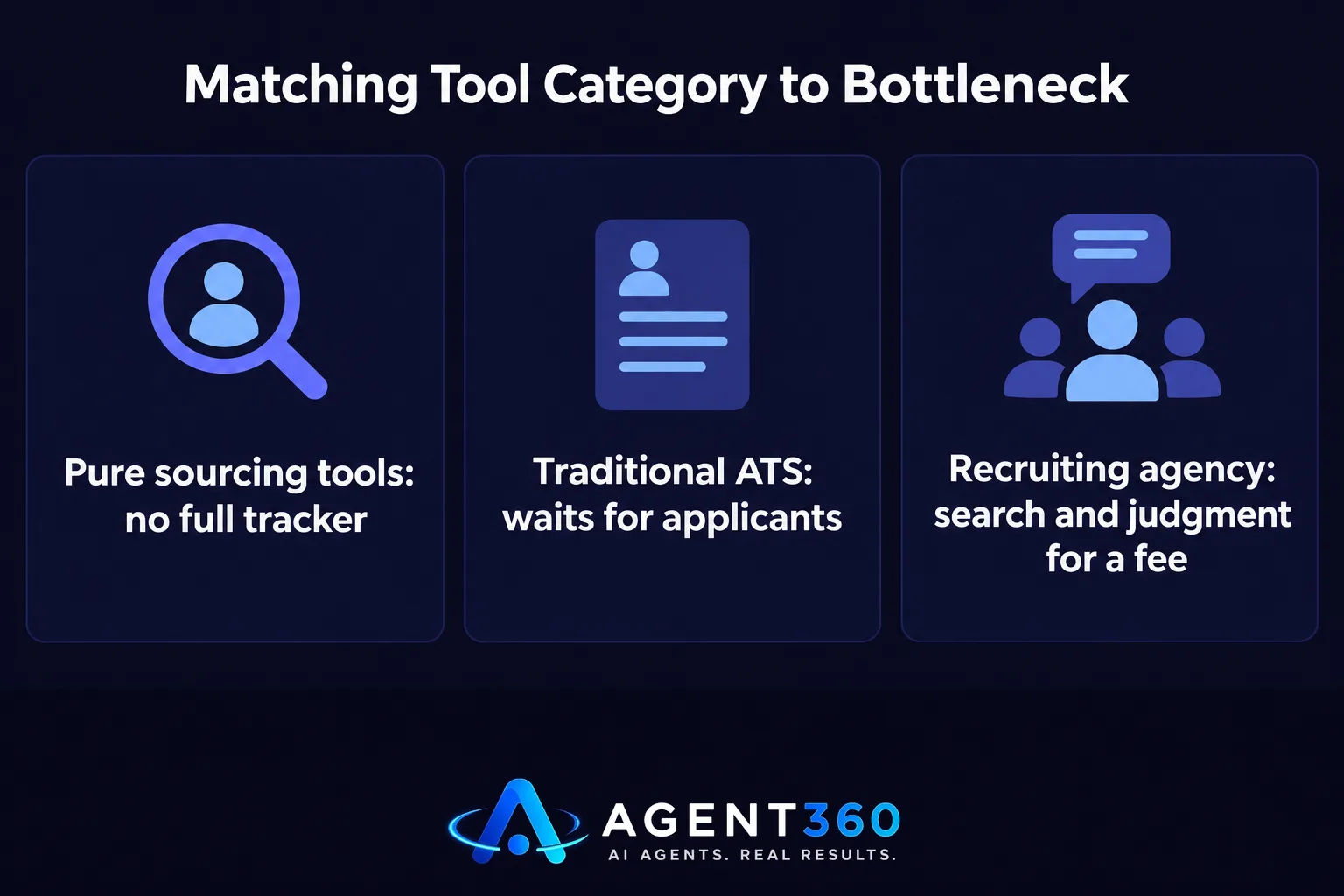
So skip the question of who has the best agent. Ask which bottleneck is costing you time right now. If it's finding people for a hard-to-fill role, you want strength in sourcing and match scoring. If it's applicants piling up in an inbox, you want strength in resume parsing and pipeline tracking. If it's getting candidates on the phone for a first conversation, you want strength in scheduled, scripted screening calls. Reading a comparison of a traditional ATS, LinkedIn Recruiter and a recruiting agency side by side gets you to the gap faster than reading vendor marketing ever will.
What to check before buying in 2026
A short list of questions that cuts through most sales pitches:
- Where do candidates come from? A tool that only scores applicants you already have is solving a different problem than one that also goes out and sources people who haven't applied anywhere.
- Is the score explained or just a number? A bare 0–100 with no sub-scores or reasoning is hard to trust and harder to defend to a hiring manager who disagrees with it.
- Does screening replace a recruiter's time or just add a step? A phone screen that books itself and runs without a recruiter dialing out is a real time saver; one that still needs a human to schedule and sit on the call is closer to a scripting aid.
- Is pricing per hire, per seat, or a flat plan? Per-hire fees scale with your hiring volume in a way flat monthly plans don't — worth modeling against your actual headcount plans before committing.
- What does it not do? Every tool has a boundary — job board posting, calendar sync, e-signature, custom workflow stages. Know the boundary before you buy, not three months in.
HiringAgent covers sourcing, scoring, screening and tracking in one plan
HiringAgent is AI candidate sourcing and a modern ATS in one: paste a job description and its agents source up to 300 candidates a run from a database of public profiles, score each 0–100 against the role, run AI phone screens that candidates book themselves, and track everyone from applicant to hired — set up with the team on a kickoff call. Plans start at $197 a month with unlimited users, month to month, no per-hire fee. Full detail on each agent is on the features page, and current plan limits are on pricing.

Questions people ask
What are the best AI recruiting tools in 2026?
There's no single best tool, because sourcing, scoring, screening and tracking are different jobs and vendors specialize differently. The better question is which of those four jobs is slowing your hiring down, then comparing tools inside that category rather than across all of them.
Who has the best AI agent for recruitment?
No vendor leads in every category at once. Some are built around sourcing and matching, some around applicant tracking, some around screening calls. Match the agent to the bottleneck — a hard-to-fill role needs sourcing strength, a full inbox needs parsing and tracking strength.
What is AI recruitment software?
Software that uses machine learning or language models to automate part of hiring — writing job descriptions, finding and scoring candidates, running first-round calls, or tracking applicants through a pipeline — instead of a person doing that step manually.
What type of AI is used in recruiting?
Mostly two types: language models that read unstructured text like resumes and job descriptions and turn it into structured data, and scoring or ranking models that compare that structured data against a role to produce a match score. Neither one makes the hiring decision.
More articles
- Resume Parsing Software: What It Gets Right (and Wrong)
- AI Resume Screening Scores Resumes, Not Hires
- Automated Phone Screening Interviews: What They Replace
- AI Phone Screening for Recruiters: What the Call Should Do
- What an ATS With AI Candidate Matching Should Actually Do
- The Best ATS for Startups Finds Candidates Too
- What a Modern Applicant Tracking System Actually Does
- What an Applicant Tracking System for Small Business Costs
