Get Found on Google AI: Three Surfaces, Three Fixes
To get found on Google AI (or “googleai”, as plenty of people type it), you need three things: a page Google can index and show a snippet from, a page that already competes for the question, and an answer near the top that can be lifted out whole. There is no opt-in, no tag and no submission form. A plan that promises one is selling you a story.
The rest of this post splits out what Google means by AI, what you can influence, and what to check first. It is ordered so you can stop at any point and still have done the most valuable thing.
How does Google Search use AI?
Two ways, and only one of them is something you can work on.
The first is invisible. Machine-learning systems help Google interpret the query and judge which pages are relevant. You can't see them, test them or tune for them directly. Anyone selling you a trick for this layer is guessing.
The second is visible. Google writes an answer, such as an AI Overview above the links or a conversational AI Mode, and names or links the sources it used. This is where businesses get mentioned or left out, and it is the part you can measure. Type the question, read the answer, see who is in it.
So reframe the job. Don't optimize for Google AI as a system. Pick the questions your buyers ask, and find out which businesses and sites those answers name.
How to get found on Google Search?
Start here, because it is the unglamorous prerequisite. An AI answer is assembled from pages. If a page isn't indexed, is blocked from crawlers, or can't show a snippet, it can't be cited. Google doesn't publish exactly how it picks sources, so be wary of anyone who claims to know the formula. The mechanism is plain, though: the answer has to draw on something, and it draws on pages it can find.
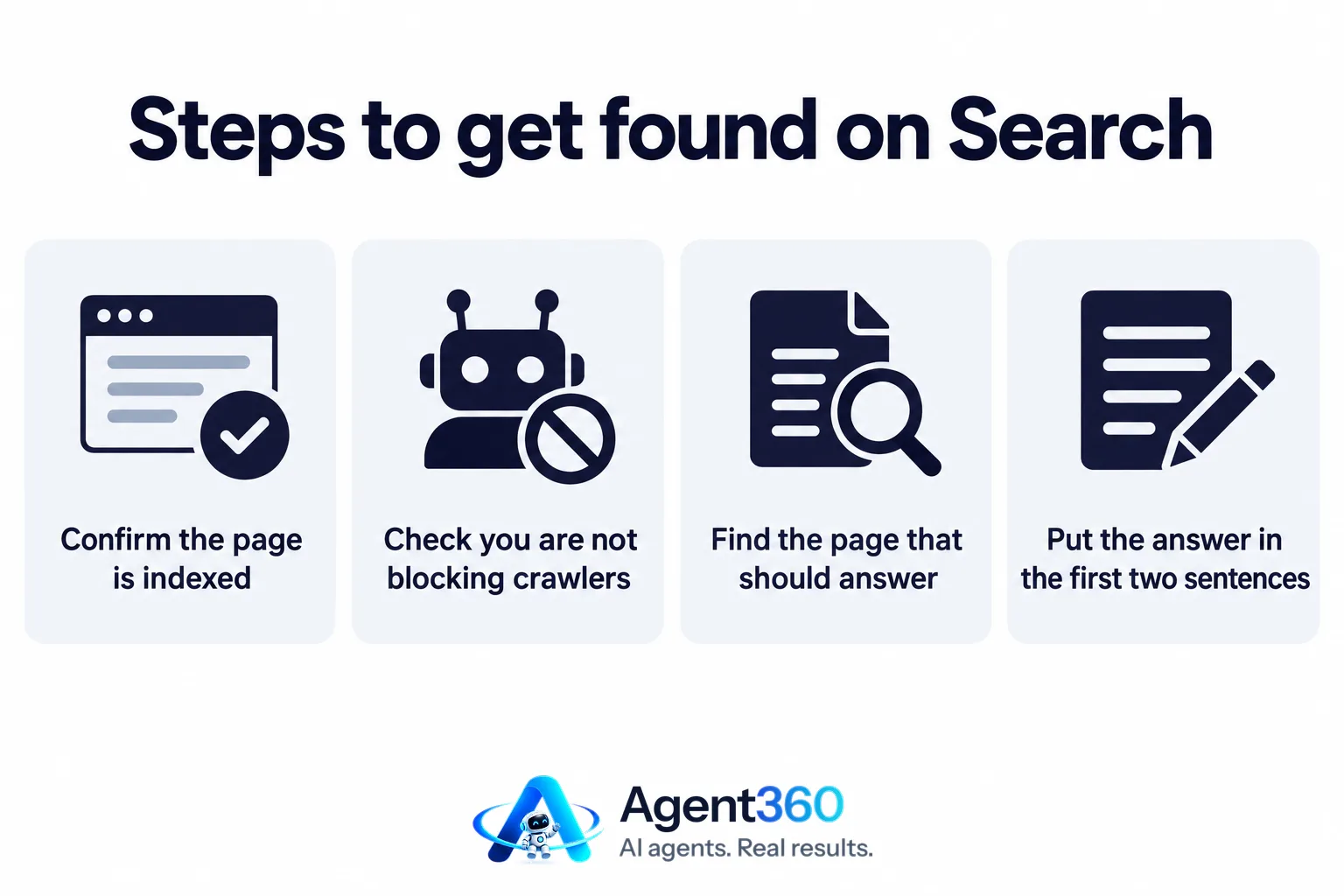
Do these in order:
- Confirm the page is indexed. Check it in Search Console. If you have never opened it, start with this walkthrough.
- Check you are not blocking crawlers by accident. A robots rule or a noindex tag left over from a site rebuild is more common than people admit.
- Find the page that should answer the question. If you have none, that is the finding. If you have two, they may be competing with each other; here is how to spot it.
- Put the answer in the first two sentences under the heading. No warm-up, no story. The answer, then the qualification.
- Use the same words your buyer uses. If they ask for the “best payroll software for a 20-person agency”, a heading that says “our solutions” gives a system nothing to match.
Some readers will push back on this next part. For most businesses, that is the whole job. Special AI formatting matters far less than being a clear, specific page on a question your competitors answer vaguely. Structured data and an llms.txt file can help machines read your site, but they won't rescue a page with nothing to say. If you're weighing it, this is what llms.txt does and doesn't do.
How to get featured in Google AI Overviews?
You can't apply. You can run a loop, though, and the loop is what separates people who get cited from people who only read about it. The no-opt-in explanation is here; this is the working version.

- Write down ten questions a buyer would ask before choosing you. Mix the broad (“how do I choose a…”) with the specific (“best… for…”, “…vs…”).
- Run each one in a clean browser and record three things: does an overview appear, which businesses are named, which sites are linked.
- Repeat weekly for a month. A single run tells you almost nothing, because generated answers vary from one run to the next. You're looking for who shows up most of the time, not who showed up once.
- Sort the misses. If you have a page on the topic that isn't cited, edit it: tighten the answer, add the specifics the cited pages include. If you have no page, write one. Editing existing pages usually comes first.
- Look at who is cited and why. If the linked sources are review sites or directories rather than competitors, your move may be getting listed there, not publishing more on your own blog.
If no overview appears for a question, that is data too. Not every query gets one, and chasing a surface that doesn't exist for your buyers' searches wastes a month. This guide covers how to check, and how to see who beat you.
Is there a search engine without AI?
Yes, in the sense that you can usually avoid AI summaries. Google offers a results filter that shows plain links, and other search engines differ in how much generated content they add. But that is a question about your preferences, not your buyers'. Most people never change defaults, so plan for the default.
There's a useful consequence. AI answers are optional for the searcher and absent on some queries, so don't abandon ordinary rankings. A page that ranks and also answers cleanly gets found by the person reading links and by the person reading the summary. That is the practical reason to treat SEO, AEO and GEO as one set of pages rather than three budgets.
Is Google AI as good as ChatGPT?
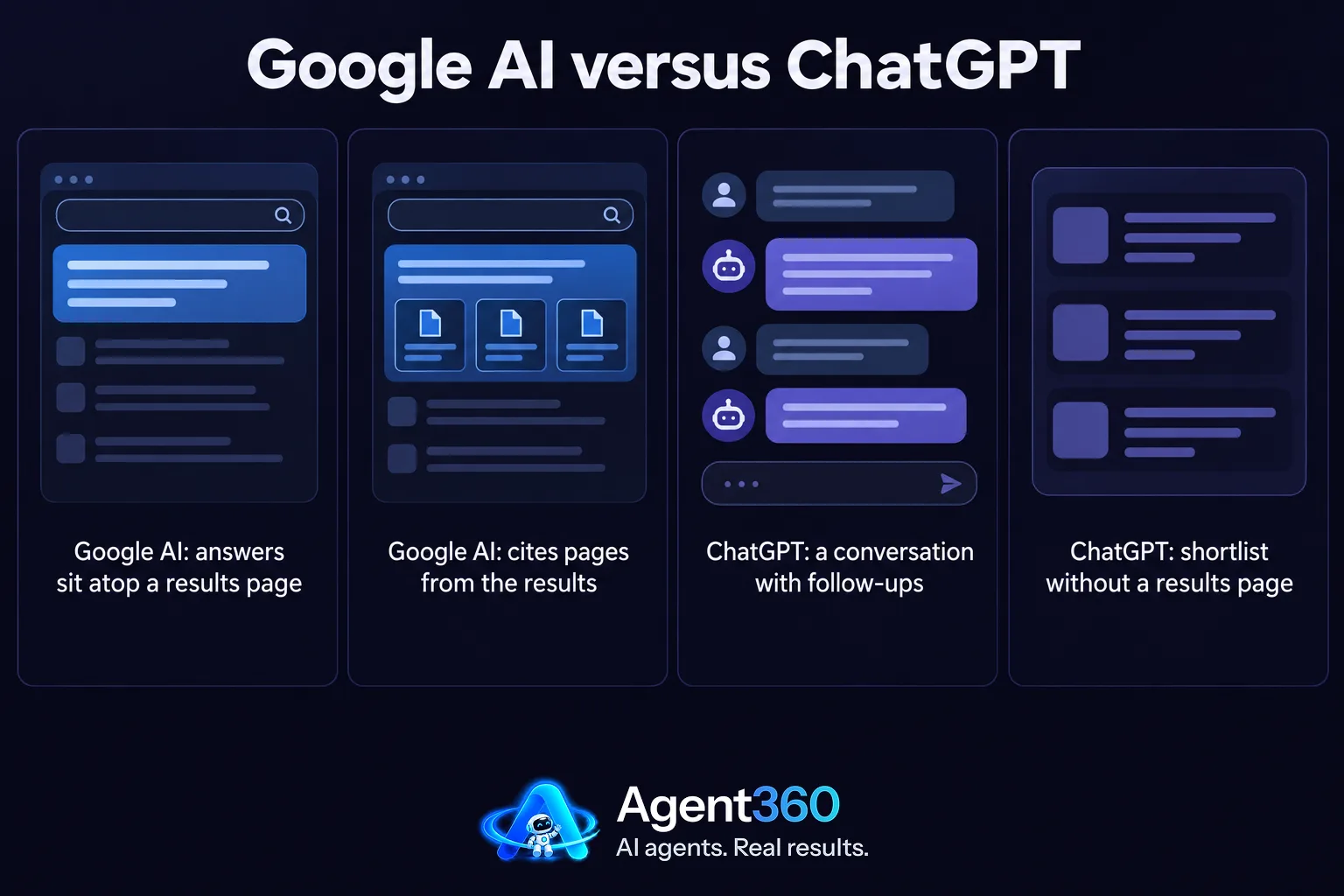
It depends on the job, and for visibility it's the wrong question. They behave differently. Google's AI answers sit on top of a search results page and cite pages from it. ChatGPT is a conversation, where a buyer can ask follow-ups and get a shortlist without ever seeing a results page. A business can be named in one and absent from the other.
Which is better for the person asking is their call. Which matters for you is an empirical question. Ask your ten questions in Google and in ChatGPT, and compare. If you appear in one and not the other, the gap tells you where to look. The pages that help usually help both.
What to do this week
- Check indexing and snippet eligibility on your five most important pages.
- Write your ten buyer questions and run them. Save the results in a sheet with the date.
- Pick the two questions where a competitor is named and you are not. Fix or write one page for each.
- Run the same ten again in seven days. Change nothing in between that you don't write down.
Expect movement to be slow and uneven. Nobody can promise a date for a mention, and you should be wary of anyone who does.
Where SearchAgent fits
If you'd rather not run that loop by hand, SearchAgent's AI Visibility Agent asks your buyers' questions to Google AI Overviews, ChatGPT and Claude on a schedule. It records who gets named and which sites get cited, then turns the misses into page ideas that our agents can write and publish. It doesn't track Gemini or Perplexity today, and it doesn't guarantee mentions. Plans start at $297 a month, month to month; see pricing.
Questions people still ask
Can I pay or sign up to appear in Google's AI Overviews?
No. There is no opt-in or paid placement for AI Overviews. Your page has to be indexed, eligible to show a snippet, and relevant to the question. What you control is the quality and clarity of the page, not a switch.
How long does it take to get found on Google AI?
It depends on how fast Google recrawls your page and whether you already rank for the question. A new page on a topic you've never covered takes longer than an edit to a page that already ranks. Nobody can honestly give a fixed number of days, so measure weekly and judge the trend over a month or more.
Do I need special markup to appear in an AI answer?
No. Clear headings, a direct answer under each, and accurate business details help machines and people alike. Structured data such as FAQ markup can make your content easier to parse, but it won't beat a page that answers the question better than the ones already cited.
More articles
- AI Visibility Monitoring: What a Good Score Really Is
- Local Teaser Pack: What It Is and How to Get Into It
- Reject AI Blog Drafts Fast: A Six-Check Review Queue
- AI Overviews Optimization Starts With Pages You Already Have
- Set Posts Per Week From Your Gap List, Not a Calendar
- GEO Tools: Buy the Fix, Not Another Dashboard
- SEO Reporting for Small Business: One Page, Five Numbers
- AI Overview Search Visibility: Check It, Then Fix It
