Reject AI Blog Drafts Fast: A Six-Check Review Queue
If your process approves everything your AI blog writer produces, you don't have a review step. You have a delay. Drafts are nearly free now, so volume isn't the constraint. Judgment is.
Below are six checks, in the order that kills the most drafts the fastest. Run them top to bottom and stop at the first failure. A draft that fails check one hasn't earned your time on check five.
Read the first 100 words and ask whether they answer the search
Take the keyword the article is meant to win and picture the person typing it. Then read only the opening. Does it hand that person the answer, or does it warm up with context about how important the topic is?
AI drafts drift toward throat-clearing because that is the average shape of the web pages they learned from. Search engines and AI answer engines both lift text that resolves the question fast. Three sentences on why the topic matters give them nothing to quote.
Reject if: the first paragraph could be moved to the top of any article on the same subject without a single edit.
Strike every number you cannot source in 60 seconds
Language models produce statistics the way they produce any other sentence: by writing what sounds right. A figure such as “most buyers research for weeks before contacting a vendor” reads fine and may be unsupported. Your name goes on the page, not the model's.
The rule is mechanical. For each number, percentage or “studies show” claim, find the original source quickly. Can't find it? Cut the claim, or rewrite it as a mechanism that needs no figure. “Buyers compare several vendors before they call” is weaker than a precise number. It is also true, and nobody will quote it back to you on a sales call after checking.
The same check covers claims about other companies' products: limits, thresholds, feature lists. Those change, and they are rarely published. If the draft states them as fact, verify them or delete them.
Search your own site before you approve the topic
The most expensive mistake in automated content isn't a bad article. It's a good article that competes with one you already have. Two pages aimed at the same search split the signal, and often neither ranks well.

Before approving, search your domain for the draft's main phrase and its two closest variants. If an existing page already covers the intent, update that page rather than publishing a second one. And if overlaps have already crept in, read up on the merge, redirect or split decision before you touch anything.
People skip this check because the draft looks fine on its own. It only fails in context.
Delete any sentence a competitor could publish unchanged
Picture pasting a paragraph into a rival's blog. If it fits, it adds nothing for you. An AI writer left alone turns out a lot of these sentences: agreeable, accurate, interchangeable.
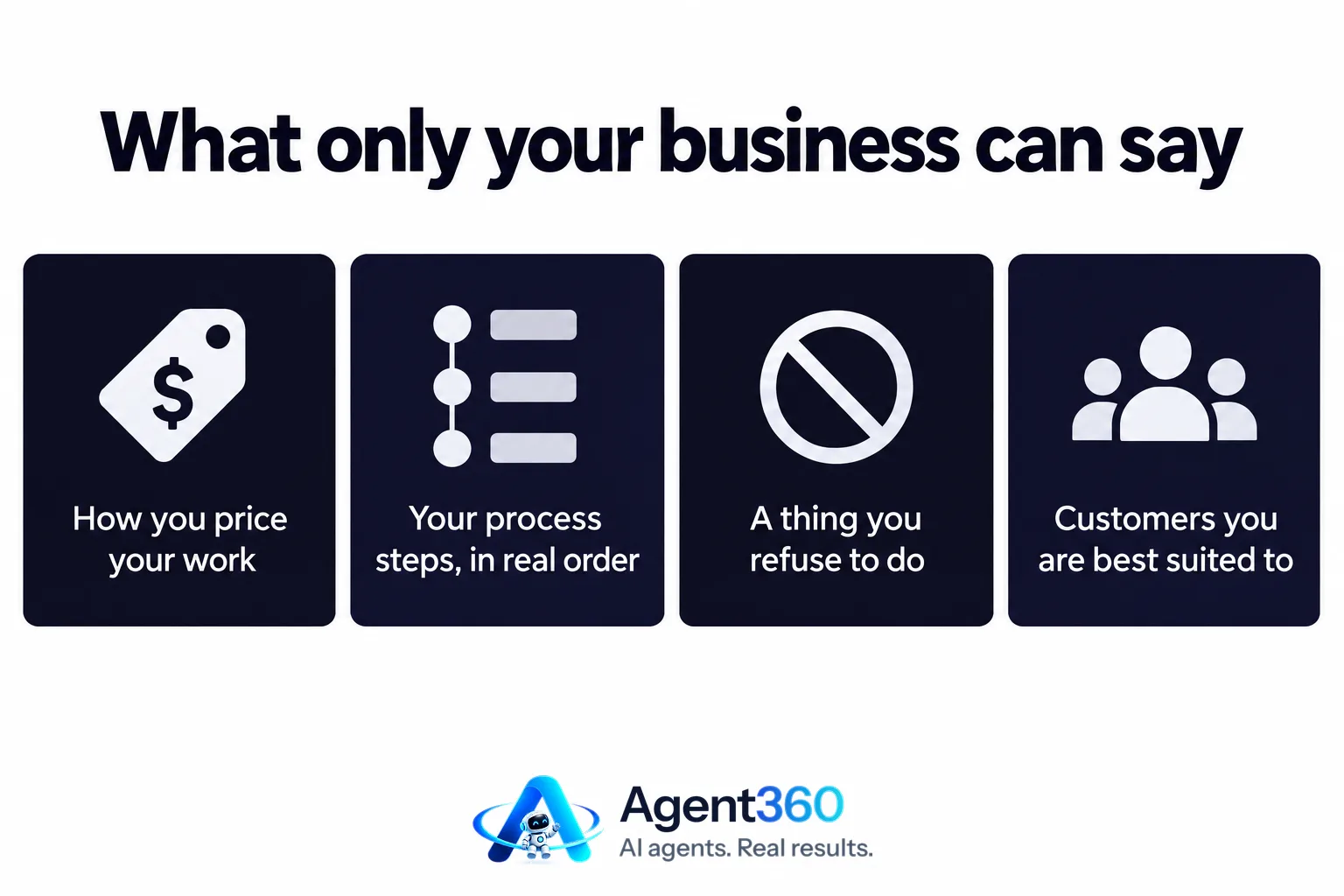
Every article needs a few things only your business can say. Good candidates:
- How you price, and what a typical job or engagement costs you to deliver.
- A specific process step, in the order you actually do it.
- A thing you refuse to do, and why.
- The service area, customer type or situation you are best suited to, and the ones you aren't.
If the draft contains none of these, add them or send it back with a note on what to include. Your edit is where the specificity comes from. The model can structure and phrase it, but it can't supply what it hasn't been told.
Check every fact about your own business against a one-page sheet
Drafts will state your prices, hours, service areas, guarantees and team size with total confidence, and some of it will be guessed. A wrong price on a blog post is a small embarrassment. A wrong guarantee is a liability.
Keep one page of approved facts: what you sell, what it costs, where you operate, what you promise and what you don't. Check each business claim in the draft against it. Catch yourself fixing the same fact again and again? Fix it upstream, in the brief or notes the writer works from.
Cap the queue at what you can actually read
Publishing rate should follow review capacity, not the other way around. If you can properly read and approve five drafts a week, publishing twenty means fifteen went out unchecked. How many posts a week SEO needs is a real question, and the honest answer depends on your gaps, not a quota. Whatever the number is, keep it under your reviewer's breaking point.
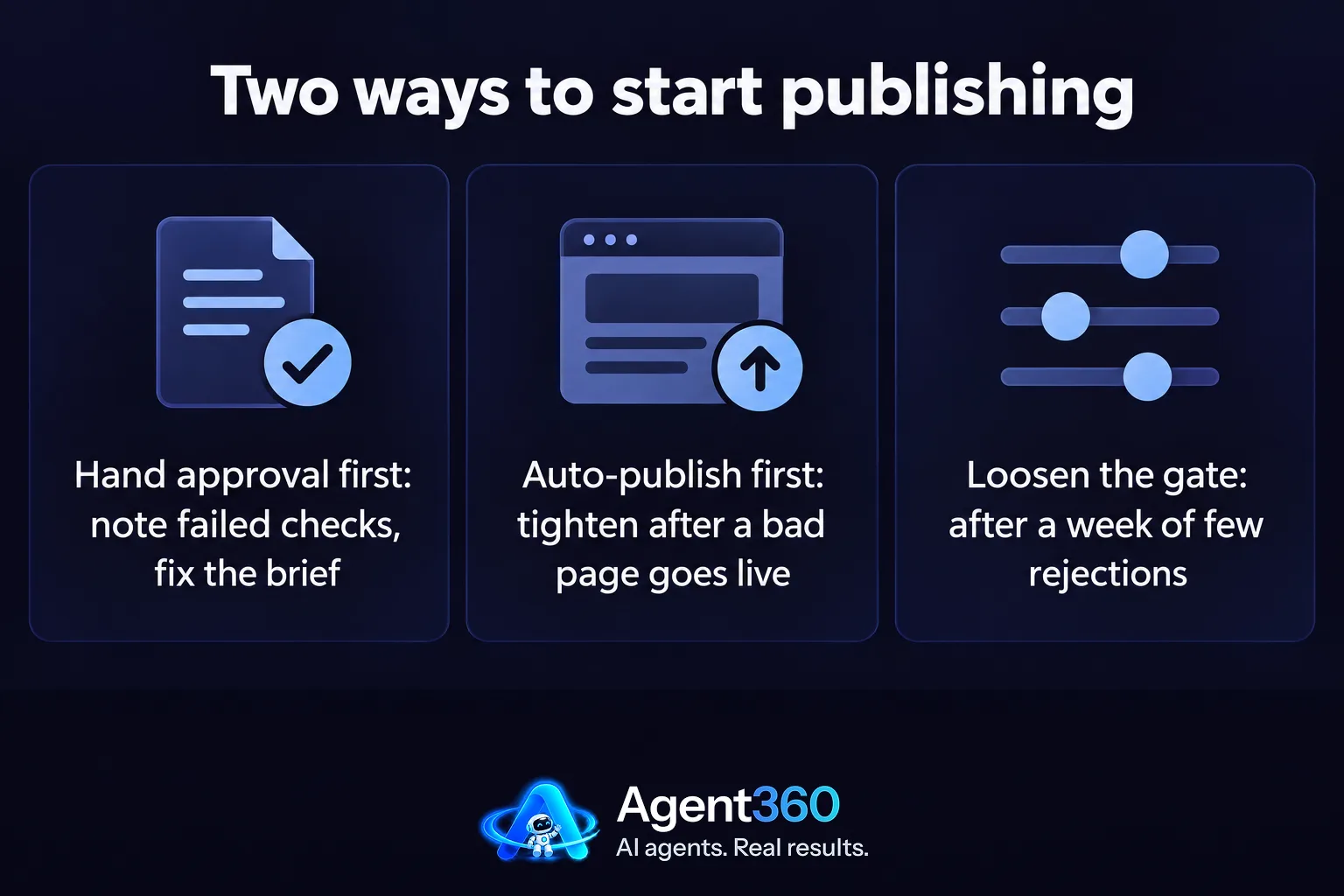
Here is the part some readers will dispute: for the first month, don't auto-publish. Approve by hand, note which checks the drafts fail most often, and fix those causes in the brief. Once a week passes with few or no rejections, loosening the gate is a defensible call. Starting loose and tightening after a bad page goes live is the same decision, made later and at higher cost.
We make the longer argument for why a writing tool alone doesn't move rankings in An AI Blog Writer Won't Rank You. The short version: the draft is the cheap part.
Where SearchAgent fits in this queue
SearchAgent's Writer Agent writes each morning from a plan you've approved, and every article is checked before it lands. By default each one arrives as a draft for you to approve, so the six checks above are the intended workflow, not a workaround. Auto-publish is optional, and you can leave it off as long as you like. Articles go to a blog we host on your domain; publishing into WordPress or Webflow isn't supported today. Topics come from searches you lose and AI questions where nobody names you, which makes check three easier, since the plan starts from real gaps. Plans start at $297 a month with no contract; see pricing for the tiers.
Questions readers still ask
Can an AI blog writer rank without human editing?
It can, for some low-competition searches, but nothing guarantees it. The risk isn't poor writing. It's that unreviewed drafts carry invented figures, wrong facts about your business, and topics that overlap pages you already have. A review step catches those before they cost you.
How long should reviewing one AI draft take?
Checks one to three usually take minutes: read the opening, verify the numbers, search your site. The slower work is adding what only you know. If every draft needs more than a light edit, the problem sits in the brief or the source notes, not in the review.
Should I publish AI articles on a separate blog?
Not for search reasons alone. What matters is that the pages are useful, distinct from your existing ones and clearly yours. Where the blog lives is a branding and technical decision. Put it on your own domain, so whatever authority the pages earn stays with your business.
More articles
- AI Visibility Monitoring: What a Good Score Really Is
- Local Teaser Pack: What It Is and How to Get Into It
- Get Found on Google AI: Three Surfaces, Three Fixes
- AI Overviews Optimization Starts With Pages You Already Have
- Set Posts Per Week From Your Gap List, Not a Calendar
- GEO Tools: Buy the Fix, Not Another Dashboard
- SEO Reporting for Small Business: One Page, Five Numbers
- AI Overview Search Visibility: Check It, Then Fix It
