What Is llms.txt and Do You Actually Need One?

llms.txt is real. It's a plain markdown file you drop at the root of your site, listing your most important pages with a short description of each, so an AI tool can skim it instead of crawling the whole thing. It isn't an official web standard. No AI company has confirmed it reads one. And adding it won't, on its own, get you named in ChatGPT or Google AI Overviews. Call it a reasonable, low-cost bet with no confirmed payoff — yet.
That's the short answer. Here's what sits behind each piece of it.
Is llms.txt a real thing?
Yes — it exists, and you can find it sitting on real sites today. It was proposed in September 2024 as a convention, not handed down by any standards body, and no search engine or AI provider requires it. Think of it less like robots.txt, which every major crawler actually reads and obeys, and more like an early sitemap format before anyone agreed to support it. A handful of developer-heavy teams have adopted it. Most of the web hasn't, and most AI crawlers haven't confirmed they even look for it. “Real” and “required” are different claims — llms.txt is the first, not yet the second.
What is llms.txt and how to use it?
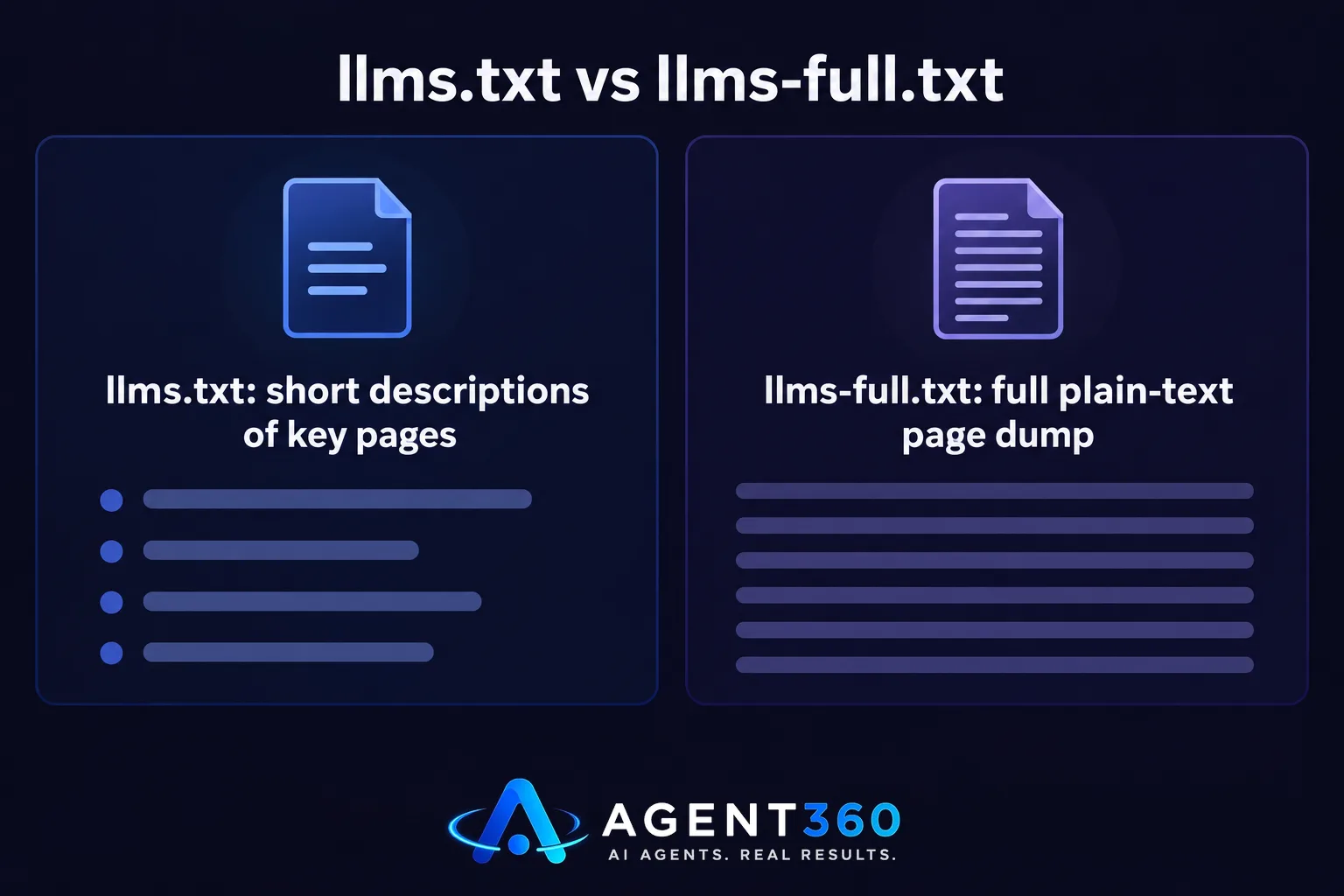
The file sits at yourdomain.com/llms.txt and lists, in markdown, your key sections and pages with one-line descriptions — a documentation page, a pricing page, a product overview, each with a short note on what it covers. The thinking: a language model with a limited context window can read this short file instead of crawling and parsing your entire site, then use it to decide which pages are worth pulling into an answer. A companion convention, llms-full.txt, does something similar but bigger — a plain-text dump of full page content, less HTML noise, more of what the model can actually use.
Building one is mechanical. List your highest-value pages. Write a sentence of context for each. Group them under a few headings. Publish the file. It takes an afternoon, not a project plan. The open question isn't how to make it — it's whether anyone reads it once you have.
What does “LLM text” mean?
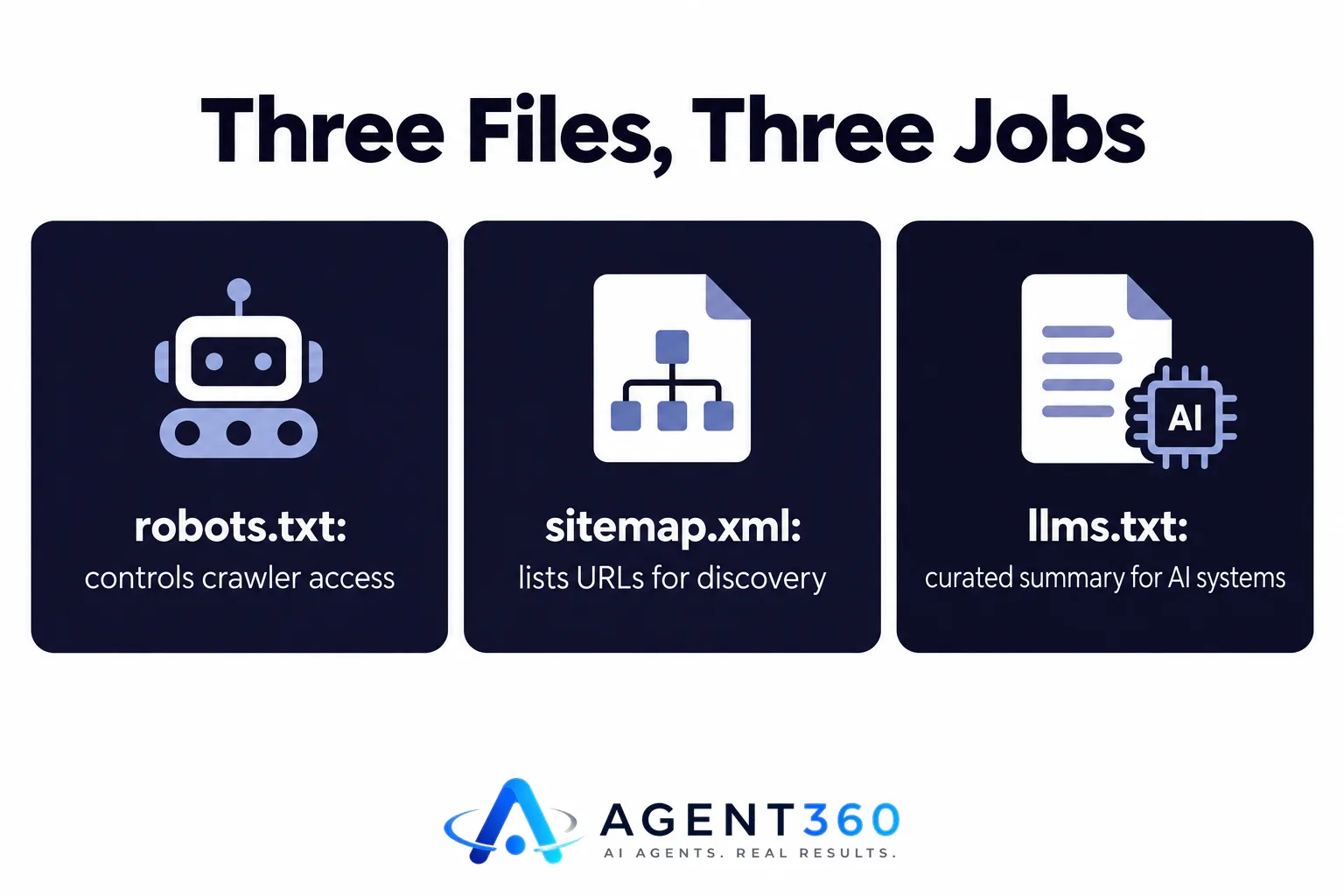
This phrase causes more confusion than it should, because three different things get lumped together. robots.txt controls which crawlers may access which parts of your site — it's about permission, and every major crawler respects it. sitemap.xml is a list of URLs for discovery, telling search engines what exists and when it changed. llms.txt is neither permission nor a full URL index; it's a curated summary aimed specifically at AI systems that answer questions rather than crawl and rank pages. “LLM text,” when people use the phrase loosely, usually means this third thing: a short, human-written guide to your site, written for a model instead of a search index.
Should I add llms.txt to my website?
Add it if you've got a free afternoon and nothing more urgent on the list. It costs almost nothing, it won't hurt your site, and if any AI system ever does start reading it consistently, you'll already have one sitting there. What it won't do is substitute for the two things that actually move the needle: pages that directly answer the questions your buyers ask AI tools, and a site that's technically easy for any crawler — human-built or AI — to parse. If the choice is between spending that afternoon on llms.txt or writing the page that answers “best [your category] for [your situation],” write the page. That's the one with a confirmed mechanism for getting you cited.
The file does not replace the content that gets you named
This is the part most explanations skip: llms.txt is a map, not a destination. If the pages it points to don't answer a real question plainly, with a direct, citable sentence near the top, no map fixes that. AI answer engines pull from pages that say things outright — who something is for, what it costs, how it compares — not from pages that bury the answer under three paragraphs of throat-clearing. Our guide to what AEO is walks through what that kind of page actually looks like, and the companion piece on GEO covers the wider job of getting named by AI assistants — llms.txt included, as one small tactic among several.

Where SearchAgent fits
If you'd rather not manage this file by hand, SearchAgent sets up llms.txt and FAQ markup as part of onboarding on every plan, alongside the site health scoring that checks the technical items AI crawlers and search engines both care about — titles, headings, structured data, crawler access. That's table stakes, not the main event. The main event is still the content. Plans start at $297 a month, laid out on the pricing page.
Questions people ask
Does llms.txt replace robots.txt or sitemap.xml?
No. robots.txt controls crawler access, sitemap.xml lists your URLs for discovery, and llms.txt is a separate, optional summary aimed at AI tools. Keep all three if you use them — they do different jobs.
Will adding llms.txt get me mentioned by ChatGPT or Google AI Overviews?
Not by itself. No AI provider has confirmed it reads the file consistently, so treat it as a low-cost addition, not a strategy. Pages that directly answer buyer questions are the confirmed lever.
Where do I put the file, and does the format matter?
At the root of your domain, as yourdomain.com/llms.txt, written in plain markdown with headings and a short description per linked page. There's no enforced schema, so clarity matters more than exact formatting.
More articles
- An AI Blog Writer Won't Rank You. Here's What Will
- SEO Content Automation: What to Automate, What Not To
- How to Appear in Google AI Overviews
- AI Visibility Tracking: What to Measure and How Often
- Track Brand Mentions in ChatGPT Without Fooling Yourself
- How to Get Mentioned by ChatGPT: A Practical Playbook
- How to Rank in ChatGPT: What Actually Gets You Named
- Generative Engine Optimization: What Actually Works
