SEO Reporting for Small Business: One Page, Five Numbers
A small business SEO report should fit on one page and answer one question: did more of the right people find us and get in touch? Domain scores, total sessions, the 40-slide deck. They mostly exist to make the work look bigger than the result.
That is a harsh claim, so here is the reasoning. A small business has a handful of services, a small service area and a few dozen searches that actually produce customers. A report built for an enterprise, with hundreds of metrics, buries those few searches in noise. Report less. Split it correctly. End with a decision.
Stop leading with traffic and domain scores
Total organic sessions is the most common headline number in small business reports, and the least useful. It lumps together people searching your company name, people who landed on a blog post and left, and the occasional visitor who was never going to buy. It can climb while your phone stays quiet.
Third-party authority scores have a different problem. They measure something about your site, not something about your business. Nobody ever booked a job because a score went up two points. If a report opens with either number, ask what decision it supports. Usually the answer is none.
Average position is the third offender. One average across every query blends a page-one result for a term nobody searches with a page-four result for the term that pays. The average can sit still while the one query that matters moves a lot.
Report five numbers, in this order
The order matters because it runs from closest to the money to furthest away. If the first number is bad, the rest are diagnosis. If the first is good, the rest explain why.
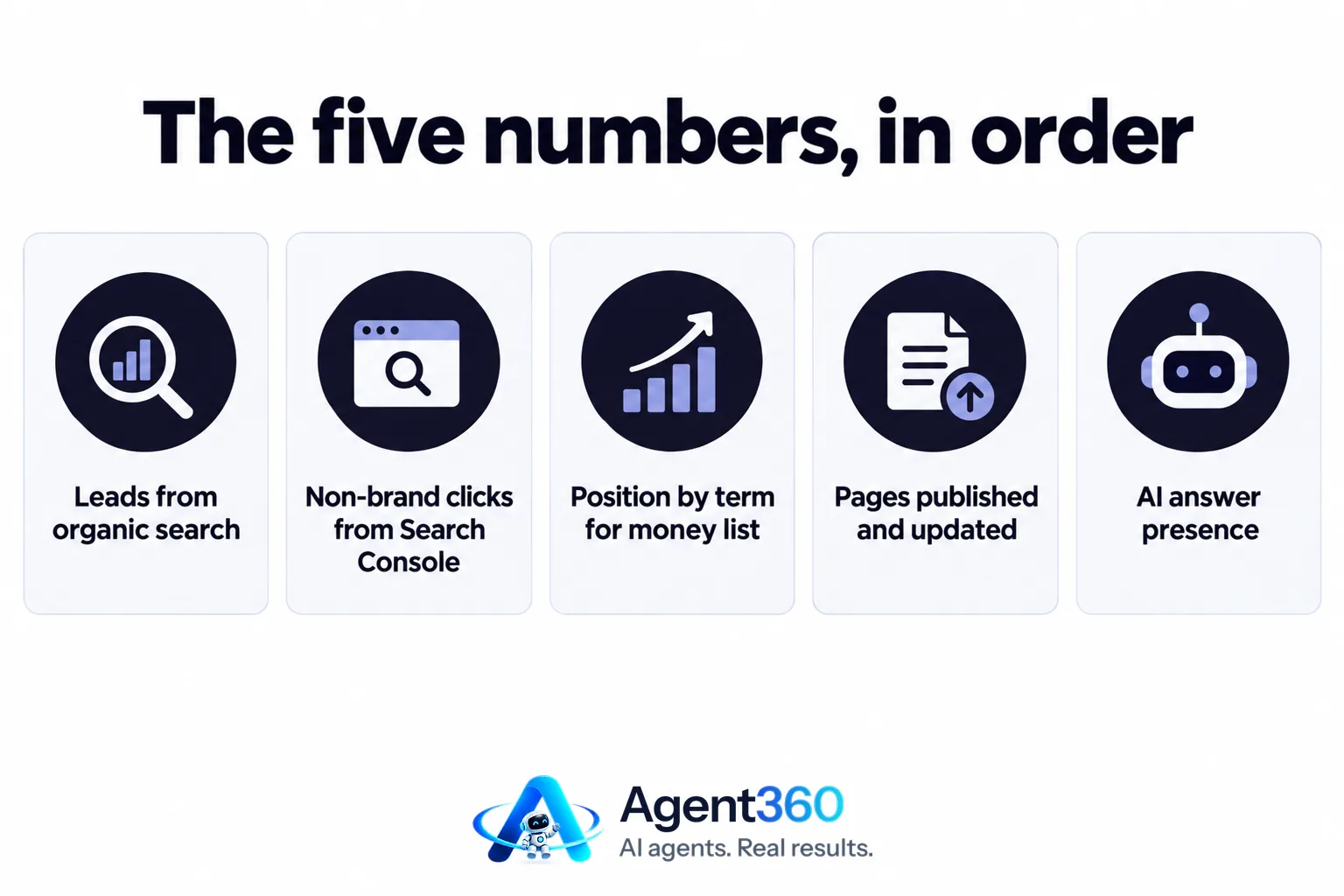
- Leads from organic search. Form fills, calls, booked appointments or quote requests that came from search. Count them from your own form submissions or call log, not from an analytics guess. Ten honest, hand-tagged leads beat a dashboard full of estimates.
- Non-brand clicks from Search Console. Clicks on queries that do not contain your business name. This is the number that shows whether strangers are finding you.
- Position by term for your money list. Pick 10 to 20 searches a buyer would type before hiring someone like you. List each one with its current position and last month's position. Never average them.
- Pages published and updated. What went live this month, what was refreshed, and whether Google has indexed it. This is the output number, and it keeps the work honest even when results lag.
- AI answer presence. Ask the same fixed set of buyer questions in ChatGPT, Claude and Google on a schedule, and record how many named you. Keep the questions constant or the trend means nothing. Single answers vary, so read the pattern over time; this guide to AI visibility tracking covers what to measure and how often.
That is the whole report. If a sixth number cannot change what you do next month, leave it out.
Split brand from non-brand or the chart lies
People who already know your name will search it. Those clicks are real, but they mostly reflect your reputation, your referrals and your ads, not your SEO. Fold them in and a good word-of-mouth month looks like an SEO win. Worse, a stalled SEO program hides behind loyal customers.
In Search Console, filter the query report to exclude your business name and its common misspellings, then save that view. Do the same for the money list. If you are new to the tool, Google Search Console for beginners walks through where those filters live.
One caveat: Search Console hides some queries for privacy, so the query list will never add up to your total clicks. Treat it as a reliable direction, not an exact count.
Match the reading rhythm to how slow each number moves
Different numbers deserve different cadences. Get this wrong and you end up panicking over noise.
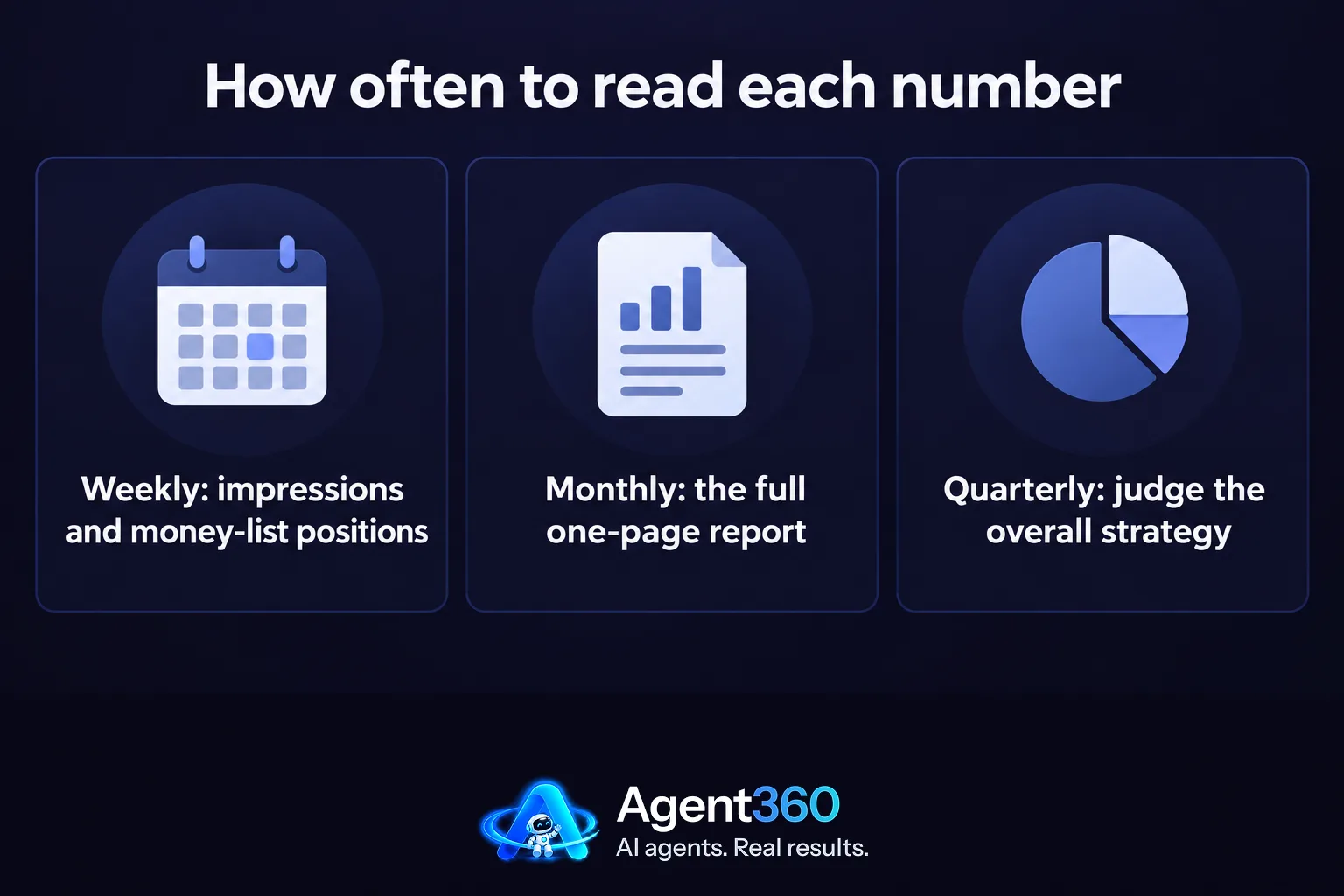
- Weekly: glance at impressions and the money-list positions. Positions wobble day to day, so you are only looking for a break in the pattern, such as a page that has dropped out entirely.
- Monthly: read the full one-pager. Leads and non-brand clicks are too lumpy for a week and about right for a month.
- Quarterly: judge the strategy. A new page usually needs weeks or months before it settles, so one quiet month after publishing is not a verdict. Our piece on how long SEO really takes sets expectations by stage.
Be wary of anyone who wants to change course every time a weekly number dips. Be just as wary of anyone who says to wait indefinitely. The quarterly review is where you decide whether the plan has earned another quarter.
End every report with three decisions
A summary tells you what happened. A decision tells you what to do about it. Close each monthly report with three lines:

- Keep: one thing that is working and deserves more of the same, such as a page type that is climbing.
- Change: one thing that is stalled and needs a different approach, such as a money term stuck on page two where an existing page could be rewritten.
- Stop: one thing consuming effort without moving a number on the page.
If a report cannot produce a Stop, it is probably not looking hard enough. It is also the easiest test of a provider: ask what they stopped doing last month.
Where SearchAgent fits
Building this page by hand means pulling Search Console, rechecking positions and asking AI engines the same questions on a schedule. SearchAgent's Rank Agent reads your Search Console every night and tracks positions and movement for your terms. Its AI Visibility Agent runs your fixed questions across ChatGPT, Claude and Google AI Overviews. Rankings need Search Console connected, which we set up with you at kickoff. It does not show search volume or keyword difficulty, and it does not track Perplexity or Gemini. Plans start at $297 a month with no contract; see pricing.
Three questions owners still ask
How long should a small business SEO report be?
One page. It should hold five numbers (organic leads, non-brand clicks, positions for a short money list, pages published and updated, and AI answer presence) plus a Keep, Change, Stop decision. Anything longer belongs in an appendix nobody has to read.
Should I include rankings in the report?
Yes, but only by term and only for the 10 to 20 searches that bring customers. A single average position across all queries hides the movement that matters, so leave it out.
What if SEO leads are small but my provider says it is working?
Check the first number before any other. If organic leads are flat after several months of published pages, ask which money-list terms have moved and which pages target them. Plenty of activity with no movement on those terms means the plan needs changing, not more patience.
More articles
- Set Posts Per Week From Your Gap List, Not a Calendar
- GEO Tools: Buy the Fix, Not Another Dashboard
- AI Overview Search Visibility: Check It, Then Fix It
- How to Appear in AI Overviews (and Why You Can't Opt In)
- How to Get Your Firm Featured in Google's AI Overviews
- Keyword Cannibalization at Enterprise Scale: The Real Fix
- How to Get Into Google's AI Overview, Really
- Hur du rankar i ChatGPT (och vad det egentligen betyder)
