AI Visibility Monitoring: What a Good Score Really Is
Ask ChatGPT, Claude and Google AI Overviews the questions your buyers ask, on a schedule, and write down whether you were named, whether your site was cited, and who got named instead. That is AI visibility monitoring. Your score is the share of answers where you appear, and there is no universal good one. A good score beats the competitor you lose deals to, on the same questions, and climbs over a couple of months.
Anyone who hands you a benchmark like “aim for 40%” is guessing. The number depends on your question set, your category and how crowded it is. Below: how to build a score you can defend, and how to read it.
How do I monitor my visibility in AI?
Start with a fixed list of questions, not a feeling. Write 15 to 25 questions in the words a buyer would actually type, and split them into four types:
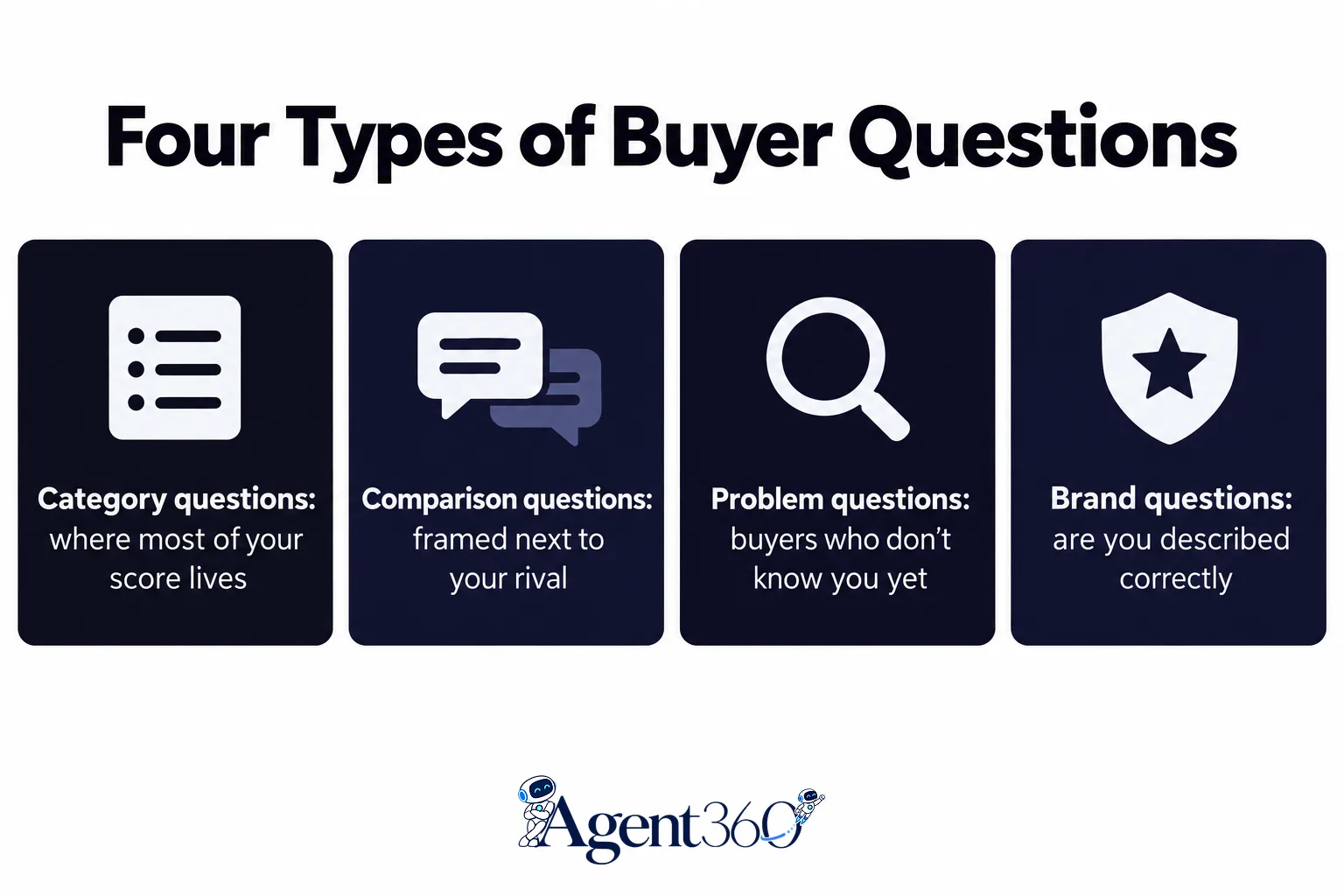
- Category questions: “best accounting software for construction firms.” This is where most of your score lives.
- Comparison questions: “Brand A vs Brand B.” These show how you are framed next to the rival you lose to.
- Problem questions: “how do I stop invoices going out late.” Buyers ask these before they know your category exists.
- Brand questions: “is Brand A any good.” These test whether the engines describe you correctly.
Then run every question on every engine, and run each one more than once. AI answers shift from one run to the next, so a single response proves nothing. Three runs per question per engine is a sensible floor. Log the date, the engine, whether you were named, whether your domain was cited, and which brands appeared. Use a fresh, logged-out session where you can, because your own history can colour the answer.
The manual method works, and it costs only time. We cover the mechanics in how to track your brand in ChatGPT. Where it breaks is discipline. Monitoring only helps if the question list stays the same for months, and spreadsheets drift.
How is AI visibility measured?
Four measures cover it. Anything beyond them is decoration.
- Mention rate: answers that name you divided by answers collected.
- Citation rate: answers that link to or cite your own domain. Being named without a citation means the engine knows of you but is not using your pages.
- Prominence: whether you are the first brand named, or the fifth in a list. First mention carries more weight with a buyer building a shortlist.
- Share against rivals: of all brand mentions in your category questions, what fraction are yours versus each named competitor.
The arithmetic is simple. Run 20 questions, three times each, on three engines, and you collect 180 answers. Get named in 45 of them and your mention rate is 25%. That figure is made up for illustration, and on its own it means nothing. It starts to mean something when a competitor sits at 50% on the same 180 answers.
Add one qualitative check: is what the engine says about you true? A wrong price, a discontinued product or a mixed-up service area deserves a fix before you chase more mentions.
What is a good AI visibility score?
A good score is relative, and it has three tests.
- Brand questions should name you almost every time. If they do not, the problem is not content volume. Your basic facts are missing or inconsistent across your site and the pages that describe you.
- On category questions, you should be in the same conversation as your top two rivals. Missing from questions where they appear is the gap that costs you shortlist spots.
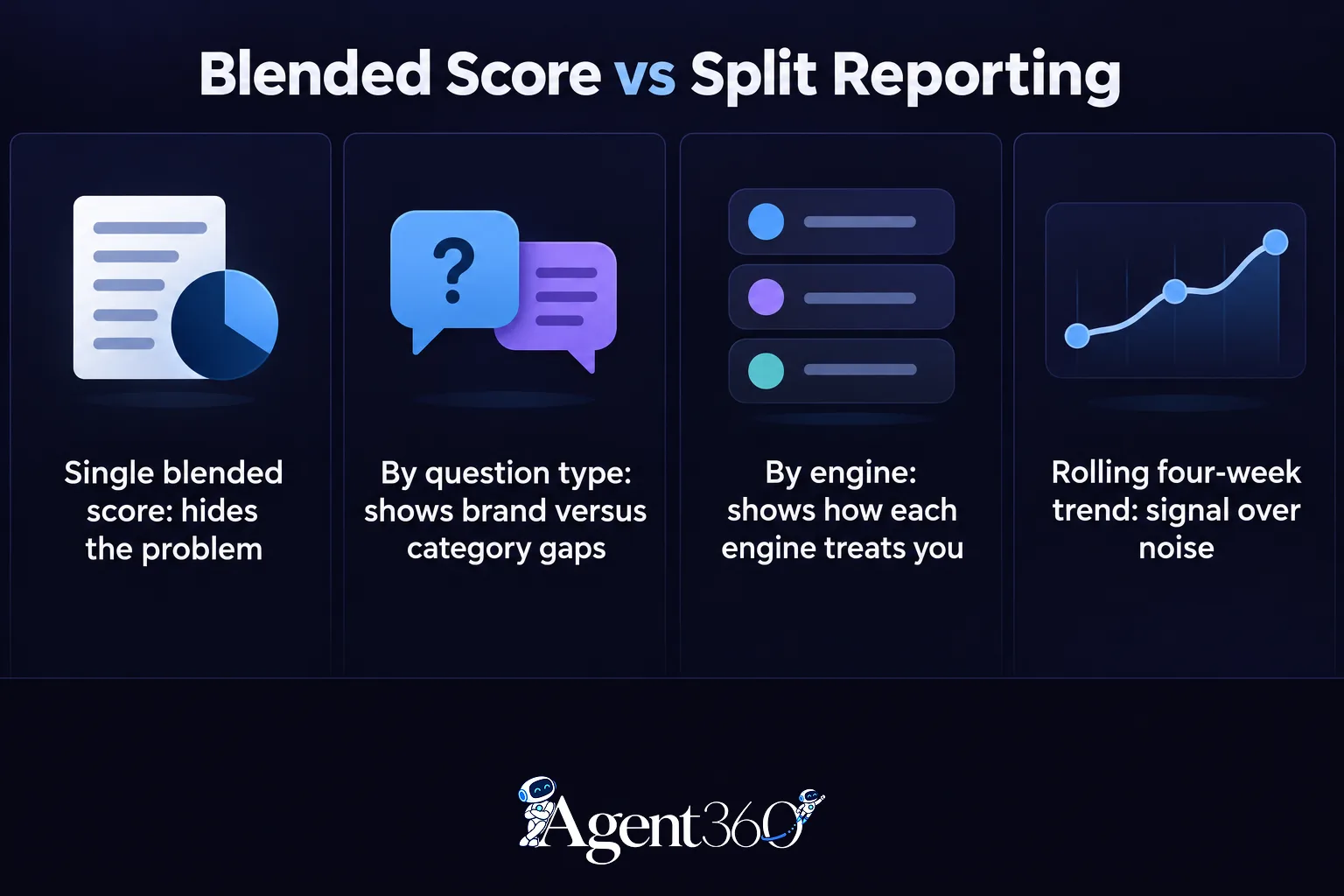
- The trend matters more than the level. Compare a rolling four-week window with the prior four. A small move across many answers is signal. A big move on one question is usually noise.
Here is the part some will disagree with: do not track a single blended score. Brand questions (where you may be near the ceiling) and category questions (where you may be near zero) average out to a comfortable middle number that hides the problem. Report by question type and by engine. One engine can treat you very differently from another, and a blended average erases that.
And never compare your score to someone else’s. A different question list means a different measurement.
What is an AI visibility report?
An AI visibility report is a short record of what the engines said about you this period, and what you will do about it. No dashboards needed. One page is enough:
- A table: question, engine, named or not, cited or not, which brands appeared instead.
- Mention rate and citation rate by question type, this period versus last.
- Your share against the two rivals that matter.
- Three lines: what moved, what you changed on your site, what you will publish next.
The last line is the point. A report that stops at the numbers is a scoreboard. If you already keep a lean reporting habit for search, the same discipline applies, as in one page, five numbers.
Treat every miss as a page brief
Every question where a rival is named and you are not is a to-do item. Look at which sites the engine cited. Usually one of two things is true: no page on your site answers that question directly, or a page exists but buries the answer under a long introduction. The fix is a page that states the answer in its opening lines, names who it is for, and backs it with specifics.

For the Google side, checking whether you are in AI Overviews and who beat you walks through reading the overview itself.
Watch your attribution. You will not know how quickly any engine picks up a new page, because those companies do not publish how their systems refresh. Judge a change over several weeks of repeated runs, not the morning after you publish.
Where SearchAgent fits
If you would rather not run the spreadsheet, SearchAgent’s AI Visibility Agent asks your questions to ChatGPT, Claude and Google AI Overviews on a schedule and shows who was named, which sites were cited and what to publish next. Starter checks weekly with 10 questions, Pro checks every 3 days with 20, and Scale checks daily with 20; see pricing. It does not track Perplexity or Gemini, and it cannot guarantee mentions. On Starter you get 10 questions, so pick the ones that map to real deals.
Questions people ask next
How often should I check my AI visibility?
Weekly is enough for most businesses. Answers vary run to run, so daily checks mostly add noise unless you collect enough repeats to average it out. Check more often only while you are shipping pages meant to change specific answers.
Can I monitor AI visibility by hand?
Yes. Fix a list of 15 to 25 buyer questions, run each several times on each engine, and log whether you were named and cited and who else appeared. It is slow but valid. The risk is inconsistency, so keep the question list unchanged for at least a quarter.
Does a higher AI visibility score mean more revenue?
Not automatically. The score shows how often engines recommend you, not whether those buyers convert. Tie it to evidence you already hold: lead sources, the pages leads read before enquiring, and branded search in Search Console. If the score rises and those do not, check which questions improved.
More articles
- Local Teaser Pack: What It Is and How to Get Into It
- Reject AI Blog Drafts Fast: A Six-Check Review Queue
- Get Found on Google AI: Three Surfaces, Three Fixes
- AI Overviews Optimization Starts With Pages You Already Have
- Set Posts Per Week From Your Gap List, Not a Calendar
- GEO Tools: Buy the Fix, Not Another Dashboard
- SEO Reporting for Small Business: One Page, Five Numbers
- AI Overview Search Visibility: Check It, Then Fix It
