AI Overviews Optimization Starts With Pages You Already Have
Don't open a blank document. The fastest route into a Google AI Overview is usually a rewrite of a page that already ranks for the question. Most teams do the opposite: they hear “AI search” and start a new article. That adds to the pile of pages Google already has to choose from, and it ignores the pages that have earned some trust.
What follows is a working method for Google AI Overviews optimization. Pick the right existing pages, change the parts an answer engine reads first, and measure the result without fooling yourself. One caveat: Google does not publish how it picks sources for an overview, so this is practice built on mechanism, not a guaranteed lever. Nobody can promise you a citation. Anyone who does is selling something.
Start with pages that already rank, not a blank page
An AI Overview is a summary written from pages Google already considers relevant to the question. A page nowhere near the results has a thin case for being used. A page on page one or two has a real one. So build your candidate list from rankings, not brainstorming.
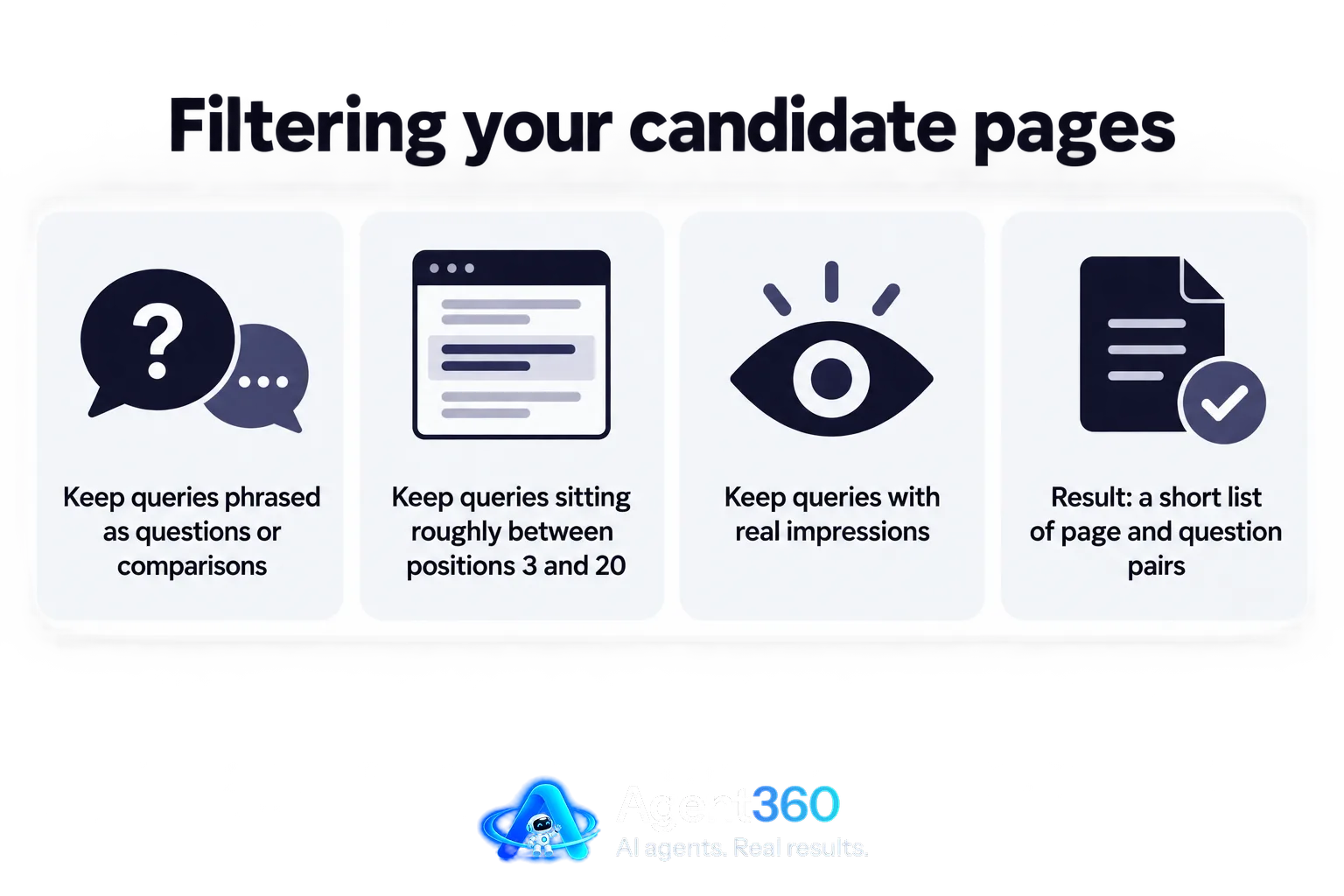
Pull your queries from Search Console. If you have not used it much, the Search Console starter guide covers the export. Then filter in three steps:
- Keep queries phrased as questions or comparisons. “How much does X cost”, “best X for Y”, “X vs Z”, “is X worth it”. Short head terms rarely carry the kind of intent a summary answers.
- Keep queries where you sit roughly between positions 3 and 20. That band is a rule of thumb, not a Google threshold. Above it you are probably already a source. Far below it, the page needs ranking work before answer work.
- Keep queries with real impressions. A question nobody asks is not worth an afternoon.
What survives is usually a short list, perhaps ten to twenty page and question pairs. That is your first month of work, and none of it needs a new URL.
Rewrite the first screen as a direct answer
Open each candidate page and read only the first 100 words. Most business pages fail right here. They open with scene-setting, a brand claim or a definition of the obvious, and the actual answer waits four scrolls down.
The edit is mechanical:
- Put the answer in the first one or two sentences under the heading. State it flat, with the number, the condition or the recommendation. If the real answer is “it depends”, say what it depends on and give the default case.
- Make the heading the question, in the buyer's words. Not “Pricing overview”, but “How much does a commercial roof inspection cost?”
- Keep one claim per paragraph. A paragraph making three points can't be lifted cleanly. One making a single point can.
- Use a list or a small table where the answer is a set. Steps, options and criteria are easier to extract when they are actually structured as steps, options and criteria.
Notice what is missing: keyword repetition, a word-count target, a stack of generic FAQs bolted onto the bottom. If a question is worth answering, answer it where a reader and a summarizer will meet it first.
Be specific enough to be quotable, and keep the claim you can defend
A summary has to choose between sources that say roughly the same thing. A page with an actual threshold, a named condition or a clear trade-off gives the system something a generic page can't. “Most businesses should…” is filler. “If you have fewer than X, do Y; above that, do Z” is a position.
This is also where overreaching costs you. Don't invent statistics to sound specific. A made-up number that a summary repeats under your name is a liability. When you lack data, describe the mechanism instead: why the cost rises, what drives the delay, which step people skip. That is specific, and it is true.
Skip the shortcuts that promise inclusion
Three habits get sold as AI Overviews tactics. You can safely push all three down the list:
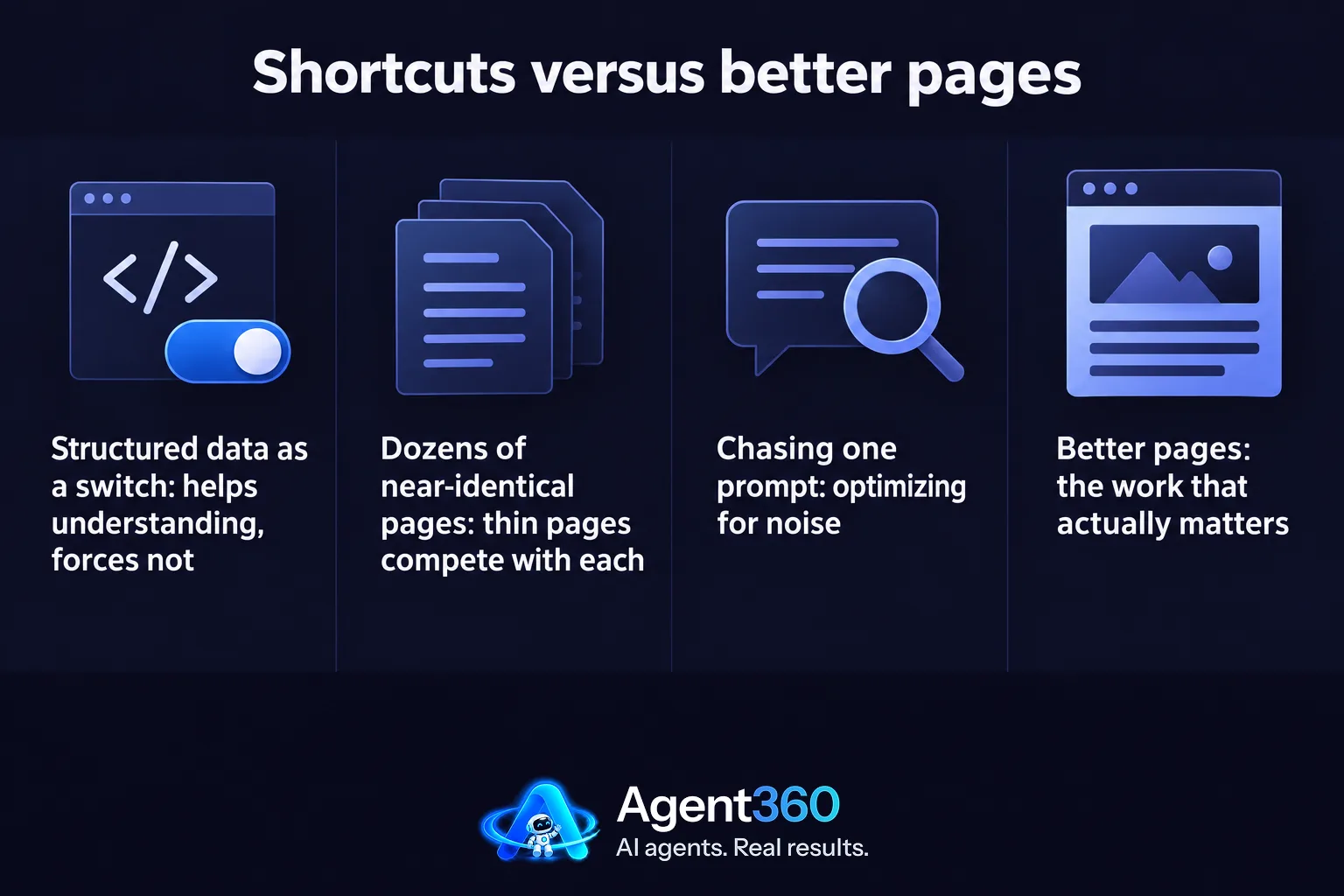
- Structured data as a switch. Clean markup helps machines understand a page. It does not force a page into a summary, and no markup makes up for a weaker answer.
- Dozens of near-identical question pages. Ten thin pages answering variations of one question compete with each other. Read the merge, redirect or split options before you publish a second page on a topic you already cover.
- Chasing one prompt. Overviews vary by query wording, by location and over time. Optimizing for the phrasing you typed this morning is optimizing for noise.
If you want the longer case for why there is no opt-in, this explainer goes through it. The short version: the work is better pages, not a submission.
Measure by checking the same questions on a schedule
Before you edit, open the overview for each target question and write down who is named and which sites are cited. Then edit. Then check again, but not the next day. Rankings move on their own timetable, and an overview that changes on Tuesday may change back on Thursday. Pick a fixed cadence (weekly is a sensible default) and judge the trend over several checks, not one screenshot. This walkthrough shows the manual version, and this one covers what to record and how often.

Record three things per question: whether an overview appears at all, whether you are named or cited, and who is named instead. The third column earns its keep. A competitor cited for a question you have a page on tells you exactly which page to hold yours up against. If no overview appears, that is a result too, and the effort belongs in ranking. Our guide to answer engine optimization explains how the two efforts relate.
Write a new page only when the gap is real
Some questions have no page of yours behind them at all. Those need a new article. Before you write it, confirm that nothing you already have covers the question, even loosely, and make the page answer one question well rather than five shallowly. The order of work: fix pages that rank, merge pages that compete, then fill true gaps.
Where SearchAgent fits
If you would rather not run this by hand, SearchAgent handles the tracking and drafting side. Its AI Visibility Agent asks your buyers' questions on a schedule across ChatGPT, Claude and Google AI Overviews, and records who got named and which sites were cited. Its Strategy Agent turns the questions where nobody named you into page ideas, and on Pro and Scale plans the Refresh Agent rewrites articles that are slipping in search. It does not track Perplexity or Gemini, and it cannot guarantee a mention. Plans start at $297 a month, month to month; see pricing.
Questions readers ask
Can I optimize an existing page for AI Overviews, or do I need a new one?
You can, and it is usually the better first move. A page that already ranks for a question has a stronger case for being used in the overview than a brand-new page. Rewrite the opening to state the answer directly, make the heading the question, and check the result over several weeks.
How long before an edit shows up in an AI Overview?
There is no published timeline, and overviews change with wording, location and time. Re-check the same questions on a fixed schedule, such as weekly, and judge the trend over several checks. One appearance or one absence tells you very little.
Does FAQ markup get me into AI Overviews?
No markup guarantees inclusion. Structured data helps systems read a page, but the page still has to answer the question better than the alternatives. Treat markup as housekeeping, not as a tactic.
More articles
- AI Visibility Monitoring: What a Good Score Really Is
- Local Teaser Pack: What It Is and How to Get Into It
- Reject AI Blog Drafts Fast: A Six-Check Review Queue
- Get Found on Google AI: Three Surfaces, Three Fixes
- Set Posts Per Week From Your Gap List, Not a Calendar
- GEO Tools: Buy the Fix, Not Another Dashboard
- SEO Reporting for Small Business: One Page, Five Numbers
- AI Overview Search Visibility: Check It, Then Fix It
