AI SDR for Staffing Agencies: What to Look for Before You Buy
An AI SDR for staffing agencies is software that finds hiring managers who are likely to need help filling roles, then reaches out by email, LinkedIn, and phone to get a meeting on your calendar, without a recruiter stepping away from filling jobs to chase new clients.
Staffing and recruiting firms have a specific problem: the people who are best at business development are usually also the people who are best at filling requisitions, and every hour spent prospecting is an hour not spent placing candidates. Hiring a dedicated business developer adds payroll and ramp time before a single meeting gets booked.
This article covers what an AI SDR actually does, where it falls short of a human, what to check before you buy one, and what it costs against adding headcount.
Key Takeaways
- An AI SDR finds and contacts hiring managers across channels so your recruiters stay focused on filling roles, not chasing new clients.
- It works best on volume and consistency, not on judgment calls about which prospects are worth a custom pitch.
- Check whether the tool detects buying signals like recent job postings or headcount growth, not just contact data.
- Compare the all-in cost of software against what a business development hire actually costs before you decide.
- Decide upfront who takes the meeting and how fast a reply gets a human response, since that handoff is where most tools lose deals.
Table of Contents
What does an AI SDR actually do for a staffing agency?
It finds companies that are likely to be hiring, contacts the right person there, and hands you a booked meeting. For a staffing agency, that means identifying buyers such as hiring managers, VPs of talent, or operations leaders at companies showing signs they need outside help filling roles, then running outreach across email, LinkedIn, and phone until someone agrees to talk.
How does it find hiring managers who are hiring right now?
It looks for signals: open job postings, recent funding, headcount growth, or a company expanding into a new market. Agencies that sell into hiring and staffing needs get more value from a tool that flags these signals than from a flat contact list, because timing matters more in staffing sales than in most B2B categories.
What happens after a hiring manager replies?
A reply should route to a human fast. Software can draft and send the first few messages, but once a hiring manager asks a real question about rates, timelines, or candidate quality, someone on your team needs to answer it, not a script.
Can an AI SDR replace a business development recruiter?
No, it replaces the manual prospecting work, not the relationship-building. An AI SDR handles the repetitive parts of outbound: building lists, sending sequences, following up, and logging activity. A person still needs to close the meeting into a client relationship and negotiate terms. Agencies weighing this tradeoff in more detail can read how outsourced business development compares to hiring in-house.
Where does software fall short for staffing sales specifically?
Staffing deals often hinge on trust and speed: a hiring manager wants to know you can deliver a candidate this week. Software can get you the meeting, but it cannot vouch for your bench or negotiate a rate. That part stays human.
What should a staffing agency check before buying an AI SDR tool?
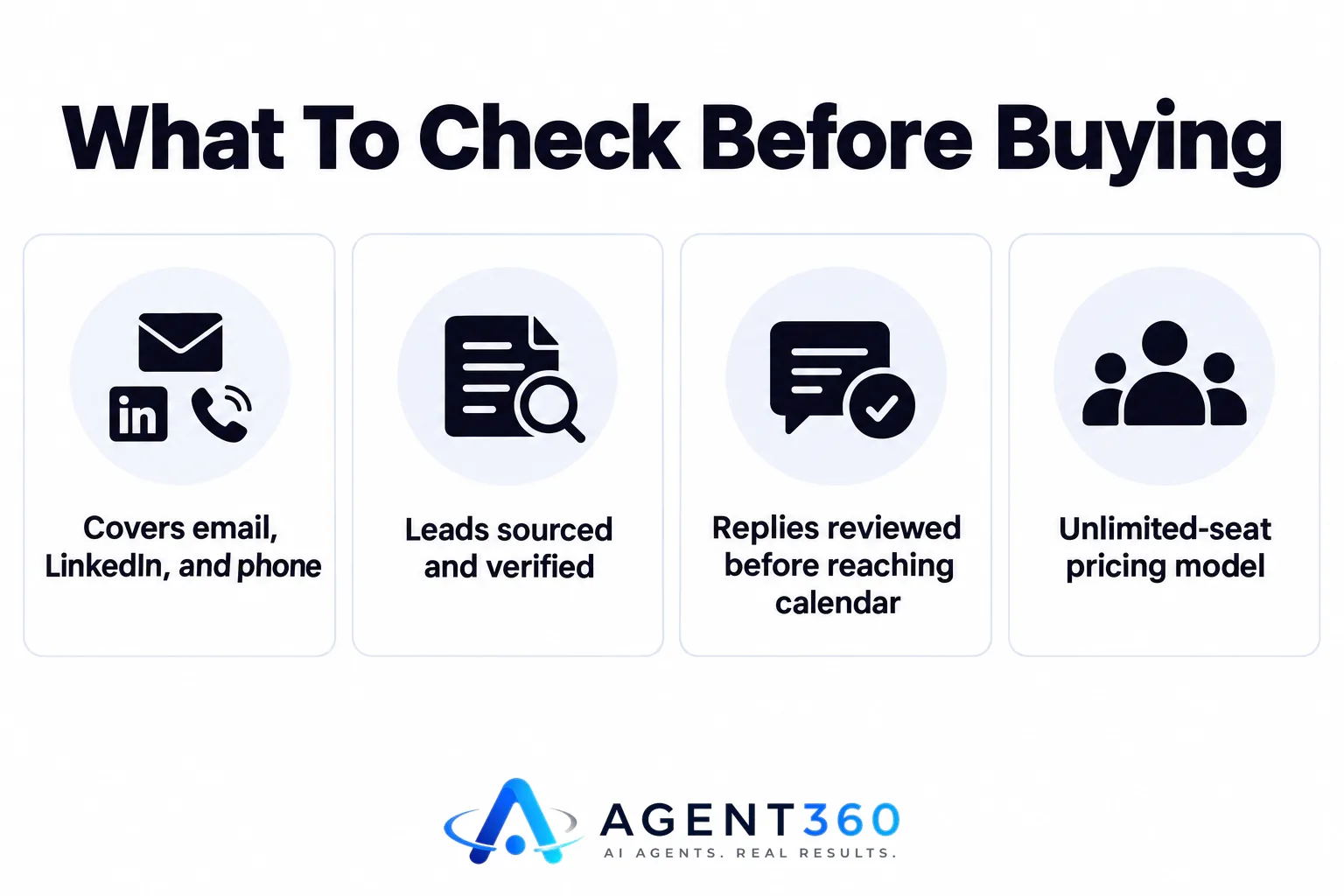
- Confirm it covers multiple channels. Email alone gets ignored; a tool that also runs LinkedIn and phone outreach reaches more hiring managers in the same window.
- Ask how leads are sourced and verified. A list of stale contacts wastes sends and damages your sender reputation before you book a single meeting.
- Check how replies are handled. Find out whether a person reviews replies before they reach your calendar, or whether everything routes straight to you unfiltered.
- Look at the pricing model. Per-seat pricing punishes agencies that want every recruiter involved in business development; unlimited-seat pricing does not.
- Test it on a narrow segment first. Run it against one industry or role type you place often before rolling it out across every vertical you serve.
How much does an AI SDR cost compared to adding a business development hire?
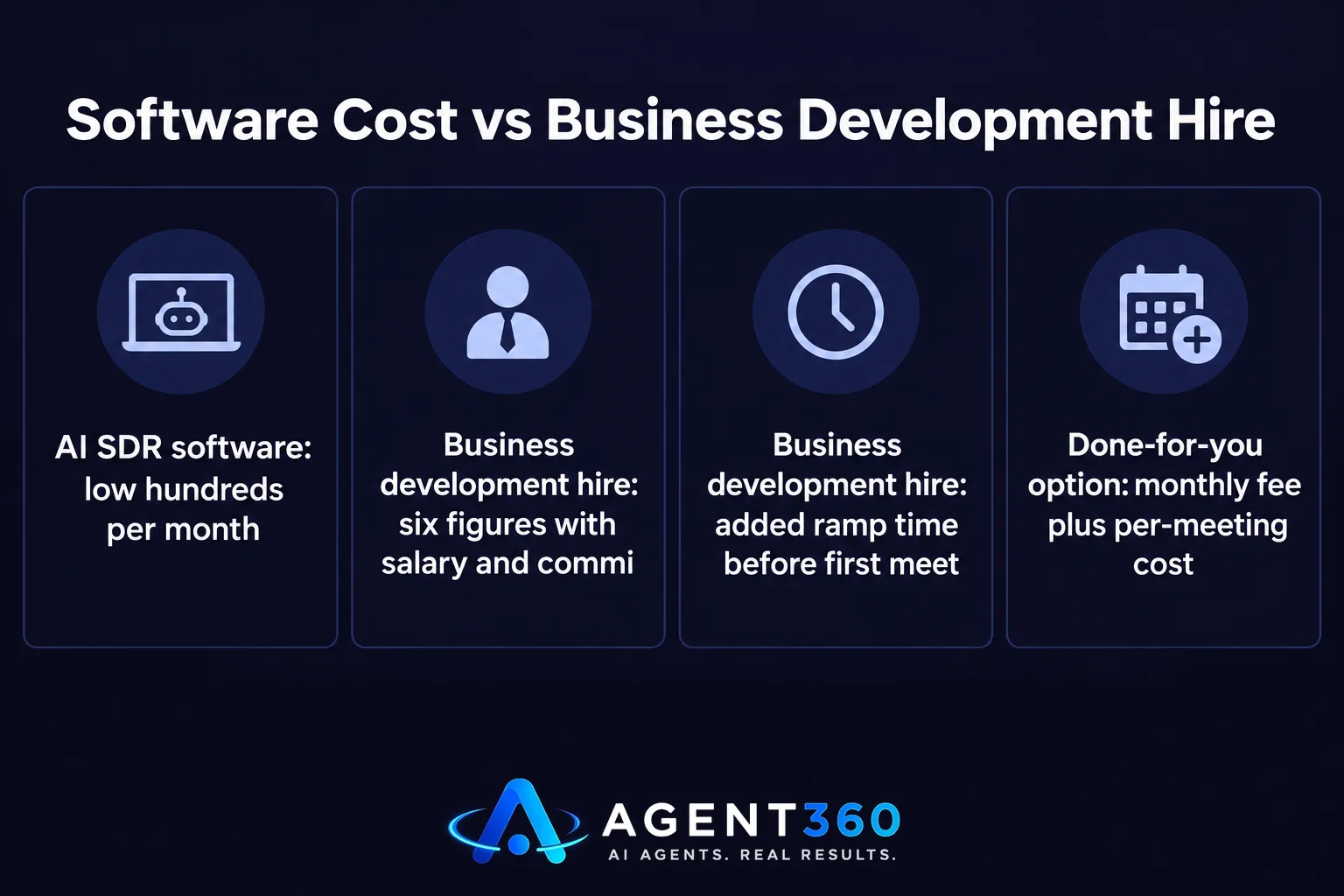
Software pricing runs in the low hundreds per month; a business development hire runs into six figures once salary, commission, and ramp time are counted. A full breakdown of what that hire actually costs, including the months before they book a meeting on their own, is worth reading before you compare the two options side by side: see what an SDR costs fully loaded.
Does a done-for-you option make sense instead?
If no one on your team has time to run outbound even with software handling the busywork, a done-for-you service shifts the execution to someone else while you take the meetings. That trades a monthly fee and a per-meeting cost for recruiter time you get back to spend on placements.
Book More Client Meetings Without Adding a Recruiter
Staffing agencies run on two things: candidates ready to place and clients who need them filled. Agent360 handles the second half. The Agent360 Platform starts at $99/mo and runs cold outbound in-house, with leads included, an email and LinkedIn sequencer, a parallel dialer, and a CRM, all on unlimited seats with no per-user fees.

For agencies that would rather hand off outbound entirely, the VIP Done-For-You option runs your outbound end to end with a dedicated GTM engineer and strategist for $2,000/mo plus $250 per booked meeting. Every email sent comes with one triple-verified lead included.
See current plans and compare pricing, or book a demo to see how it fits your agency's business development.
Frequently Asked Questions
What is an AI SDR?
An AI SDR is software that automates the prospecting and outreach work of a sales development representative: finding likely buyers, sending multi-channel outreach, and booking meetings, while a human handles the conversation once a prospect replies.
Is an AI SDR worth it for a small staffing agency?
It can be, if the agency's bottleneck is time spent prospecting rather than closing. A small agency with one or two people doing business development on the side often gets more meetings by automating the outreach than by trying to fit it in between placements.
Does an AI SDR work for recruiting firms the same way it does for other B2B companies?
The mechanics are the same, but the signals differ. Staffing and recruiting firms benefit most from tools that flag hiring activity and headcount growth, since those signals indicate a company may need outside help filling roles right now.
Can recruiters use an AI SDR without hiring a dedicated business developer?
Yes. That is the main use case: recruiters keep filling roles while the software runs outreach to new prospective clients in the background, and a booked meeting lands on the calendar when someone is ready to talk.
What should I check before switching tools?
Check how leads are sourced, whether pricing scales per seat or stays flat, and how replies get handled. A side-by-side look at pricing and features, like the one on the Agent360 FAQ, helps clarify what is included before you commit.
More articles
- Staffing Agency Lead Generation: A Practical Playbook
- Otter.ai Alternative: What Sales Teams Need Beyond Notes
- Fireflies Alternative: What Sales Teams Should Check First
- JustCall Alternative: What to Check Before You Switch
- Dialpad Alternative: What to Look for in a Sales Dialer
- The Best Aircall Alternative for Outbound Sales Teams
- Gong Alternative: What to Check Before You Switch Tools
- Looking for a Clay Alternative? What to Check First
