How an AI Agent Produces On-Brand Social Assets Weekly

Stop asking an AI agent to be creative and give it a loop instead, and it will produce on-brand social assets every week. The loop has four parts: a stored brand kit, one real input from you, a self-check against platform rules, and an approval step before anything publishes. Drop any one and you get exactly what you were trying to avoid. Generic posts, in a slightly different font each Monday.
Most advice on this starts with prompts. Prompts are the weakest part of the system. You retype them, forget them and rephrase them, and that is how voice drifts. What follows is the loop that still holds on week twelve, not just week one.
Split the job: one agent writing, drawing and posting will do all three badly
A weekly social run is at least six jobs: learn the brand, write per platform, design the picture, cut the video, schedule, and read the numbers. A single chat window can attempt all six. It has no memory of the last five, though, and no reason to check its own work.
The workable structure is a set of narrow agents with handoffs. A brand agent holds the rules. A writer drafts. A designer draws from the same rules. A video agent or clipper cuts. A scheduler publishes only what is approved. An analyst reports back, so next week's brief is better than this week's. Every handoff is a place where something can be checked, and that is the whole reason to split the work.
If you are weighing this against a general chat assistant, the gap is not writing quality. It is memory, checking and publishing. We lay that out in how a chat tool differs from an agent team.
Store the brand once, so nobody retypes it weekly
“On brand” has to be something the agent reads, not something you describe. Voice and tone, colours, fonts, logo, and a handful of phrases you never use: store them once and apply them to every post, picture and video. The best source is your own website, because it already shows how you talk to customers. A brand kit built from your site beats a paragraph of adjectives pasted into a prompt.
Two tests tell you whether the kit works. First, cover the logo on a draft. Could a stranger tell it is yours? Second, give the agent the same topic in two different weeks. Do the outputs sound like one author? If not, the kit is too vague, so add specifics: sentence length, whether you open with a claim or a story, what you refuse to say.
Feed it one real input a week, or it will invent filler
Here is where we part ways with a lot of people. Many believe the goal is zero effort. It isn't. An agent with nothing real to work from fills the gap with plausible, empty advice, and your buyers have already learned to scroll past that.
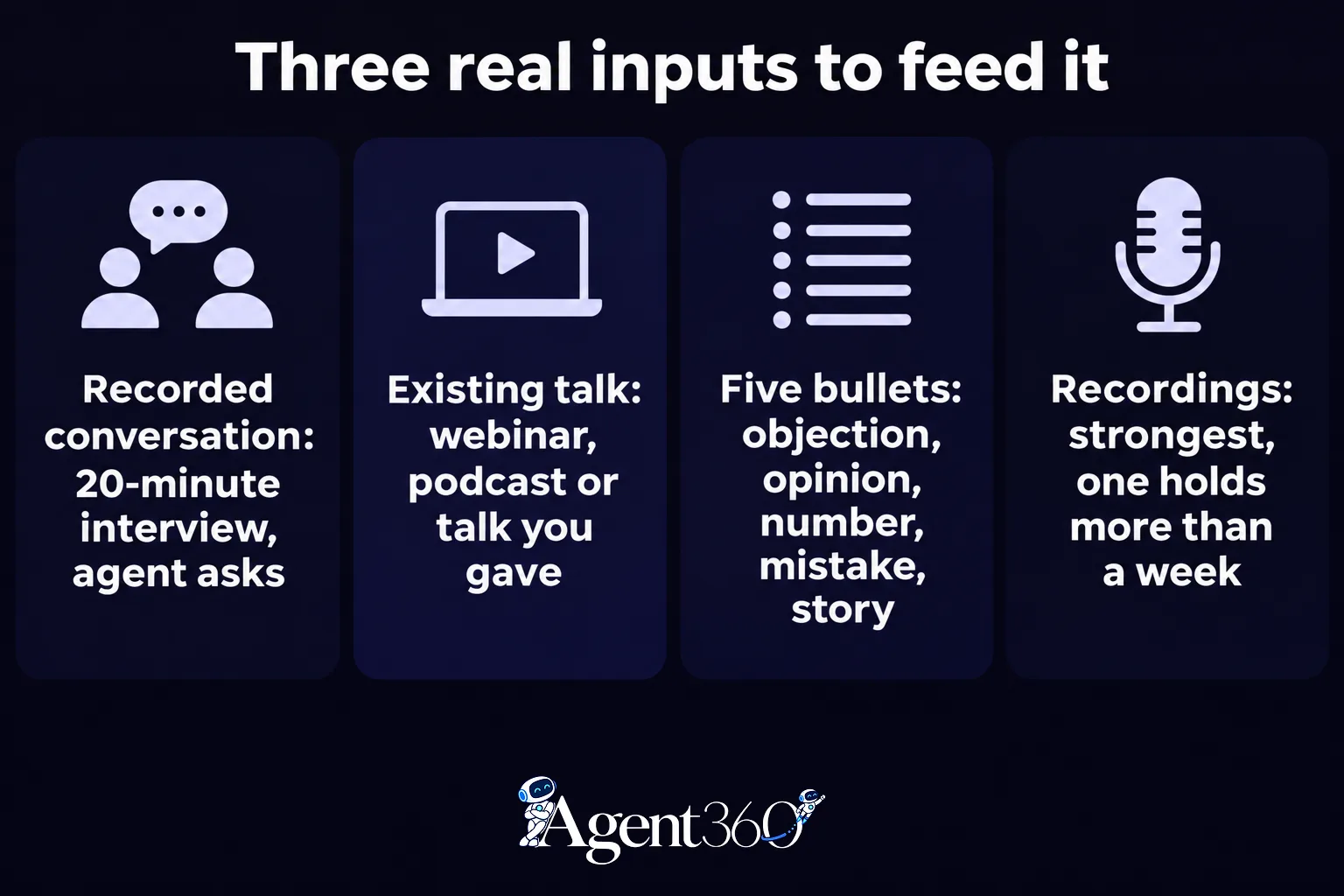
Give it one input per week that only you could supply:
- A 20-minute recorded conversation or a guided interview, where the agent asks and you answer out loud.
- A webinar, podcast or talk you already gave.
- Five bullet points: one customer objection, one opinion you hold that others in your field do not, one number from your own business, one mistake, one story.
Recordings are the strongest option, since one recording holds far more posts than a week needs. The mechanics are in how one video becomes a month of clips, and the same idea applies to written notes. The agent shapes and distributes your material. It should not supply the opinions.
Make the agent grade its own draft before you see it
If a draft goes straight from generation to your inbox, you become the quality filter. That is the job you meant to hand off. Put a scoring step in between: each draft is checked against the platform it was written for, and rewritten if it fails.
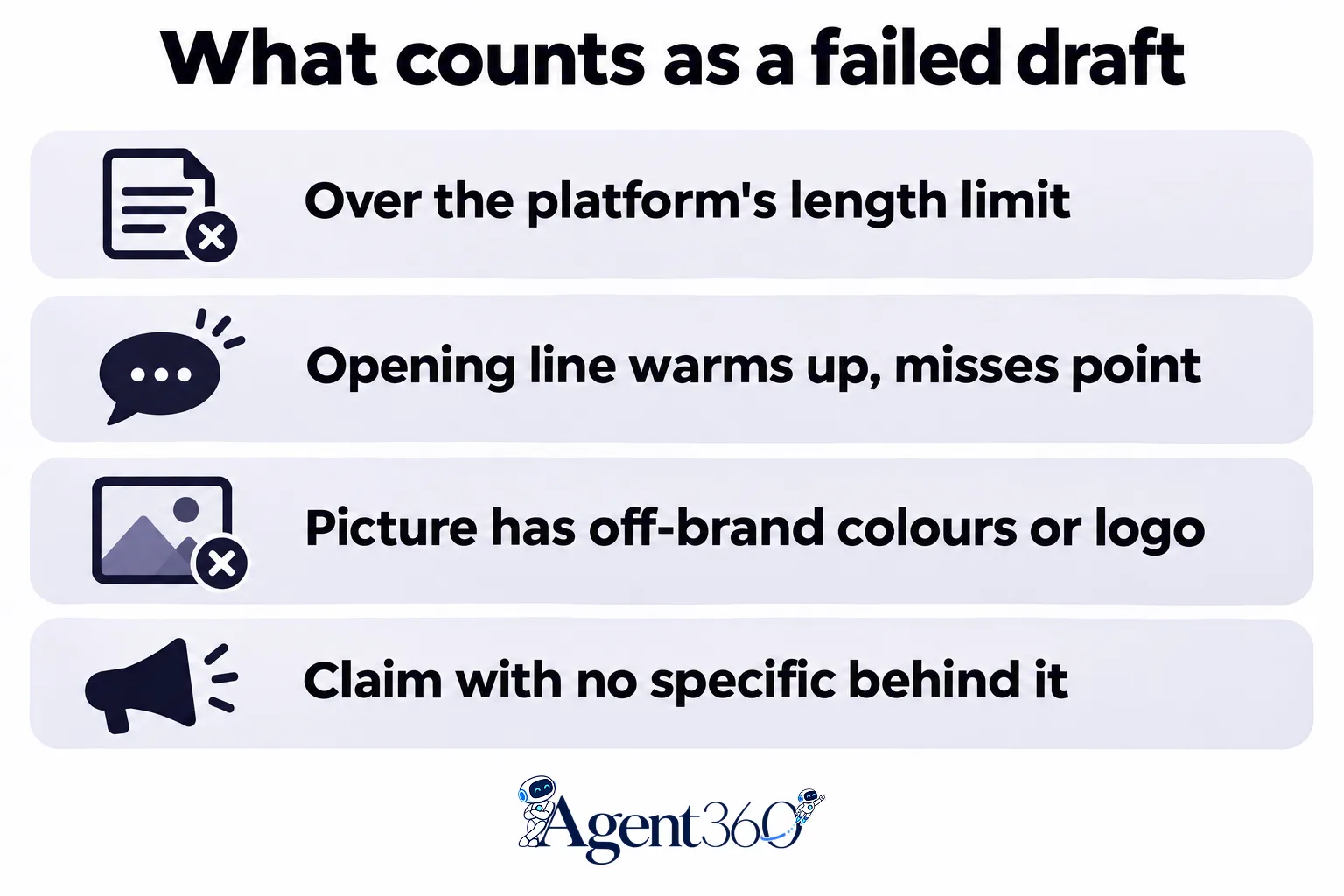
“Fails” should mean something concrete:
- Over the length a platform can use (X posts must fit 280 characters).
- An opening line that warms up instead of making the point.
- A LinkedIn post that reads like an Instagram caption, or the reverse.
- A picture with off-brand colours, a missing logo or unreadable text.
- A claim with no specific behind it.
That is how a writer agent that scores every draft keeps weak posts out of your queue. It is also why one idea should be rewritten per platform, not pasted four times. For the wider case on what separates usable AI posts from filler, see AI social media posts: what actually works.
Keep your approval as the only gate to publishing
Never let an agent post unsupervised. The risk is lopsided: one off-tone or factually wrong post costs more than a week of saved time. Every asset should wait for a yes from a named person, and only approved, scheduled posts should go out on their own.
Approval stalls when it is vague, so make it small. One owner, one batch a week, one sitting. Ask for three outcomes only: approve, edit, kill. If drafts sit unread for days, fix it with a set approval slot. The longer treatment is in an approval workflow that doesn't stall.
A weekly rhythm that fits around a real job
- Monday, 20 to 30 minutes: record or write the week's input.
- Tuesday: the agents turn it into per-platform posts, pictures, a short video or clips.
- Wednesday, 15 minutes: you approve, edit or kill, then schedule.
- Thursday to Sunday: posts publish at the times you set.
- Next Monday: read last week's views, comments and saves before recording the next input.
Treat these time blocks as a target, not a measured benchmark. Your input may take longer if you are still finding your opinions. The shape matters more than the minutes: one human input, one human decision, and everything between automated.

How to use AI agents in everyday life? Give them the repeatable job
Agents earn their keep on work that recurs on a schedule, follows rules and can be checked. A weekly content batch fits all three. Strategy, pricing, who you hire and what you believe do not, so keep those. A useful sorting rule: if you could write a checklist for the task, an agent can probably draft it. If the task is deciding what the checklist should say, it is yours.
Do AI agents have their own social media?
For business use, they shouldn't. An agent is a worker acting on your accounts, not a persona with followers of its own. You connect your LinkedIn profile, Instagram Business or Creator account, YouTube channel or X account through each platform's own sign-in, and the agent publishes there under your name. Nobody should be handing over passwords.
Experimental bot-run accounts do exist. But a buyer deciding whether to trust you is looking for a human with a point of view, which is why posting from the person usually beats posting as a faceless brand.
Where BrandAgent fits
BrandAgent is this loop, already built. Agents for brand, writing, pictures, video, presenter videos, clips, scheduling and analytics run inside the Agent360 app. Our team sets it up with you on a kickoff call, and you approve every post before it goes out to LinkedIn, Instagram, YouTube or X.
Starter is $97 a month for 40 posts with a picture, 2 short videos, 1 talking-head video and 10 clips, which averages about ten posts a week. Pro and Scale raise the volumes, and the pricing page has the rest. Some limits: it does not make carousels, polls or Stories, and TikTok gets captions and vertical cuts that you post yourself. It does not guarantee followers or leads either. What it guarantees is a full, on-brand calendar each month and the numbers to see what worked.
Questions people still ask
How to use AI to make $10,000 a month?
No honest answer includes a formula. AI can cut the cost and time of producing consistent content, but revenue comes from an offer people want and a way of reaching them. If you already sell something, weekly on-brand posts keep you visible to buyers between sales conversations. If you have no offer yet, content won't create one. Be wary of anyone promising a monthly figure from AI alone.
How to make $1000 a day using AI?
Same answer, with a warning. A daily income target says nothing about the work that produces it. Pick a measurable input instead, such as published posts per week, then track over a quarter whether replies, enquiries and booked calls follow. Measuring social ROI without guessing covers how to tie posts to pipeline.
How much does an AI agent need from me each week?
One real input and one approval pass. Without the input, output goes generic. Without the approval, mistakes reach your audience. Everything between the two can run on its own, scheduling included: once you approve, the publishing calendar takes over.
More articles
- Customer Testimonial Posts for LinkedIn That Prove Something
- What AI-Assisted Video Clip Generation Actually Looks Like
- Run a Social Media Content Audit in 90 Minutes
- Before You Buy a Social Media Calendar Tool for Your Team
- Get Executives Posting on LinkedIn Without Asking Them to Write
- Managing Social Media for Multiple Clients Without Chaos
- How Startups Should Pick an Instagram Scheduling Tool
- LinkedIn Personal Profile vs Company Page: Post From the Person
