AI Social Media Posts: What Actually Works
Yes, you can use AI to make social media posts. Most brands posting more than once a day already do, whether they admit it or not. The real question isn't whether AI can write a post — it can — but which parts of the job it should handle, which parts still need a human hand, and how you tell when a tool is quietly wrecking your reach instead of building it.
Here's the honest split. AI is reliable at drafting, formatting for each platform, and keeping a brand voice consistent across forty posts a month. It's unreliable at knowing what actually happened in your business last week — and that's the thing that makes a post worth reading. Feed it a real detail — a client objection, a number from a deal, a mistake you caught — and it writes something specific. Feed it nothing and it writes something generic, fast, in volume. The tool doesn't change that. Your input does.
Can you use AI to make social media posts?
You can, and the workflow that holds up looks like this: you supply the raw material — a voice note, a transcript, a set of bullet points, a recording — and the tool turns it into a platform-ready draft, not the other way around. Tools that ask you to type a topic into a blank box and expect a finished post produce the flattest content around, because there's nothing underneath the prompt except the prompt.
The gap between a usable AI post and an unusable one is almost always the brief. A model that has read your site, your past posts, and your actual tone of voice writes differently from one that's read a single sentence of instructions. That's the whole case for a brand kit step before generation even starts. It's also why a general chat tool and a purpose-built posting agent turn the same idea into such different output.
Follow the 5-5-5 rule before you post, not after
The 5-5-5 rule is an engagement habit, not a writing formula: spend five minutes commenting on five posts from five accounts in your field before you publish your own. The logic is that platforms favor accounts that show up as participants, not just broadcasters. A post dropped into a feed where you've engaged with no one that day gets a colder first hour than one dropped where you've already been visible.
AI doesn't help with this part, and no tool should claim it does. Commenting as a bot reads as exactly that. What AI frees up is the five minutes you'd otherwise spend drafting, so you can spend it reading and replying instead. If your posting plan only ever pushes content out and never engages with anyone else's, the 5-5-5 habit is the fastest fix — and it costs nothing but attention. Pair it with a content mix that isn't all offers; the same logic sits behind the value-versus-pitch ratio that keeps a feed from going quiet.
Five tells that give an AI post away
People ask how to spot AI content because they've started noticing a pattern, and the pattern is real. Five tells, in order of how often they show up:
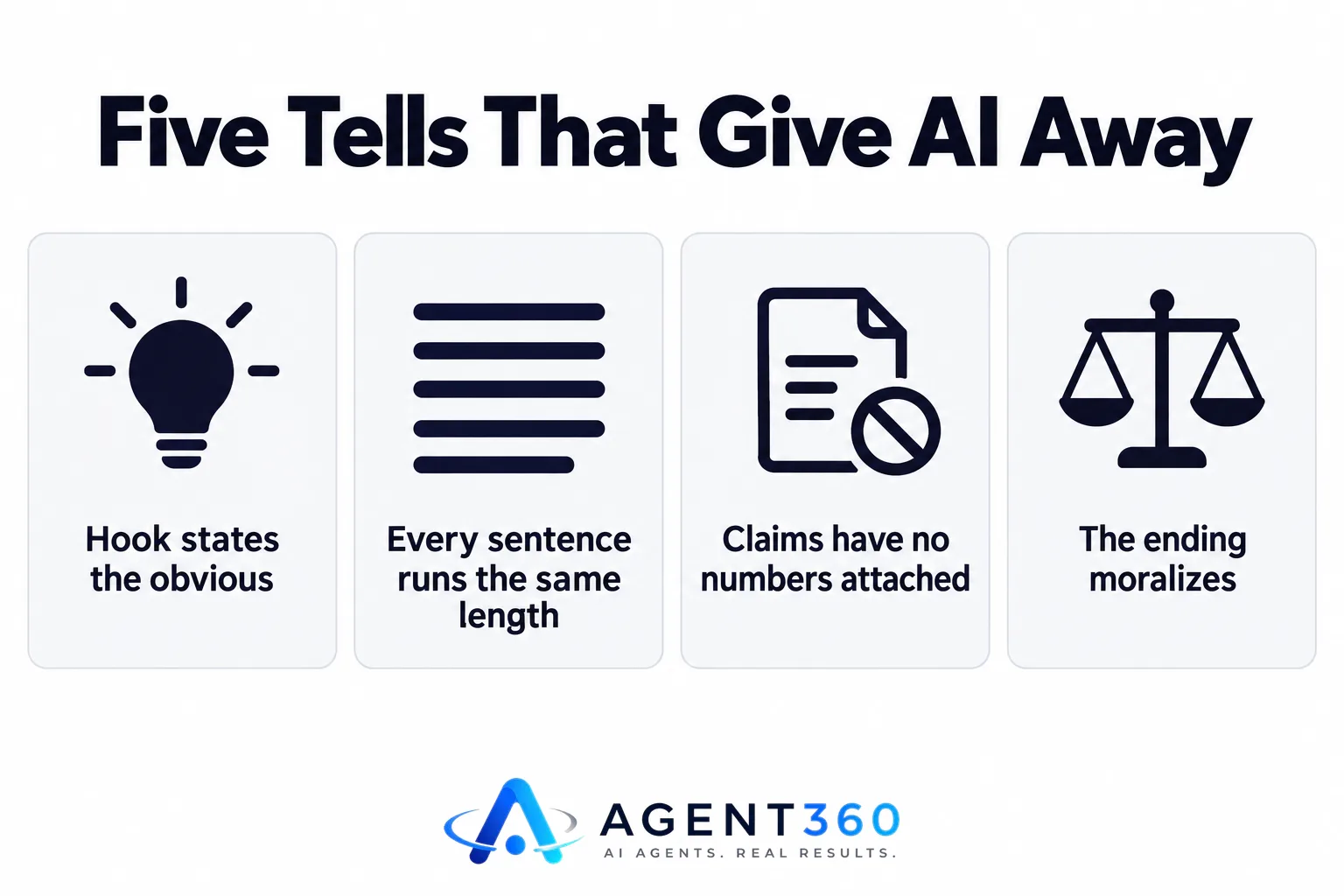
- The hook states the obvious. “In today's competitive market” or “Let's talk about” opens dozens of posts a day because the model defaults to a safe runway before the point.
- Every sentence runs the same length. Human writing varies; a six-word sentence next to a twenty-word one is a rhythm most models smooth away unless told not to.
- The claims have no numbers attached. “Significant improvement” instead of a figure, because the model has no figure to give and isn't supposed to invent one.
- The ending moralizes. A tidy closing line that restates the opening in nicer words is the clearest tell of all.
- The voice is identical to every other post on the account. No deviation, no opinion that could start an argument — because nothing in the brief told it to have one.
The fix for most of these isn't avoiding AI. It's giving the draft a real edit pass before it goes out, and starting generation from an actual brand voice rather than a generic prompt. A model working from a proper brand kit — colors, tone, past posts, specific phrases you actually use — produces fewer of these tells than one guessing from scratch. The same discipline matters structurally: a post built from a proven format tends to read less like filler than one pulled from a blank-page prompt.
Where a posting agent actually earns its $97
BrandAgent is built around the gap this article keeps circling: a writer agent that drafts from a learned brand kit instead of a blank prompt, scores each draft against the platform it's headed to, and rewrites anything that scores weak before you ever see it. A designer agent adds a picture in your colors, a video agent cuts a short version for Reels or Shorts, and a scheduler publishes the ones you approve — nothing goes out without you clicking approve first. Plans start at $97 a month on the pricing page, month to month, no contract.

Can I make $1,000 a day using AI?
Not from posting alone. No honest source will tell you otherwise. A thousand dollars a day is a revenue number, and revenue depends on your offer, your price, your sales process, and your audience — none of which a writing tool touches. What AI actually changes is the cost and time of producing content, not the demand for what you sell. If you already have an offer that converts and an audience that isn't seeing enough of you, AI-assisted posting can clear the production bottleneck and let more of your ideas reach people. If you don't have those two things yet, more posts won't create them.
What's the best AI social media post generator?
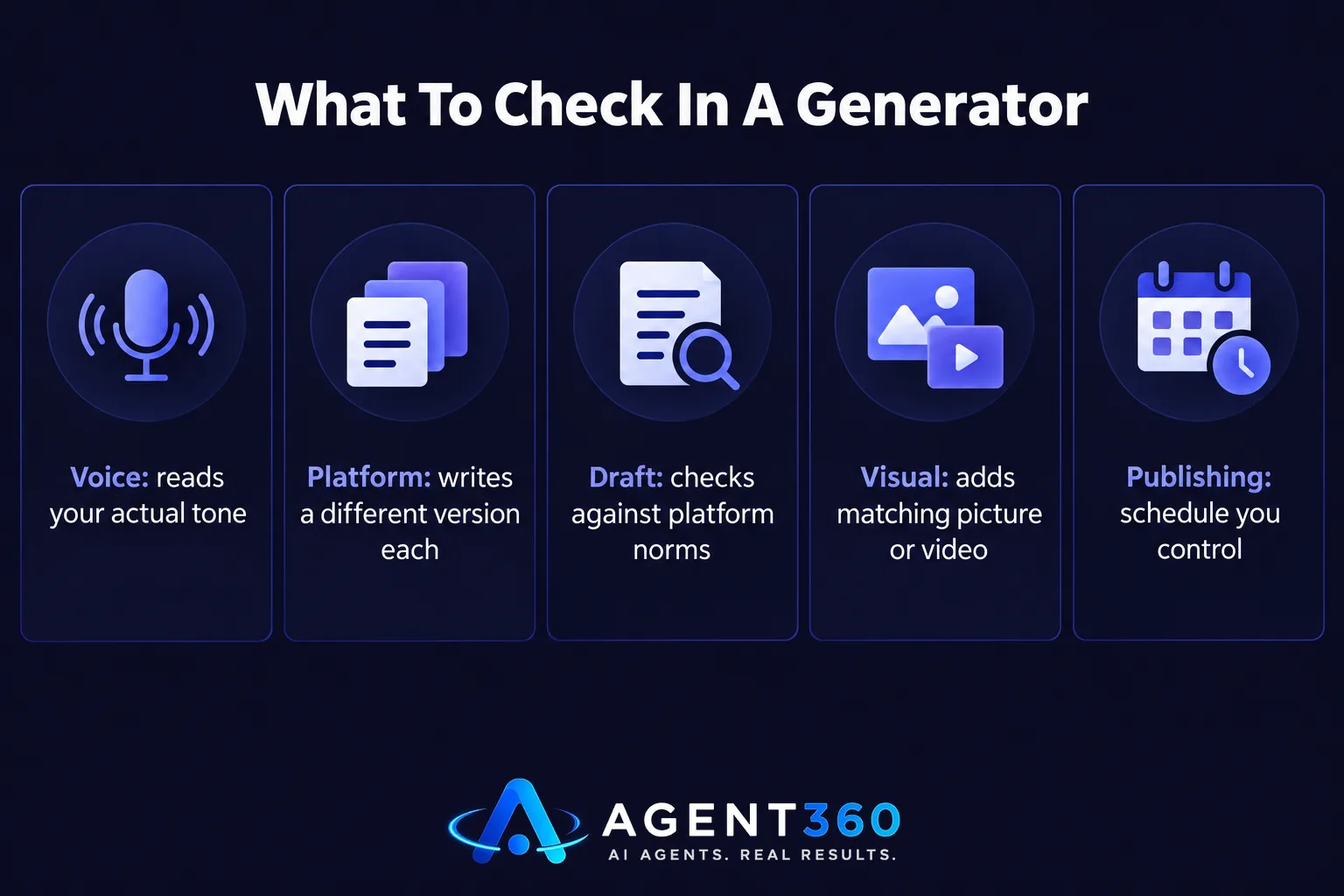
The best one for you checks five things before it generates anything: it reads your actual voice instead of asking you to describe it, it writes a different version for each platform instead of copy-pasting one post everywhere, it checks its own draft against that platform's norms before showing it to you, it adds a matching picture or short video without a separate tool, and it publishes on a schedule you control rather than leaving that as a manual last step. A longer breakdown of what to check before picking one is in this checklist.
Does posting AI-generated content hurt reach?
Platforms haven't published a rule that penalizes AI text as a category, and there's no public evidence that they do. What does hurt reach is the behavior AI makes easy to fall into: posting the same generic message everywhere, posting without engaging with anyone else, or posting so often with so little substance that people stop opening your profile. The origin of the content was never the variable that mattered. Your specificity was, and so is showing up around it.
More articles
- Managing Social Media for Multiple Clients Without Chaos
- How Startups Should Pick an Instagram Scheduling Tool
- LinkedIn Personal Profile vs Company Page: Post From the Person
- How to Schedule Posts for a Retail Sales Event
- Content Pillars for Instagram: Pick Four and Ratio Them
- The Social Media Scheduler Test Most Businesses Skip
- Generating Instagram Posts With AI: What Actually Works
- AI Social Media Content Generator for Instagram, Explained
