Run a Social Media Content Audit in 90 Minutes

An audit that ends in a slide deck about what performed isn't worth your 90 minutes. You've done the expensive half of the work and skipped the half that changes anything. A social media content audit earns its keep only when it ends in next month's calendar.
This method is for sales and marketing leaders who already publish and suspect a good share of it is wasted. Keep it to one brand and 90 days of posts, and it takes about 90 minutes.
Pull 90 days per platform, and stop if you have fewer than 20 posts
Export or copy the last 90 days of posts, one platform at a time. Don't blend LinkedIn and Instagram into one sheet. The audiences, formats and signals differ, and a blended average describes neither.
If a platform has fewer than 20 posts in the window, there's nothing to audit. The finding is that you didn't publish enough to learn anything, and the fix is a calendar, not an analysis. Skip ahead to the last section.
For each post, capture the date, the format (text, picture, video), the first line, the topic, the headline metrics your platform shows, and whether the post asked the reader to do something.
Tag every post three ways before you read a single number
Tag first, while you still have no opinion about which posts did well. Otherwise you'll tag the winners generously.
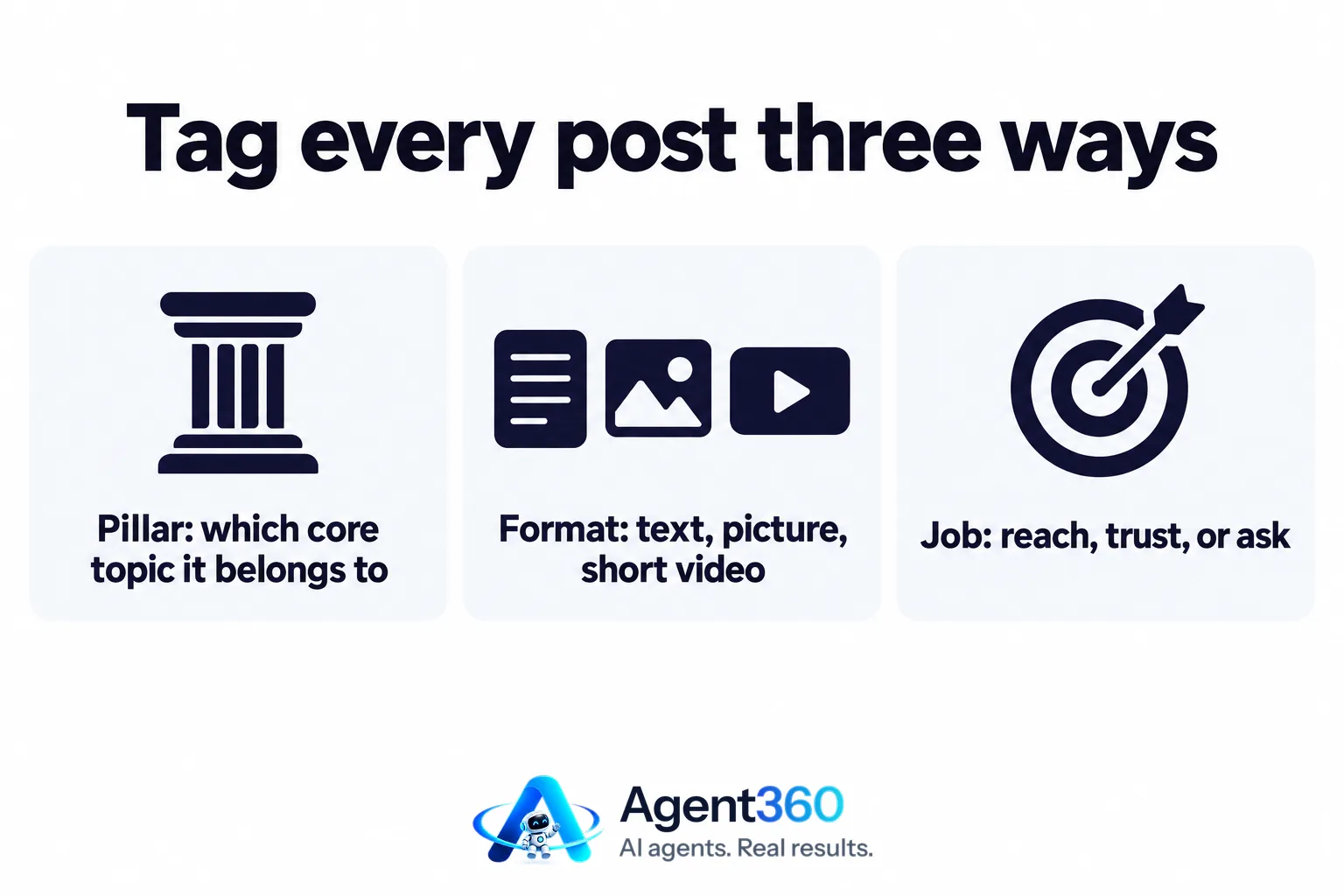
- Pillar. Which of your core topics does it belong to? If you haven't set these, read why four pillars beat twelve first. A post you can't assign to any pillar is your first finding.
- Format. Text, picture, short video, talking head, clip.
- Job. Was it meant to reach new people, build trust with people who already know you, or ask for an action? Pick one. A post that tries to do all three usually does none.
Count the totals by job. Many accounts find that nearly everything they post is trust-building commentary, with almost no reach plays and no asks. Others find the opposite: a feed of pitches. The mix matters, so check your counts against the value-versus-pitch balance.
Judge every post against your own median, not your best post
Pick one primary metric per platform and calculate your median across the 90 days. Use the median, not the average. One lucky post drags the average up and makes everything else look like a failure.
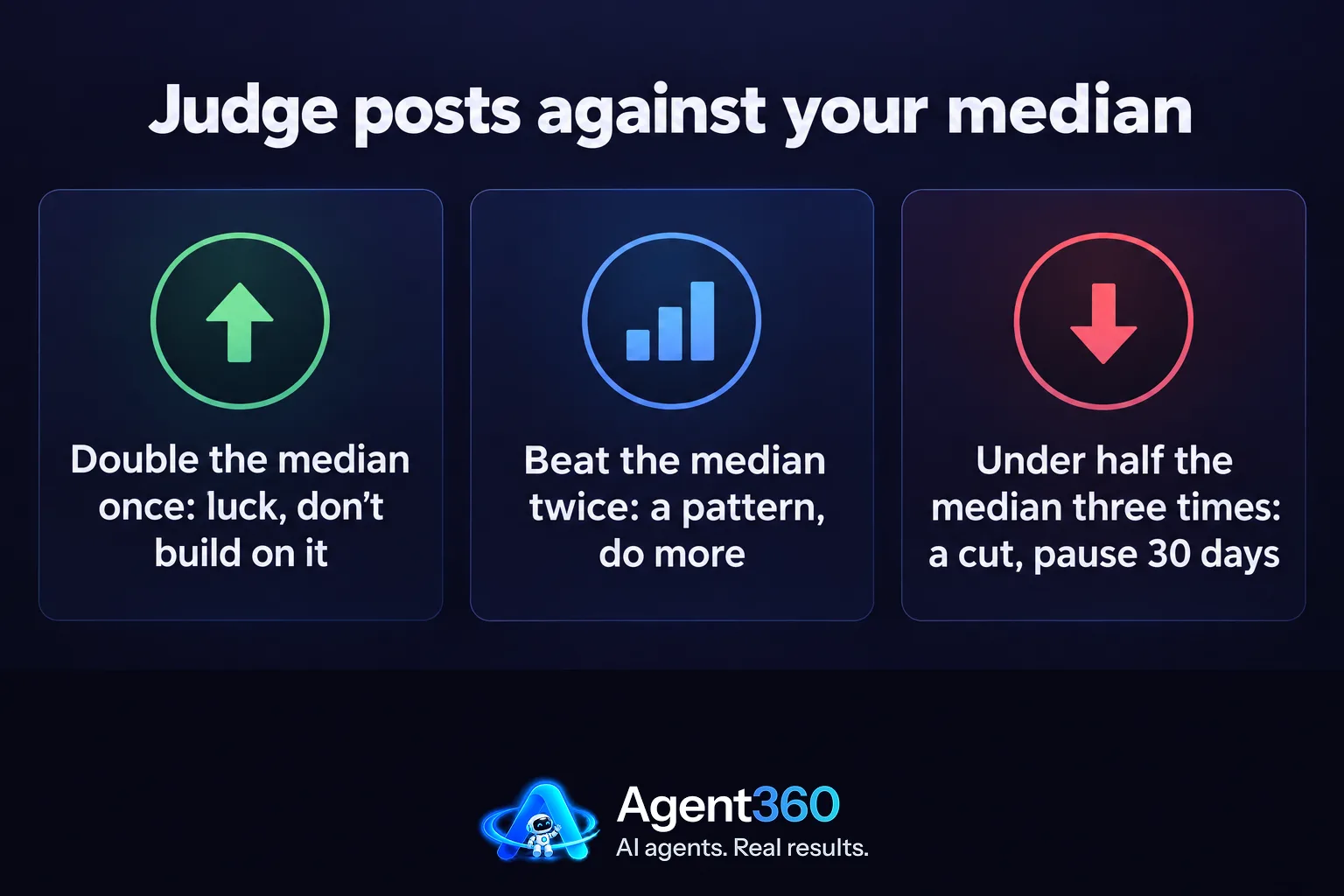
Then apply blunt rules. They're rules of thumb, not platform facts, and their value is that they force a decision:
- A post at roughly double your median once is luck. Don't build a strategy on it.
- A pillar or format that beats the median twice is a pattern. Do more of it.
- A pillar or format that lands under half your median three times is a cut. Stop it for 30 days.
This will annoy people who love a post that scored well. Good. One strong post tells you about that day's feed. Repeats tell you about your audience.
Score each job on its own metric, and leave likes out
Likes mislead more than any other number, because the easiest posts to like often attract the wrong audience. Match the metric to the job instead.
- Reach posts: views or reach, plus shares. A share is someone putting their name next to your idea.
- Trust posts: comments from people you would actually want as customers, and saves. Read the commenters; don't just count them.
- Ask posts: replies, direct messages and booked conversations. Those live in your inbox and your CRM, not in the platform dashboard. Measuring ROI without guessing covers how to connect the two.
Can't trace a single conversation back to a post in 90 days? That doesn't prove social isn't working. It proves you aren't tracking asks, and you should fix that before the next quarter.
Read your worst ten posts, not your best ten
Everyone studies the winners. That's survivorship bias: you copy the topic and miss the cause. The losers teach more, because failures tend to share a visible flaw.

Lay the ten weakest posts side by side and look for the common thread. The usual suspects:
- The first line is a warm-up, not the point.
- The topic could belong to any company in your category.
- No opinion anywhere, so there's nothing to agree or disagree with.
- An ask with no value in front of it.
Then run a voice check. Cover your name and logo and read five random posts aloud. If a competitor could have published them unchanged, your voice has drifted into generic. That's a production problem, so fix it at the source rather than post by post.
Finish with three decisions and a calendar
An audit has to produce decisions. Write down exactly three:
- Double. One pillar or format that beat the median twice.
- Cut. One that missed three times.
- Test. One thing you haven't tried, such as a short video where you only post text, run for four weeks so you get a fair read.
Then turn the decisions into numbers: how many posts per pillar, per platform, for the next 30 days, with a job assigned to each. A calendar with those counts filled in is the real output. The spreadsheet is scaffolding.
Repeat the audit every 90 days, not monthly. At a normal posting rhythm, 30 days gives you too small a sample to tell a pattern from noise.
Where BrandAgent fits once the audit is done
The audit usually exposes two bottlenecks: you can't see results next to your drafts, and you can't produce the calendar the audit calls for. BrandAgent's Analyst Agent pulls views, reach, likes, comments, shares, saves and followers for your posts on LinkedIn, Instagram, X and YouTube over 30 or 90 days, right where you write the next one. The writer and designer agents then draft against your Brand Kit, learned from your website, and you approve every post before it publishes. Nobody can honestly promise followers or leads, and we don't. We promise a full, on-brand calendar each month and the numbers to judge it. Plans start at $97 a month, month to month, on the pricing page.
Quick answers before you start
How often should I run a social media content audit?
Every 90 days works for most teams. That gives you enough posts per platform to compare against a median, and enough time for changes from the last audit to show up. Monthly reviews are fine for checking that the calendar is filled, but not for deciding what to cut.
How many posts do I need before an audit means anything?
Aim for at least 20 posts per platform in the window. Below that, one outlier dominates your median and any pattern you see is probably noise. If you're under that number, start by publishing consistently, not analysing.
Which metric matters most in a content audit?
There's no single metric. Judge reach posts on views and shares, trust posts on the quality of comments and saves, and ask posts on conversations you can trace to them. Likes alone say the least about whether a post helped your pipeline.
Should I audit competitors at the same time?
Not first. Audit your own posts before you look at anyone else's, or you'll measure yourself against someone else's strategy instead of your own audience's behaviour. Look at competitors afterwards, and only to find an idea for your test slot.
More articles
- Customer Testimonial Posts for LinkedIn That Prove Something
- What AI-Assisted Video Clip Generation Actually Looks Like
- Before You Buy a Social Media Calendar Tool for Your Team
- Get Executives Posting on LinkedIn Without Asking Them to Write
- Managing Social Media for Multiple Clients Without Chaos
- How Startups Should Pick an Instagram Scheduling Tool
- LinkedIn Personal Profile vs Company Page: Post From the Person
- How to Schedule Posts for a Retail Sales Event
