Get Executives Posting on LinkedIn Without Asking Them to Write
Ask an executive to write a LinkedIn post and you will get a polite no. Writing is the part they refuse, and the refusal makes sense: a blank box costs forty minutes they do not have, and a bad post costs more than no post. Take writing off their plate and what remains is something they already do all day. Talking.
Here is the workflow that follows from that, including the parts most executive-visibility programs get wrong.
Ask for 15 minutes of talking, not a post a week
A good executive post starts with an opinion or a story the executive already holds. It does not start with a draft. So make the ask a short recorded conversation, ideally every two weeks, where someone asks the questions a customer or a new hire would ask.

Good questions are specific and a little uncomfortable:
- What did you believe about this market three years ago that turned out to be wrong?
- What do prospects keep asking for that you refuse to build or sell?
- Tell me about the last deal you lost. What was the real reason?
- What does your industry say that you think is nonsense?
One fifteen-minute answer set holds several posts. That is the math that keeps the program alive: the executive spends fifteen minutes, and the marketing team turns it into weeks of material. If the plan needs the executive to sit down and produce text alone, it stalls by month two. Their calendar always wins.
Start with one executive, not the whole leadership team
The instinct is to roll this out to six leaders at once so it looks like a real program. Don't. Six executives means six voices to learn, six approval habits to build, and six chances for the first month to go quiet. Pick the one leader who already has opinions and does not flinch when someone disagrees. That is usually the CEO, the founder, or the head of a revenue function.
Run that person for two months. Add a second only when the first has a rhythm. One visible executive who posts steadily beats five who each post twice and vanish.
Post from the person, not from a shared brand account. The reasoning is in LinkedIn personal profile vs company page: people follow people, and a leader's profile is where a buyer goes to decide whether to trust the company.
Give them a veto, not a review queue
Approval is where executive programs die quietly. When every draft lands in the executive's inbox as a document to edit, it sits there. So change the ask. You are not asking them to edit. You are asking one question per post: would I say this out loud?
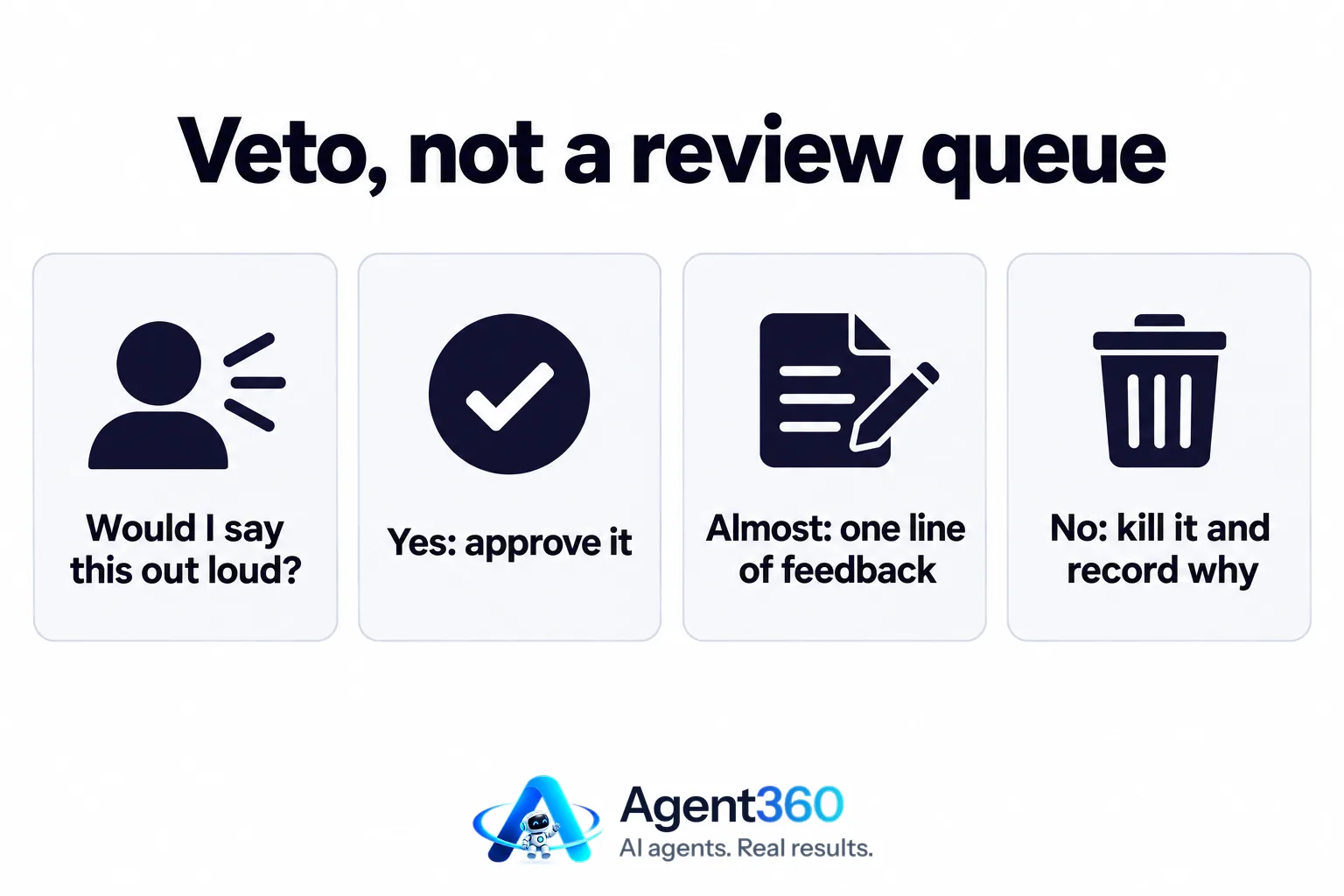
- Yes: approve it.
- Almost: one line of feedback, such as “too salesy” or “I would never say synergy,” and the draft is redone.
- No: kill it, and record why so the next batch avoids the same mistake.
Send drafts in a batch on a fixed day, a week ahead of publishing. Four to six drafts take a few minutes to scan. Single drafts arriving at random times cost attention every time. The mechanics of keeping this from clogging are covered in a social media approval workflow that doesn't stall.
Nothing publishes without a yes. That rule is not red tape. It is what lets a cautious executive agree to the program at all.
Build every post on something only they could say
Here is the test: could a competitor's CEO post this unchanged? If so, delete it. “Great teams win through trust” survives that swap. “We lost a six-figure renewal because we took nine days to answer a security questionnaire, and here is what we changed” does not.
Specifics are what make a leader's profile worth following. Listen for these in the interview:
- A decision they made with the numbers they had at the time, and what it cost.
- A customer objection, phrased the way the customer actually said it.
- A position that a peer at another company would argue with.
The third one matters most. If nobody could reasonably disagree with a post, it says nothing. Executives often balk at this, so agree up front on how sharp is too sharp: criticize practices, not named people or companies.
Keep a loose ratio of insight to pitch so the profile does not read like a brochure. Value vs pitch lays out a simple mix.
Set the first month's cadence so it can be kept
One post a week for the first four weeks. Not daily, not three times a week. Month one is not about reach. It is about proving the loop works: interview, draft, veto, publish, repeat, with no step slipping. A program that holds one post a week for a quarter is in better shape than one that posts daily for ten days and stops.
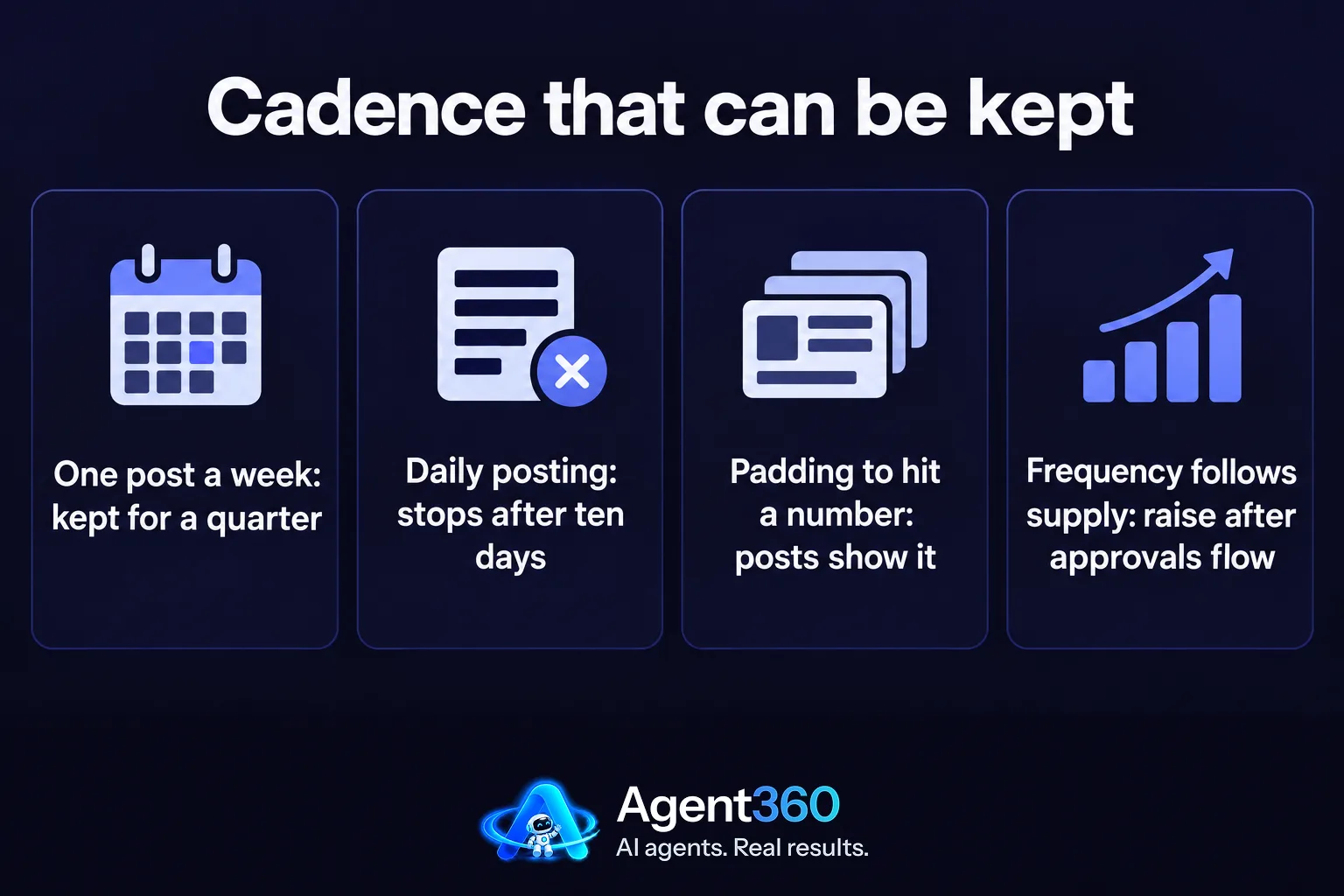
Raise the cadence only after two things are true: the executive approves batches without being chased, and you have more interview material than you are using. Frequency follows supply. Pad to hit a number and the posts will show it.
Judge the program on replies and conversations, not impressions
Executives lose interest when the feedback is a chart of views they cannot tie to anything. Show them what they care about instead:
- Which posts drew comments from people at target accounts.
- Which led to a direct message, an introduction, or a prospect saying “I saw your post” on a call.
- Which topics produced replies from customers, since that tells you what to say more of.
Keep a simple log that sales fills in whenever a prospect mentions a post. It is crude. It is also far more persuasive to a skeptical leader than reach. To connect this to pipeline without inflating the claim, see how to measure social media ROI without guessing.
Where BrandAgent fits
The weak point of this workflow is the conversion step: turning a recorded conversation into posts that sound like the executive, then publishing on schedule. BrandAgent does that part. Its Clip Agent can interview the executive out loud and turn each answer into a captioned clip with a post drafted for it. The Brand Agent learns voice and tone from your website, so drafts do not read like generic AI. Every post waits for the executive's approval, and approved ones publish to their LinkedIn profile at the time you set. Setup is covered on a kickoff call. The approach is described on the founders and executives page, and plans start at $97 a month on the pricing page, month to month. It does not guarantee followers or leads, and neither should anyone selling you this.
Questions people ask next
How often should an executive post on LinkedIn?
Start with one post a week and hold it for a month before changing anything. The right frequency is the highest one you can sustain with real material, not a number borrowed from a growth guide. If the executive's interviews supply more good material, raise it. If you are stretching, drop back.
Should executives write their own LinkedIn posts?
Not if writing is the reason they are not posting. The opinions and stories must be theirs, and they must approve every post, but someone else can do the drafting from a recorded conversation or short notes. A post is authentic when the executive would say it and stands behind it. Who typed it matters less.
What if the executive is nervous about saying the wrong thing?
Give them a veto and a clear boundary. Nothing publishes without their approval, they can reject any draft with a one-line reason, and the agreed rule is to challenge ideas and practices, never named people or companies. Most hesitation is fear of losing control, and a veto speaks to that directly.
How do we know it is working?
Look at conversations, not views: comments from target accounts, direct messages, and prospects who mention a post on a call. Have sales log those mentions. If a couple of months pass and none appear, the posts are probably too generic. Sharpen the opinions before you add volume.
More articles
- Customer Testimonial Posts for LinkedIn That Prove Something
- What AI-Assisted Video Clip Generation Actually Looks Like
- Run a Social Media Content Audit in 90 Minutes
- Before You Buy a Social Media Calendar Tool for Your Team
- Managing Social Media for Multiple Clients Without Chaos
- How Startups Should Pick an Instagram Scheduling Tool
- LinkedIn Personal Profile vs Company Page: Post From the Person
- How to Schedule Posts for a Retail Sales Event
