Customer Testimonial Posts for LinkedIn That Prove Something

A testimonial post works when the buyer sees their own situation in it, and fails when all they see is a compliment. Most fail. The usual version is a quote in a branded box, Great team, easy to work with, would recommend, sitting over a logo. A skeptical buyer scrolls straight past it, because there is nothing in it they can use.
Here is how to write the other kind. The kind that has a prospect nodding at the problem before you have said a word about your product.
Cut the adjectives and keep the before, the after and the decision
Praise is cheap, so readers discount it. A specific situation is harder to wave off. A usable testimonial has three parts:
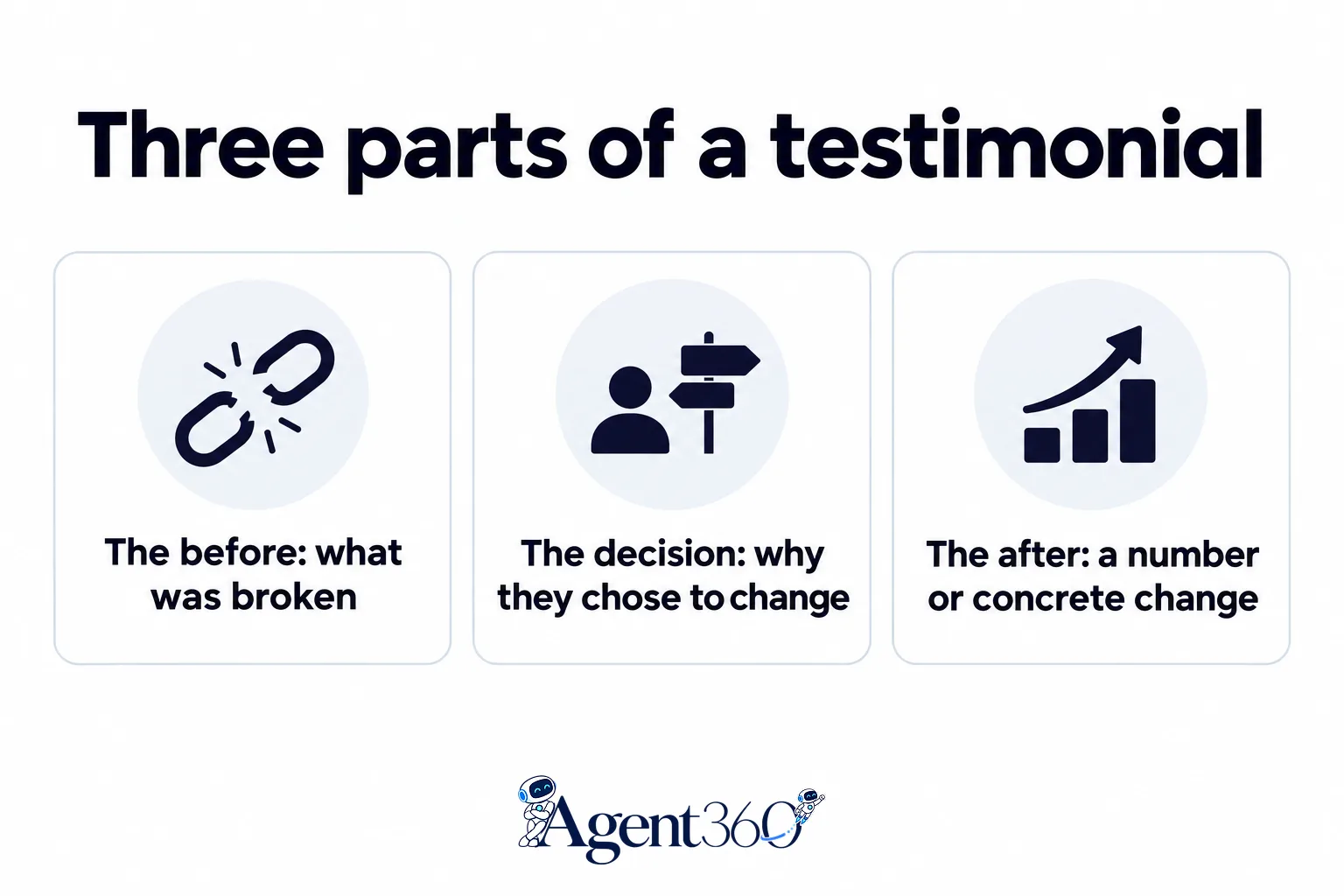
- The before. What was broken, in the customer's own terms. Quotes took nine days to turn around beats our process was inefficient.
- The decision. Why they chose to change, and what else they considered, including doing nothing. A prospect is quietly rehearsing exactly this part in their own head.
- The after. A number if the customer will give one. If they will not, a concrete change in how a week runs.
If all you have is the third part and it is an adjective, you do not have a testimonial yet. You have a compliment. Keep asking questions.
Do not ask customers to write the testimonial. Interview them for ten minutes.
Asking a customer for a quote hands them homework. They dash off two polite sentences, or they never write anything. Either way, that is on you, not them.

Ask for a ten-minute call instead and use five questions:
- What was happening the week you decided to look for something?
- What else did you consider, and why not that?
- What was the first thing that changed after you started?
- What would you tell someone in your old position?
- Is there a number you track that moved? If not, what do you notice now that you did not before?
Most teams skip question two because it feels risky. It is also the one that makes the post believable. A customer who explains why they turned down the cheaper option is handling your objections for you, in front of a room full of your prospects.
Then write the post yourself from the transcript and send it back for approval. Editing a draft is easy; staring at a blank page is not. So the answer comes back in a day instead of never.
Open on their problem, and put your product in the third paragraph
Nobody cares about your product until they recognise their own situation. So the first lines should be about the customer's world, not yours.
A structure that holds up:
- Line one: the before, stated plainly. A three-person ops team was rebuilding the same customer report by hand every Friday.
- Middle: what they tried and why it did not stick, then the decision point.
- Third paragraph: what they changed, with your product named once, briefly.
- Close: what is different now, and a single plain line inviting the reader to ask about it. No hard sell, no three-link footer.
The customer's name does not have to be in the first line. Lead with the logo and you are advertising to people who already know them. Lead with the situation and you are speaking to everyone who has the same problem.
Get approval before you draft, and use the anonymous version when you must
Some customers cannot be named. Their legal team says no, or their policy bans vendor endorsements. The post survives that. A regional logistics firm with about forty drivers is weaker than a name, but still far stronger than a vague adjective, as long as the details are real: the size, the old process, the week it changed.
What you should never do is sand down the specifics to protect anonymity until nothing is left. Drop the name and keep the situation. If the situation cannot stand without the name, wait for permission. Publishing a post that proves nothing is worse than not publishing.
Whichever route you take, the customer sees the final text before it goes live. Every time. A testimonial that surprised them is a relationship problem that outlasts the post. If your approval step tends to stall, the fix is the same as for any other content: one named person, one deadline. This approval workflow covers it.
Count a testimonial as a pitch, and post one a month
A testimonial is a sales message with a friendly face on it, so treat it like one. If most of your feed already promotes your product, weekly testimonials tip the mix further toward pitch, and a feed that only pitches gets shown less and trusted less. The value versus pitch mix is the right frame: a small share of posts can sell, so spend that share on proof.
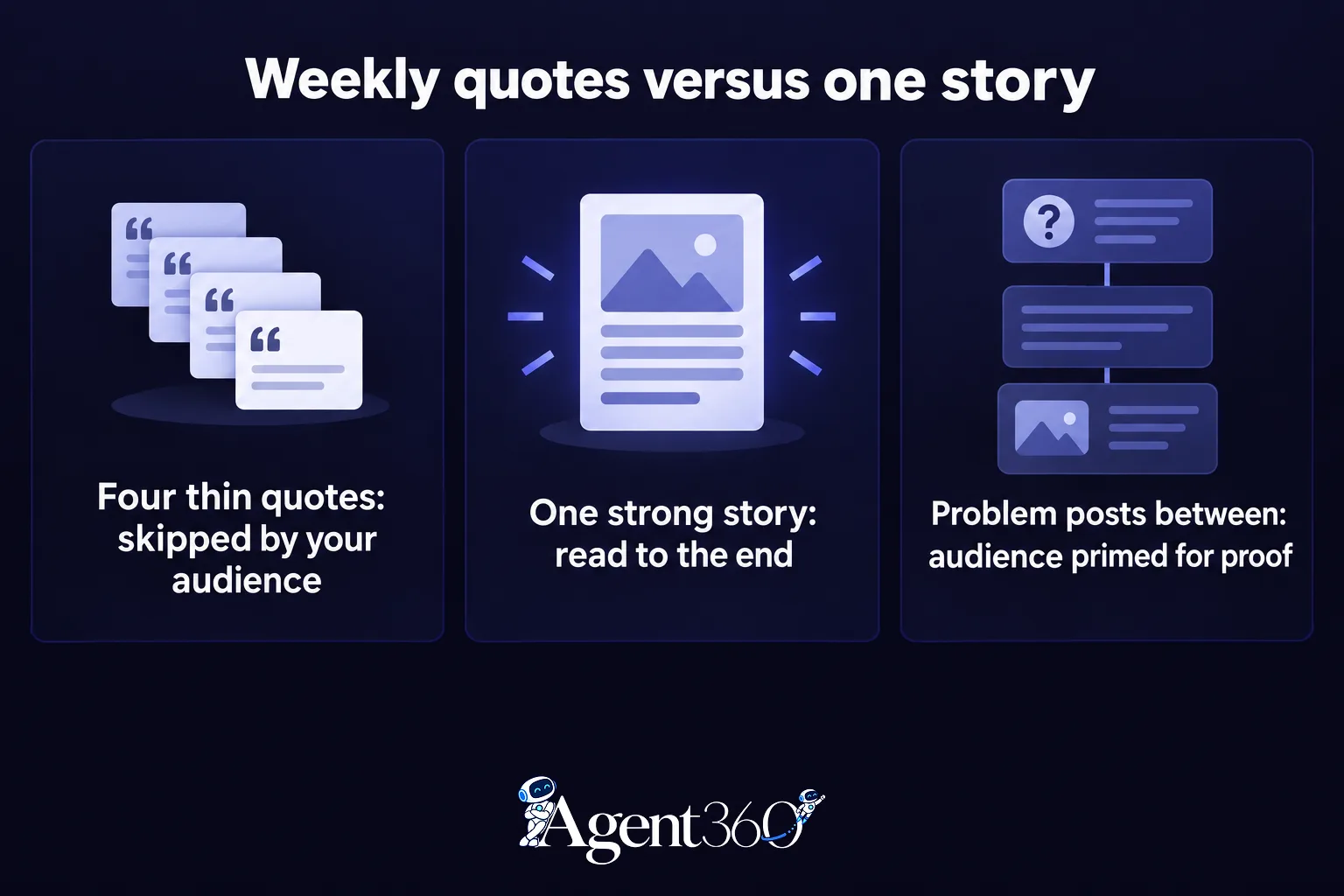
Here is the part you may disagree with. The common instinct says more proof posts are always better. They are not. One strong, specific story a month beats four thin quotes, because the strong one gets read to the end and the thin ones teach your audience to skip your proof.
Between testimonials, post the problem on its own, with no customer attached: the mistake you keep seeing, the decision framework, the thing that usually goes wrong. Then the testimonial lands on an audience that has already been chewing on the problem. If you want a wider look at how posts turn into conversations rather than likes, this piece on posts that get leads goes deeper.
Use the recording, not just the transcript
If the customer agrees to be recorded on that ten-minute call, you have more than a post. You have their own voice describing the before and the after, which reads as more credible than any paraphrase. Pull the best fifteen seconds as a short captioned clip, put the text version beside it, and one conversation gives you two formats. Ask for recording permission at the start of the call, and again in the follow-up message.
Where BrandAgent fits
The interview is the part only you can do. The drafting, the clip and the scheduling around it do not have to be. BrandAgent's Clip Agent takes a recording and cuts captioned vertical clips, each with a post drafted for it, and the Writer Agent adjusts the text to each platform. You approve every post before anything publishes. Plans start at $97 a month, and pricing is on the site if you want the details.
Common questions
How many testimonial posts should I publish a month?
One well-built story is a sensible default for most B2B teams, because a testimonial counts as a pitch and the feed should not tilt toward pitching. If a customer story is unusually strong, publish it as a text post and then a clip a week later, rather than adding a second unrelated testimonial.
What if my customer will not give a number?
Ask what changed in how their week runs. We stopped rebuilding the report on Fridays is a specific, believable result, and it often convinces more than a percentage with no context. Do not invent a figure or round one up to fill the gap.
Do I need the customer's permission to post their story?
Yes, and in writing, even if it is just an email reply approving the final draft. Show them the exact text before it goes live. If your customer has a legal or communications team, expect that team to want its own look, and build the extra days into your plan.
Should I tag the customer in the post?
Only if they say they want to be tagged. A tag can bring their network in, but it also puts the post in front of colleagues who never agreed to it. Ask when you send the draft for approval, and do what they say.
More articles
- What AI-Assisted Video Clip Generation Actually Looks Like
- Run a Social Media Content Audit in 90 Minutes
- Before You Buy a Social Media Calendar Tool for Your Team
- Get Executives Posting on LinkedIn Without Asking Them to Write
- Managing Social Media for Multiple Clients Without Chaos
- How Startups Should Pick an Instagram Scheduling Tool
- LinkedIn Personal Profile vs Company Page: Post From the Person
- How to Schedule Posts for a Retail Sales Event
