Social Media Scheduler for Small Business: How to Pick
The best social media scheduler for a small business is the one that publishes to the channels your buyers use, has an approval step, and fits whoever writes your posts. No single tool wins for everyone. Any list that names one without asking what you sell is guessing.
A scheduler does one job: it publishes posts at the times you set. It never decides what to say. Most small businesses stall on the writing, not the posting, so settle who creates the content before you pick a tool.
Below: how to compare schedulers, what the 5-3-2 rule is, and how to think about what a social media manager costs.
Key Takeaways
- Choose a scheduler by channel coverage, approval flow and team access, not by a ranked top-five list.
- Use the 5-3-2 rule as a starting mix: five posts curated from others, three of your own, two personal.
- Decide who writes the posts before you buy a tool, because a scheduler only publishes what you give it.
- Price a social media manager by scope (channels, posts per week, video, reporting), and get quotes against the same scope.
- If writing is the bottleneck, read what a social media AI content creator actually does before adding another tool.
Table of Contents
What is the best social media scheduler in 2026?
The best scheduler in 2026 is the one that covers your channels, lets you approve before anything goes live, and does not charge you more as your team grows. Features change fast, so check each vendor's own pricing and help pages on the day you buy.
What are the top 5 social media schedulers?
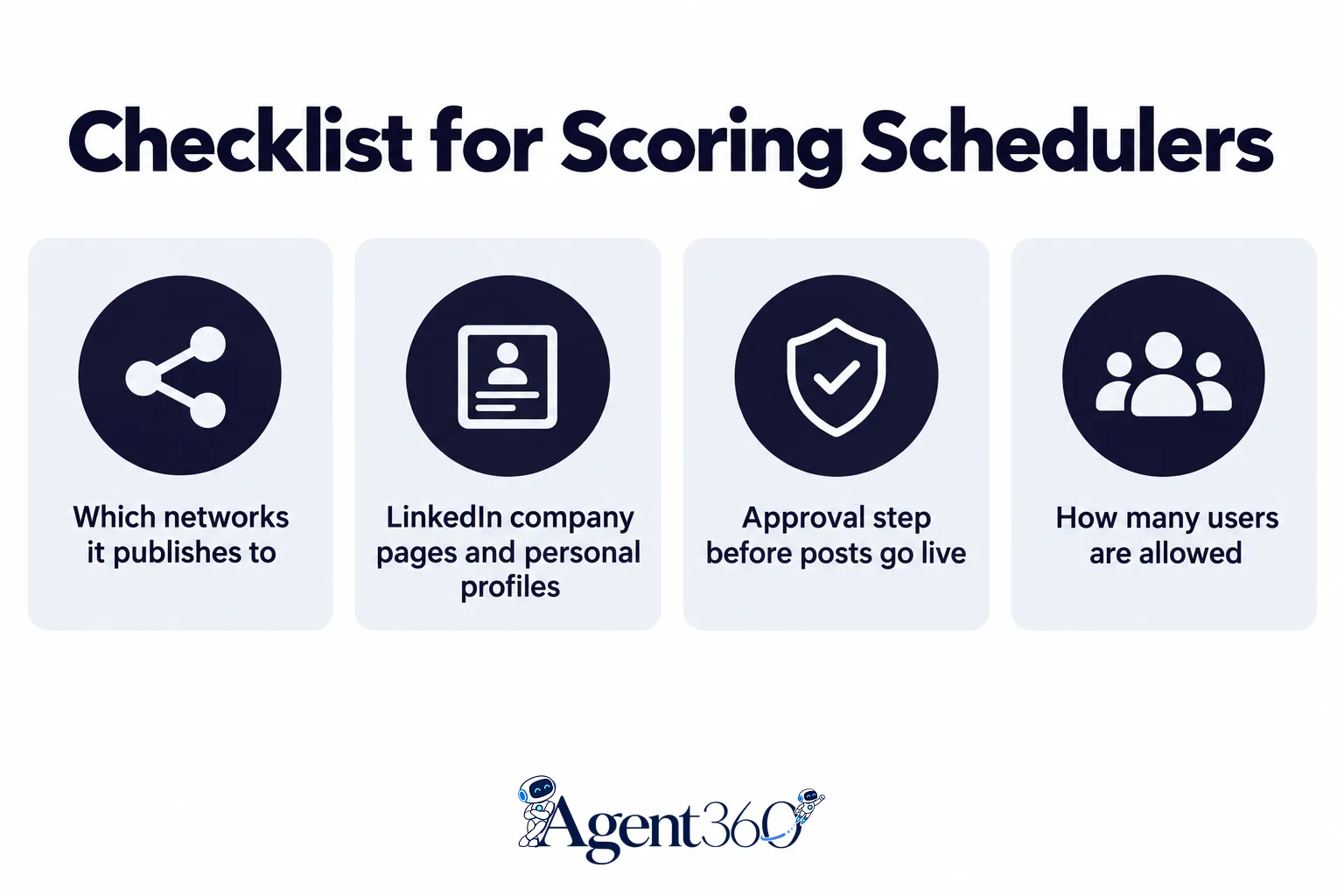
We are not going to rank five products here. We cannot verify their current limits or prices, and both change. Shortlist any five and score them on the same checklist: which networks they publish to, whether LinkedIn company pages and personal profiles are both supported, whether there is an approval step, how many users are allowed, and whether video posts are handled.
Which features matter for a B2B or recruiting business?
LinkedIn, first. Founders and recruiting firm owners usually sell to people who check a profile before they reply. So look for LinkedIn support, then a calendar view, then a way to reuse one idea across channels. Our guide on content repurposing shows how one asset can feed several posts.
What is the 5 3 2 rule for social media?
The 5-3-2 rule is a rule of thumb for every ten posts: five curated from other people, three created by you, and two personal. It is a widely shared guideline, not a platform requirement. No network enforces it.
How do you apply the 5-3-2 rule to a business account?
Treat it as a starting mix. The five curated posts share useful articles or commentary from others in your market. Your three cover your offer, a lesson, or a client-facing answer. The two personal posts show the people behind the business. A recruiting firm might spend its three own posts on hiring-market insight aimed at hiring managers. Once you see which posts get replies, adjust the ratio.
Does a scheduler help you stick to it?
Yes, mainly through the calendar view. You can see at a glance whether a week is all promotion. But the rule only works if you have enough material to fill the slots, which takes you back to who writes it.
How much does it cost to hire a social media manager for a small business?
The cost depends almost entirely on scope, so a single figure with no scope attached tells you nothing. We do not have a market average we can cite, and we will not make one up.
What drives the price?
Four things: how many channels, how many posts a week, whether video and images are included, and whether someone reports on results. Ask every quote to state all four, then compare like for like. Weighing a ghostwriter for LinkedIn in particular? See how much a LinkedIn ghostwriter costs.
Scheduler, manager or done-for-you: which fits?
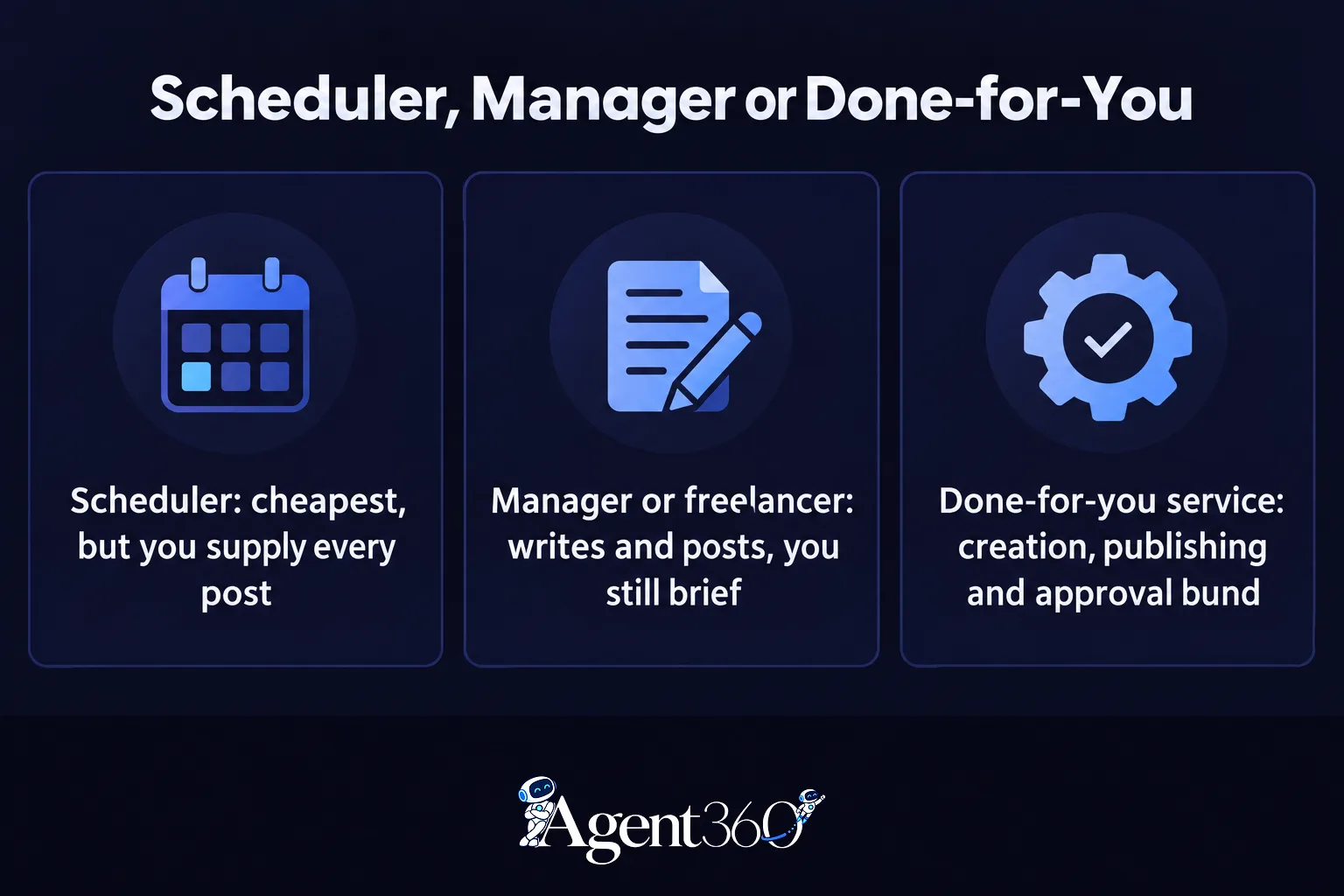
A scheduler is the cheapest option, but you supply every post. A manager or freelancer writes and posts, though you pay for their time and still have to brief them. A done-for-you service bundles creation, publishing and approval. If nobody has the hours to write, a scheduler alone leaves you staring at an empty queue.
How do you set up a scheduler this week?
Keep it to a few short steps, and keep the first month simple. You want a queue you can maintain, not a perfect strategy.

- Pick two channels. Start where your buyers are, usually LinkedIn first. Add others later.
- Name the writer. Decide whether it is you, a team member, a ghostwriter or an AI tool, and who approves.
- Draft a batch. Write or generate a set of posts in one sitting using the 5-3-2 mix.
- Schedule and review. Load the queue, check it weekly, and replace anything that no longer fits.
- Read the replies. Note which posts start conversations, and make more like them.
Take the Next Step With Your Social Calendar
If the scheduler isn't your real problem, the writing is. That is where we come in. Agent360's BrandAgent uses AI agents to make and publish on-brand posts, pictures and videos for LinkedIn, Instagram, YouTube and X, and you approve every post before it goes out. AI does the drafting. People stay in the loop.
BrandAgent also sits inside our all-in-one done-for-you growth plan. It covers website, SEO and AI search, ads, funnels, CRM and automation on one monthly plan from $297/mo. That suits owners who want one partner instead of five tools.
Not sure which fits? Compare the options on our pricing page.
Frequently Asked Questions
What is the 5 3 2 rule for social media?
It is a rule of thumb for every ten posts: five curated from other sources, three created by you, and two personal. It is a guideline, not a platform rule. Use it as a starting mix and adjust based on which posts earn replies.
How much does it cost to hire a social media manager for a small business?
It varies with channels, posts per week, video and reporting. We do not have a verified market average, so ask each provider to quote against the same written scope. That makes the numbers comparable.
What are the top 5 social media schedulers?
We do not rank products, because their features and prices change. Build your own shortlist and score each on channel coverage, LinkedIn support, approval steps, user limits and video handling. Check each vendor's own pricing page before you decide.
What is the best social media scheduler in 2026?
It is the one that fits your channels, your approval process and your team size. For B2B founders and recruiting firms, strong LinkedIn support usually comes first. Test two options against your real posting plan before you commit.
Do I need a scheduler if I post only a few times a week?
Not always. A scheduler pays off most when you batch your writing and want posts to go out on a steady rhythm without logging in each time. If you post rarely, the bigger gain comes from having something worth posting.
Can a scheduler write my posts for me?
A basic scheduler publishes what you give it. Writing needs a person, an AI tool, or a service. With BrandAgent, AI agents create the posts and you approve each one before it is published.
More articles
- White Label Geofencing: What to Check Before You Resell
- MSP Telemarketing: How to Book Meetings by Phone
- First Round Interview Questions and How to Answer Them
- How to Optimize Your Google Business Profile for Local SEO
- Map Pack SEO: What Moves You Into the Top Three
- Clay vs LeadSwift: Which Fits Your Outbound Job?
- Local SEO Checklist: What to Fix First, in Order
- Agent360 vs Belkins: a fair, side-by-side comparison
