First Round Interview Questions and How to Answer Them
First round interview questions are screening questions, and they test three things: whether you fit the role on paper, whether you can explain your background clearly, and whether you want this job for a real reason. Expect a short run of questions about your experience, your motivation, your availability and your pay expectations.
The round is rarely a deep skills exam. It's a filter. Keep each answer tight, and ask a few good questions back. Below: what you'll be asked, how long the round runs, what to say, and what to ask the employer.
Key Takeaways
- Prepare a 60-second answer to tell me about yourself that links your last role to the job you are interviewing for.
- Ask the recruiter how long the round will run when you accept the invite, because lengths vary by company.
- Write down three specific stories from past work, each with the problem, your action and the result.
- Bring three open-ended questions of your own about the role, the team and what success looks like.
- If you run a staffing firm, brief candidates on all of this before submission, and read how AI phone screening fits the same stage.
Table of Contents
What Are the Most Common First Round Interview Questions?
Most first round interviews open with the same five or six screening questions, and each one has a purpose behind it. Know the purpose and you know what a good answer contains.
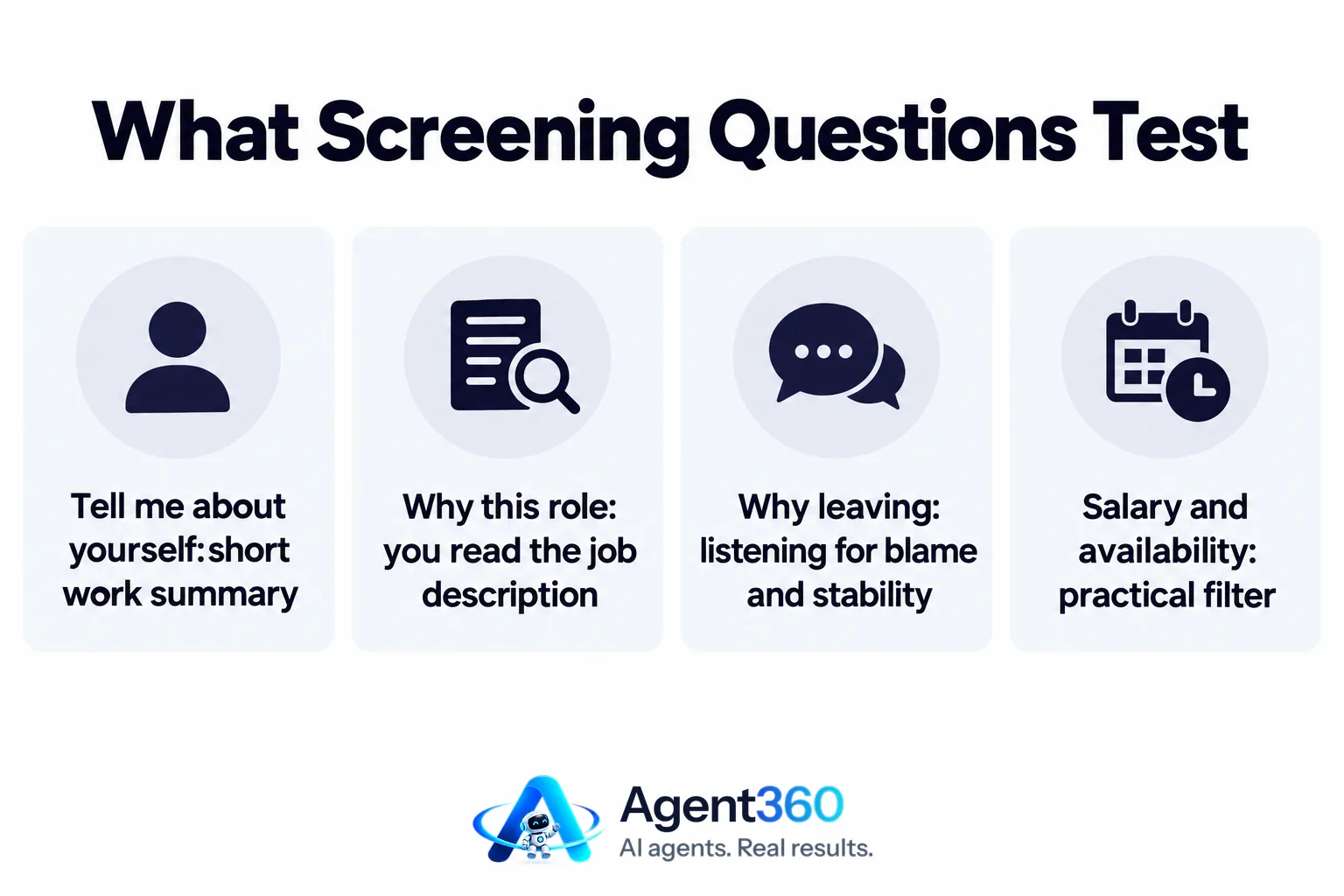
- Tell me about yourself. They want a short work summary, not your life story.
- Why are you interested in this role? They are checking you read the job description and have a real reason.
- Why are you leaving, or why did you leave? They are listening for blame and for stability.
- What are your strengths? Pick ones the job actually needs and back them with an example.
- Tell me about a time you handled a hard situation. This is a behavioral question. They want a real story with a result.
- What are your salary expectations and availability? This is a practical filter before anyone spends more time.
What do I say at my first job interview?
Start with a short summary of who you are professionally, then your most relevant experience, then why this role. A simple shape works: where you are now, what you did that matters for this job, and why you want the next step. Stay specific. Name the tools, the type of customers or the kind of work, and stop once you have made the point.
How do I answer a question I was not expecting?
Pause. Repeat the question in your own words, then answer one point at a time. It's fine to say you want a moment to think. If you don't know something, say what you do know and how you'd find out. A calm, honest answer reads better than a bluff.
How Long Does a First Round Interview Last?
There is no fixed length, so the reliable answer is to ask when you accept the invitation. Length depends on the company, the role and whether the first round is a recruiter screen, a hiring manager call or a panel.
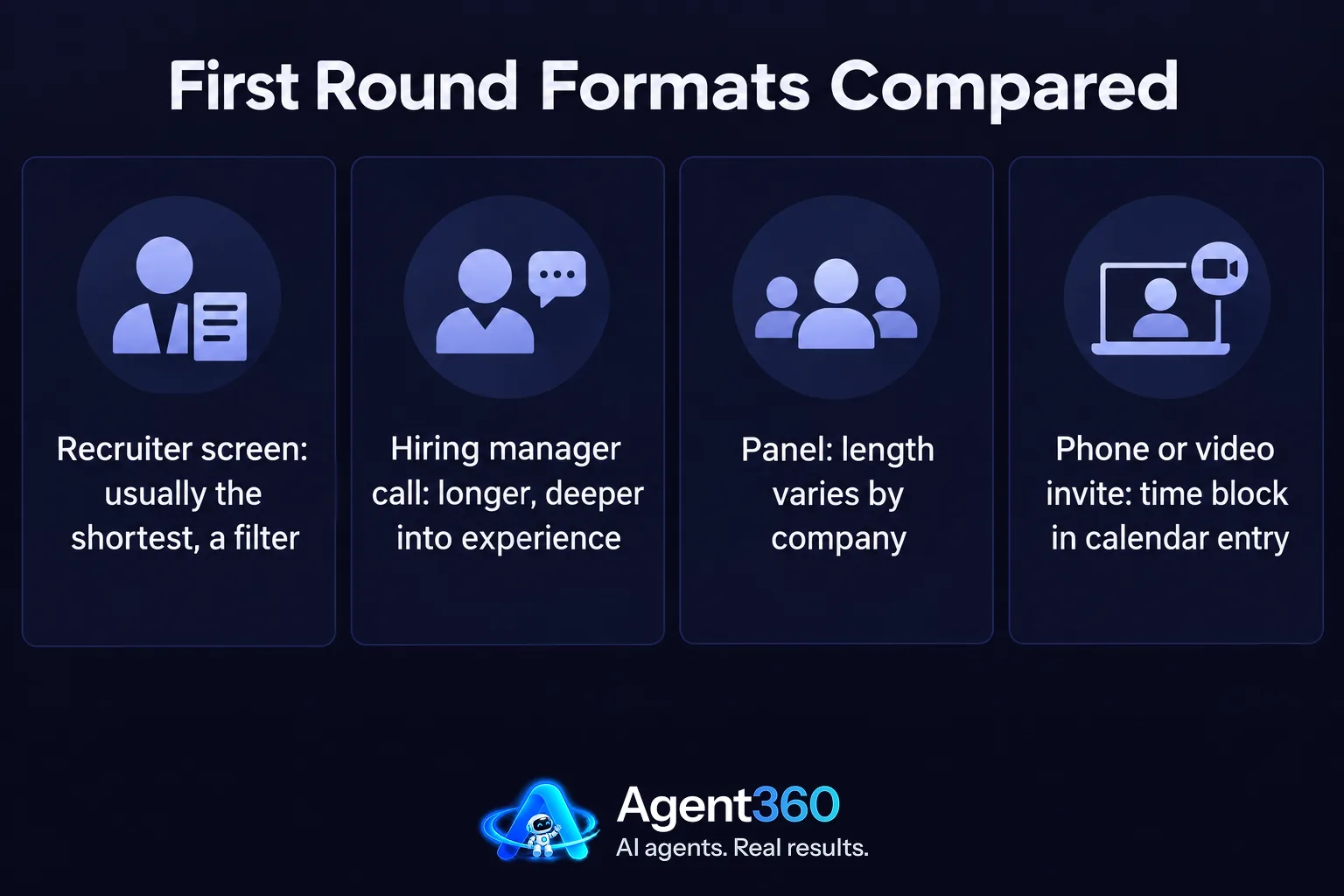
A recruiter screen is usually the shortest format, since it's a filter. A first round with the hiring manager tends to run longer because it goes into your experience in more detail. A video or phone invite often states the time block in the calendar entry, so read it. Be ready a little early, and keep your calendar clear for some time afterward in case the conversation runs over.
Is a first round interview on the phone or on video?
Either. The invite should say which. For a phone screen, sit somewhere quiet and keep your résumé and the job description in front of you. For video, test your camera, audio and link ahead of time, and keep your background plain.
What does it mean if my first round is very short?
Not much on its own. Short screens are normal, and a quick call can still lead to the next round. Judge it by what the interviewer says about next steps, and ask about the timeline before you hang up.
How Do You Prepare for a 1st Round Interview?
Prepare by matching your experience to the job description, rehearsing a handful of stories out loud, and sorting out the logistics before the day. Thirty to sixty minutes of focused preparation beats hours of generic reading.

- Read the job description line by line. Highlight the top three requirements. These are what your answers need to prove.
- Research the company. Know what they sell, who they sell to and one recent thing about them. Their website and public pages are enough.
- Write your opening answer. Draft a short summary of your background that ends on why you want this role.
- Build three stories. For each, note the problem, what you did and what changed. Reuse them for most behavioral questions.
- Settle pay and availability. Decide your range and your start date before you are asked.
- Prepare your questions. Bring three open-ended ones, covered below.
- Do a spoken run-through. Say your answers aloud once or twice. Written answers sound different when spoken.
- Handle logistics early. Check the link or phone number, the interviewer's name and the time zone.
Should I bring anything to a first round interview?
For an in-person round, bring a few copies of your résumé, a notebook and a pen. For a call, keep the same items within reach. With your notes in view, you won't freeze on your own dates and details.
What Are Good Open-Ended Questions to Ask an Employer in an Interview?
Good open-ended questions start with what, how or tell me, and they get the interviewer talking about the job instead of giving a yes or no. They also show you're thinking about the work, not only the offer.
- What does success look like in this role after the first few months?
- How would you describe the team and how people work together day to day?
- What are the biggest challenges someone in this role will face?
- How does the company measure performance for this position?
- What made the last person in this seat do well, or what would you change?
- What are the next steps in the process, and what is the timeline?
What should I not ask in a first round?
Hold detailed questions about holiday allowance, perks and remote exceptions until the process is further along, unless the interviewer raises them. Skip anything a quick look at the website would answer. Spend your questions on the role and the team.
How many questions should I ask?
Two or three well-chosen ones are enough. If the conversation has already covered one, say so and move to the next. Always finish with the question about next steps.
Take the Next Step With Your Recruiting Pipeline
If you run a staffing or recruiting firm, all of this applies to your candidates too. A candidate who gives a clear opening answer, tells real stories and asks sharp questions makes you look good with the hiring manager. Brief them on the round before you submit them. And if you want to widen your candidate funnel, our guide to AI sourcing for recruiters shows where it helps.
Then there's the other side of the desk: client meetings. Candidates only get interviews when hiring managers hand you roles. Agent360 helps recruiting and staffing agencies build a steady flow of new client meetings without adding recruiters to business development. You can run outbound yourself on the Agent360 Platform from $99/mo, with an email and LinkedIn sequencer, a parallel dialer, a CRM, unlimited seats and one triple-verified lead included for every email sent. Or we run it for you with VIP Done-For-You Outbound at $2,000/mo plus $250 per booked meeting, with a dedicated GTM engineer and strategist. You take the meetings. See the pricing page for the details.
Curious how that would work for a firm like yours? Explore how Agent360 helps agencies book client meetings.
Frequently Asked Questions
How long does a first round interview last?
It varies by company and format. A recruiter screen is typically the shortest, and a hiring manager round is often longer. Ask the recruiter for the time block when you accept the invite, and check the calendar entry.
How to prepare for a 1st round interview?
Match the job description to your experience, write a short opening answer, and prepare three stories from past work. Settle your pay range and availability, then rehearse out loud. Finish by preparing three open-ended questions to ask.
What do I say at my first job interview?
Open with a brief summary of your background, highlight the experience most relevant to the job, and explain why you want the role. Keep answers specific and concise. Use real examples instead of general claims about being a hard worker.
What are some good open-ended questions to ask my employer during an interview?
Try asking what success looks like in the first few months, what the biggest challenges of the role are, and how the team works together. Ask how performance is measured and what the next steps are. These get the interviewer explaining the job in detail.
What are the most common first round interview questions?
Expect tell me about yourself, why this role, why you are leaving your current job, your strengths, a behavioral question about a hard situation, and salary and availability. Each is a screening check on fit, motivation and practicalities.
Can recruiters prepare candidates for the first round?
Yes, and good recruiters do. A short briefing on the role, the likely questions and the hiring manager's priorities helps candidates answer clearly. It also protects your relationship with the client.
More articles
- Social Media Scheduler for Small Business: How to Pick
- White Label Geofencing: What to Check Before You Resell
- MSP Telemarketing: How to Book Meetings by Phone
- How to Optimize Your Google Business Profile for Local SEO
- Map Pack SEO: What Moves You Into the Top Three
- Clay vs LeadSwift: Which Fits Your Outbound Job?
- Local SEO Checklist: What to Fix First, in Order
- Agent360 vs Belkins: a fair, side-by-side comparison
