White Label Geofencing: What to Check Before You Resell
White label geofencing means someone else runs location-triggered mobile ads and you sell them to your clients as your own. The provider handles the ad buying and the tech. You keep the client relationship, the pricing and the reports with your logo on them.
The model is simple. Making money from it is the hard part, because you need a provider you can trust, clients who suit the tactic, and a steady stream of new conversations to sell into. We cover all three below.
Key Takeaways
- Treat white label geofencing as one more ad channel you resell, not a new business model.
- Before you sign with a provider, get written answers on reporting, minimum spend, contract length and who owns the data.
- Sell it only to clients with a physical place people visit, a clear offer and a way to track the result.
- Do not add a service to a crowded market until you know how you will get the first client meetings; our agency outbound approach covers that part.
Table of Contents
What is white label geofencing?
It is location-based advertising sold under your brand, built and delivered by a third-party provider. You draw a boundary around a place, and the provider serves ads to mobile devices that enter it.
How does geofencing advertising work?
You pick a physical area: a competitor's shop, a venue, a trade-show hall or a neighborhood. Ads then appear for people on mobile devices seen in that area, usually inside apps or on mobile web. How accurate that is depends on the provider's location data, so ask where it comes from.
What does white label mean here?
The provider stays out of sight. Your client sees your logo on the proposal and on the report. You set the price, the provider charges you a wholesale rate, and you keep the difference.
The risk sits with you. If a campaign underperforms, the client blames you, not the provider.
What should you check before you resell it?
Check the provider's reporting, pricing terms, data sources and support before you put your name on anything. A vendor can look great in a demo and still leave you exposed in month three.
Can you show clients reports that prove the work?
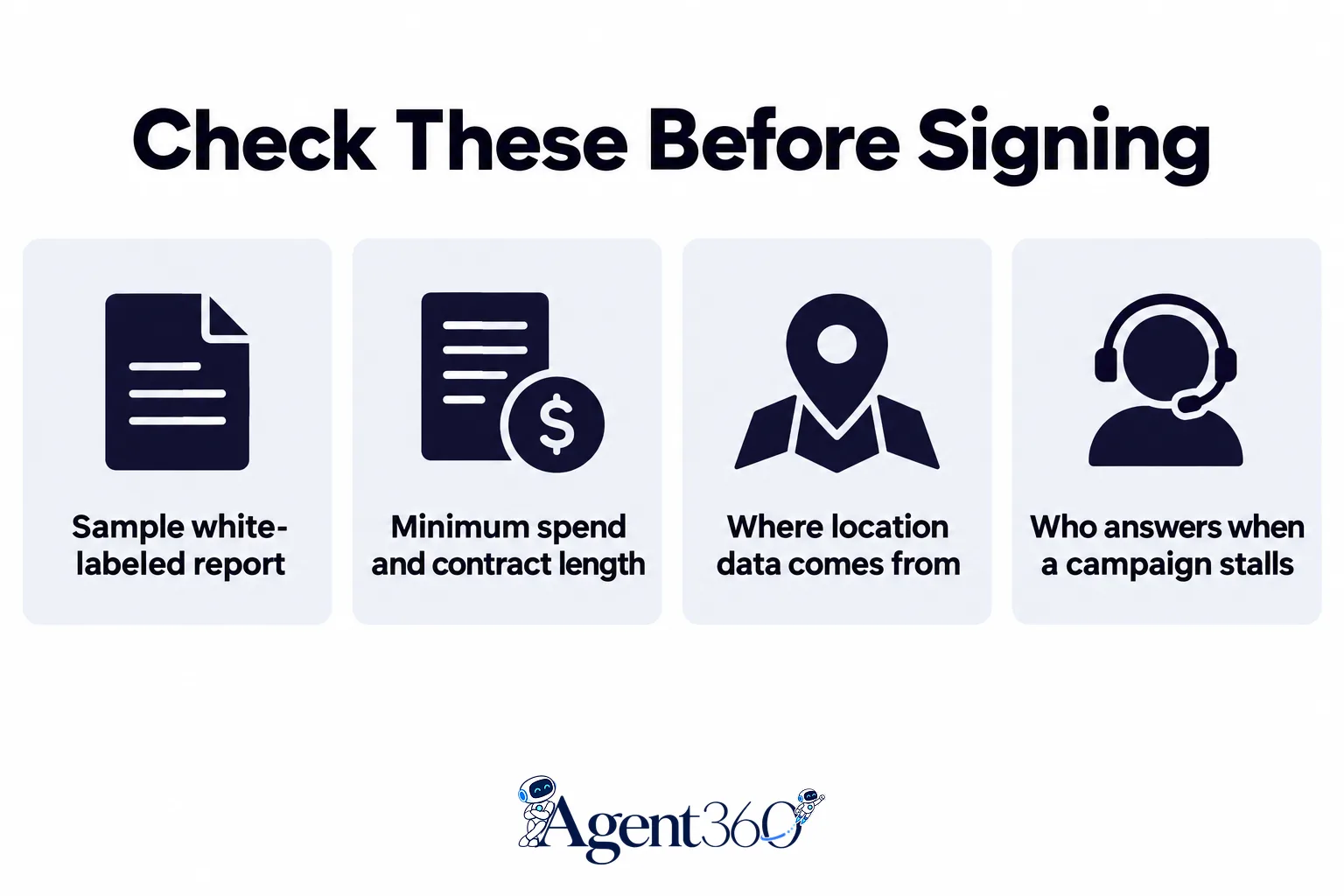
Ask for a sample white-labeled report. Look for impressions, clicks and the geofenced locations served, all under your brand. Then ask how foot-traffic or conversion claims are measured. Some providers estimate store visits from location data, which is a model, not a headcount. Don't quote a visit number to a client unless you understand how it was produced.
What are the minimums, contracts and data rules?
Get these in writing. Providers set their own terms and rarely publish them, so we won't guess at numbers.
- Minimum spend. Is there a floor per campaign or per month?
- Contract length. Can you stop a campaign when a client leaves?
- Data and privacy. Where does location data come from, and how does the provider handle consent and local privacy rules?
- Support. Who answers when a campaign stalls, and how fast?
Don't mix this up with GEO as in AI search. That is a different service, and our guide to whitelabel GEO covers it.
Is it worth adding when SEO and PPC agencies are everywhere?
Only if it solves a specific problem for a specific client; as a bolt-on to look more full-service, it just adds to the noise. Business owners already get pitched by search and paid agencies all the time. One more menu item won't change that.
Which clients actually fit geofencing?
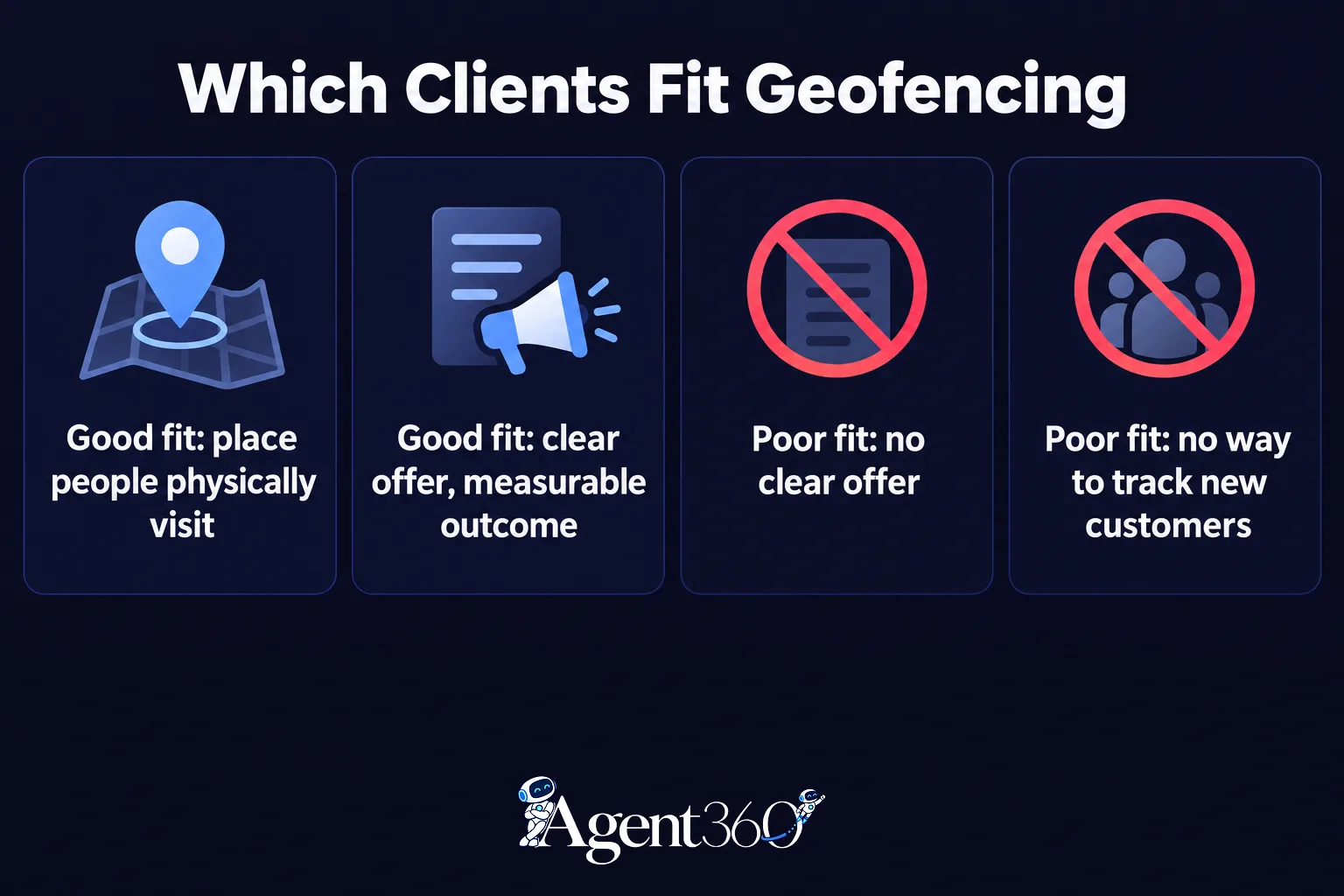
The best fits have a place people physically go and a way to measure the outcome. Think clinics, home-service showrooms, restaurants, events and local retail. A client with no clear offer, or no way to tell where a new customer came from, is a poor fit whatever the channel.
How do you stand apart from other agencies?
Pick a niche. State the result you are aiming for, and be plain about what you can't promise, because geofencing does not guarantee sales. Say what you will report, what it will cost and how long you will test before judging it. Specific beats broad.
How do you sell white label geofencing to new clients?
Start with a short list of fit clients and reach them directly, one conversation at a time. Waiting on referrals leaves your pipeline to chance.

- Choose one niche. Pick a type of local business you can describe in one line.
- Build a target list. Gather owners and marketing leads in that niche, with verified contact details.
- Lead with one offer. For example, a pilot campaign around one location, with a defined reporting date.
- Contact by email and LinkedIn. Keep messages short and specific to their location or event.
- Follow up on a schedule. Most replies come after the first touch, so plan the sequence before you send.
- Review the pilot honestly. Show what the report says and recommend the next step, even if that is stopping.
Weighing a hire against software for this? SDR versus outbound software lays out the trade-off.
Take the Next Step With Your Agency Pipeline
Picking a geofencing provider is the easy half. The harder half is a steady flow of client meetings to sell it into, and that is the part we build.
With the Agent360 Platform, you run cold outbound in-house from $99/mo. It includes leads, an email and LinkedIn sequencer, a parallel dialer and a CRM, with unlimited seats and one triple-verified lead included for every email sent. Would you rather not run it yourself? Our VIP Done-For-You Outbound is $2,000/mo plus $250 per booked meeting. A dedicated GTM engineer and strategist runs it end to end, and you take the meetings. If your client needs paid campaigns, our Ads service builds, runs and reports them for you.
We pair AI with a human team, and we don't promise specific results. See pricing or book a demo to talk through your agency's pipeline.
Frequently Asked Questions
What is white label geofencing?
It is a service where a provider runs location-triggered mobile ad campaigns and you resell them under your own brand. You handle the client, pricing and reporting. The provider handles the ad buying and technology.
Is geofencing the same as GEO?
No. Geofencing targets devices inside a physical area with ads. GEO usually means generative engine optimization, which aims to get a business named in AI answers. They solve different problems.
Does geofencing work for B2B?
It can, when your buyers gather in a known place, such as a conference venue or an industrial park. It fits poorly when buyers are spread out and not tied to a location. No provider can promise results, so test with a small pilot.
How much does white label geofencing cost?
Pricing varies by provider and campaign, and many don't publish rates. Ask for the wholesale rate, any minimum spend and any setup or reporting fees before you quote a client.
What should I ask a white label provider first?
Ask for a sample branded report, where their location data comes from, their minimum spend, contract length and support response times. Get the answers in writing. Then run a small pilot before you offer it widely.
How do I find clients to resell it to?
Pick a niche with physical locations, build a verified list and contact owners directly with one specific offer. Outbound by email, LinkedIn and phone lets you decide how many conversations you start each week.
More articles
- Social Media Scheduler for Small Business: How to Pick
- MSP Telemarketing: How to Book Meetings by Phone
- First Round Interview Questions and How to Answer Them
- How to Optimize Your Google Business Profile for Local SEO
- Map Pack SEO: What Moves You Into the Top Three
- Clay vs LeadSwift: Which Fits Your Outbound Job?
- Local SEO Checklist: What to Fix First, in Order
- Agent360 vs Belkins: a fair, side-by-side comparison
