Map Pack SEO: What Moves You Into the Top Three
Map pack SEO is how you get your business into the short list of local results Google shows above the regular listings, right beside a map. You earn a spot with a complete, accurate Google Business Profile, strong reviews, and a website that proves you serve the area.
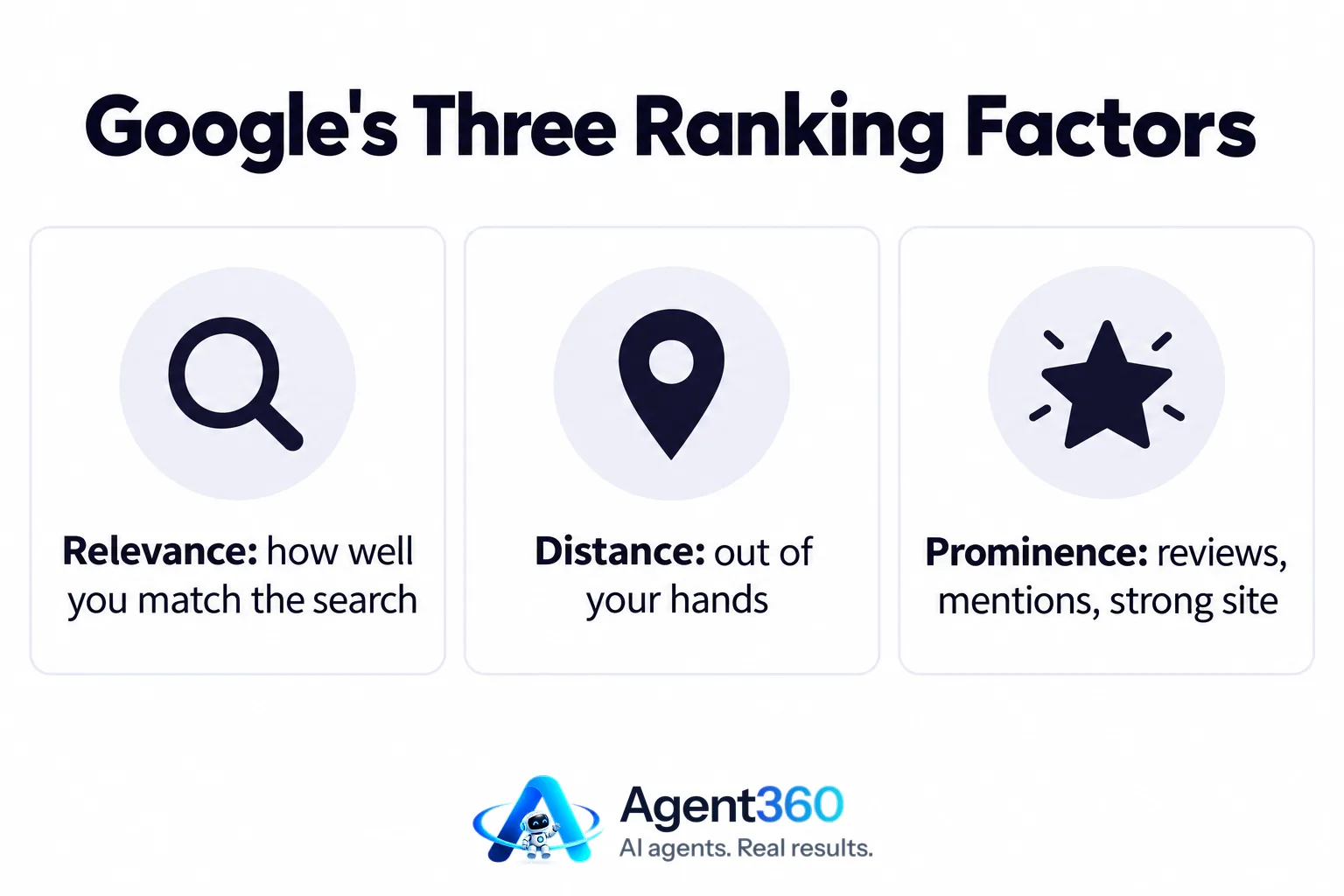
Google says local results are ranked on three things: relevance, distance and prominence. Distance is out of your hands. The other two you can improve, and this guide shows you the order to do it in.
Key Takeaways
- Google ranks local results on relevance, distance and prominence, so fix the two you control first.
- Choose the right primary category before anything else, because it drives which searches you can appear for.
- Build a steady review habit instead of chasing a one-off burst.
- Check for guideline problems such as duplicate listings or a name stuffed with keywords before you add anything new.
- Measure calls and direction requests, not just rank; our local pack ranking guide goes deeper on the mechanics.
Table of Contents
What is map pack SEO and how is it different from regular SEO?
Map pack SEO optimizes your business listing and local signals, while regular SEO optimizes web pages. The two overlap. But the map pack is driven mostly by your Google Business Profile, your reviews and how well Google can confirm where you operate.
Which searches show a map pack?
Searches with local intent do, such as a service plus a place, or a service with the words near me. Google decides when to show the map. The same business can appear for one phrase and vanish for a close variant.
Does map pack SEO matter for B2B and staffing firms?
Only if your buyers search by location. A recruiting firm with a walk-in office, or a trades business serving a metro area, can win calls from it. If your buyers never search for you, outbound outreach is the better route to meetings.
What does Google use to rank businesses in the map pack?
Google names three factors: relevance, distance and prominence. Its Business Profile help pages describe them, and they work together rather than as a checklist.
How do you improve relevance?
Relevance is how well your listing matches what the person searched. Set the primary category to the thing customers actually buy. Add secondary categories only where they are true, list your services, and write a plain description. Your website should have a page for each core service and each area you serve.
Can you beat a closer competitor?
Sometimes. Distance counts, but a competitor sitting closer to the searcher does not automatically take the spot if you are clearly more relevant and better known. Prominence is your lever: reviews, mentions across the web and a strong site all feed it.
Do reviews really matter?
Yes. Google lists review count and score as part of prominence. Ask every happy customer, reply to every review, and keep the flow steady. One burst followed by silence looks thin next to a competitor who picks up reviews every week.
How do you improve your map pack ranking?
Work through the profile first, then reviews, then your website, in that order. Most listings are held back by basics, not tricks.

- Fix your primary category. Search the terms customers use and see which category the businesses ahead of you chose. Pick the one that matches your main revenue.
- Complete every profile field. Hours, services, service area, phone number, website link and a plain description should all be filled in and correct.
- Make your name, address and phone match everywhere. Use the same details on your site, your profile and the directories you appear in.
- Set up a review routine. Send a direct review link right after the job is done, from the person who did the work.
- Upload real photos. Show your team, your work and your premises, not stock images.
- Build location and service pages. Each page should say what you do, where, and how to reach you. Our local SEO checklist lays out the order.
- Answer calls and messages fast. A listing that wins the click still loses the job if no one picks up.
Why is your business not showing in the map pack?
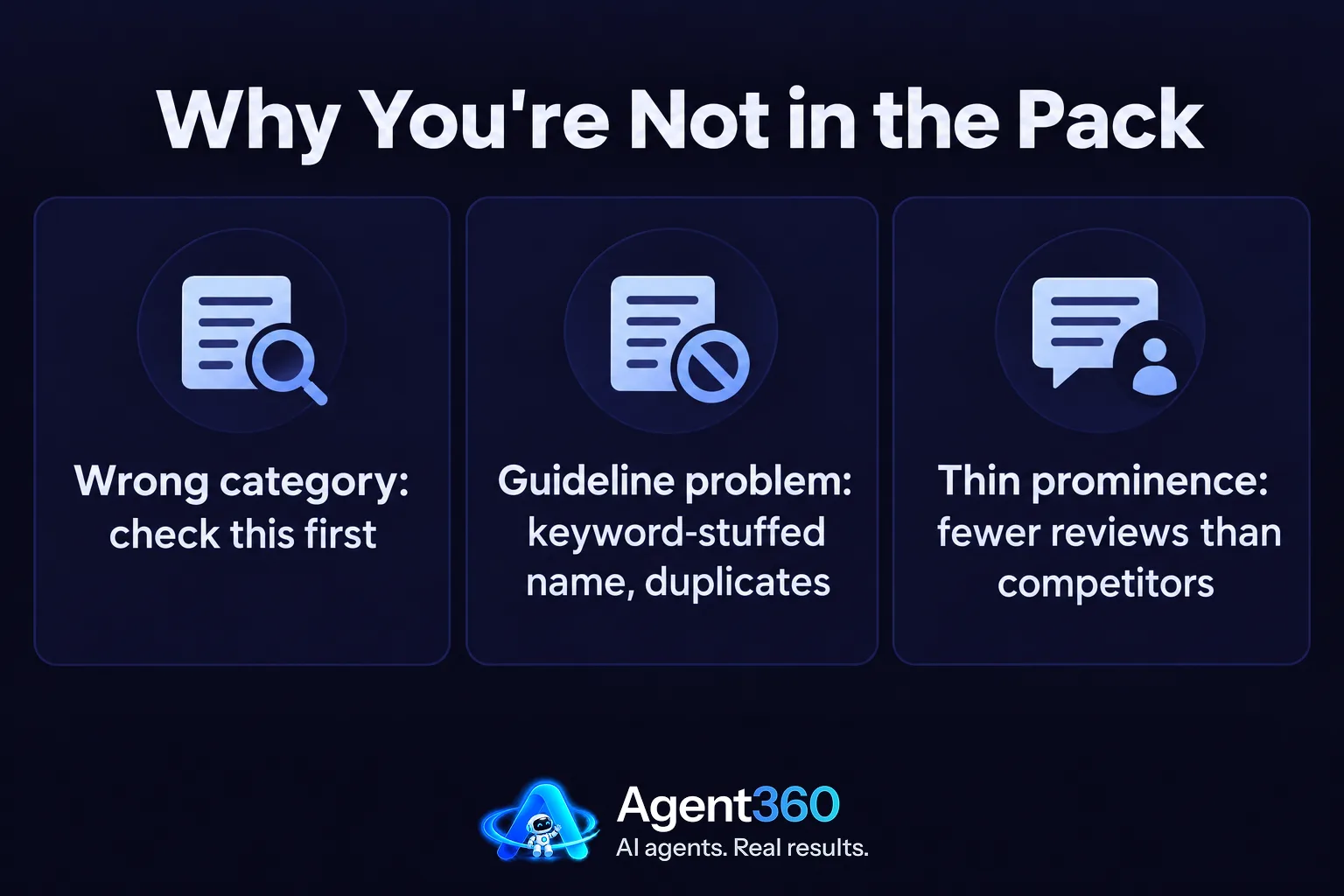
The usual causes are the wrong category, a guideline problem, or thin prominence. Check them in that order.
Could a guideline problem be holding you back?
Read Google's Business Profile guidelines against your listing. Common problems include a business name padded with keywords, a virtual office or mailbox used as an address, and duplicate listings for the same business. Any of these can suppress a listing or get it suspended. Adding more content will not fix them.
What if your profile is clean but you still rank low?
Then prominence is usually the gap. Compare your reviews, your site and your web mentions with the businesses above you. Look for what they have that you do not, such as a page for the service you are missing. And be patient: local changes rarely land overnight, as how long SEO takes to show results explains.
How do you know map pack SEO is working?
Track the actions customers take, not only your position. Google Business Profile reports show calls, direction requests and website clicks, and those tie directly to jobs.
Rank can differ from street to street, so a single check from your office can mislead you. Watch the trend in calls and booked jobs over several weeks. Then log where each lead came from, and chase missed calls fast with something like missed call text back.
Take the Next Step With Your Map Pack Plan
Start with the category and the review routine. Both are free, and both change what Google can say about you. Then fix any guideline issues and add service and location pages.
If you would rather not run this yourself, we handle it. Our done-for-you growth plan, from $297/mo, covers your website, SEO and AI search, ads, funnels, CRM and automation on one monthly plan. Our AI handles the repetitive work, and our team stays in charge of the result. You can see what is included on our pricing page.
We do not promise a ranking, because Google decides that. We do help you build the signals that earn it, plus the follow-up that turns calls into booked jobs. Book a demo and we will walk through your listing with you.
Frequently Asked Questions
What is the map pack in SEO?
The map pack is the group of local business listings Google shows with a map for searches with local intent. It sits above or among the regular results. You will also hear it called the local pack or local 3-pack.
How do I get into the Google map pack?
Claim and complete your Google Business Profile, choose the right primary category, collect reviews steadily and keep your details consistent across the web. Add service and location pages to your website. Google ranks on relevance, distance and prominence, so you are working on the first and third.
How long does map pack SEO take?
It depends on your competition and what is holding you back right now. Fixing a wrong category can matter quickly, while reviews and prominence build over time. Nobody can honestly promise you a date.
Do reviews affect map pack rankings?
Yes. Google lists review count and score as part of prominence. Replying to reviews and getting new ones regularly also keeps your listing looking active.
Is map pack SEO different from local SEO?
Map pack SEO is one piece of local SEO. Local SEO also covers your website pages, citations and tracking. The map pack is the piece tied most closely to your Business Profile.
Can a service-area business rank in the map pack?
Yes, Google lets service-area businesses list the areas they cover. Just follow its address rules, and name those areas on your site too.
More articles
- Social Media Scheduler for Small Business: How to Pick
- White Label Geofencing: What to Check Before You Resell
- MSP Telemarketing: How to Book Meetings by Phone
- First Round Interview Questions and How to Answer Them
- How to Optimize Your Google Business Profile for Local SEO
- Clay vs LeadSwift: Which Fits Your Outbound Job?
- Local SEO Checklist: What to Fix First, in Order
- Agent360 vs Belkins: a fair, side-by-side comparison
