Content Repurposing: Turn One Asset Into Outbound Fuel

Content repurposing means taking one piece of content you already made and reshaping it into other formats, so it works harder without forcing you to start from a blank page each time. A single customer FAQ answer becomes a LinkedIn post, a line in a cold email, a script for a voicemail drop. Same research. Same proof points. Same argument. Only the wrapper changes.
For founders running their own outbound, and staffing firm owners selling in the gaps between candidate searches, this matters because content and pipeline work fight for the same hours. Repurposing is how you squeeze more outbound material out of writing you've already done, rather than treating every channel like a fresh assignment.
Below: what counts as repurposing, examples you can copy, the seven content types worth knowing before you plan a pass, and one worked example start to finish.
Key Takeaways
- Content repurposing reshapes one proven idea into multiple formats instead of creating new material for every channel.
- Start with your best-performing piece, not your newest one, because it already proved the idea works.
- Match the format to the channel: a blog post needs cutting down for LinkedIn and email, not just copy-pasting.
- Founders running their own outbound can turn one case study or FAQ answer into a week of sequence content, which matters more when you are selling and prospecting at the same time.
- Build a simple repurposing checklist so every new asset automatically gets planned for at least two other formats.
Table of Contents
What Is Content Repurposing?
Content repurposing is the practice of adapting one existing piece of content into different formats or for different channels instead of writing something new each time. The source material is the backbone — a webinar recording, a long blog post, a client-facing FAQ, even a cold email that got replies. Repurposing pulls the argument, the data point, or the story out of that source and rebuilds it to fit a shorter format, a different platform, or a different stage of a buyer's attention.
How is repurposing different from reposting?
Reposting is the same content, unchanged, shown again on a different day or channel. Repurposing changes the format or the depth. A 1,200-word article becomes a five-slide LinkedIn carousel. Three sentences from it become a cold email opener. The idea survives. The shape doesn't.
What Are Some Examples of Content Repurposing?
Common examples include turning a blog post into social posts, a webinar into short clips, a client FAQ into email copy, and a sales call into a case study. None of it calls for new research — just editing and reformatting what already exists.
What does this look like in a B2B sales or staffing context?
Take a staffing agency owner who writes one article on hiring trends in their niche. Three sentences become a LinkedIn connection note. One statistic becomes a subject line. The closing argument becomes a talk track for the follow-up call. Or take a SaaS founder who records a product walkthrough for a single prospect — that recording gets cut into a 90-second clip for outbound video and a written summary for a nurture email. Planning this ahead beats improvising after the fact, which is easier with a simple content calendar built around repurposing instead of one-off posts.
What Are the 7 Main Types of Content?
The seven types commonly used in content planning are written content, video, audio, images, interactive content, live content, and user-generated content. Knowing all seven before a repurposing pass shows you which formats you haven't touched yet.
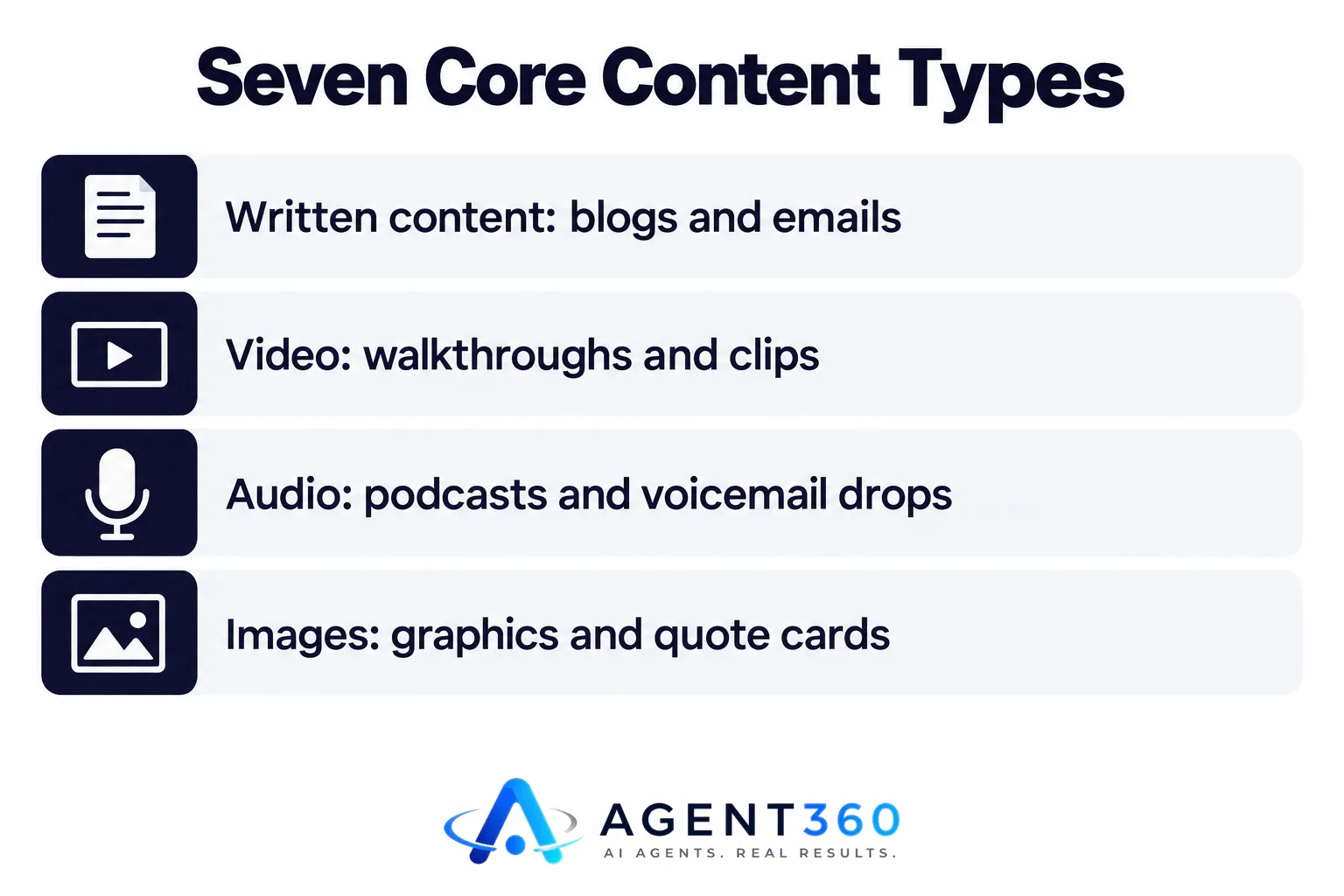
- Written content. Blog posts, emails, LinkedIn posts, and case studies.
- Video. Walkthroughs, short clips, recorded calls, and video messages used in outbound.
- Audio. Podcasts, voice notes, and voicemail drops.
- Images. Graphics, screenshots, and quote cards pulled from longer pieces.
- Interactive content. Calculators, quizzes, and configurators.
- Live content. Webinars, live Q&A sessions, and demo calls.
- User-generated content. Reviews, testimonials, and client quotes.
Which of these types is easiest to repurpose first?
Written content, hands down. It already has a beginning, middle, and end, and most editing tools work directly with text. A blog post or FAQ answer can be cut into email lines, social posts, or talking points in under an hour. Video and live content take longer — they need transcription or editing software before you can touch them.
What Is an Example of Repurposing a Single Piece of Content?
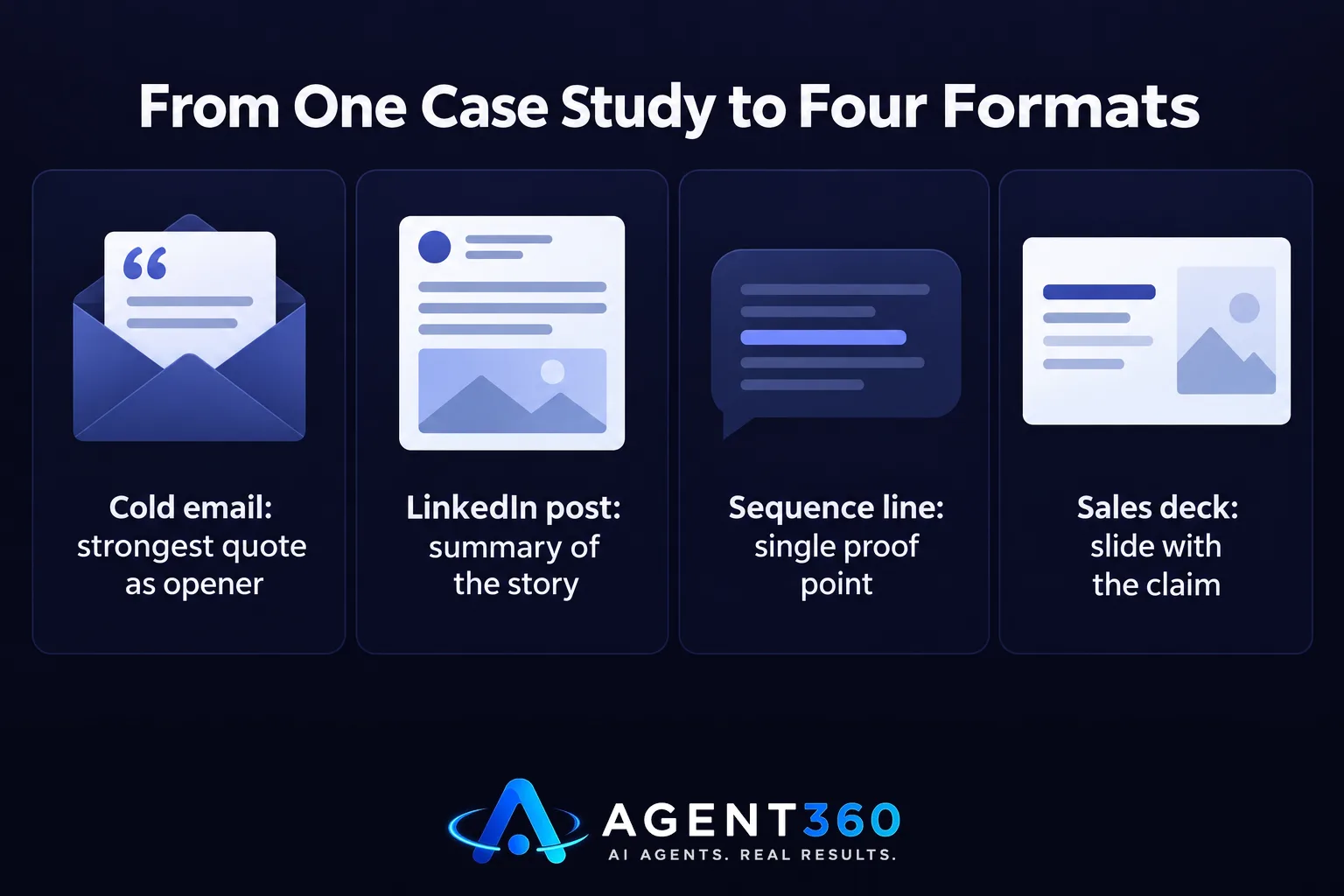
A single detailed case study can become a cold email, a LinkedIn post, a one-line proof point in a sequence, and a slide in a sales deck, all without new writing. The source does the heavy lifting once. Every other format just pulls a piece of it.
- Pick the strongest source. Choose the piece that already got the best response, whether that is a blog post, an FAQ, or a client story, not whatever you wrote most recently.
- List the reusable pieces inside it. Pull out the single statistic, the one-sentence summary, and the strongest quote or claim.
- Match each piece to a format. The statistic becomes a subject line, the summary becomes a LinkedIn post, and the quote becomes a reply template for objection handling.
- Schedule the repurposed pieces across weeks, not days. Spacing them out means the same idea reaches a prospect multiple times without looking copy-pasted.
- Track which version gets replies or clicks. That tells you which format to repurpose from next time.
Turn Your Repurposed Content Into Booked Meetings
Writing the content is half the job. Getting it in front of the right person, on the channel they actually check, at the right moment — that's the other half. Agent360's multi-channel outreach runs those sequences across LinkedIn, email, and phone, so the repurposed lines you wrote actually reach prospects instead of sitting in a drafts folder.

Agent360's AI prospecting finds the buyers worth sending that content to in the first place, so repurposed material lands with people who match your target market, not a generic list. Plans start at $99/mo with unlimited seats and no per-user fees, and every email sent comes with one triple-verified lead.
If writing and sending it all yourself is swallowing your week, book a demo and watch the sequencing and prospecting do the sending for you.
Frequently Asked Questions
What is content repurposing?
Content repurposing means adapting one existing piece — a blog post, a video, an FAQ answer — into a different format or channel instead of writing something new from scratch.
What are some examples of content repurposing?
Turning a blog post into LinkedIn posts, cutting a webinar into short clips, pulling a statistic from a case study into an email subject line, using a client testimonial as a reply template in a sales sequence — all of it counts.
What are the 7 main types of content?
The seven main types are written content, video, audio, images, interactive content, live content, and user-generated content. Most repurposing work is just moving an idea from one of these into another.
What is an example of repurposing?
Take a single customer case study and turn it into a cold email opener, a LinkedIn post, and a slide in a sales deck — that's repurposing. The research and the proof don't change. Only the format does, channel by channel.
How often should content be repurposed?
There's no fixed schedule. Reviewing your best-performing pieces every few weeks and pulling new formats from them keeps outbound and social content fresh without constant new writing.
Does repurposed content perform worse than original content?
Not inherently — often the opposite. Repurposed content is built from material that already proved it resonates, instead of an untested new idea.
More articles
- ATS Tracking Cost: What You'll Actually Pay in 2025
- AI Content Calendar: What It Is and How to Build One
- Automotive Repair Marketing: Winning B2B Fleet Accounts
- Content Automation SEO: What It Can Actually Do
- How to Show Up in AI Overviews When Prospects Google You
- How to Appear in Google's AI Overviews
- White Label GEO: What It Means and How to Buy It
- Auto Repair Shop Marketing: What Actually Brings In Customers
